
BuddhistCatholicContemplativeEvangelicalGeneral ChristianHinduJewishLatter-day SaintMuslimNew VisionsProgressive Christian
Beliefs
- Buddhist
- Catholic
- Contemplative
- Evangelical
- General Christian
- Hindu
- Jewish
- Latter-day Saint
- More Voices
- Muslim
- New Visions
- Pagan
- Progressive Christian
Topics
- Religion News
- Food and Religion
- Sports and Religion
- Religious Art
- Religious Music and Entertainment
- Religious Events
- History and Religion
- Style and Religion
- Politics and Religion
- Women in Religion
- Recreation Outdoors and Religion
- Business Finance and Religion
- Careers Workplace and Religion
- Education and Religion
- Family Parenting and Religion
- Health Fitness and Religion
- Home and Religion
- Relationships and Religion
- Technology and Religion
- Travel and Religion
Columnists
- Buddhist Columnists
- Business Finance and Religion Columnists
- Careers Workplace and Religion Columnists
- Catholic Columnists
- Contemplative Columnists
- Education and Religion Columnists
- Evangelists Columnists
- Family Parenting and Religion Columnists
- General Christian Columnists
- Health Fitness and Religion Columnists
- Hindu Columnists
- History and Religion Columnists
- Home and Religion Columnists
- Jewish Columnists
- More Voices Columnists
- Latter Day Columnists
- Muslim Columnists
- New Visions Columnists
- Nonreligious Columnists
- Pagan Columnists
- Politics and Religion Columnists
- Progressive Columnists
- Recreation Outdoors and Religion Columnists
- Relationships and Religion Columnists
- Religion News Columnists
- Religious Art Columnists
- Religious Events Columnists
- Religious Music and Entertainment Columnists
- Sports and Religion Columnists
- Style and Religion Columnists
- Technology and Religion Columnists
- Travel and Religion Columnists
- Women in Religion Columnists
Resource Library
- 2026 Calendar
- Library of World Religions
- The 100 Most Holy Places on Earth
- Patheos Answers
- Podcasts
- Videos
- Faith Leaders Database
- Anglican Episcopalian
- Bahai
- Baptist
- Buddhism
- Christianity
- Confucianism
- Eastern Orthodoxy
- Hinduism
- Holiness and Pentecostal
- ISKCON
- Islam
- Judaism
- Lutheran
- Methodist
- The Church of Jesus Christ of Latter-day Saints
- New Age
- Paganism
- Presbytarian and Reformed
- Protestantism
- Religion Behind the Scenes
- Roman Catholic
- Scientology
- Shia Islam
- Sikhism
- Sufism
- Sunni Islam
- Taoism
- Zen
- See all religions
Research Tools
 Ad-Free & Subscriber Log-In Subscription Support
Ad-Free & Subscriber Log-In Subscription Support
Follow Patheos 

- Trending:
- Forgiveness
- |
- Marriage
- |
- Consciousness
- |
- Death Penalty
- |
- Election
- |
- Halloween
 Jesus Creed
- Home
- Evangelical
- Theology After Darwin 1 (RJS)
Theology After Darwin 1 (RJS)
Last updated on: April 7, 2014 at 6:01 pm by RJS
Theology After Darwin 1 (RJS) 2014-04-07T18:01:51-05:00 RJS
Patheos Explore the world's faith through different perspectives on religion and spirituality! Patheos has the views of the prevalent religions and spiritualities of the world.
One of the more important and more difficult pieces of the puzzle as we feel our way forward at the interface of science and faith is the theological implications of discoveries in modern science. A comment on my post Evolution in the Key of D: Deity or Deism noted:
…this reminds me of why I get annoyed so much by those who write on theology and evolution. It’s usually just deism and fluff, to be frank.
I’ve enjoyed reading through the comments and seeing some of the ideas shared by others. I firmly believe that this discussion on deism vs/compared to theism in natural theology should be given much more attention. Some of the scientist-theologians (Barbour, Polkinghorne come to mind) speak of a “theology of nature” instead of a natural theology, but in my mind, they haven’t really given us a good framework for how God acts in and through nature. It’s important to note that while natural theology is only one component of theology, it’s clearly a vital one today.
Justin developed these thoughts a bit more on his own blog A Biologists View of Science & Religion.
I think that this is an extremely important issue that should receive more attention by theologians (especially those that have training or a fairly deep understanding of evolutionary biology). The scientists like me or those at BioLogos have got to admit that our theology of evolution is weak. You cannot persuade Christians that evolution is not the enemy (and literal Creationism is bunk) if you don’t provide them with a meaningful and understandable natural theology alongside thescientific evidence.
What kind of discussion do you think we need to develop a workable theological understanding of evolution? What is the most significant issue?
I agree with Justin here. As a result one of the things I intend to do over the next many months is to post on ideas and books that delve into the details of theology in the context of evolution from a variety of different viewpoints. We will examine different facets of the relationship between science and theology. Some, perhaps all, will fall short in various ways – erring in the understanding of science or wavering on the edge of the trap of deism, removing God too far from creation. This will be something of a meander, don’t expect resolution in three short lessons or seven easy steps. Real life simply doesn’t work that way.
So – to begin…
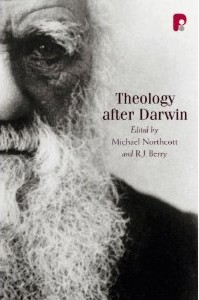 I received a book recently Theology After Darwin (not available in the US – but available from amazon UK (HT DV)). This book contains 11 scholarly essay on theology in the context of evolution. I haven’t read much of the book yet – but intend to post a sporadic series through the book as I have a chance to read and process the ideas put forth in the various chapters.
The first chapter, by R. J. Berry, an evolutionary biologist and Professor Emeritus at University College London, explores biology after Darwin. While the emphasis is on science rather than theology the essay brings up some important issues. I am not going to bother to try to summarize the entire chapter, but rather concentrate on a common conception, or perhaps misconception, regarding evolution that came to mind as I read.
Evolution is bloody and violent and inconsistent with the revealed nature of God. It is often suggested that evolution is inconsistent with the notion of God as creator and creation as good. After all evolution relies on death and destruction, competition and conquest for life to develop and to progress … doesn’t it? Alfred Lord Tennyson famously addressed the conflict between the love of God central in the Christian faith and the apparent bloody callousness of nature with an image that sticks in the imagination:
Are God and Nature then at strife,
That Nature lends such evil dreams?
So careful of the type she seems,
So careless of the single life;That I, considering everywhere
Her secret meaning in her deeds,
And finding that of fifty seeds
She often brings but one to bear,…
‘So careful of the type?’ but no.
From scarped cliff and quarried stone
She cries, ‘A thousand types are gone:
I care for nothing, all shall go.…
Man, her last work, who seem’d so fair,
Such splendid purpose in his eyes,
Who roll’d the psalm to wintry skies,
Who built him fanes of fruitless prayer,Who trusted God was love indeed
And love Creation’s final law-
Tho’ Nature, red in tooth and claw
With ravine, shriek’d against his creed-(excerpts from canto 55 and 56)
Nature red in tooth and claw, of fifty seeds but one brought to bear, a thousand types are gone. Tennyson wrote before Darwin’s The Origin of Species (1859), but after the influential book by Robert Chambers Vestiges of the Natural History of Creation published in 1844. (Darwin did not, we must remember, drop a new idea in the lap of an innocent and unsuspecting age, he was part of a swirling mass of ideas. He rushed publication of his ideas to avoid being scooped. Darwin had an important new insights, but if he had not published, some one else would have – and soon. )
It appears difficult to reconcile evolution with a God of love. For Tennyson the observation of the predators and prey along with the apparent wastefulness of the natural world was sufficient to raise questions. Darwin’s ideas of gradual change by natural selection takes it one step further. Predation, waste, extinction, and death are part of the creative process. A commenter put it quite bluntly on the post linked above: “Theistic evolution gives a false representation of the nature of God because death and ghastliness are ascribed to the Creator as principles of creation.“
But is this really true? When we consider evolution and natural selection we often think of it in terms of survival of the fittest. The vision is of competition and bloody fight, of victors and vanquished. But this is not the point. Fitness in biology has little to do with competition and victory in the local specific situation. Rather the fittest are those who raise most offspring, nothing more, nothing less. In the long run a variant with greater fitness will survive, but in the short term many will coexist. Evolution does require a natural cycle and process of life and death with successive generations. But this need be neither violent or wasteful. Each succeeding generation fulfills a role in the process of the unfolding of creation.
When we come to mankind and human mortality the theological issues become more complex. But leaving that off the table for the time, there is nothing in Genesis, or in a careful reading of Romans, that suggests that immortality was the norm in biology. prior to the Fall There is nothing, so it seems to me, that suggests that predation or hunting is the result of human sin. Evolution is a marvelous creative mechanism to explore and expand the possibilities and potentialities for life on this planet. It is more akin to growth and flowering than to violence and conquest.
What do you think? How do you view evolution – as violent, wasteful, ghastly or as natural growth and flowering or perhaps something else?
If you wish you may contact me directly at rjs4mail[at]att.net
Previous Post

August 31, 2010
Almost Christian 4
Next Post
September 1, 2010 Not all write
Browse Our Archives
Select a Category Acts of the Apostles Adam Advent Anabaptism Angels Anglican Apologetics Atonement Baptism BCP Prayers Bible Biblical Studies Birds Blogging Bloglossary Bonhoeffer Books Calvinism Christianity Church Church History Coffee Colossians Commentary Recs Conversion Creation Creeds Culture Death Ecclesiastes Economics Education Embracing Grace Emergent Emerging Movement Eschatology Essays Ethics Eucharist Evangelicalism Family Fasting Fathers Fellowship of Differents Footsteps Tour Fun and Whimsical Gospel Grace Happiness Heaven Hell Holy Spirit Irenaeus James Jesus Jesus Creed Job Justification Kingdom of God Law Lectures Lent Liberalism Love and Marriage Mabanteneni Manhood Mary Miracles Missio Alliance MissioLife Missional Missional Jesus Movies and Film New Perspective Northern Seminary OneLife Origins Project Orthodox Parables Pastor's Spouse Pastoring and Leading Pastoring and Preaching Patristics Paul Paul-John Tour Pharisees Pietism Political Theology Prayer and Formation Preaching Problems for Faith Psalm 119 Psalms Public Issues Purgatory Religions Resurrection Revelation Romans Rule of JCreed Science and Faith Sermon on the Mount Sports Ten Commandments Theology Third Way Top Ten Lists Translations Uncategorized Universalism University Ministry Way Out Weekly Meanderings Wisdom Women and Ministry Work Worship Writing & Blogging Youth Ministry
Select a Month July 2021 January 2020 December 2019 November 2019 October 2019 September 2019 August 2019 July 2019 June 2019 May 2019 April 2019 March 2019 February 2019 January 2019 December 2018 November 2018 October 2018 September 2018 August 2018 July 2018 June 2018 May 2018 April 2018 March 2018 February 2018 January 2018 December 2017 November 2017 October 2017 September 2017 August 2017 July 2017 June 2017 May 2017 April 2017 March 2017 February 2017 January 2017 December 2016 November 2016 October 2016 September 2016 August 2016 July 2016 June 2016 May 2016 April 2016 March 2016 February 2016 January 2016 December 2015 November 2015 October 2015 September 2015 August 2015 July 2015 June 2015 May 2015 April 2015 March 2015 February 2015 January 2015 December 2014 November 2014 October 2014 September 2014 August 2014 July 2014 June 2014 May 2014 April 2014 March 2014 February 2014 January 2014 December 2013 November 2013 October 2013 September 2013 August 2013 July 2013 June 2013 May 2013 April 2013 March 2013 February 2013 January 2013 December 2012 November 2012 October 2012 September 2012 August 2012 July 2012 June 2012 May 2012 April 2012 March 2012 February 2012 January 2012 December 2011 November 2011 October 2011 September 2011 August 2011 July 2011 June 2011 May 2011 April 2011 March 2011 February 2011 January 2011 December 2010 November 2010 October 2010 September 2010 August 2010 July 2010 June 2010 May 2010 April 2010 March 2010 February 2010 January 2010 December 2009 November 2009 October 2009 September 2009 August 2009 July 2009 June 2009 May 2009 April 2009 March 2009 February 2009 January 2009 December 2008 November 2008 October 2008 September 2008 August 2008 July 2008 June 2008 May 2008 April 2008 March 2008 February 2008 January 2008 December 2007 November 2007 October 2007 September 2007 August 2007 July 2007 June 2007 May 2007 April 2007 March 2007 February 2007 January 2007 December 2006 November 2006 October 2006 September 2006 August 2006 July 2006 June 2006 May 2006 April 2006 March 2006 February 2006 January 2006 December 2005 November 2005 October 2005 September 2005 August 2005 July 2005 June 2005 May 2005 April 2005 0000
Follow Us!
TAKE THE
Religious Wisdom Quiz
True or False: Thomas doubted Jesus' resurrection until he saw and touched Jesus' wounds.
Select your answer to see how you score.
FALSE TRUE
Related posts from Jesus Creed

Participation-in-Christ: The Major Themes


What Makes a Worldview Most Christian?

Elements in a Christian Worldview
TRENDING AT PATHEOS Evangelical

The REST of Your Life: A Creative Wrestles...
This week I had a conversation with a good friend from church....

How the author of the world's best hymn...
I've been working with John Newton for a while now. This makes...

Long before this Lectio Divina, Psalm 130 - the song - started...

What About the Trees? Another Living Parable
After I finished writing the last article about falling leaves as a...

Why Classical Education Is a Conversation, Not a...
Come and Read: Joy in Classical Education When I was a little...

Cornell University has received a great deal of negative publicity and intense...
view all Evangelical blogs
Ad-Free & Subscriber Log-In Subscription Support
- About Us
- 2026 Calendar
- Videos
- Podcasts
- Library of World Religions
- Faith In Media Tracker
- Advertise With Us
- Write for Us
- Privacy Policy
- Terms of Service
- Do Not Sell My Data
- Contact Us
- Radiant Digital
- Manage Newsletter Subscriptions
- Unsubscribe From Notifications
- Sitemap
Copyright 2008-2026, Patheos. All rights reserved.
Subscription Support Ad-Free & Subscriber Log-In
Follow Patheos