
BuddhistCatholicContemplativeEvangelicalGeneral ChristianHinduJewishLatter-day SaintMuslimNew VisionsProgressive Christian
Beliefs
- Buddhist
- Catholic
- Contemplative
- Evangelical
- General Christian
- Hindu
- Jewish
- Latter-day Saint
- More Voices
- Muslim
- New Visions
- Pagan
- Progressive Christian
Topics
- Religion News
- Food and Religion
- Sports and Religion
- Religious Art
- Religious Music and Entertainment
- Religious Events
- History and Religion
- Style and Religion
- Politics and Religion
- Women in Religion
- Recreation Outdoors and Religion
- Business Finance and Religion
- Careers Workplace and Religion
- Education and Religion
- Family Parenting and Religion
- Health Fitness and Religion
- Home and Religion
- Relationships and Religion
- Technology and Religion
- Travel and Religion
Columnists
- Buddhist Columnists
- Business Finance and Religion Columnists
- Careers Workplace and Religion Columnists
- Catholic Columnists
- Contemplative Columnists
- Education and Religion Columnists
- Evangelists Columnists
- Family Parenting and Religion Columnists
- General Christian Columnists
- Health Fitness and Religion Columnists
- Hindu Columnists
- History and Religion Columnists
- Home and Religion Columnists
- Jewish Columnists
- More Voices Columnists
- Latter Day Columnists
- Muslim Columnists
- New Visions Columnists
- Nonreligious Columnists
- Pagan Columnists
- Politics and Religion Columnists
- Progressive Columnists
- Recreation Outdoors and Religion Columnists
- Relationships and Religion Columnists
- Religion News Columnists
- Religious Art Columnists
- Religious Events Columnists
- Religious Music and Entertainment Columnists
- Sports and Religion Columnists
- Style and Religion Columnists
- Technology and Religion Columnists
- Travel and Religion Columnists
- Women in Religion Columnists
Resource Library
- 2026 Calendar
- Library of World Religions
- The 100 Most Holy Places on Earth
- Patheos Answers
- Podcasts
- Videos
- Faith Leaders Database
- Anglican Episcopalian
- Bahai
- Baptist
- Buddhism
- Christianity
- Confucianism
- Eastern Orthodoxy
- Hinduism
- Holiness and Pentecostal
- ISKCON
- Islam
- Judaism
- Lutheran
- Methodist
- The Church of Jesus Christ of Latter-day Saints
- New Age
- Paganism
- Presbytarian and Reformed
- Protestantism
- Religion Behind the Scenes
- Roman Catholic
- Scientology
- Shia Islam
- Sikhism
- Sufism
- Sunni Islam
- Taoism
- Zen
- See all religions
Research Tools
 Ad-Free & Subscriber Log-In Subscription Support
Ad-Free & Subscriber Log-In Subscription Support
Follow Patheos 

- Trending:
- Forgiveness
- |
- Marriage
- |
- Consciousness
- |
- Death Penalty
- |
- Election
- |
- Halloween
 Jesus Creed
- Home
- Evangelical
- Genesis 4-5 – Biblical Genealogies (RJS)
Genesis 4-5 – Biblical Genealogies (RJS)
Last updated on: March 14, 2014 at 7:26 pm by RJS
Genesis 4-5 – Biblical Genealogies (RJS) 2014-03-14T19:26:48-05:00 RJS
Patheos Explore the world's faith through different perspectives on religion and spirituality! Patheos has the views of the prevalent religions and spiritualities of the world.
We discussed the creation narratives in Genesis 1-3 in a series of posts earlier this year. The questions on the proper interpretation of Genesis don’t stop with Genesis 3 however, and I received an e-mail last week with the following question:
My question regards the age of people and the Biblical account. Is there any scientific evidence one way or another to promote or refute Methuselah being 969 years old? If evolution was the way God brought us about, is it possible that some of those people could have lived that long?
This is a common question – and one I think worth discussion today. To get straight to the point, I don’t think that people lived that long, I don’t think that the genealogies are literal history, and I don’t think that the function or intent of the Biblical genealogies in Genesis (or elsewhere) was to provide literal, historical chronologies. I reach this conclusion not as a skeptic, not because I devalue the authority of scripture, but from a position of faith, valuing the Bible as the inspired Word of God, and with a strong desire to spread the gospel today. I reach this conclusion in part because the evidence of the text itself demands it.
What do you think – are the genealogies literal history? Why or why notWhy do I say not literal? I could give scientific reasons, and certainly there are strong scientific reasons to question lifespans nearing a thousand years. There are also archaeological and historical reasons. But the primary reasons I doubt the literal historical nature of these genealogies are not scientific or even historical. The primary reasons come simply from a careful reading of the text itself.
First – the numbers.
Lets step back and take a different look. I am a scientist and a professor. Suppose a student included the following data in a lab
report.
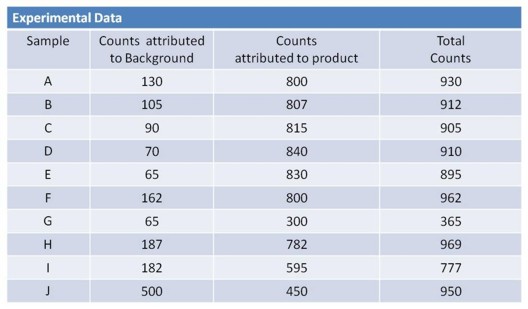
When you look at this table what do you see?
If a student brought me a table of data like this as part of a a lab report I would send the student before the Assistant Dean on a charge of academic dishonesty – unless they confessed first. The student wasn’t even smart about it. If one of my graduate students included the table in a paper and I published it, I would be censured. The verdict would be immediate and unquestioned – because the data are clearly fabricated.
Why do I say this? Because the first two columns are not random in the last digit. There is no way that an “honest” data set from the lab would contain the numbers in this chart. There should be a random distribution of 0-9 in the last digit. Yet in the data here there is an evident pattern in the last digit based on an underlying pattern using 0, 2, 5, and 7.
The odds of such a pattern in an “honest” experiment are minuscule (on the order of 1 in 100 million or less see comments below). It is not even worth considering unless the student can provide a systematic explanation for the result.
These numbers, of course, come from the genealogy in Genesis 5. This is part of a table reproduced from Kent Sparks’ book God’s Word in Human Words (p. 217).

So – one reason that I don’t consider the genealogies as literal history is because the numbers do not support that interpretation. The numbers are not natural. They were chosen to match a pattern. We don’t know exactly what the pattern was, but it is essentially certain that the original author did not intend the time spans to be literal, historical, chronological numbers. These numbers served a function, there was a systematic reason for them. And, it is probably not coincidence that 5 and 7 figure strongly in the pattern. These were important numbers in ancient Israelite thinking. I suggest that the purpose of the genealogy was not even to accurately reflect longer lifespans in ancient history. I see no reason to take the long life spans literally.
Second – other patterns in the genealogies.
Bill Arnold in his commentary on Genesis notes that the genealogies of Cain in Gen 4 and Seth in Gen 5 contain remarkable similarities, both begin with Adam, both have ten names, both contain Enoch and Lamech, and both highlight Enoch for special notation. (p. 84)
Kent Sparks in GWHW suggests that the author of Gen 5 used the genealogy in Gen 4 as a pattern. These are variations of the same genealogy only interchanging one pair of names. (p. 83-84; 216-218).
Arnold also notes:
Israelite genealogies tend to highlight especially noteworthy ancestors by placing them in the seventh position in the list, and at times in the fifth position of a genealogical order. Such a literary convention was not followed rigidly, but allowed ancient authors to focus didactic efforts on one or sometimes two positions in the genealogical tree.Thus Cain’s genealogy was segmented at the seventh generation, Lamech who was lifted for special treatment, and noted for exacting vengeance “seventy-sevenfold” (Lamech, 4:19-24). In Seth’s genealogy, Lamech is moved to the ninth position, … So unlike Cain’s genealogy and its interest in the cultural innovations of Lamech’s family, Gen 5 is more interested in lifting Enoch for special treatment in the seventh position, and culminates in the tenth position at Noah. (p. 87)
Once again – the genealogies are present to provide historical connection, but are arranged according to a pattern. This was not intended by the author to be literal-historical.
Third – The functional significance of the genealogies.
John Walton in his NIVAC commentary on Genesis is fairly traditional. He appears to take both the genealogies and the dates literally. He points out that attempts to interpret the numbers literally, but in other than base 10, or to interpret a year differently (a “moon” for example) fail because these would have Mahalel and Enoch begetting first sons at an unacceptably young age. Certainly a simple scale factor doesn’t suffice, but as we saw above – neither does a literal interpretation. Walton does point out a functional significance in the genealogies however.
In Cain’s line we find record of the first building of a city as well as the earliest development of the arts of civilization. … The arts civilization include animal domestication, invention of musical instruments, and the development of metal technology. (p. 276)
In Genesis the arts of civilization are attributed to mankind fulfilling the mandate to subdue and rule the earth. In Ancient Near East literature these developments are typically attributed to the gods. One of the functions of the genealogy of Gen 4 is to give an account of the development of human civilization in human terms.
To sum it up…
The significance of 5 and 7, the nonrandom numbers, the similarity in the lines of Cain and Seth, the etiological function of the text… these are among the reasons I don’t think that the genealogies are intended to be literal-historical accounts. The author didn’t lie – he used a legitimate genre of his time, in the manner of his time. The genealogies are key literary components of the story of Genesis, they relate key historical and theological truths. But…the genealogies of Gen 4 and Gen 5 are not and were never intended by the original author to be literal historical accounts of the generations of Adam.
What do you think?
If you wish to contact me directly you may do so at rjs4mail [at] att.net.
Previous Post

April 14, 2009
Our Collective Faith 9
Next Post
April 14, 2009 A Brother's Wisdom 34
Browse Our Archives
Select a Category Acts of the Apostles Adam Advent Anabaptism Angels Anglican Apologetics Atonement Baptism BCP Prayers Bible Biblical Studies Birds Blogging Bloglossary Bonhoeffer Books Calvinism Christianity Church Church History Coffee Colossians Commentary Recs Conversion Creation Creeds Culture Death Ecclesiastes Economics Education Embracing Grace Emergent Emerging Movement Eschatology Essays Ethics Eucharist Evangelicalism Family Fasting Fathers Fellowship of Differents Footsteps Tour Fun and Whimsical Gospel Grace Happiness Heaven Hell Holy Spirit Irenaeus James Jesus Jesus Creed Job Justification Kingdom of God Law Lectures Lent Liberalism Love and Marriage Mabanteneni Manhood Mary Miracles Missio Alliance MissioLife Missional Missional Jesus Movies and Film New Perspective Northern Seminary OneLife Origins Project Orthodox Parables Pastor's Spouse Pastoring and Leading Pastoring and Preaching Patristics Paul Paul-John Tour Pharisees Pietism Political Theology Prayer and Formation Preaching Problems for Faith Psalm 119 Psalms Public Issues Purgatory Religions Resurrection Revelation Romans Rule of JCreed Science and Faith Sermon on the Mount Sports Ten Commandments Theology Third Way Top Ten Lists Translations Uncategorized Universalism University Ministry Way Out Weekly Meanderings Wisdom Women and Ministry Work Worship Writing & Blogging Youth Ministry
Select a Month July 2021 January 2020 December 2019 November 2019 October 2019 September 2019 August 2019 July 2019 June 2019 May 2019 April 2019 March 2019 February 2019 January 2019 December 2018 November 2018 October 2018 September 2018 August 2018 July 2018 June 2018 May 2018 April 2018 March 2018 February 2018 January 2018 December 2017 November 2017 October 2017 September 2017 August 2017 July 2017 June 2017 May 2017 April 2017 March 2017 February 2017 January 2017 December 2016 November 2016 October 2016 September 2016 August 2016 July 2016 June 2016 May 2016 April 2016 March 2016 February 2016 January 2016 December 2015 November 2015 October 2015 September 2015 August 2015 July 2015 June 2015 May 2015 April 2015 March 2015 February 2015 January 2015 December 2014 November 2014 October 2014 September 2014 August 2014 July 2014 June 2014 May 2014 April 2014 March 2014 February 2014 January 2014 December 2013 November 2013 October 2013 September 2013 August 2013 July 2013 June 2013 May 2013 April 2013 March 2013 February 2013 January 2013 December 2012 November 2012 October 2012 September 2012 August 2012 July 2012 June 2012 May 2012 April 2012 March 2012 February 2012 January 2012 December 2011 November 2011 October 2011 September 2011 August 2011 July 2011 June 2011 May 2011 April 2011 March 2011 February 2011 January 2011 December 2010 November 2010 October 2010 September 2010 August 2010 July 2010 June 2010 May 2010 April 2010 March 2010 February 2010 January 2010 December 2009 November 2009 October 2009 September 2009 August 2009 July 2009 June 2009 May 2009 April 2009 March 2009 February 2009 January 2009 December 2008 November 2008 October 2008 September 2008 August 2008 July 2008 June 2008 May 2008 April 2008 March 2008 February 2008 January 2008 December 2007 November 2007 October 2007 September 2007 August 2007 July 2007 June 2007 May 2007 April 2007 March 2007 February 2007 January 2007 December 2006 November 2006 October 2006 September 2006 August 2006 July 2006 June 2006 May 2006 April 2006 March 2006 February 2006 January 2006 December 2005 November 2005 October 2005 September 2005 August 2005 July 2005 June 2005 May 2005 April 2005 0000
Follow Us!
TAKE THE
Religious Wisdom Quiz
What does James say is the implanted word able to do?
Select your answer to see how you score.
Save your souls Defeat your enemies Heal your body Judge the nations
Related posts from Jesus Creed

It's American for our Politicians to Reference the...



The Thrust of the Biblical Plot (RJS)
TRENDING AT PATHEOS Evangelical

The REST of Your Life: A Creative Wrestles...
This week I had a conversation with a good friend from church....

How the author of the world's best hymn...
I've been working with John Newton for a while now. This makes...

Long before this Lectio Divina, Psalm 130 - the song - started...

What About the Trees? Another Living Parable
After I finished writing the last article about falling leaves as a...

Why Classical Education Is a Conversation, Not a...
Come and Read: Joy in Classical Education When I was a little...

Cornell University has received a great deal of negative publicity and intense...
view all Evangelical blogs
Ad-Free & Subscriber Log-In Subscription Support
- About Us
- 2026 Calendar
- Videos
- Podcasts
- Library of World Religions
- Faith In Media Tracker
- Advertise With Us
- Write for Us
- Privacy Policy
- Terms of Service
- Do Not Sell My Data
- Contact Us
- Radiant Digital
- Manage Newsletter Subscriptions
- Unsubscribe From Notifications
- Sitemap
Copyright 2008-2026, Patheos. All rights reserved.
Subscription Support Ad-Free & Subscriber Log-In
Follow Patheos