
BuddhistCatholicContemplativeEvangelicalGeneral ChristianHinduJewishLatter-day SaintMuslimNew VisionsProgressive Christian
Beliefs
- Buddhist
- Catholic
- Contemplative
- Evangelical
- General Christian
- Hindu
- Jewish
- Latter-day Saint
- More Voices
- Muslim
- New Visions
- Pagan
- Progressive Christian
Topics
- Religion News
- Food and Religion
- Sports and Religion
- Religious Art
- Religious Music and Entertainment
- Religious Events
- History and Religion
- Style and Religion
- Politics and Religion
- Women in Religion
- Recreation Outdoors and Religion
- Business Finance and Religion
- Careers Workplace and Religion
- Education and Religion
- Family Parenting and Religion
- Health Fitness and Religion
- Home and Religion
- Relationships and Religion
- Technology and Religion
- Travel and Religion
Columnists
- Buddhist Columnists
- Business Finance and Religion Columnists
- Careers Workplace and Religion Columnists
- Catholic Columnists
- Contemplative Columnists
- Education and Religion Columnists
- Evangelists Columnists
- Family Parenting and Religion Columnists
- General Christian Columnists
- Health Fitness and Religion Columnists
- Hindu Columnists
- History and Religion Columnists
- Home and Religion Columnists
- Jewish Columnists
- More Voices Columnists
- Latter Day Columnists
- Muslim Columnists
- New Visions Columnists
- Nonreligious Columnists
- Pagan Columnists
- Politics and Religion Columnists
- Progressive Columnists
- Recreation Outdoors and Religion Columnists
- Relationships and Religion Columnists
- Religion News Columnists
- Religious Art Columnists
- Religious Events Columnists
- Religious Music and Entertainment Columnists
- Sports and Religion Columnists
- Style and Religion Columnists
- Technology and Religion Columnists
- Travel and Religion Columnists
- Women in Religion Columnists
Resource Library
- 2026 Calendar
- Library of World Religions
- The 100 Most Holy Places on Earth
- Patheos Answers
- Podcasts
- Videos
- Faith Leaders Database
- Anglican Episcopalian
- Bahai
- Baptist
- Buddhism
- Christianity
- Confucianism
- Eastern Orthodoxy
- Hinduism
- Holiness and Pentecostal
- ISKCON
- Islam
- Judaism
- Lutheran
- Methodist
- The Church of Jesus Christ of Latter-day Saints
- New Age
- Paganism
- Presbytarian and Reformed
- Protestantism
- Religion Behind the Scenes
- Roman Catholic
- Scientology
- Shia Islam
- Sikhism
- Sufism
- Sunni Islam
- Taoism
- Zen
- See all religions
Research Tools
 Ad-Free & Subscriber Log-In Subscription Support
Ad-Free & Subscriber Log-In Subscription Support
Follow Patheos 

- Trending:
- Forgiveness
- |
- Marriage
- |
- Consciousness
- |
- Death Penalty
- |
- Election
- |
- Halloween
 Jesus Creed
- Home
- Evangelical
- Apostasy from Orthodoxy
Apostasy from Orthodoxy
Last updated on: September 11, 2008 at 12:30 am by Scot McKnight
Apostasy from Orthodoxy 2008-09-11T00:30:43-05:00 Scot McKnight
Patheos Explore the world's faith through different perspectives on religion and spirituality! Patheos has the views of the prevalent religions and spiritualities of the world.
An informed reader of the blog has sent this letter into me and I want to post it and offer a response — a brief one — at the end.
Scot, these are my thoughts on Chrysalis: The Hidden Transformation in the Journey of Faith
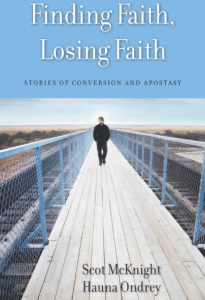
I read through most of your Finding Faith, Losing Faith book. I was quite interested in the “apostasy” section because some of those issues bubbled up strong for me this past year — the natural sciences and Biblical criticism, which are not so easily dismissed as I once thought, and hell (in my case, in relation to my own disabled child) in particular.
I was a little distracted, though, by the continued use in Finding Faith, Losing Faith of the qualifier “orthodox” for “Christianity.” In my own case, I find that I’m moving towards a Christian “orthodoxy” that is more “generous” to borrow a perhaps worn-out phrase. So I can’t really use the word “inerrancy” easily anymore, I’m not sure what parts of the Bible’s protohistory are simply “historical,” and I’m not willing to opine with any certainty about exactly how or exactly whom God will save in Christ (though “in Christ” remains central). Yet I’ll happily confess the Apostles’ Creed. I think there are many, many folks like me, many of whom stay in evangelical churches and try to adopt an “emerging” or “missional” attitude, others who end up in ELCA, PCUSA, Episcopal, and other “mainline” churches — and many I gather who teach at “moderate” evangelical seminaries like Fuller and Regent College. Well, I guess some folks in my old fundamentalist church would consider me apostate — but then, the folks in my mom’s old Plymouth Bretheren church considered her apostate when she started going to a fundamentialst-evangelical church with my dad without wearing a head covering. I got a little sense of this “softening” that many people go through in your reference to Pete Enns’ book, but it just seemed odd that this term “apostasy” seemed to be defined against an “orthodoxy” that means “fundamentalism.”
This is where the Chrysalis book was both helpful and not helpful to me. The Chrysalis idea offers hope that someone facing difficult questions can emerge into a Christian faith that is more open, generous, and intellectually coherent. It’s encouraging to know that this time of being wrapped up in the cocoon of questioning isn’t an inevitable path towards conversion into Agnosticism. It can be a path into a richer Christian faith.
But the term “orthodox” is curiously absent in Chrysalis even as it’s undefined in Finding Faith, Losing Faith. This is the really hard question: can the Chrysalis journey lead into a renewed, sustainable Christian faith that is “orthodox?” I think so, if “orthodox” means the most basic confession that “Jesus is Lord”; and I think so, if “orthodox” also means the broad outline of the faith historically confessed by the Church, even if contingently and imperfectly, in ecumenical documents such as the Apostle’s and Nicene creeds. This is where it’s crucial, I think, that the Chrysalis journey be one that is undertaken in conversation with the great thinkers of the Church (the Fathers, the Reformers, and others, who wrestled with these questions in their own way) and in community with others who are sensitive to the demands of the journey.
Yet this, for me, is the rub: the person taking this journey must at some point gain confidence that he or she is moving towards an authentically Christian faith and not just a kind of Agnosticism or New Age spirituality that retains some Christian words. Communities of scholars and thinkers who take this seriously do exist, and many of them still call themselves “evangelical!” In fact, even at “conservative” evangelical seminaries and colleges, most of the faculty are far, far more nuanced in their thinking about these hard issues than ever seems to filter down to the popular level — I know, I’ve corresponded with many of them in my own questioning, and I’ve read many (too many!) of their books. There is a kind of “conversion” at work here as well: a conversion from an often rigid, received, pre-critical Christian faith into a post-critical, owned Christian faith that is more flexible, less sure of some things, and yet solidly within the trajectory of “orthdoxy” set by the Tradition — a faith grounded in relationship with Jesus that moves out continually, boldly, and patiently to seek understanding.
Dear David,
Thanks much for your note. I sense there’s some serious pondering here and I also sense that we can learn from one another on the issues.
Let me begin with an observation about Finding Faith, Losing Faith: I chanced upon a discovery of some stories of losing faith and a simple reading of a couple of them led me to the view that they could be seen as the mirror image of conversion. So, the hunch turned into an experiment. The hunch was that conversion theory can help us understand why some walk away from the faith. The theory might not illuminate everything, but I hope what we were able to discover will help pastors and youth leaders and college professors.
When doing that work I had to figure what these “apostates” were leaving. Should I call it “Christianity” or the “Christian faith”? I landed upon the term “orthodoxy” because the focus of nearly all of those who walked away from the faith was on what Christians believed instead of a “personal engagement with God.” In fact, I was quite surprised how rarely anything like the personal relationship these folks had with God was something they missed or struggled to abandon. Whey they abandoned was the coherent set of beliefs Christians have. What I mean by “orthodoxy” then is the basic beliefs that Christians — all Christians — hold in common. So, yes, one could say the Apostles’ Creed is enough to measure what I mean by this.
On the chrysalis and orthodoxy … this is an interesting connection you make here. I do think many who go through a chrysalis experience move into a deeper embrace of orthodoxy, in its big general sense. In fact, many who encounter the chrysalis experience struggle but end up with a second naivete, that is, a second commitment to Christ but this time in a deeper more penetrating way, a deeper level of personal commitment, and a strong embrace of the whole history of the church.
You’ve got some good wisdom when you mention the need for the chrysalis people to have good friends — the great thinkers of the church. I just have this sense that too many want to find only those who will tell them what they want to hear instead of struggling, as some of the great spiritual masters did, with the great sources of our faith. I think of some of the stories Richard Foster has told over the years, and I know the dark night of the soul was faced by many with Augustine and Aquinas and Luther and others in hand. For the chrysalis experience to yield genuine spirituality, it must keep in view that depths of the Psalms and the Prophets and the great masters of our faith.
Well, those are some thoughts.
Blessings,
Scot
Previous Post

September 11, 2008
Heaven 32
Next Post
September 11, 2008 Influences in Spiritual Formation: A Letter
Browse Our Archives
Select a Category Acts of the Apostles Adam Advent Anabaptism Angels Anglican Apologetics Atonement Baptism BCP Prayers Bible Biblical Studies Birds Blogging Bloglossary Bonhoeffer Books Calvinism Christianity Church Church History Coffee Colossians Commentary Recs Conversion Creation Creeds Culture Death Ecclesiastes Economics Education Embracing Grace Emergent Emerging Movement Eschatology Essays Ethics Eucharist Evangelicalism Family Fasting Fathers Fellowship of Differents Footsteps Tour Fun and Whimsical Gospel Grace Happiness Heaven Hell Holy Spirit Irenaeus James Jesus Jesus Creed Job Justification Kingdom of God Law Lectures Lent Liberalism Love and Marriage Mabanteneni Manhood Mary Miracles Missio Alliance MissioLife Missional Missional Jesus Movies and Film New Perspective Northern Seminary OneLife Origins Project Orthodox Parables Pastor's Spouse Pastoring and Leading Pastoring and Preaching Patristics Paul Paul-John Tour Pharisees Pietism Political Theology Prayer and Formation Preaching Problems for Faith Psalm 119 Psalms Public Issues Purgatory Religions Resurrection Revelation Romans Rule of JCreed Science and Faith Sermon on the Mount Sports Ten Commandments Theology Third Way Top Ten Lists Translations Uncategorized Universalism University Ministry Way Out Weekly Meanderings Wisdom Women and Ministry Work Worship Writing & Blogging Youth Ministry
Select a Month July 2021 January 2020 December 2019 November 2019 October 2019 September 2019 August 2019 July 2019 June 2019 May 2019 April 2019 March 2019 February 2019 January 2019 December 2018 November 2018 October 2018 September 2018 August 2018 July 2018 June 2018 May 2018 April 2018 March 2018 February 2018 January 2018 December 2017 November 2017 October 2017 September 2017 August 2017 July 2017 June 2017 May 2017 April 2017 March 2017 February 2017 January 2017 December 2016 November 2016 October 2016 September 2016 August 2016 July 2016 June 2016 May 2016 April 2016 March 2016 February 2016 January 2016 December 2015 November 2015 October 2015 September 2015 August 2015 July 2015 June 2015 May 2015 April 2015 March 2015 February 2015 January 2015 December 2014 November 2014 October 2014 September 2014 August 2014 July 2014 June 2014 May 2014 April 2014 March 2014 February 2014 January 2014 December 2013 November 2013 October 2013 September 2013 August 2013 July 2013 June 2013 May 2013 April 2013 March 2013 February 2013 January 2013 December 2012 November 2012 October 2012 September 2012 August 2012 July 2012 June 2012 May 2012 April 2012 March 2012 February 2012 January 2012 December 2011 November 2011 October 2011 September 2011 August 2011 July 2011 June 2011 May 2011 April 2011 March 2011 February 2011 January 2011 December 2010 November 2010 October 2010 September 2010 August 2010 July 2010 June 2010 May 2010 April 2010 March 2010 February 2010 January 2010 December 2009 November 2009 October 2009 September 2009 August 2009 July 2009 June 2009 May 2009 April 2009 March 2009 February 2009 January 2009 December 2008 November 2008 October 2008 September 2008 August 2008 July 2008 June 2008 May 2008 April 2008 March 2008 February 2008 January 2008 December 2007 November 2007 October 2007 September 2007 August 2007 July 2007 June 2007 May 2007 April 2007 March 2007 February 2007 January 2007 December 2006 November 2006 October 2006 September 2006 August 2006 July 2006 June 2006 May 2006 April 2006 March 2006 February 2006 January 2006 December 2005 November 2005 October 2005 September 2005 August 2005 July 2005 June 2005 May 2005 April 2005 0000
Follow Us!
TAKE THE
Religious Wisdom Quiz
Which book comes immediately after the Gospels in the New Testament?
Select your answer to see how you score.
Hebrews Romans Acts 1 Corinthians
Related posts from Jesus Creed

Rethinking Evangelism Through The Reformation


Walk Away Renee (by Michelle Van Loon)
TRENDING AT PATHEOS Evangelical

How the author of the world's best hymn...
I've been working with John Newton for a while now. This makes...

Long before this Lectio Divina, Psalm 130 - the song - started...

What About the Trees? Another Living Parable
After I finished writing the last article about falling leaves as a...

Why Classical Education Is a Conversation, Not a...
Come and Read: Joy in Classical Education When I was a little...

Falling Leaves: A Living Parable on Letting Go
I’ve spent the vast majority of my life in the southeast corner...

Cornell University has received a great deal of negative publicity and intense...
view all Evangelical blogs
Ad-Free & Subscriber Log-In Subscription Support
- About Us
- 2026 Calendar
- Videos
- Podcasts
- Library of World Religions
- Faith In Media Tracker
- Advertise With Us
- Write for Us
- Privacy Policy
- Terms of Service
- Do Not Sell My Data
- Contact Us
- Radiant Digital
- Manage Newsletter Subscriptions
- Unsubscribe From Notifications
- Sitemap
Copyright 2008-2026, Patheos. All rights reserved.
Subscription Support Ad-Free & Subscriber Log-In
Follow Patheos