
BuddhistCatholicContemplativeEvangelicalGeneral ChristianHinduJewishLatter-day SaintMuslimNew VisionsProgressive Christian
Beliefs
- Buddhist
- Catholic
- Contemplative
- Evangelical
- General Christian
- Hindu
- Jewish
- Latter-day Saint
- More Voices
- Muslim
- New Visions
- Pagan
- Progressive Christian
Topics
- Religion News
- Food and Religion
- Sports and Religion
- Religious Art
- Religious Music and Entertainment
- Religious Events
- History and Religion
- Style and Religion
- Politics and Religion
- Women in Religion
- Recreation Outdoors and Religion
- Business Finance and Religion
- Careers Workplace and Religion
- Education and Religion
- Family Parenting and Religion
- Health Fitness and Religion
- Home and Religion
- Relationships and Religion
- Technology and Religion
- Travel and Religion
Columnists
- Buddhist Columnists
- Business Finance and Religion Columnists
- Careers Workplace and Religion Columnists
- Catholic Columnists
- Contemplative Columnists
- Education and Religion Columnists
- Evangelists Columnists
- Family Parenting and Religion Columnists
- General Christian Columnists
- Health Fitness and Religion Columnists
- Hindu Columnists
- History and Religion Columnists
- Home and Religion Columnists
- Jewish Columnists
- More Voices Columnists
- Latter Day Columnists
- Muslim Columnists
- New Visions Columnists
- Nonreligious Columnists
- Pagan Columnists
- Politics and Religion Columnists
- Progressive Columnists
- Recreation Outdoors and Religion Columnists
- Relationships and Religion Columnists
- Religion News Columnists
- Religious Art Columnists
- Religious Events Columnists
- Religious Music and Entertainment Columnists
- Sports and Religion Columnists
- Style and Religion Columnists
- Technology and Religion Columnists
- Travel and Religion Columnists
- Women in Religion Columnists
Resource Library
- 2026 Calendar
- Library of World Religions
- The 100 Most Holy Places on Earth
- Patheos Answers
- Podcasts
- Videos
- Faith Leaders Database
- Anglican Episcopalian
- Bahai
- Baptist
- Buddhism
- Christianity
- Confucianism
- Eastern Orthodoxy
- Hinduism
- Holiness and Pentecostal
- ISKCON
- Islam
- Judaism
- Lutheran
- Methodist
- The Church of Jesus Christ of Latter-day Saints
- New Age
- Paganism
- Presbytarian and Reformed
- Protestantism
- Religion Behind the Scenes
- Roman Catholic
- Scientology
- Shia Islam
- Sikhism
- Sufism
- Sunni Islam
- Taoism
- Zen
- See all religions
Research Tools
 Ad-Free & Subscriber Log-In Subscription Support
Ad-Free & Subscriber Log-In Subscription Support
Follow Patheos 

- Trending:
- Forgiveness
- |
- Marriage
- |
- Consciousness
- |
- Death Penalty
- |
- Election
- |
- Halloween

- Home
- Catholic
- Education and Religion
- What’s Going on with the French Ban on Abayas in Public Schools?
What’s Going on with the French Ban on Abayas in Public Schools?
Last updated on: August 29, 2023 at 2:00 pm by Jennifer Fitz
What’s Going on with the French Ban on Abayas in Public Schools? 2023-08-29T14:00:09-05:00 Jennifer Fitz
Patheos Explore the world's faith through different perspectives on religion and spirituality! Patheos has the views of the prevalent religions and spiritualities of the world.
H/T to Jonathan Turley for the heads up on the new ban on abayas in French public schools. I want to address a question he posed, and also provide some background and context for American religious readers. Most of the links will be in French, but Google Translate should hold you in good stead.
Turley writes extensively on freedom of speech issues, but his specialty is American law, not French law. Therefore he wrote:
The same intolerance could be used to ban crosses around necks or yarmulkes on heads as conveying religious faith.
There’s a slight error of implication here. The outward wearing of religious symbols in French public schools has been banned since 2004. You can read the text of the law here (use Google translate). Here’s the text of article one of the law, followed by my paraphrase translation of the key concepts:
Dans les écoles, les collèges et les lycées publics, le port de signes ou tenues par lesquels les élèves manifestent ostensiblement une appartenance religieuse est interdit. Le règlement intérieur rappelle que la mise en oeuvre d’une procédure disciplinaire est précédée d’un dialogue avec l’élève.
In public elementary, intermediate, and high schools, wearing signs or clothing by which students openly display religious affiliation is prohibited. School administration is reminded that disciplinary actions follow only after dialog with the student.
[So: Administration should attempt to correct the violation via conversation with the student and parents prior to carrying out any disciplinary action. This is expanded on in the follow-on document linked below.]
This very short law was followed by a more detailed set of guidelines on how administrators should enforce it.
Some of the key elements of these guidelines:
- The intended target is clothing or symbols that are immediately, obviously recognized as being affiliated with a given religion.
- Specifically mentioned as examples of prohibited items are: Islamic veils, kippahs, and large crosses visibly displayed.
- Small, discretely worn items (such as a necklace worn under the shirt) are permitted.
So, correction to Prof. Turley’s original concern: The abaya regulation is a follow-on to a law that already prohibits kippahs and certain crosses.
Why the abaya regulation now?
A quick perusal of the press coverage (example here) seems to agree that the education ministry was asked by school administrators to make a formal decision about whether abayas counted as “religious” clothing. Is it a long, flowing, modest outfit that has certain cultural origins but is just a piece of clothing? Or is it indeed an item indicating religious affiliation and therefore prohibited by the existing law?
The minister of education ruled that it is indeed a religiously-affiliated garment, and therefore prohibited for students to wear in public schools.
Where do these laws leave religious believers?
Something that is hard for Americans to understand is that these French laws really do prohibit from attending public schools those students who consider religious clothing essential to the practice of their faith.
Obviously, not every Muslim girl nor Jewish boy personally feels that the wearing of a religious head-covering is absolutely required by their faith, but some do. Furthermore, I did a quick search and it does appear that head coverings such as ordinary hats are generally prohibited in French public schools (as they are in many American schools) by longstanding custom, so there isn’t really a religiously-neutral alternative that could be worn in school as a compromise between school administrators and religious students.
As a result, students whose religious beliefs require them to wear religious head coverings need to attend private schools.
Of note on this topic: It’s been estimated that circa 2015 or so, approximately 1/3 of Jewish students in France attended Jewish schools, 1/3 attended other private schools (Christian or secular) and 1/3 attended public schools. Since that time there’s been a significant increase in attendance at specifically Jewish schools, fueled by concerns about open and at times quite vicious anti-Semitism.
Why are these laws against religious apparel so popular?
It would be a mistake to think that these secularist rulings are being foisted on an unwilling public by elites who think they know better.
Even though Americans tend to think of France as a “Catholic country,” and indeed the Catholic Church has an ancient and highly visible role in French culture, French people, like other Europeans, are overwhelming secular and post-Christian. Furthermore, there is a longstanding anti-religious current in French political philosophy. This makes the French more comfortable with forbidding public displays of religious belief. However, it is not the fuel behind the most recent laws.
The public concern is over violent Muslim extremist terrorism, and, inter-related, concern that students in schools with a significant Muslim population will feel pressured to adopt religious practices they would otherwise not adhere to.
This is not a puffed-up concern, it is a genuine social dynamic that the French are wrestling with. By way of example, reportedly Jewish immigration from France to Israel has increased significantly as more and more Jewish families fear for their safety amid violent anti-Semitic attacks in France.
How does this compare to American freedom of religion?
Though I don’t always agree with Jonathan Turley on his free speech commentary, I’m certainly an old-school patriot when it comes to favoring the protections of the US Constitution concerning freedom of religion and freedom of speech.
While Americans tend to imagine that Western European governments have something corresponding to the US Bill of Rights protecting freedom of religion and freedom of speech, that is not necessarily the case.
For example, in the guidelines for how to implement the French legal restrictions on religious symbols in schools, administrators are instructed to affirm that the school is not asking students to deny their religious beliefs — but also there will be no compromises on the enforcement of the law.
From an American constitutional and cultural point of view, that is absolutely not freedom of religion.
How is this relevant to American religious believers?
From a purely pragmatic standpoint, it’s worth noting that if you are an American religious believer traveling abroad, be aware that the “it’s my religion” protection you have at home doesn’t necessarily apply even in countries that seem like they should be similar to the US.
For example, French public swimming pools have regulations about bathing suits that are designed to prohibited Islamic dress, but which apply equally to many Americans who order relatively less-revealing swimwear off the Land’s End catalog, whether for religious or purely practical reasons. It’s a small thing, but you might find yourself arguing at the gate over your rash guard.
More importantly, though, Americans (and others) need to think seriously about the implications of restrictions on freedom of religion.
Perusal of a source like the Religion Clause blog makes it clear that the US is still very much in a state of churn over exactly when and how religious belief and practice should be protected in public life.
I think Catholics and others, both religious and non-religious, can make a strong case for the value of protecting religious liberty, even when it involves protecting beliefs or practices we personally find weird, off-putting, or concerning.
How do we draw lines when the religious and the political intersect?
Fundamentally, the French abaya decision is just another in a long line of moral choices that we have to make with public policy.
We have to decide: Is this student’s freedom to practice her religion more or less important than this other student’s desire to avoid social pressure that comes from being in class with an openly religious student? Is this parent’s right to direct her child’s clothing choices more or less important than the child’s right to wear what she likes?
The principles of freedom of speech and freedom of religion rest on the idea that freedom to think, speak, and act according to our conscience is itself of a fundamental value to society. This freedom, therefore, should be protected.
However, we still have to use discernment to decide about proportionality. These freedoms are intrinsically good, but they aren’t the highest goods. We would say, for example, that if your religion requires human sacrifice, too bad. You can’t murder people in the name of freedom of religion. The right of other people not to be murdered is a higher good.
What distinguishes French from American jurisprudence is that in the US, we would not generally consider concerns about peer pressure or the maintaining of a “secular” atmosphere to be a higher good than the student’s freedom to wear religiously-affiliated clothing.
And that, I think is an important decision. In skimming the comments on articles related to this recent French administrative ruling, I’ve noticed that many American commenters have fallen more or less into the “If you allow hijab the terrorists win” line of thinking. I would propose that the opposite is true: If you don’t allow hijab, you’ve let the terrorists gut the Bill of Rights.
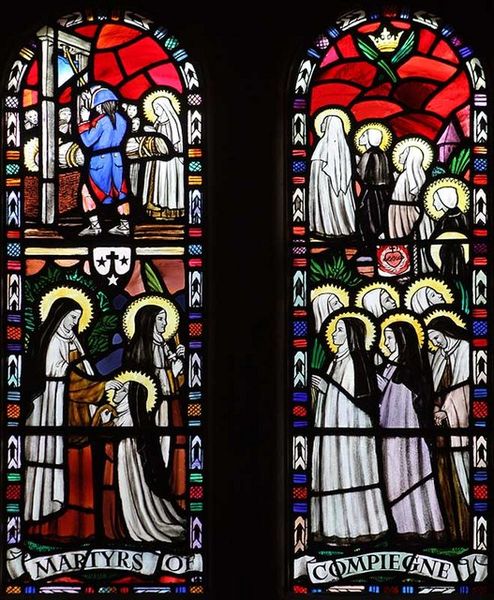
Artwork: Stained glass of the Martyrs of Compiègne, photograph by John Salmon, cc 2.0. Amy Welborn has some nice links on-theme as well.

Muslim
Education and Religion
Politics and Religion

About Jennifer Fitz
Jennifer Fitz is just not gonna give up on this whole freedom of religion thing. Home base is JenniferFitz.com, Jesus topics at the 'stack. On Twitter @JenFitz_Reads. You can read more about the author here.
Previous Post

August 15, 2023
How Much College Tuition is 'Reasonable'?
Next Post

September 30, 2023 Is Graded Exercise Therapy Safe and Effective?
Recent Comments
"You think I don't know people who were homeschooled? I'm married to one! I know ..."
3 Ways Homeschoolers Socialize Differently than ..."
"And you know this how? You personally know enough about 2 million+ homeschooling families that ..."
3 Ways Homeschoolers Socialize Differently than ..."
"So because homeschooled students would do well in another setting, these families should be denied ..."
3 Ways Homeschoolers Socialize Differently than ..."
"Thank you. My point about "mature sex life" is that most people wouldn't want their ..."
3 Ways Homeschoolers Socialize Differently than ..."
Browse Our Archives
Select a Category Books Catechesis Catholic Q&A Chastity Church Craziness Come See Me Talk Disability & Chronic Illness Economics Evangelization Facepalm Forgiveness Good Things History Homeschooling Human Rights It's All Catholic Listen to Me Survey Series Liturgical Living Marriage Modesty Not Satire. But almost. Rant-o-Rama Sacred Art & Music Satire South Carolina Spark Clutter Stick that Corner Suffering Thinking Topics Writing Stuff
Select a Month September 2026 July 2026 June 2026 January 2026 December 2025 September 2025 July 2025 June 2025 May 2025 April 2025 March 2025 November 2024 August 2024 July 2024 June 2024 May 2024 April 2024 February 2024 January 2024 December 2023 October 2023 September 2023 August 2023 July 2023 June 2023 May 2023 April 2023 March 2023 February 2023 January 2023 December 2022 November 2022 October 2022 September 2022 August 2022 July 2022 May 2022 April 2022 March 2022 February 2022 January 2022 December 2021 November 2021 October 2021 September 2021 August 2021 July 2021 June 2021 May 2021 January 2021 December 2020 November 2020 October 2020 September 2020 August 2020 July 2020 June 2020 May 2020 April 2020 March 2020 February 2020 January 2020 October 2019 September 2019 August 2019 May 2019 April 2019 February 2019 September 2018 August 2018 July 2018 June 2018 May 2018 April 2018 March 2018 February 2018 January 2018 December 2017 November 2017 October 2017 September 2017 August 2017 June 2017 May 2017 April 2017 March 2017 February 2017 January 2017 December 2016 November 2016 October 2016 September 2016 August 2016 July 2016 May 2016 April 2016 March 2016 February 2016 January 2016 December 2015 November 2015 October 2015 September 2015 August 2015 July 2015 June 2015 May 2015 April 2015 March 2015 February 2015 January 2015 December 2014 November 2014 October 2014 September 2014 August 2014 July 2014 June 2014 May 2014 April 2014 March 2014 February 2014
Follow Us!
TAKE THE
Religious Wisdom Quiz
Where did Jacob and his family settle in Egypt?
Select your answer to see how you score.
Memphis Goshen Cairo Thebes
Related posts from Sticking the Corners

Is a 'Catholic Lifestyle' a Real Thing?

AI Detection and the Sin of Slander


How Catholic is Wake Up Dead Man?
TRENDING AT PATHEOS Catholic

In "Irreplaceable," our book on vocation and technology, Trevor Sutton and I...

I was strolling through the top floor of the brand new Parthenon...

What Does Gêvâh Mean For Kimberley Guifoyle &...
This week, a lot of the news is focused on Kimberly Guilfoyle....

INNER CIRCLE: Profound Mystery (Of Christ In All...
Ephesians 5:31-32 “For this reason, a man will leave his father and...

Do Not Rejoice When Your Enemy Falls: The...
Turning an execution into a public spectacle is a disturbing expression of...

'The Chosen' S6 Trailer: The Passion Gets Very...
Not many watching 'The Chosen' worry about spoilers, but just because they...
view all Catholic blogs
Ad-Free & Subscriber Log-In Subscription Support
- About Us
- 2026 Calendar
- Videos
- Podcasts
- Library of World Religions
- Faith In Media Tracker
- Advertise With Us
- Write for Us
- Privacy Policy
- Terms of Service
- Do Not Sell My Data
- Contact Us
- Radiant Digital
- Manage Newsletter Subscriptions
- Unsubscribe From Notifications
- Sitemap
Copyright 2008-2026, Patheos. All rights reserved.
Subscription Support Ad-Free & Subscriber Log-In
Follow Patheos