
BuddhistCatholicContemplativeEvangelicalGeneral ChristianHinduJewishLatter-day SaintMuslimNew VisionsProgressive Christian
Beliefs
- Buddhist
- Catholic
- Contemplative
- Evangelical
- General Christian
- Hindu
- Jewish
- Latter-day Saint
- More Voices
- Muslim
- New Visions
- Pagan
- Progressive Christian
Topics
- Religion News
- Food and Religion
- Sports and Religion
- Religious Art
- Religious Music and Entertainment
- Religious Events
- History and Religion
- Style and Religion
- Politics and Religion
- Women in Religion
- Recreation Outdoors and Religion
- Business Finance and Religion
- Careers Workplace and Religion
- Education and Religion
- Family Parenting and Religion
- Health Fitness and Religion
- Home and Religion
- Relationships and Religion
- Technology and Religion
- Travel and Religion
Columnists
- Buddhist Columnists
- Business Finance and Religion Columnists
- Careers Workplace and Religion Columnists
- Catholic Columnists
- Contemplative Columnists
- Education and Religion Columnists
- Evangelists Columnists
- Family Parenting and Religion Columnists
- General Christian Columnists
- Health Fitness and Religion Columnists
- Hindu Columnists
- History and Religion Columnists
- Home and Religion Columnists
- Jewish Columnists
- More Voices Columnists
- Latter Day Columnists
- Muslim Columnists
- New Visions Columnists
- Nonreligious Columnists
- Pagan Columnists
- Politics and Religion Columnists
- Progressive Columnists
- Recreation Outdoors and Religion Columnists
- Relationships and Religion Columnists
- Religion News Columnists
- Religious Art Columnists
- Religious Events Columnists
- Religious Music and Entertainment Columnists
- Sports and Religion Columnists
- Style and Religion Columnists
- Technology and Religion Columnists
- Travel and Religion Columnists
- Women in Religion Columnists
Resource Library
- 2026 Calendar
- Library of World Religions
- The 100 Most Holy Places on Earth
- Patheos Answers
- Podcasts
- Videos
- Faith Leaders Database
- Anglican Episcopalian
- Bahai
- Baptist
- Buddhism
- Christianity
- Confucianism
- Eastern Orthodoxy
- Hinduism
- Holiness and Pentecostal
- ISKCON
- Islam
- Judaism
- Lutheran
- Methodist
- The Church of Jesus Christ of Latter-day Saints
- New Age
- Paganism
- Presbytarian and Reformed
- Protestantism
- Religion Behind the Scenes
- Roman Catholic
- Scientology
- Shia Islam
- Sikhism
- Sufism
- Sunni Islam
- Taoism
- Zen
- See all religions
Research Tools
 Ad-Free & Subscriber Log-In Subscription Support
Ad-Free & Subscriber Log-In Subscription Support
Follow Patheos 

- Trending:
- Forgiveness
- |
- Marriage
- |
- Consciousness
- |
- Death Penalty
- |
- Election
- |
- Halloween

- Home
- Catholic
- Reasoning vs. Rationalizing
Reasoning vs. Rationalizing
Last updated on: January 21, 2022 at 10:25 am by Jennifer Fitz
Reasoning vs. Rationalizing 2022-01-21T10:25:39-05:00 Jennifer Fitz
Patheos Explore the world's faith through different perspectives on religion and spirituality! Patheos has the views of the prevalent religions and spiritualities of the world.
There’s a screenshotted homework assignment, reputedly from a Georgia virtual school, that’s circulating right now, generating outrage and counter-reaction. It reads:
Writing Prompt
Trail of Tears
Write letters from the different points of view listed in the questions. Remember to use facts to support your point of view.
The specific assignment then says:
Write a letter to President Andrew Jackson from the perspective of an American settler. Explain why you think removing the Cherokee will help the United States grow and prosper.
My initial reaction was I think typical: If the thought of writing such a thing doesn’t turn your stomach, you shouldn’t be teaching history.
Not asking anyone to be “literally shaking” or whatever. Historians have to face tough subjects all the time. It’s part of the job. And obviously we would have no fiction, no theatre, if someone weren’t willing to step into the bad guy’s shoes. Writers and actors have a variety of tools for probing the depths of evil without being harmed by it. But if you both know what happened (“genocide” is not an overstatement) and you have a conscience, this should at some level be a disgust-provoking exercise.
Nonetheless, let’s move on from the personal affront that this question is for many Americans, but which apparently doesn’t provoke an emotional reaction from some, for whatever reason.
I want to address two different questions related to this type of assignment. First are the developmental milestones involved in writing “bad guy” point-of-view. Second is the more fundamental issue: Is it necessary and beneficial to undertake exercises like this in order to learn how to reason well?
Finally I’ll finish with a reprint of my experience with teaching a debate course where students were forbidden to argue any position they knew to be false.
Seeing the World Through the Eyes of Evil
My background is this: I have designed and taught religion courses for students ranging from ages preschool through adult, in all kinds of contexts. One of the fundamental aspects of that work is helping your students hone their moral thinking. I have also taught literature, creative writing, debate, and history to middle and high school students. Those jobs requires cultivating an understanding of alternate points of view, including frankly immoral points of view.
(Obviously I’m writing on the Catholic Channel, duh, but everything I’m going to say applies regardless of your personal moral or religious framework. This isn’t about a specific religion, it’s about the development of the human mind. Also, clarifying here: I’m not sure I’ve ever taught a course that didn’t involve teaching history in some manner. So I guess I’m all-ages on that one.)
So. First thing you need to know is that human brains go through stages of development in their capacity for abstract thinking. There is a marked difference between the thinking of ten-year-olds and teenagers, not because one group is smarter than the other or more capable of reason than the other, but because puberty brings a leveling-up of abstract thinking abilities.
(Alas, the experience of your brain’s abstract thinking during the upgrade can be quite intense — you suddenly are able to perceive emotions you were previously oblivious too, and it’s a long few years there while you develop the skill of knowing what to do with those emotions. We who enjoy teaching middle school are a rare breed.)
What I’ve seen therefore is that fifth graders (age 10-11) are absolutely on board with being given facts about anything — including morality — and reasoning through how to apply those facts. If you say, “racism is wrong” and you have any credibility with your audience whatsoever, they will easily see the truth of your assertion and they will happily work away at figuring out how that truth applies in real-world situations.
Because they have a strong sense of justice, they will also feel deeply anything that smacks of unfairness. This is a good thing! As teachers and parents, we should not do anything to undermine or dull this sense of right and wrong.
What is helpful, because the kids we know are imperfect creatures just like ourselves, is helping students explore their own tendency towards rationalization, within the framework of clearly-defined moral thinking. So questions like “Why do you think some students are tempted to cheat on tests or copy homework?” can be good material for properly-guided discussion (not a test question!), because kids do know the excuses they make for their own bad behavior, and do benefit from learning to see ways to escape those excuses. (The ones who would themselves never cheat need help with resolve to not cave if pressured to share answers.)
What’s not helpful is teaching students to rationalize the cheater’s behavior. They don’t need any help with that. They need help with learning to examine their own motivations and sort out the good from the bad and develop confidence in claiming the good and discarding the bad.
You could call it self-centered, but it’s more accurately centering-the-self: A child who enters puberty with a clear sense of him or herself as a person who knows what is right and makes an effort to do what is right is in a strong position to process the abstract thinking abilities that are going to hit like a sledgehammer over the next few years.
Conclusion: Questions like the one posed in the sample homework assignment are utterly inappropriate for children. Developmentally this is just not where they are and what they need. So what about teens?
This is Your Brain on Puberty
Here is a very gross generalization that you can no doubt find exceptions to: Twelve-year-old girls start getting interested in role-playing the bad guy while twelve-year-old boys still just want to always be the hero.
Not rocket science. Girls and boys experience the changes of puberty at different rates (on average) and their ability to experience and process emotions differs as well (on average). The emotional-social dynamics of their same-sex interactions (sports teams, clubs, friend groups) are different because of this (on average).
But what this means for a teacher of tweens and teens is that some students are eager to explore bad-guy point-of-view and other students need more time solidifying good-guy point-of-view. As a history, literature, or writing instructor a legitimate assignment that respects these differing developmental needs would be something like: “Write a letter from a person living in western Georgia at the time of the Trail of Tears.”
There are students, usually a minority of students even into later teenage years and adulthood, who want to explore bad-guy point-of-view. For some people, it is a way of processing the reality of evil and thinking through the ramifications of evil. It can be a tool, for someone who is capable of this kind of emotional task, of developing a deeper sense of morality and self-examination. An open-ended assignment allows for students to choose to go that route if they are ready for it, but doesn’t force such an exercise on the many, many people of any age who have no desire or need to do such a thing.
Understanding Your Opponent Doesn’t Require Lying
There’s an extremely popular myth embedded in our culture that goes like this:
- It is important and necessary to fully understand your opponents’ point of view.
- Therefore, practice arguing from your opponent’s point of view is important and necessary.
#1 is absolutely true. #2 is wrong-headed in the extreme.
(I say this, remember, as a person who absolutely does permit students to freely choose, unprompted by me but allowed by me if requested, to write bad-guy point-of-view.)
This intellectual nonsense is the justification for assigning groups of students to argue crudely-defined “debate” topics, and in some cases belittling students who protest they don’t wish to pretend to believe something they know to be patently false.
The exercises are invariably absurd in their results, but alas many instructors are unable to see that it is so, because they’ve never been exposed to authentic, reasoned debate*.* Others can see the problem clearly, but don’t know any better way host reasoned debate in the classroom. They accept the wooden debate experience as the necessary cost of teaching an important skill. Unfortunately, these exercises don’t even accomplish the hoped-for learning.
When you are forced to argue a position you know to be wrong, the skill you develop isn’t reasoning but rationalization.
To reason is to think through a topic in the quest for the truth. Rationalization is to gin up defenses of a position you wish to promote, regardless of whether it is true or false.
I write all this as an experienced teacher, not some rosy idealist*.* I promise you, there is a much better way. You’ll have more engaged classes, your students will do more research, and you the teacher will have far more fun. What follows is a reprint of how you teach a debate class where students are never asked to rationalize and are always required to reason.
How to Teach a Real Debate Class
In prepping my first debate class for teenagers, I instituted a revolutionary rule: No participant would ever be permitted to argue a position he or she believed was false.
I can’t be the only instructor who’s ever done such a thing. Still, the pushback is proof of how strong our cultural prisons can be. The most common objection is: “How will students learn to see the other side of an issue?”
Well, that is where reasoning and research and good arguments come into play. If you forbid straw men, your debaters will be obliged to learn the actual beliefs of their opponents or else suffer mortal embarrassment as they are vanquished by the least little assertion of fact.
Teenagers do not enjoy being embarrassed.
***
Allow me to tell you what happens when you take a room full of teenagers from similar backgrounds, with similar religious beliefs, whose parents all hold similar political views, and who mostly get along with one another, and tell them that they must, as a class, debate the topic of their choice — and also everyone must argue a position they believe is true.
The first thing that happens is that the students gravitate towards emerging issues for which prudential judgement reigns. In my first debate class, the two big topics the teens chose to debate were (1) whether teens playing video games is helpful or harmful and (2) whether marijuana ought to be legalized.
The second thing that happens is that as the teens begin to research the issues, factions form and re-form as students change opinions as they learn more.
The third that happens is that even while, by debate day, there remain stark differences of opinion on a given topic, everyone has moved closer to a consensus.
Therefore, the fourth thing that happens is that when students present their cases, they marshal far more facts and use far more nuance in explaining how their position is different from a similar — but not identical — opponent’s position.
This is what happens when debate is treated as a tool for finding the truth rather than as a device for rationalizing one’s preconceived opinions.
***
Very few Americans today have ever experienced a course, at any time in their education, where they were taught how to use debate as a means of discovering truth.
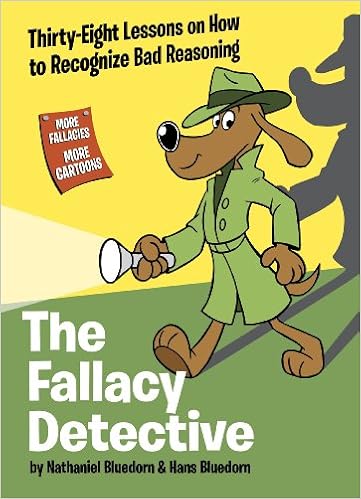
Cover art for The Fallacy Detective by Nathaniel & Hans Bluedorn. Great resource for teaching reasoning skills, recommended for 8th grade and up, but no sooner than students are interested and capable. For some kids, that’s going to come much later in high school or even early college.
Catholic readers, if you’re interested in exploring how reason and argumentation fit into the bigger picture of evangelization, can I recommend The How-to Book of Evangelization by someone you apparently enjoy reading?
Previous Post

January 15, 2022
Medical Gaslighting Illustrated
Next Post
January 25, 2022 The Healthcare Experience for Difficult Diagnoses
Browse Our Archives
Select a Category Books Catechesis Catholic Q&A Chastity Church Craziness Come See Me Talk Disability & Chronic Illness Economics Evangelization Facepalm Forgiveness Good Things History Homeschooling Human Rights It's All Catholic Listen to Me Survey Series Liturgical Living Marriage Modesty Not Satire. But almost. Rant-o-Rama Sacred Art & Music Satire South Carolina Spark Clutter Stick that Corner Suffering Thinking Topics Writing Stuff
Select a Month September 2026 July 2026 June 2026 January 2026 December 2025 September 2025 July 2025 June 2025 May 2025 April 2025 March 2025 November 2024 August 2024 July 2024 June 2024 May 2024 April 2024 February 2024 January 2024 December 2023 October 2023 September 2023 August 2023 July 2023 June 2023 May 2023 April 2023 March 2023 February 2023 January 2023 December 2022 November 2022 October 2022 September 2022 August 2022 July 2022 May 2022 April 2022 March 2022 February 2022 January 2022 December 2021 November 2021 October 2021 September 2021 August 2021 July 2021 June 2021 May 2021 January 2021 December 2020 November 2020 October 2020 September 2020 August 2020 July 2020 June 2020 May 2020 April 2020 March 2020 February 2020 January 2020 October 2019 September 2019 August 2019 May 2019 April 2019 February 2019 September 2018 August 2018 July 2018 June 2018 May 2018 April 2018 March 2018 February 2018 January 2018 December 2017 November 2017 October 2017 September 2017 August 2017 June 2017 May 2017 April 2017 March 2017 February 2017 January 2017 December 2016 November 2016 October 2016 September 2016 August 2016 July 2016 May 2016 April 2016 March 2016 February 2016 January 2016 December 2015 November 2015 October 2015 September 2015 August 2015 July 2015 June 2015 May 2015 April 2015 March 2015 February 2015 January 2015 December 2014 November 2014 October 2014 September 2014 August 2014 July 2014 June 2014 May 2014 April 2014 March 2014 February 2014
Follow Us!
TAKE THE
Religious Wisdom Quiz
I am a precious stone, tested and chosen. Believers will never be put to shame when they trust in me. What am I?
Select your answer to see how you score.
A foundation A living stone A rock A cornerstone
Related posts from Sticking the Corners

Is a 'Catholic Lifestyle' a Real Thing?

AI Detection and the Sin of Slander

10 Catholic Finds at the Pride Festival

TRENDING AT PATHEOS Catholic

The Sermon on the Mount, Part I: Matthew...
The Sermon on the Mount, Part I (Matthew 4:12-5:12) St. Matthew moves...

What's up from Crossway: Reviewing some of their latest A few weeks...

Janie Learns the Way of the Cross: A...
Teaching children about Jesus' Passion can be challenging. Many parents and educators...

Looking For Good Catholic Writing - October 2026
He alone extends the heavens, and he walks upon the waves of...

In "Irreplaceable," our book on vocation and technology, Trevor Sutton and I...

I was strolling through the top floor of the brand new Parthenon...
view all Catholic blogs
Ad-Free & Subscriber Log-In Subscription Support
- About Us
- 2026 Calendar
- Videos
- Podcasts
- Library of World Religions
- Faith In Media Tracker
- Advertise With Us
- Write for Us
- Privacy Policy
- Terms of Service
- Do Not Sell My Data
- Contact Us
- Radiant Digital
- Manage Newsletter Subscriptions
- Unsubscribe From Notifications
- Sitemap
Copyright 2008-2026, Patheos. All rights reserved.
Subscription Support Ad-Free & Subscriber Log-In
Follow Patheos