
BuddhistCatholicContemplativeEvangelicalGeneral ChristianHinduJewishLatter-day SaintMuslimNew VisionsProgressive Christian
Beliefs
- Buddhist
- Catholic
- Contemplative
- Evangelical
- General Christian
- Hindu
- Jewish
- Latter-day Saint
- More Voices
- Muslim
- New Visions
- Pagan
- Progressive Christian
Topics
- Religion News
- Food and Religion
- Sports and Religion
- Religious Art
- Religious Music and Entertainment
- Religious Events
- History and Religion
- Style and Religion
- Politics and Religion
- Women in Religion
- Recreation Outdoors and Religion
- Business Finance and Religion
- Careers Workplace and Religion
- Education and Religion
- Family Parenting and Religion
- Health Fitness and Religion
- Home and Religion
- Relationships and Religion
- Technology and Religion
- Travel and Religion
Columnists
- Buddhist Columnists
- Business Finance and Religion Columnists
- Careers Workplace and Religion Columnists
- Catholic Columnists
- Contemplative Columnists
- Education and Religion Columnists
- Evangelists Columnists
- Family Parenting and Religion Columnists
- General Christian Columnists
- Health Fitness and Religion Columnists
- Hindu Columnists
- History and Religion Columnists
- Home and Religion Columnists
- Jewish Columnists
- More Voices Columnists
- Latter Day Columnists
- Muslim Columnists
- New Visions Columnists
- Nonreligious Columnists
- Pagan Columnists
- Politics and Religion Columnists
- Progressive Columnists
- Recreation Outdoors and Religion Columnists
- Relationships and Religion Columnists
- Religion News Columnists
- Religious Art Columnists
- Religious Events Columnists
- Religious Music and Entertainment Columnists
- Sports and Religion Columnists
- Style and Religion Columnists
- Technology and Religion Columnists
- Travel and Religion Columnists
- Women in Religion Columnists
Resource Library
- 2026 Calendar
- Library of World Religions
- The 100 Most Holy Places on Earth
- Patheos Answers
- Podcasts
- Videos
- Faith Leaders Database
- Anglican Episcopalian
- Bahai
- Baptist
- Buddhism
- Christianity
- Confucianism
- Eastern Orthodoxy
- Hinduism
- Holiness and Pentecostal
- ISKCON
- Islam
- Judaism
- Lutheran
- Methodist
- The Church of Jesus Christ of Latter-day Saints
- New Age
- Paganism
- Presbytarian and Reformed
- Protestantism
- Religion Behind the Scenes
- Roman Catholic
- Scientology
- Shia Islam
- Sikhism
- Sufism
- Sunni Islam
- Taoism
- Zen
- See all religions
Research Tools
 Ad-Free & Subscriber Log-In Subscription Support
Ad-Free & Subscriber Log-In Subscription Support
Follow Patheos 

- Trending:
- Forgiveness
- |
- Marriage
- |
- Consciousness
- |
- Death Penalty
- |
- Election
- |
- Halloween

- Home
- Progressive Christian
- Religion News
- The Yearning of a Revolutionary: On Luigi Mangione’s Why
The Yearning of a Revolutionary: On Luigi Mangione’s Why
Last updated on: November 23, 2025 at 11:57 pm by Jeff Hood
The Yearning of a Revolutionary: On Luigi Mangione’s Why 2025-11-23T23:57:11-06:00 Jeff Hood
Patheos Explore the world's faith through different perspectives on religion and spirituality! Patheos has the views of the prevalent religions and spiritualities of the world.

The Yearning of a Revolutionary and Luigi Mangione
Luigi Mangione, Krishnamurti and Christ: A Theological Meditation on the Yearning of a Revolutionary
UnitedHealthcare CEO Brian Thompson was shot and killed in Midtown Manhattan on December 4, 2024; Luigi Mangione was arrested in Altoona, Pennsylvania on December 9, 2024, and has been charged in state and federal court. As of September 2025, terrorism enhancement charges in the state case were dismissed, though Mangione still faces a state murder charge and separate federal charges, and federal prosecutors have signaled they will seek the death penalty.”
The Yearning of a Revolutionary and Luigi Mangione. There is something unbearably human about Luigi Mangione’s story. Not in the alleged act that brought him into public view…the killing of UnitedHealthcare CEO Brian Thompson…but in the spiritual turbulence that preceded it. The fragments we possess reveal a young man consumed by questions that have haunted humanity’s most serious souls… How does one live authentically in a profoundly sick society? What does moral courage demand when confronted with systemic cruelty? And perhaps most painfully…what happens to the human heart when it sees too much, feels too much and carries alone the weight of a world it believes to be irredeemably broken?
The profile that emerges from reporting defies easy categorization. Here was a valedictorian, an elite engineering graduate from an affluent Maryland family, a young man who read widely in philosophy, Christian scripture, mystical theology, political economy and Asian spirituality. Publicly shared notes and quotations reveal a mind drawn repeatedly to voices that challenge societal complacency…particularly Jiddu Krishnamurti and Jesus Christ. These fragments reveal a figure wrestling with what Paul Tillich called “ultimate concern,” doing so in a way that fused existential distress with spiritual aspiration.
At the center of this turbulence lies what we might call Mangione’s yearning to be revolutionary…a yearning that appears less political than it is psychological, moral and devastatingly spiritual. It arises from his sense that the world he inhabits…particularly the structures of American healthcare and capitalism…is morally disordered…even apocalyptic…in its contradictions. Within this worldview, both Krishnamurti and Jesus function not simply as teachers but as catalysts…figures of disruption whose voices illuminate society’s sickness while summoning the individual into a kind of radical authenticity.
Nothing in this meditation should ever be taken as diminishing the fundamental moral gravity of what Mangione is alleged to have done. The killing of Brian Thompson was not a revolutionary act, nor an expression of genuine prophetic conscience, but a tragic and unequivocally evil outcome…an act that violates the sanctity of life at the center of both Christian theology and the ethical truthfulness Krishnamurti demands. Whatever anguish, alienation or spiritual yearning shaped Mangione’s interior world cannot transfigure a moral wrong into anything less than wrong. The psychological and theological forces examined here help us understand the pathos of his inner storm, but they do not mitigate the reality that taking a human life is never sanctioned by either Christ’s compassion or Krishnamurti’s clarity. In this sense, the tragedy of Mangione’s spiritual confusion is matched…and exceeded…by the tragedy inflicted upon Thompson, his family and the community harmed by the violent rupture of his death.
Krishnamurti and the Psychology of Revolutionary Seeing : The Yearning of a Revolutionary and Luigi Mangione
Krishnamurti’s Refusal of Authority
The quote that Mangione chose to share publicly from Krishnamurti cuts like a blade: “It is no measure of health to be well adjusted to a profoundly sick society.” These words, drawn from Krishnamurti’s vast body of work…including Freedom from the Known and The First and Last Freedom³…reveal more than philosophical agreement. They suggest a young man who had crossed a threshold of perception from which there was no return.
Krishnamurti’s philosophy is merciless in its clarity. Truth, he insists, cannot be mediated through institutions, traditions or authorities. It must be encountered directly, stripped of the thousand defenses we erect against reality. His concept of “choiceless awareness” demands we see things exactly as they are…not as we wish them to be, not as society tells us they are, but as they actually exist in their naked truth. And what Krishnamurti saw when he looked at modern society was not merely imperfection but structural sickness. Our institutions, he argued, mirror the inner disintegration of the human beings who built them. Fear breeds systems of control. Greed creates economies of exploitation. The well adjusted person, comfortable within such systems, is not healthy but symptomatic of deeper pathology.
For someone of Mangione’s evident intellectual seriousness, encountering Krishnamurti must have been simultaneously liberating and devastating. Liberating because here was a voice that validated his growing sense that something was fundamentally wrong with the world he inhabited. Devastating because once you see through Krishnamurti’s eyes, you can never quite see the same way again.
Seeing as Alienation
The comfortable illusions that allow most of us to navigate daily life begin to dissolve under Krishnamurti’s gaze. The gap between what society professes…care, justice and human dignity…and what it practices becomes an open wound. Krishnamurti warns that genuine insight produces sorrow, because it dismantles illusions that once provided meaning and stability. Not the dramatic sorrow of tragedy, but the quiet, persistent ache of seeing clearly in a world that depends on blindness.
The accounts of Mangione’s writings suggest someone who experienced this alienation with particular intensity. His reported condemnations of the American healthcare system as parasitic and exploitative reflect not mere political disagreement but something deeper…a Krishnamurtian moral diagnosis that the system itself is spiritually sick, that it feeds on human suffering while speaking the language of care. To perceive social reality through this lens is inherently alienating. The clearer one’s perception becomes, the more intolerable the structures of everyday life appear. You begin to see the violence hidden in bureaucracy, the cruelty disguised as policy and the human cost of what others call business as usual.
Krishnamurti and the Birth of Revolutionary Longing
Yet here emerges a profound tension in Krishnamurti’s teaching, one that seems to have seized Mangione’s imagination. Krishnamurti repeatedly insists that revolution must be psychological, not political…that external systems cannot change fundamentally unless human consciousness itself changes. But his writing carries an ethical urgency that can stir something else entirely. When he describes society’s sickness with the precision of a surgeon identifying cancer, when he strips away every comforting lie about why things are as they are, he sounds less like a meditation teacher and more like a prophet diagnosing collective sin.
For an intellectually earnest reader…particularly one already troubled by injustice…this creates a compelling internal struggle. If the world is sick, what is the morally responsible response? If insight reveals systematic exploitation, can one remain passive? Does clarity itself demand confrontation? This is the birthplace of what I’m calling the yearning to be revolutionary…a longing to somehow embody or enact the truth that one has painfully discerned. It’s not primarily a political impulse but something more primal…a need to align one’s actions with one’s devastating clarity.
Jesus Christ and the Theology of Prophetic Disruption : The Yearning of a Revolutionary and Luigi Mangione
Jesus as Apocalyptic Critic of Power
If Krishnamurti provided Mangione with a lens for seeing society’s sickness, Jesus Christ appears to have provided him with a model for confronting it. But the Jesus that emerges from Mangione’s reported writings is not the gentle teacher of Sunday school imagination. This is the Jesus of the Gospels read through the lens of liberation theology…a prophetic disrupter who confronts the powers of his time with uncompromising moral clarity.
This is the Jesus who enters the temple and doesn’t politely request reform but overturns tables in holy rage. The Jesus who looks at religious authorities and calls them whitewashed tombs…beautiful outside, full of death within. The Jesus who pronounces woes upon those who lay heavy burdens on others while refusing to lift a finger to help. This is the Jesus that Gustavo Gutiérrez describes when he writes that the gospel is a “liberating praxis” that exposes structures of oppression, the Jesus that Walter Brueggemann invokes when he speaks of prophetic imagination breaking open imperial consciousness.
This Jesus is not safe. He doesn’t offer comfort to the comfortable or validation to systems of exploitation. Instead, he stands with the crushed and condemned, announcing judgment on the powers that crush them. For someone already disturbed by institutional violence, already seeing through Krishnamurti’s lens the sickness of society, encountering this Jesus must have been like touching live wire.
Christological Demands and Ethical Extremity
The ethical demands of Jesus are maximalist, absolute, seemingly impossible. “Sell what you have and give to the poor.” “Love your enemies.” “Take up your cross.” These aren’t suggestions for gradual improvement but calls for total transformation. Dietrich Bonhoeffer captured this in his discussion of “the cost of discipleship,” arguing that Christ calls believers into a form of life that exists in permanent contradiction with worldly power. There is no comfortable middle ground, no way to serve both God and mammon, no path that avoids the confrontation between the kingdom of God and the kingdoms of this world.
For Mangione, wrestling with the violence of American healthcare…a system that bankrupts the sick, that rations care by wealth, that transforms human suffering into profit margins…Jesus’ words must have burned. Here was divine validation for his moral outrage, but also an intensification of his burden. Where Krishnamurti provided psychological clarity about society’s sickness, Jesus provided ethical fire, a sense that this sickness is not merely unfortunate but sinful, not merely problematic but demanding of judgment.
Jesus and the Revolutionary Imagination
Throughout Christian history, Jesus has inspired revolutionary movements. Francis of Assisi stripped naked in the public square to renounce his father’s wealth. Liberation theologians in Latin America declared God’s preferential option for the poor. James Cone argued that Christ stands with the crucified peoples of every age, that the cross reveals God’s solidarity with the lynched, the oppressed, the destroyed.
Mangione appears to have inhabited this revolutionary Christian imagination, though perhaps without the theological guardrails that traditionally accompany it. Jesus becomes for him a figure who not only validates moral outrage but embodies the confrontation he longs to enact…truth against corruption, compassion against cruelty and moral courage against institutional complicity. The revolutionary yearning that Krishnamurti awakened, Christ inflames and sanctifies, grounding it not merely in psychological insight but in divine confrontation with evil.
Convergence: Krishnamurti, Christ and Mangione’s Moral Imagination : The Yearning of a Revolutionary and Luigi Mangione
Seeing (Krishnamurti) and Acting (Christ)
Mangione stands at the intersection of two powerful currents that don’t naturally harmonize. Krishnamurti calls him to see through illusion, to understand the sickness of society with devastating clarity. Jesus calls him to challenge injustice, to overturn tables, to stand with the oppressed against their oppressors. Krishnamurti speaks of inner revolution. Jesus embodies prophetic action. Krishnamurti warns against being caught in reaction. Jesus seems to demand response.
This tension generates a psychological and theological field of extraordinary intensity. The convergence creates what we might call an existential posture of agonized clarity…the world is sick, the suffering is intolerable and one must do something. But what? And how? The questions become not philosophical but visceral, not abstract but immediate. Every day that passes, people die from lack of healthcare. Every quarter, insurance companies report record profits. Every moment, the machine grinds on, and you see it, you see it all with Krishnamurti’s clarity and feel it with Christ’s compassion, and the seeing and feeling become almost unbearable.
The Lonely Burden of Knowing
This fusion of Krishnamurti and Christ creates a potent interior drama, but it also produces profound isolation. The one who sees society’s sickness feels called to witness against it, but such witnessing is inherently lonely. Friends and family, well adjusted to the sick society, cannot understand the urgency you feel. They see your intensity as extremism, your clarity as obsession, your moral anguish as imbalance.
Kierkegaard wrote about this in The Sickness Unto Death…the despair of the self unable to reconcile its vision with the world’s refusal to change. Mangione’s writings, marked by moral disgust, urgency and loneliness, suggest someone overwhelmed by the contrast between what he believed society ought to be and what he saw it actually was. The more clearly he saw, the more alien he became. The more he understood, the less he could participate in the casual cruelties and comfortable lies that make normal life possible.
The Revolutionary Yearning as Vocation and Temptation
The Yearning of a Revolutionary and Luigi Mangione. To yearn to be revolutionary in this sense is to feel both summoned and endangered. Summoned because moral clarity seems to demand response…how can one see suffering and remain passive? Endangered because revolutionary imagination, especially when isolated, can outstrip discernment, humility or hope. The yearning becomes a vocation…a calling to somehow embody truth in a world of lies, to be authentic in a society of masks and to stand for justice in systems of exploitation.
But without community, without spiritual elders, without theological formation, this revolutionary longing can become untethered from love and rooted instead in despair. Krishnamurti warns that psychological revolution must arise from freedom, not compulsion. Jesus warns that judgment belongs to God, not to the individual ego. Yet for someone experiencing the convergence of these influences in isolation, such warnings might feel like abstractions compared to the immediate reality of suffering…the concrete violence of systems that destroy human beings while speaking the language of care and service.
The Existential Consequences of Seeing a Sick World : The Yearning of a Revolutionary and Luigi Mangione
The Sorrow of the Clairvoyant
There is a particular kind of sorrow that comes with clear seeing…what Krishnamurti calls the sorrow of perception, what Christian mystics like John of the Cross describe as the dark night of the soul. It’s the sorrow of perceiving reality without the comfort of illusion, of seeing how things actually are rather than how we wish them to be. For most of us, this clarity comes in glimpses…moments when the veil lifts and we see the machinery of suffering that underlies what we call civilization. But we quickly look away, find distraction and desperately rebuild our necessary illusions.
Mangione appears to have lost this capacity for comfortable blindness. His alleged note describing the healthcare system as parasitic reflects not just anger but a form of existential outrage…the fury of someone who cannot stop seeing the preventable deaths, the bankruptcies, the families destroyed by medical debt and the profits extracted from human pain. To feel this sorrow without spiritual scaffolding, without a community that can hold and channel such perception, is spiritually destabilizing. The sorrow becomes not a doorway to compassion but a weight that crushes.
When Moral Urgency Becomes Moral Exhaustion
Jesus’ call to radical discipleship can inspire profound transformation, but it can also overwhelm those who internalize it without balance, community or grace. Bonhoeffer warned that discipleship without the sustaining presence of Christ becomes a crushing burden…not liberation but a new form of bondage…not freedom but an impossible weight of moral responsibility.
Similarly, Krishnamurti’s demand for total psychological freedom, for complete authenticity, can exhaust those who interpret it as a personal mission to purify not just themselves but society. The revolutionary impulse, which begins as a yearning for wholeness and justice, becomes a burden too heavy for any individual to bear. Mangione appears to embody this collision of burdens…the Krishnamurtian imperative to see clearly crashing into the Christian imperative to act justly, with no mediating community, no theological tradition, no spiritual practices to sustain him through the tension.
The Tragedy of Untended Idealism
The Yearning of a Revolutionary and Luigi Mangione. At its core, what we see in Mangione’s story is the tragedy of untended idealism…high moral aspiration untempered by theological community, psychological support or spiritual formation. His longing to confront injustice appears painfully sincere. His disgust with structural exploitation aligns with both Christian social teaching and Krishnamurti’s critique of conditioning. The fragments of his thought that we possess reveal someone who cared, perhaps too much, about the suffering of others, who couldn’t make peace with systems that transform human need into corporate profit.
Yet idealism without grounding becomes volatile. The revolutionary impulse, when isolated, becomes not a path to healing but a manifestation of despair. The yearning to be revolutionary…to somehow embody truth in a false world…to enact justice in unjust system…becomes a consuming fire with no outlet, no expression and no community to channel it toward life rather than death.
The Yearning of a Revolutionary and Luigi Mangione
Luigi Mangione emerges from the fragments we possess as a profoundly human figure…intelligent, morally sensitive, spiritually restless and existentially troubled. His engagement with Krishnamurti reveals a mind drawn to psychological truth telling, unable to accept the comfortable lies that make participation in a sick society bearable. His engagement with Jesus reveals a conscience drawn to prophetic justice, unable to tolerate the violence hidden in bureaucracy and profit margins. Between these two poles lies his yearning to be revolutionary…a yearning born from sorrow, sharpened by insight, inflamed by injustice and ultimately unanchored by community.
To read Mangione theologically is not to excuse but to understand…to see him as a figure caught in tensions that haunt modern spiritual life. The tension between seeing and acting, between despair and hope, between solitude and solidarity. The tension between the psychological revolution that Krishnamurti demands and the social revolution that Jesus embodies. The tension between the clarity that alienates and the blindness that enables participation.
The tragedy is not merely what he allegedly did, but the interior storm that drove him…the storm of a young man who saw too much, felt too much and carried alone the burden of a world he believed to be sick beyond healing. His story forces us to confront unsettling questions about modern life. What happens when one perceives systemic evil with unbearable clarity but lacks the spiritual resources to transform that perception into sustainable action? What happens when revolutionary yearning has no community to hold it, no tradition to channel it and no elders to guide it? What happens when the desire for justice becomes untethered from love? When moral clarity becomes isolated from hope?
These questions reach beyond Mangione himself. They point toward a deeper spiritual crisis of our age…an age marked by institutional decay, existential loneliness, and a yearning, shared by many, to be revolutionary in a world that feels beyond repair. In Mangione’s anguish, we might recognize our own struggles with systems that seem too big to challenge, suffering that seems too vast to address, clarity that brings more pain than peace.
Perhaps the deeper tragedy is not that Mangione felt called to be revolutionary, but that his revolutionary yearning found no community capable of holding it, no tradition able to channel it toward life rather than death. In a society that increasingly produces isolated individuals with acute moral sensitivity but no spiritual formation, no communal wisdom, no practices for sustaining hope in the face of systemic evil, we may see more young people crushed by the weight of their own clarity, consumed by their own yearning for a world transformed.
The question that haunts Mangione’s story is not whether one should yearn to be revolutionary…in a sick society, such yearning may be a sign of spiritual health rather than pathology. The question is how such yearning can be held, channeled and sustained without destroying the one who carries it. This is ultimately a theological question, a communal question, a question about how we accompany each other through the sorrow of seeing clearly in a world that depends on blindness.
Notes
Primary Philosophical and Theological Sources
Bonhoeffer, Dietrich. The Cost of Discipleship. SCM Press, 1959.
Brueggemann, Walter. The Prophetic Imagination. Fortress Press, 1978.
Camus, Albert. The Rebel. Vintage Books, 1992.
Cone, James H. The Cross and the Lynching Tree. Orbis Books, 2011.
Gutiérrez, Gustavo. A Theology of Liberation. Orbis Books, 1973.
John of the Cross. Dark Night of the Soul. Trans. E. Allison Peers, Image Books, 1959.
Kierkegaard, Søren. The Sickness Unto Death. Princeton University Press, 1980.
Krishnamurti, Jiddu. Freedom from the Known. HarperCollins, 1969.
Krishnamurti, Jiddu. The First and Last Freedom. HarperCollins, 1954.
Tillich, Paul. Dynamics of Faith. Harper & Row, 1957.
Williams, Rowan. Christ the Heart of Creation. Bloomsbury, 2018.
Public Reporting and Contemporary Sources
Associated Press. Coverage of Mangione’s social media quotes and arrest details, 2025.
WHYY. Reporting on Mangione’s biography, academic background, and public writings, 2025.
Worldcrunch. “US Healthcare, Luigi Mangione, and European Comparisons,” analysis and reporting, 2025.
Reddit screenshots and aggregated reporting documenting Mangione’s public quotations, 2025.
*
*
*
*If you would like to support the Execution Intervention Project (the organization that financially supports Dr. Hood’s work), click here.
Catholic
Politics and Religion
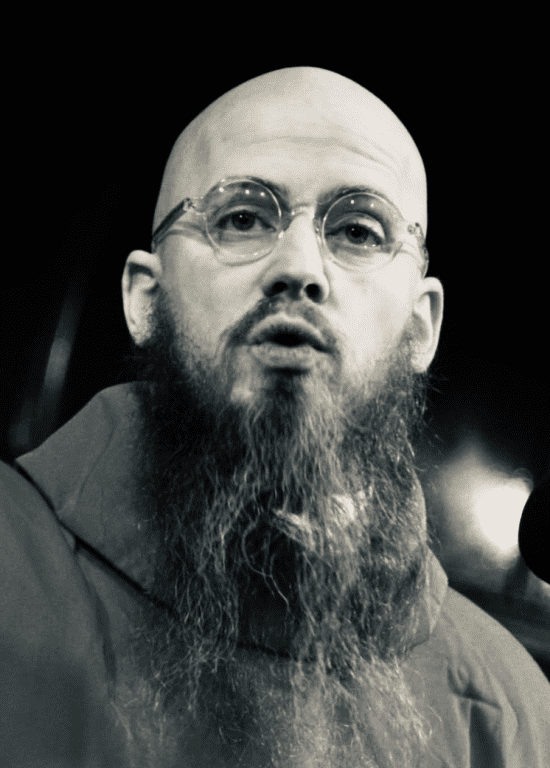
About The Rev. Dr. Jeff Hood
The Rev. Dr. Jeff Hood is a theologian, writer and activist who has spent years ministering to people on death row. As a spiritual advisor and witness to executions, he speaks out against state violence and calls for a society rooted in justice, mercy and the sacredness of life. You can read more about the author here.
Previous Post
November 22, 2025
“Today You Will Be With Me in Paradise”: Christ the King
Next Post

November 25, 2025 The Autopsy of Anthony Wainwright=Florida Killed a Dying Man
Recent Comments
"'God’s Sheep on the Sidewalk' is immensely thought-provoking and conscience-stirring. Thanks. "The people out there ..."
God’s Sheep: The Ones Who Sleep ..."
"Greetings, Jeff, and bless you for your relentlessly regular fierce posts and your profound commitments ..."
Between: On the Person and Character ..."
"God as the Between, thoughts:As a child we were taught, in the blue or green ..."
Between: On the Person and Character ..."
"Sometimes we make it harder than it is. Not saying things don't bring us to ..."
Get Behind Me, Satan: A Death ..."
Browse Our Archives
Select a Category Danny & Jeff fresh writings latest poetics north texas fellowship of reconciliation Sermon theology from death row Thoughts Uncategorized
Select a Month October 2026 September 2026 August 2026 July 2026 June 2026 May 2026 April 2026 March 2026 February 2026 January 2026 December 2025 November 2025 October 2025 September 2025 August 2025 June 2025 May 2025 April 2025 March 2025 January 2025 December 2024 November 2024 October 2024 August 2024 July 2024 June 2024 May 2024 April 2024 March 2024 February 2024 January 2024 December 2023 November 2023 October 2023 September 2023 July 2023 May 2023 April 2023 March 2023 February 2023 January 2023 December 2022 November 2022 October 2022 September 2022 August 2022 July 2022 June 2022 May 2022 April 2022 March 2022 February 2022 January 2022 December 2021 November 2021 October 2021 September 2021 July 2021 June 2021 May 2021 April 2021 March 2021 February 2021 January 2021 December 2020 November 2020 October 2020 September 2020 August 2020 July 2020 June 2020 May 2020 April 2020 March 2020 February 2020 January 2020 December 2019 November 2019 October 2019 September 2019 August 2019 July 2019 May 2019 March 2019 February 2019 January 2019 December 2018 November 2018 October 2018 September 2018 August 2018 July 2018 June 2018 May 2018 April 2018 March 2018 February 2018 January 2018 December 2017 November 2017 October 2017 September 2017 August 2017 July 2017 June 2017 May 2017 April 2017 March 2017 February 2017 January 2017 December 2016 October 2016 September 2016 August 2016 July 2016 June 2016 May 2016 April 2016 March 2016 February 2016 January 2016 December 2015 November 2015 October 2015 September 2015 August 2015 July 2015 June 2015 May 2015 April 2015 March 2015 February 2015 January 2015 December 2014 November 2014 October 2014 September 2014 August 2014 July 2014 June 2014 May 2014 April 2014 March 2014 February 2014 January 2014 December 2013 November 2013 October 2013 September 2013 August 2013 July 2013 June 2013 May 2013 April 2013 March 2013
Follow Us!
TAKE THE
Religious Wisdom Quiz
Which tribe did NOT ask for land on the east side of Jordan?
Select your answer to see how you score.
Gad Manasseh Issachar Reuben
Related posts from Jeff Hood

GOD Will Wipe Away the Tears from Every...

Why Can't Anyone Say Evil? On the Execution...

God's Sheep: The Ones Who Sleep Outside the...

Keeping the Word : Living the Word :...
TRENDING AT PATHEOS Progressive Christian

A new article, written by Jeff Lindsay and Gale L. Pooley,...

Swimfan: Forgotten Aughts Pleasures
This is a recovery effort. In 2002, My Big Fat Greek Wedding...

Top Three Anti-Catholic Lies About Catholicism
This is my initial transcript for the video, "THE 3 WORST...

Pope Leo Celebrates Mass for Nurses & Docs...
I don't have any idea how he did it, but Pope Leo...

The Sermon on the Mount, Part I: Matthew...
The Sermon on the Mount, Part I (Matthew 4:12-5:12) St. Matthew moves...

What's up from Crossway: Reviewing some of their latest A few weeks...
view all Progressive Christian blogs
What Are Your Thoughts?leave a comment
Ad-Free & Subscriber Log-In Subscription Support
- About Us
- 2026 Calendar
- Videos
- Podcasts
- Library of World Religions
- Faith In Media Tracker
- Advertise With Us
- Write for Us
- Privacy Policy
- Terms of Service
- Do Not Sell My Data
- Contact Us
- Radiant Digital
- Manage Newsletter Subscriptions
- Unsubscribe From Notifications
- Sitemap
Copyright 2008-2026, Patheos. All rights reserved.
Subscription Support Ad-Free & Subscriber Log-In
Follow Patheos