
BuddhistCatholicContemplativeEvangelicalGeneral ChristianHinduJewishLatter-day SaintMuslimNew VisionsProgressive Christian
Beliefs
- Buddhist
- Catholic
- Contemplative
- Evangelical
- General Christian
- Hindu
- Jewish
- Latter-day Saint
- More Voices
- Muslim
- New Visions
- Pagan
- Progressive Christian
Topics
- Religion News
- Food and Religion
- Sports and Religion
- Religious Art
- Religious Music and Entertainment
- Religious Events
- History and Religion
- Style and Religion
- Politics and Religion
- Women in Religion
- Recreation Outdoors and Religion
- Business Finance and Religion
- Careers Workplace and Religion
- Education and Religion
- Family Parenting and Religion
- Health Fitness and Religion
- Home and Religion
- Relationships and Religion
- Technology and Religion
- Travel and Religion
Columnists
- Buddhist Columnists
- Business Finance and Religion Columnists
- Careers Workplace and Religion Columnists
- Catholic Columnists
- Contemplative Columnists
- Education and Religion Columnists
- Evangelists Columnists
- Family Parenting and Religion Columnists
- General Christian Columnists
- Health Fitness and Religion Columnists
- Hindu Columnists
- History and Religion Columnists
- Home and Religion Columnists
- Jewish Columnists
- More Voices Columnists
- Latter Day Columnists
- Muslim Columnists
- New Visions Columnists
- Nonreligious Columnists
- Pagan Columnists
- Politics and Religion Columnists
- Progressive Columnists
- Recreation Outdoors and Religion Columnists
- Relationships and Religion Columnists
- Religion News Columnists
- Religious Art Columnists
- Religious Events Columnists
- Religious Music and Entertainment Columnists
- Sports and Religion Columnists
- Style and Religion Columnists
- Technology and Religion Columnists
- Travel and Religion Columnists
- Women in Religion Columnists
Resource Library
- 2026 Calendar
- Library of World Religions
- The 100 Most Holy Places on Earth
- Patheos Answers
- Podcasts
- Videos
- Faith Leaders Database
- Anglican Episcopalian
- Bahai
- Baptist
- Buddhism
- Christianity
- Confucianism
- Eastern Orthodoxy
- Hinduism
- Holiness and Pentecostal
- ISKCON
- Islam
- Judaism
- Lutheran
- Methodist
- The Church of Jesus Christ of Latter-day Saints
- New Age
- Paganism
- Presbytarian and Reformed
- Protestantism
- Religion Behind the Scenes
- Roman Catholic
- Scientology
- Shia Islam
- Sikhism
- Sufism
- Sunni Islam
- Taoism
- Zen
- See all religions
Research Tools
 Ad-Free & Subscriber Log-In Subscription Support
Ad-Free & Subscriber Log-In Subscription Support
Follow Patheos 

- Trending:
- Forgiveness
- |
- Marriage
- |
- Consciousness
- |
- Death Penalty
- |
- Election
- |
- Halloween

- Home
- Progressive Christian
- Religion News
- An Appeal to Join the Execution Intervention Project
An Appeal to Join the Execution Intervention Project
Last updated on: March 4, 2026 at 11:31 pm by Jeff Hood
An Appeal to Join the Execution Intervention Project 2026-03-04T23:31:08-06:00 Jeff Hood
Patheos Explore the world's faith through different perspectives on religion and spirituality! Patheos has the views of the prevalent religions and spiritualities of the world.

The Execution Intervention Project
A Letter from The Rev. Dr. Jeff Hood
Founder, Execution Intervention Project
How Moral Failure Forms
We tend to think of moral failure as something explosive and obvious…a headline event, a singular action that can be pointed to, condemned, and punished. This way of thinking is comforting because it allows us to believe that wrongdoing is rare and easily identifiable. Yet most harm does not erupt out of nowhere. It forms slowly. It gathers in the unnoticed corners of the mind…in habits of speech, in repeated justifications, in the subtle ways we decide who deserves empathy and who does not.
Long before any visible act occurs, an interior permission has already been granted. The imagination has already made room for outcomes we once would have rejected. What eventually becomes policy or punishment often began as a quiet accommodation of resentment, fear or moral distance.
The death penalty exposes this gradual moral process with unusual clarity.
It is often described as a tool of justice…a legal mechanism reserved for the most severe crimes. But beyond its statutes and procedures, it also functions as a cultural statement about what a society is willing to authorize in the name of order. Capital punishment does not only end a life…it reveals a collective threshold. It shows the point at which a community decides that killing, under certain conditions, can be transformed from taboo into duty.
That transformation does not happen overnight. It is built through years of rhetoric that emphasizes retribution over restoration, through language that turns people into categories, through public narratives that frame execution as necessity rather than tragedy.
An execution chamber is not simply constructed of steel, glass and protocol. It is constructed of arguments repeated until they feel like common sense…of fears amplified until they resemble certainty…of moral fatigue that prefers finality over complexity.
Each scheduled execution is preceded by countless smaller moments in which anger was validated, distance was normalized and empathy was quietly narrowed. By the time the state carries out a sentence, the emotional groundwork has already been laid. The visible act is only the final step in a long chain of interior and collective decisions.
What Witness Teaches
I know this not as theory. I have witnessed the state kill eleven of my friends.
I arrived each time carrying the same questions…about justice, about dignity, about what we tell ourselves to make such a thing possible. Each time, I left carrying something heavier. Not answers. Weight. The kind that accumulates when you have seen, with your own body, what it costs a society to execute one of its members…and how efficiently everyone learns to look away.
Anyone who has watched an execution date inch closer on a calendar knows how abstract language suddenly becomes painfully concrete.
One of the most significant shifts that accompanies acceptance of the death penalty is the movement from principle to procedure. At first, the question is whether taking a life can ever be justified. Over time, if the answer becomes sometimes, the debate changes. The focus turns to methods, timelines, appeals, and eligibility. The moral boundary that once seemed absolute becomes administrative.
Language softens the act…carrying out a sentence, administering justice, closure. The vocabulary of bureaucracy replaces the vocabulary of life and death.
When this shift occurs, society begins to evaluate human worth through criteria rather than conscience. The conversation becomes less about the sanctity of life and more about the efficiency of systems.
What the Death Penalty Does to a Culture
This recalibration does not remain contained within courtrooms or legislation. Once a culture becomes accustomed to the idea that a life can be weighed and deemed expendable, that logic can echo into other areas. It can influence how poverty is discussed, how immigration is debated, how incarceration is expanded and how public empathy is rationed.
The death penalty is not the sole cause of these attitudes, but it can reinforce a broader moral posture in which people are measured primarily by their worst actions or lowest status. It trains the collective imagination to accept final solutions instead of difficult transformations.
Supporters of capital punishment often speak of justice, safety and deterrence. Opponents speak of dignity, mercy and irreversible error. Beneath these arguments lies a deeper question about the emotional and ethical habits a society chooses to cultivate.
A culture that repeatedly rehearses the legitimacy of execution may find it easier to justify other forms of exclusion or neglect…not because the people within it are uniquely cruel, but because repeated exposure to sanctioned harm gradually dulls the shock that once accompanied it. What was once unthinkable becomes debatable…what was once debatable becomes routine.
The issue then is not only whether the death penalty achieves its intended legal goals, but what it shapes within the collective conscience. Laws do more than regulate behavior…they teach. They communicate which impulses are acceptable and which are forbidden.
When the state reserves the right to kill, it sends a complicated message about the limits of human worth and the acceptable uses of power. Even when exercised rarely, the authority itself becomes symbolic. It stands as a declaration that, under certain circumstances, elimination can be interpreted as resolution.
Resisting the death penalty, therefore, is not solely a political stance or a legal reform effort. It is also an examination of the emotional currents that make such a penalty seem reasonable or necessary. It requires asking uncomfortable questions about anger, fear and the desire for closure.
It asks whether justice must always culminate in destruction…or whether accountability can coexist with the preservation of life.
This is not an easy inquiry. But it is a necessary one.
Why I Founded the Execution Intervention Project
After eleven executions, I am more convinced of this than ever. Witness does not harden you to the machinery. It clarifies you. It strips away every abstraction until what remains is simply this: a human life, a room and a decision that a society made long before anyone entered that room. The question is not whether we can stop what has already been set in motion. The question is whether we are willing to intervene…spiritually, organizationally, publicly…before the machinery reaches its conclusion.
That is why I founded the Execution Intervention Project.
Our calling is simple but urgent: to provide tangible spiritual and organizational resources to intervene in human executions. We believe that every scheduled execution is not only a legal event…it is a moral moment. A moment when the machinery of the state moves toward finality, and when people of conscience must decide whether they will remain spectators or become participants in resistance.
Intervention can take many forms. It can be spiritual accompaniment for those facing death. It can be public witness. It can be organized advocacy. It can be the simple but profound act of refusing to look away.
But none of this work happens in isolation.
It requires a community of people who are willing to stay informed, to respond when moments of urgency arise and to help cultivate a different moral imagination…one that refuses to accept execution as a normal instrument of justice.
By joining the Execution Intervention Project mailing list, you become part of a growing network of people committed to paying attention when executions are scheduled, speaking when silence becomes convenient, and standing in the difficult space between the condemned and the machinery that seeks to end their lives.
You will receive updates about upcoming executions, opportunities to intervene, reflections on the moral and spiritual dimensions of capital punishment and ways to participate in this work wherever you are.
The death penalty depends on distance. Intervention begins with attention.
The structures we build are often mirrors of the convictions we quietly carry. The death penalty reflects a particular moral atmosphere…one that has learned to accept elimination as resolution.
But another atmosphere is possible.
It begins whenever people decide that every human life is worth wrestling for.
I am asking you to join us.
You can sign up at the bottom of our homepage: https://www.executionintervention.org/
— JH.+
Catholic
Politics and Religion
About The Rev. Dr. Jeff Hood
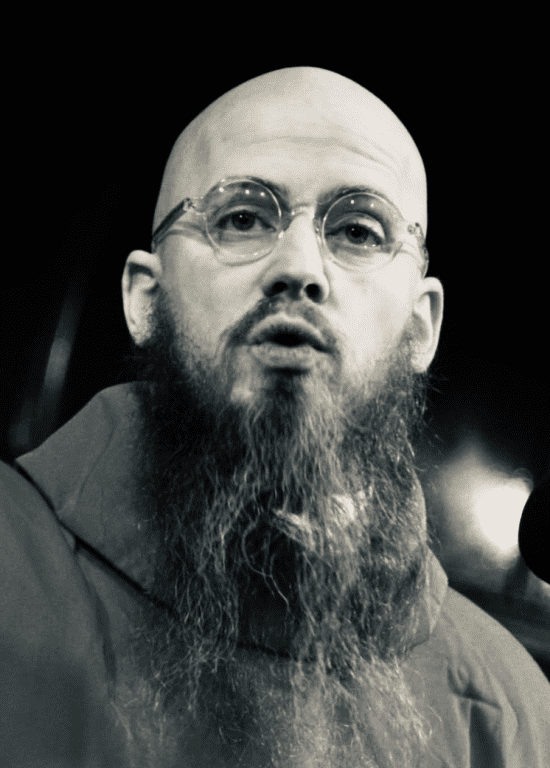
The Rev. Dr. Jeff Hood is a Catholic priest (Old Catholic), theologian, and nationally recognized activist based in North Little Rock, Arkansas. A spiritual advisor to death row inmates across the country, Dr. Hood has accompanied more people to their executions than any other advisor in the U.S., including the first-ever nitrogen hypoxia execution in 2024. His work sits at the intersection of justice, radical compassion, and public theology. Dr. Hood holds advanced degrees from Auburn, Emory, Southern Baptist Theological Seminary, University of Alabama, Creighton, and Brite Divinity School, among others. He also earned a PhD in metaphysical theology and founded The New Theology School, where he serves as Dean and Professor of Prophetic Theology. Author of over 100 books—including the award-winning The Courage to Be Queer—Dr. Hood’s writings and activism have been featured in The New York Times, Rolling Stone, NPR, CNN, and more. A frequent collaborator with men on death row, he sees theology as a shared, liberative act. Dr. Hood has served on the leadership teams of organizations like the Texas Coalition to Abolish the Death Penalty and the Fellowship of Reconciliation. His activism has earned multiple awards, including recognition from PFLAG and the Next Generation Action Network. On July 7, 2016, Dr. Hood led the Dallas protest against police brutality that ended in tragedy. His actions that night saved lives, and his story is now archived in the Dallas Public Library. A father of five, husband to Emily, and friend to the incarcerated, Dr. Hood rejects institutionalism in favor of a theology rooted in people, presence, and prophetic witness. You can read more about the author here.
Previous Post
March 1, 2026
Dissociation is the Root of War
Next Post

March 11, 2026 A Strange Witness: Cedric Ricks Said He Wanted to Die.
Recent Comments
"'God’s Sheep on the Sidewalk' is immensely thought-provoking and conscience-stirring. Thanks. "The people out there ..."
God’s Sheep: The Ones Who Sleep ..."
"Greetings, Jeff, and bless you for your relentlessly regular fierce posts and your profound commitments ..."
Between: On the Person and Character ..."
"God as the Between, thoughts:As a child we were taught, in the blue or green ..."
Between: On the Person and Character ..."
"Sometimes we make it harder than it is. Not saying things don't bring us to ..."
Get Behind Me, Satan: A Death ..."
Browse Our Archives
Select a Category Danny & Jeff fresh writings latest poetics north texas fellowship of reconciliation Sermon theology from death row Thoughts Uncategorized
Select a Month October 2026 September 2026 August 2026 July 2026 June 2026 May 2026 April 2026 March 2026 February 2026 January 2026 December 2025 November 2025 October 2025 September 2025 August 2025 June 2025 May 2025 April 2025 March 2025 January 2025 December 2024 November 2024 October 2024 August 2024 July 2024 June 2024 May 2024 April 2024 March 2024 February 2024 January 2024 December 2023 November 2023 October 2023 September 2023 July 2023 May 2023 April 2023 March 2023 February 2023 January 2023 December 2022 November 2022 October 2022 September 2022 August 2022 July 2022 June 2022 May 2022 April 2022 March 2022 February 2022 January 2022 December 2021 November 2021 October 2021 September 2021 July 2021 June 2021 May 2021 April 2021 March 2021 February 2021 January 2021 December 2020 November 2020 October 2020 September 2020 August 2020 July 2020 June 2020 May 2020 April 2020 March 2020 February 2020 January 2020 December 2019 November 2019 October 2019 September 2019 August 2019 July 2019 May 2019 March 2019 February 2019 January 2019 December 2018 November 2018 October 2018 September 2018 August 2018 July 2018 June 2018 May 2018 April 2018 March 2018 February 2018 January 2018 December 2017 November 2017 October 2017 September 2017 August 2017 July 2017 June 2017 May 2017 April 2017 March 2017 February 2017 January 2017 December 2016 October 2016 September 2016 August 2016 July 2016 June 2016 May 2016 April 2016 March 2016 February 2016 January 2016 December 2015 November 2015 October 2015 September 2015 August 2015 July 2015 June 2015 May 2015 April 2015 March 2015 February 2015 January 2015 December 2014 November 2014 October 2014 September 2014 August 2014 July 2014 June 2014 May 2014 April 2014 March 2014 February 2014 January 2014 December 2013 November 2013 October 2013 September 2013 August 2013 July 2013 June 2013 May 2013 April 2013 March 2013
Follow Us!
TAKE THE
Religious Wisdom Quiz
What specific sin does Paul say is against one's own body?
Select your answer to see how you score.
Sexual immorality Gluttony Self-harm Drunkenness
Related posts from Jeff Hood

GOD Will Wipe Away the Tears from Every...

Why Can't Anyone Say Evil? On the Execution...

God's Sheep: The Ones Who Sleep Outside the...

Keeping the Word : Living the Word :...
TRENDING AT PATHEOS Progressive Christian

The First Eucharistic Controversy: Christ’s Real Presence
For Catholics, the Eucharist is the source and summit of the Christian...

What a Stop Sign Can Teach Us About...
How to Make a Decision When You Can't Hear God Main point:...

Archdiocese Hosts Military Marriage Retreat in Germany
RASTATT, Germany — The transient military lifestyle, with its frequent deployments and...

Nearly every morning, I make the drive to Detroit with my high-school-age...

The Real AI Story Is Adoption Without Trust
Artificial intelligence has crossed a political threshold. It is no longer a...

A new article, written by Jeff Lindsay and Gale L. Pooley,...
view all Progressive Christian blogs
What Are Your Thoughts?leave a comment
Ad-Free & Subscriber Log-In Subscription Support
- About Us
- 2026 Calendar
- Videos
- Podcasts
- Library of World Religions
- Faith In Media Tracker
- Advertise With Us
- Write for Us
- Privacy Policy
- Terms of Service
- Do Not Sell My Data
- Contact Us
- Radiant Digital
- Manage Newsletter Subscriptions
- Unsubscribe From Notifications
- Sitemap
Copyright 2008-2026, Patheos. All rights reserved.
Subscription Support Ad-Free & Subscriber Log-In
Follow Patheos