
BuddhistCatholicContemplativeEvangelicalGeneral ChristianHinduJewishLatter-day SaintMuslimNew VisionsProgressive Christian
Beliefs
- Buddhist
- Catholic
- Contemplative
- Evangelical
- General Christian
- Hindu
- Jewish
- Latter-day Saint
- More Voices
- Muslim
- New Visions
- Pagan
- Progressive Christian
Topics
- Religion News
- Food and Religion
- Sports and Religion
- Religious Art
- Religious Music and Entertainment
- Religious Events
- History and Religion
- Style and Religion
- Politics and Religion
- Women in Religion
- Recreation Outdoors and Religion
- Business Finance and Religion
- Careers Workplace and Religion
- Education and Religion
- Family Parenting and Religion
- Health Fitness and Religion
- Home and Religion
- Relationships and Religion
- Technology and Religion
- Travel and Religion
Columnists
- Buddhist Columnists
- Business Finance and Religion Columnists
- Careers Workplace and Religion Columnists
- Catholic Columnists
- Contemplative Columnists
- Education and Religion Columnists
- Evangelists Columnists
- Family Parenting and Religion Columnists
- General Christian Columnists
- Health Fitness and Religion Columnists
- Hindu Columnists
- History and Religion Columnists
- Home and Religion Columnists
- Jewish Columnists
- More Voices Columnists
- Latter Day Columnists
- Muslim Columnists
- New Visions Columnists
- Nonreligious Columnists
- Pagan Columnists
- Politics and Religion Columnists
- Progressive Columnists
- Recreation Outdoors and Religion Columnists
- Relationships and Religion Columnists
- Religion News Columnists
- Religious Art Columnists
- Religious Events Columnists
- Religious Music and Entertainment Columnists
- Sports and Religion Columnists
- Style and Religion Columnists
- Technology and Religion Columnists
- Travel and Religion Columnists
- Women in Religion Columnists
Resource Library
- 2026 Calendar
- Library of World Religions
- The 100 Most Holy Places on Earth
- Patheos Answers
- Podcasts
- Videos
- Faith Leaders Database
- Anglican Episcopalian
- Bahai
- Baptist
- Buddhism
- Christianity
- Confucianism
- Eastern Orthodoxy
- Hinduism
- Holiness and Pentecostal
- ISKCON
- Islam
- Judaism
- Lutheran
- Methodist
- The Church of Jesus Christ of Latter-day Saints
- New Age
- Paganism
- Presbytarian and Reformed
- Protestantism
- Religion Behind the Scenes
- Roman Catholic
- Scientology
- Shia Islam
- Sikhism
- Sufism
- Sunni Islam
- Taoism
- Zen
- See all religions
Research Tools
 Ad-Free & Subscriber Log-In Subscription Support
Ad-Free & Subscriber Log-In Subscription Support
Follow Patheos 

- Trending:
- Forgiveness
- |
- Marriage
- |
- Consciousness
- |
- Death Penalty
- |
- Election
- |
- Halloween

- Home
- Progressive Christian
- Religion News
- The Death Penalty and the Prophetic Legacy of Jesse Jackson
The Death Penalty and the Prophetic Legacy of Jesse Jackson
Last updated on: February 18, 2026 at 1:47 am by Jeff Hood
The Death Penalty and the Prophetic Legacy of Jesse Jackson 2026-02-18T01:47:37-06:00 Jeff Hood
Patheos Explore the world's faith through different perspectives on religion and spirituality! Patheos has the views of the prevalent religions and spiritualities of the world.

Shaka Sankofa and Gary Graham / AI
Jesse Jackson and the Death Penalty
The passing of Reverend Jesse Jackson invites not only remembrance but honest moral examination. His life stretched across movements, presidencies and generations, yet one thread remained constant…his insistence that the value of human life could not be bargained away for the sake of political convenience or public fear. Among all the causes he embraced, his opposition to the death penalty stands as one of the clearest expressions of his prophetic faith, particularly in his later years. It was never a narrow legal argument for him. It was a mirror held up to the American conscience, a test of whether justice in this country was grounded in dignity or in vengeance.
Jesse Jackson: Justice as a Living Force
Jackson understood that the death penalty forces a society to reveal what it truly believes about redemption. In debates over crime, punishment and public safety, he consistently pulled attention away from the spectacle of violence and toward the structures of that shape who ultimately faces execution. The condemned were overwhelmingly poor, disproportionately Black and frequently represented by lawyers who were overworked or underprepared. To Jackson, these weren’t statistical accidents. They were moral warnings. When a system reliably produces unequal outcomes, he believed, the system itself has to be questioned…not defended out of habit.
Scripture gave Jackson a framework that moved the conversation past policy and into conscience. He returned often to the words of Amos…“Let justice roll down like waters, and righteousness like an ever-flowing stream” (Amos 5:24). Justice, for Jackson, wasn’t a verdict handed down and filed away. It was a living force that demanded continual examination of outcomes and intentions. A justice system that produces predictable inequity cannot claim righteousness simply because it follows procedure. True justice must flow toward equality, not away from it.
Legal Lynching: Naming the Pattern
That conviction found its most direct and uncompromising expression in his book Legal Lynching: Racism, Injustice, and the Death Penalty (1996, with a later edition in 2001 titled Legal Lynching: The Death Penalty and America’s Future, coauthored with his son Jessee Jackson, Jr. and journalist Bruse Shapiro). The title alone made people uncomfortable, which was undoubtedly the point. Jackson argued that the death penalty in modern America carried forward the shadow of lynching…not in identical form, but in troubling resemblance. Lynchings were once public rituals of terror dressed up as social order. Executions, he contended, had become institutional rituals dressed up as legality. The rope had been replaced by paperwork, but the question of whose lives were deemed expendable remained disturbingly familiar, rooted in race, class and systemic bias. He wasn’t saying courts and mobs are the same thing. He was saying that injustice can outlast institutional reform when moral awakening fails to accompany it.
His critique wasn’t only about the moment of execution. It was about everything that leads there…prosecutorial discretion, racial bias in jury selection, the stark difference in legal resources available to the wealthy versus the poor. Jackson kept returning to one simple but devastating point: a punishment that cannot be undone demands a level of fairness that no imperfect system can guarantee. Executing even one innocent person wasn’t an acceptable margin of error to him. It was a catastrophic moral failure. The death penalty asks for infallibility from institutions that are, demonstrably, never going to be infallible.
Jesse Jackson and the Case of Shaka Sankofa (Gary Graham): When the Abstract Became Life
Perhaps no case made Jackson’s arguments more concrete or more painful than that of Shaka Sankofa (Gary Graham), a young Black man from Texas whose execution in June 2000 Jackson fought against with everything he had. Sankofa had been convicted in 1981 of murdering a man in a Houston parking lot. He was seventeen years old at the time of the alleged crime. The case rested almost entirely on the testimony of a single eyewitness who had glimpsed someone through a car windshield at night, for a matter of seconds. Other witnesses said Sankofa was not the shooter. His trial lawyer, who later lost his law license for unrelated misconduct, called no witnesses in his defense and spent virtually no time preparing the case. Sankofa maintained his innocence until the end.
Standing Outside the Walls
Jackson had long raised concerns about inadequate counsel, racial bias and the dangers of convicting on thin evidence, but in Sankofa’s case all of those concerns converged in a single life. He traveled to Huntsville, Texas, joining thousands of protesters outside the Walls Unit prison as the execution date approached. He appealed to then-Governor George W. Bush to grant a stay. He spoke publicly about what he saw as a system preparing to kill a man it had never given a fair chance.
The execution went forward on June 22, 2000. Sankofa was pronounced dead that evening. Jackson wasn’t simply there to protest…he was there to witness (standing behind the glass, a few feet away from Sankofa), and to make sure others witnessed too. He understood that the death penalty is most dangerous when it becomes invisible, when executions are processed as administrative procedures rather than irreversible acts carried out in the name of all citizens. By standing outside that prison and refusing to look away, he forced a public reckoning with what the state had just done.
A Confirmation, Not an Exception
For Jackson, Sankofa’s case was not an isolated tragedy. It was a confirmation of everything he had argued in Legal Lynching…that the system was not broken in some accidental way, but was producing outcomes exactly consistent with the inequalities built into it. A poor Black teenager, defended by a negligent lawyer, convicted on a single uncertain identification, executed by a state that never seriously entertained his claims of innocence. The particulars were different from a Jim Crow era lynching. The pattern, Jackson insisted, was not.
Mercy as Moral Courage
Central to Jackson’s opposition was his belief in the possibility of redemption…the conviction that execution closes the door on transformation, for the condemned and for the rest of us. This echoed something he returned to often: “Blessed are the merciful, for they shall obtain mercy” (Matthew 5:7). Mercy, in his moral vision, wasn’t softness toward crime. It was strength against despair…the courage to insist that even those who have done terrible things remain human beings capable of reflection, remorse and change. The death penalty assumes finality where faith assumes possibility…and for Jackson…that was the heart of the problem.
He also asked a harder question, one that people tend to avoid: what does capital punishment do to us? What kind of people does a nation become when execution is its answer? He worried that it risks normalizing the very violence it claims to condemn…that when the state kills routinely and quietly enough, something in the collective conscience goes numb. By invoking the memory of lynching, he insisted America confront the racial dimensions of its punitive systems. By grounding his arguments in scripture, he pushed the debate past questions of legality toward questions of responsibility. By emphasizing redemption, he challenged a culture inclined toward final judgment to reckon seriously with what mercy costs…and what abandoning it costs more.
Jesse Jackson: A Legacy Still Demanding Change
To remember Jesse Jackson without acknowledging his stance on the death penalty…particularly its forceful expression in his later writings and in moments like his witness in Huntsville…would be to miss one of his most courageous commitments. He stood against the machinery of execution not because it was politically safe, but because he believed it was spiritually and ethically incompatible with a society trying to move toward justice. His voice called the nation to examine whether its punishments reflected its highest ideals or its deepest fears.
He never got a clean answer. Neither have we. Yet Rev. Jackson’s challenging voice still echoes loudly…the measure of a society is found not only in whom it protects, but in how it chooses to punish. Such challenging words now belong to the living.
*
*
*
*
*If you would like to support the Execution Intervention Project (the organization that financially supports Dr. Hood’s work), click here.
Catholic
Politics and Religion
About The Rev. Dr. Jeff Hood
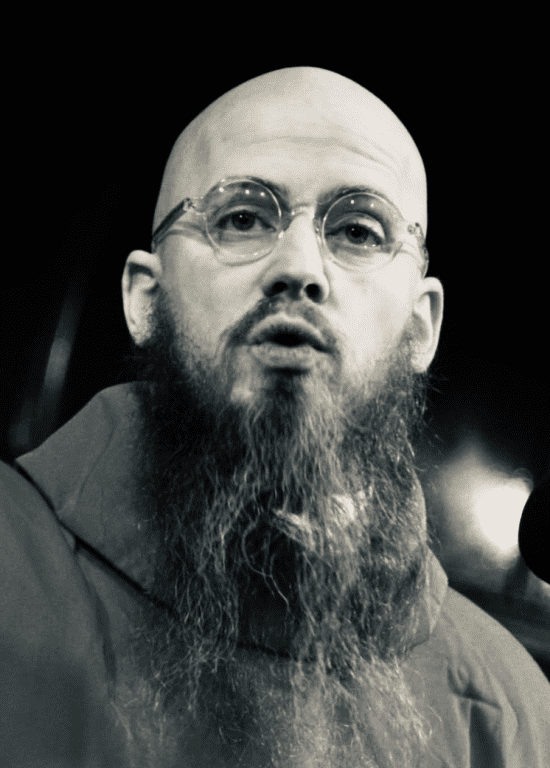
The Rev. Dr. Jeff Hood is a Catholic priest (Old Catholic), theologian, and nationally recognized activist based in North Little Rock, Arkansas. A spiritual advisor to death row inmates across the country, Dr. Hood has accompanied more people to their executions than any other advisor in the U.S., including the first-ever nitrogen hypoxia execution in 2024. His work sits at the intersection of justice, radical compassion, and public theology. Dr. Hood holds advanced degrees from Auburn, Emory, Southern Baptist Theological Seminary, University of Alabama, Creighton, and Brite Divinity School, among others. He also earned a PhD in metaphysical theology and founded The New Theology School, where he serves as Dean and Professor of Prophetic Theology. Author of over 100 books—including the award-winning The Courage to Be Queer—Dr. Hood’s writings and activism have been featured in The New York Times, Rolling Stone, NPR, CNN, and more. A frequent collaborator with men on death row, he sees theology as a shared, liberative act. Dr. Hood has served on the leadership teams of organizations like the Texas Coalition to Abolish the Death Penalty and the Fellowship of Reconciliation. His activism has earned multiple awards, including recognition from PFLAG and the Next Generation Action Network. On July 7, 2016, Dr. Hood led the Dallas protest against police brutality that ended in tragedy. His actions that night saved lives, and his story is now archived in the Dallas Public Library. A father of five, husband to Emily, and friend to the incarcerated, Dr. Hood rejects institutionalism in favor of a theology rooted in people, presence, and prophetic witness. You can read more about the author here.
Previous Post

February 14, 2026
Deadly Hearts : On Matthew 5:21-22
Next Post

February 18, 2026 Ash Wednesday: The Call of the Dust
Recent Comments
"'God’s Sheep on the Sidewalk' is immensely thought-provoking and conscience-stirring. Thanks. "The people out there ..."
God’s Sheep: The Ones Who Sleep ..."
"Greetings, Jeff, and bless you for your relentlessly regular fierce posts and your profound commitments ..."
Between: On the Person and Character ..."
"God as the Between, thoughts:As a child we were taught, in the blue or green ..."
Between: On the Person and Character ..."
"Sometimes we make it harder than it is. Not saying things don't bring us to ..."
Get Behind Me, Satan: A Death ..."
Browse Our Archives
Select a Category Danny & Jeff fresh writings latest poetics north texas fellowship of reconciliation Sermon theology from death row Thoughts Uncategorized
Select a Month October 2026 September 2026 August 2026 July 2026 June 2026 May 2026 April 2026 March 2026 February 2026 January 2026 December 2025 November 2025 October 2025 September 2025 August 2025 June 2025 May 2025 April 2025 March 2025 January 2025 December 2024 November 2024 October 2024 August 2024 July 2024 June 2024 May 2024 April 2024 March 2024 February 2024 January 2024 December 2023 November 2023 October 2023 September 2023 July 2023 May 2023 April 2023 March 2023 February 2023 January 2023 December 2022 November 2022 October 2022 September 2022 August 2022 July 2022 June 2022 May 2022 April 2022 March 2022 February 2022 January 2022 December 2021 November 2021 October 2021 September 2021 July 2021 June 2021 May 2021 April 2021 March 2021 February 2021 January 2021 December 2020 November 2020 October 2020 September 2020 August 2020 July 2020 June 2020 May 2020 April 2020 March 2020 February 2020 January 2020 December 2019 November 2019 October 2019 September 2019 August 2019 July 2019 May 2019 March 2019 February 2019 January 2019 December 2018 November 2018 October 2018 September 2018 August 2018 July 2018 June 2018 May 2018 April 2018 March 2018 February 2018 January 2018 December 2017 November 2017 October 2017 September 2017 August 2017 July 2017 June 2017 May 2017 April 2017 March 2017 February 2017 January 2017 December 2016 October 2016 September 2016 August 2016 July 2016 June 2016 May 2016 April 2016 March 2016 February 2016 January 2016 December 2015 November 2015 October 2015 September 2015 August 2015 July 2015 June 2015 May 2015 April 2015 March 2015 February 2015 January 2015 December 2014 November 2014 October 2014 September 2014 August 2014 July 2014 June 2014 May 2014 April 2014 March 2014 February 2014 January 2014 December 2013 November 2013 October 2013 September 2013 August 2013 July 2013 June 2013 May 2013 April 2013 March 2013
Follow Us!
TAKE THE
Religious Wisdom Quiz
What was the primary material for writing in biblical times?
Select your answer to see how you score.
Clay tablets Papyrus Stone Parchment
Related posts from Jeff Hood

GOD Will Wipe Away the Tears from Every...

Why Can't Anyone Say Evil? On the Execution...

God's Sheep: The Ones Who Sleep Outside the...

Keeping the Word : Living the Word :...
TRENDING AT PATHEOS Progressive Christian

The Sermon on the Mount, Part I: Matthew...
The Sermon on the Mount, Part I (Matthew 4:12-5:12) St. Matthew moves...

What's up from Crossway: Reviewing some of their latest A few weeks...

Janie Learns the Way of the Cross: A...
Teaching children about Jesus' Passion can be challenging. Many parents and educators...

Looking For Good Catholic Writing - October 2026
He alone extends the heavens, and he walks upon the waves of...

In "Irreplaceable," our book on vocation and technology, Trevor Sutton and I...

I was strolling through the top floor of the brand new Parthenon...
view all Progressive Christian blogs
What Are Your Thoughts?leave a comment
Ad-Free & Subscriber Log-In Subscription Support
- About Us
- 2026 Calendar
- Videos
- Podcasts
- Library of World Religions
- Faith In Media Tracker
- Advertise With Us
- Write for Us
- Privacy Policy
- Terms of Service
- Do Not Sell My Data
- Contact Us
- Radiant Digital
- Manage Newsletter Subscriptions
- Unsubscribe From Notifications
- Sitemap
Copyright 2008-2026, Patheos. All rights reserved.
Subscription Support Ad-Free & Subscriber Log-In
Follow Patheos