
BuddhistCatholicContemplativeEvangelicalGeneral ChristianHinduJewishLatter-day SaintMuslimNew VisionsProgressive Christian
Beliefs
- Buddhist
- Catholic
- Contemplative
- Evangelical
- General Christian
- Hindu
- Jewish
- Latter-day Saint
- More Voices
- Muslim
- New Visions
- Pagan
- Progressive Christian
Topics
- Religion News
- Food and Religion
- Sports and Religion
- Religious Art
- Religious Music and Entertainment
- Religious Events
- History and Religion
- Style and Religion
- Politics and Religion
- Women in Religion
- Recreation Outdoors and Religion
- Business Finance and Religion
- Careers Workplace and Religion
- Education and Religion
- Family Parenting and Religion
- Health Fitness and Religion
- Home and Religion
- Relationships and Religion
- Technology and Religion
- Travel and Religion
Columnists
- Buddhist Columnists
- Business Finance and Religion Columnists
- Careers Workplace and Religion Columnists
- Catholic Columnists
- Contemplative Columnists
- Education and Religion Columnists
- Evangelists Columnists
- Family Parenting and Religion Columnists
- General Christian Columnists
- Health Fitness and Religion Columnists
- Hindu Columnists
- History and Religion Columnists
- Home and Religion Columnists
- Jewish Columnists
- More Voices Columnists
- Latter Day Columnists
- Muslim Columnists
- New Visions Columnists
- Nonreligious Columnists
- Pagan Columnists
- Politics and Religion Columnists
- Progressive Columnists
- Recreation Outdoors and Religion Columnists
- Relationships and Religion Columnists
- Religion News Columnists
- Religious Art Columnists
- Religious Events Columnists
- Religious Music and Entertainment Columnists
- Sports and Religion Columnists
- Style and Religion Columnists
- Technology and Religion Columnists
- Travel and Religion Columnists
- Women in Religion Columnists
Resource Library
- 2026 Calendar
- Library of World Religions
- The 100 Most Holy Places on Earth
- Patheos Answers
- Podcasts
- Videos
- Faith Leaders Database
- Anglican Episcopalian
- Bahai
- Baptist
- Buddhism
- Christianity
- Confucianism
- Eastern Orthodoxy
- Hinduism
- Holiness and Pentecostal
- ISKCON
- Islam
- Judaism
- Lutheran
- Methodist
- The Church of Jesus Christ of Latter-day Saints
- New Age
- Paganism
- Presbytarian and Reformed
- Protestantism
- Religion Behind the Scenes
- Roman Catholic
- Scientology
- Shia Islam
- Sikhism
- Sufism
- Sunni Islam
- Taoism
- Zen
- See all religions
Research Tools
 Ad-Free & Subscriber Log-In Subscription Support
Follow Patheos 

- Trending:
- Advent
- |
- Forgiveness
- |
- Thanksgiving
- |
- Election
- |
- Seasonal Holidays
- |
- Marriage

- Home
- Progressive Christian
- Religion News
- The Body of Death: Bioethics & Nitrogen Hypoxia Execution
The Body of Death: Bioethics & Nitrogen Hypoxia Execution
Last updated on: August 31, 2025 at 1:38 am by Jeff Hood
The Body of Death: Bioethics & Nitrogen Hypoxia Execution 2025-08-31T01:38:21-06:00 Jeff Hood
Patheos Explore the world's faith through different perspectives on religion and spirituality! Patheos has the views of the prevalent religions and spiritualities of the world.
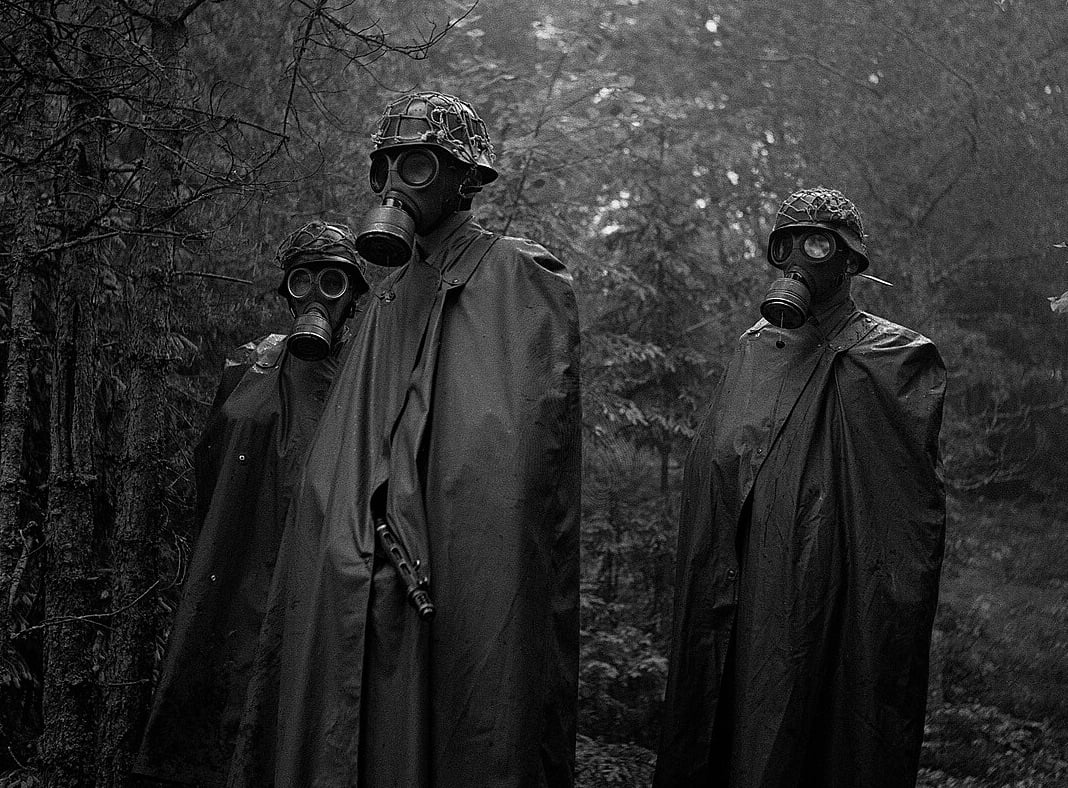
Finnish Defence Forces soldiers in nuclear, biological, and chemical gear. / 1961 // Wikimedia Commons
Listening to the Bodies: Witness Accounts of Nitrogen Hypoxia Execution
Kenneth Eugene Smith
On a January evening in 2024, Kenneth Eugene Smith walked into a room remade for something no one had ever seen before. The chamber at William C. Holman Correctional Facility in Atmore, Alabama was stark…pale walls and fluorescent lights everywhere. Strapped to a gurney, mask over his face, Smith became the first person to be executed by nitrogen hypoxia.
Within moments of the gas flowing, Smith’s body shuddered. His hands fisted tight, legs twitching and shoulders jerking over and over. There were heaves and long irregular breaths as the lack of oxygen ripped at his lungs. Minutes passed. The silence that followed was almost tangible.
Alan Eugene Miller
Eight months later, Alan Eugene Miller laid on the same gurney. His body responded violently to the flow of nitrogen. Limbs twitched and flexed. His chest rose and fell in uneven rhythms. Breaths came in gasps, punctuated by convulsive jerks. Each movement carried the explosive tension between life and death.
Carey Dale Grayson
By November 2024, Carey Dale Grayson became the third man to meet this fate. The cycle repeated…the mask, the gas and the body writhing for air. Muscle spasms surged along his arms and legs. Shoulders stiffened and relaxed over and over. The chest heaved in extended efforts to draw oxygen. The final pronouncement punctuated a scene of horrific struggle.
Jessie Hoffman
Next, Louisiana introduced the first test outside of Alabama. Jessie Hoffman entered the chamber at Angola State Penitentiary in March 2025. The same sequence repeated. Torso flexed. Limbs jerked. Fists unclenched. Chest rising in waves. Movement persisted longer than officials had anticipated…the body conveyed the struggle…a silent, repetitive testimony of suffocation.
Demetrius Terrence Frazier
Back in Alabama, Demetrius Terrence Frazier’s execution took place in February 2025. The event followed the familiar yet harrowing pattern that had become almost routine. Witnesses reported spasms of the limbs, gasping breaths and subtle tremors that suggested the nervous system was determined to do all that it could to hold on. His arms and legs twitched in abrupt unpredictable movements.
Gregory Hunt
Several months later, in June 2025, Gregory Hunt was executed by nitrogen hypoxia in Alabama. Long intervals of jerking movements alternated with moments of stillness…rendering the progression toward death both unpredictable and grotesquely deliberate. His chest would heave suddenly…then remain motionless…while his limbs twitched in irregular sequences.
Across these six executions, a distinct pattern emerged. Nitrogen hypoxia execution…intended to be a quiet, efficient method…consistently produced visibly violent bodily reactions. Chests heaved up and down for breath. Limbs jerked unpredictably. Torsos heaved with uneven breaths. Subtle tremors underscored the disjunction between voluntary movement and reflex. Officials framed these responses as involuntary and physiologically expected…yet the bodies told a different story.
Patterns and Observations of Nitrogen Hypoxian Execution
The recurring phenomena raise difficult questions. Gasping and jerking were observed in every case. Prolonged twitching and spasms appeared across individuals with no consistent correlation to age or health status. Observers described the same sequence each time…sudden movements, intermittent convulsions, long periods of uneven chest expansion, then ultimate cessation.
The bodies themselves became a narrative. In their final moments, they performed a silent and repeated testimony of the physiological process, leaving visible evidence of the tension between the state’s promise of humane death and the observable physical struggle. Each execution reinforced the same message…nitrogen hypoxia execution was not an invisible, painless slide into oblivion…but a highly observable…violent physiological event.
Bioethical Implications of Nitrogen Hypoxia Execution
The nitrogen hypoxia execution present a bioethical landscape both stark and profoundly unsettling. Across six cases…Smith, Miller, Grayson, Hoffman, Frazier, Hunt…observers consistently documented gasping breaths, convulsive jerks, heaving torsos, repeated limb spasms and persistent movements of fingers, toes, and facial muscles. These involuntary actions, emergent from the body’s physiological struggle, transform the human form into both a site and a witness of ethical inquiry. Watching a body fight for air forces us to face the limits of state power, the role of those who carry it out and the ethics of testing unproven methods on living beings. Beyond technical considerations…these episodes reveal the inherent moral tension between legal mandates and the sanctity of human embodiment.
Autonomy and Consent
Autonomy is central to any bioethical framework. In the context of capital punishment, autonomy is legally circumscribed…the condemned individual is subjected to imposed death, a reality that profoundly constrains the scope of meaningful consent. Nitrogen hypoxia…as a newly implemented execution method…complicates this ethical terrain. Although legally permitted, the procedure functions in practice as an experimental intervention, applied to bodies for which empirical human data remains extremely limited. The visible involuntary movements…twitching limbs, irregular chest expansion, convulsions, and even facial contortions…provide material evidence of physiological processes that the individual cannot control. Even if prisoners nominally…choose…nitrogen hypoxia over other methods, the uncertainty surrounding the lived experience raises questions about whether their consent can ever be fully informed or ethically significant. In effect, the body itself becomes a site of documented experimentation.
Autonomy extends not only to the condemned but also to the professionals involved. Corrections officers, medical consultants, engineers designing hypoxia chambers and procedural overseers confront profound ethical dilemmas. They operate within a tension between mandated duties and personal moral convictions. The repeated convulsions, gasping breaths, and jerking movements observed in all six executions make evident that these professionals participate in a process whose outcomes are unpredictable and whose moral weight is unmistakable. Each movement of the body, each struggle to breathe, underscores the moral complicity of those present, raising questions about the limits of professional obedience and the responsibilities of conscience.
Nonmaleficence and Avoidance of Harm
“Do no harm” is foundational in bioethics. Nitrogen hypoxia was promoted as a supposedly humane alternative to lethal injection…yet the evidence from multiple executions challenges this claim. Convulsions, jerking, heaving and repetitive limb spasms indicate that the body undergoes measurable physiological stress. Nonmaleficence demands that such harm be acknowledged, measured and critically assessed…ignoring or minimizing these observable struggles constitutes an ethical lapse. The persistent pattern of bodily movement across cases suggests that the state is administering harm even under the guise of clinical efficiency…undermining claims of humane practice.
The experimental nature of nitrogen hypoxia further complicates the ethical assessment. Each execution produces new information about human physiology under nitrogen deprivation, yet these observations occur without the safeguards typical of ethical scientific research…no prior consent for experimentation in the fullest sense, no independent oversight, no formal risk mitigation. The body is simultaneously the subject and the instrument of inquiry, revealing the tension between empirical experimentation and moral accountability. Each spasm and jerking motion, while medically informative, exists as evidence of human suffering, creating a dual ethical challenge…the pursuit of procedural reliability versus the moral imperative to prevent harm.
Human Dignity and Embodiment
Human dignity is the cornerstone of bioethics…and it is visibly compromised during these nitrogen hypoxia executions. The spasms, gasping breaths, jerks and heaving torsos highlight the vulnerability of the human body and underscore the ethical importance of considering the question of dignity. Each movement communicates a struggle between life and the imposed legal end, transforming the body into an ethical text that cannot be ignored. From the perspective of dignity, these involuntary motions are not merely physiological events but moral signifiers…they articulate suffering and the human cost of the experimental method. Observing these movements without reflection risks normalizing harm and diminishing society’s ethical sensitivity.
Dignity is further compromised by the mechanization of the execution process. The emphasis on technical precision…timed flows of nitrogen, monitored oxygen deprivation, procedural checklists…contrasts sharply with the unpredictable reality of the human body’s response. This contrast exposes a central ethical tension…the drive for procedural efficiency versus the obligation to respect the dignity of the living body. The repeated involuntary motions serve as a visceral reminder that human dignity cannot be quantified, controlled or subordinated entirely to mechanistic design…these nitrogen executions are unpredictable.
Experimental Ethics and Human Subjects
Repeated use of nitrogen hypoxia execution underscores profound experimental ethical concerns. Condemned individuals…while legally sentenced…are de facto human subjects in an untested and minimally studied method. Research ethics frameworks require minimizing harm, securing informed consent and ensuring that benefits justify risk. Here, repeated gasping, jerking, and convulsing indicate that physiological outcomes were uncertain and that human bodies were subjected to repeated stress without comprehensive oversight. The state’s insistence on predictability and procedural control sharply contrasts with the bodies’ visible responses, highlighting the limits of knowledge when life and death intersect with experimental application.
Each execution also raises questions of reproducibility and moral reliability. While procedural efficiency can be statistically assessed, the lived human experience…the tactile, visual, and ethical dimensions of involuntary movement…cannot be ethically replicated without incurring real moral costs. Each convulsion and gasping breath is a singular moral event, impossible to reduce to a purely empirical datum. The body functions as both evidence and witness, revealing the obvious ethical boundaries of human experimentation.
Witnessing, Professional Responsibility and Societal Complicity
Ethical responsibility extends to those who bear witness. Family members, spiritual advisors, journalists, correctional staff and the wider public confront the repeated spectacle of convulsions, gasps and jerks. Observing bodies subjected to extreme physiological stress imposes moral and psychological weight, even when states frame these events as routine. Witnesses become participants in the moral landscape, their attention and emotional responses shaping the societal perception of legitimacy and ethical acceptability.
Society itself is implicated. Public sanctioning of execution methods…particularly experimental approaches with visible human struggle…reflects collective ethical responsibility. These visible struggles, repeatedly documented, confront social norms and demand ethical vigilance. Failure to critically assess these methods risks normalizing human experimentation under the guise of legal process.
Proportionality and Moral Justification
Bioethics insists upon proportionality…harm must be commensurate with intended outcomes. While nitrogen hypoxia execution achieves its legal goal…death…the physical manifestations of struggle demand moral consideration. Twisting, jerking, spasms and heaving convey ongoing distress, highlighting the moral cost of pursuing technical or procedural efficiency. Each execution, particularly when repeated in similar patterns, amplifies the ethical stakes. Proportionality cannot be assessed solely through legal or mechanical criteria…the moral calculus must account for the visible suffering of the body and the broader implications of institutionalizing a method that repeatedly produces horrific struggle.
Philosophy and Morality
The persistent, visible bodily movements…limbs jerking, torsos heaving, chests flexing…function as evidence of ethical tension. The state’s experimental approach, the involuntary suffering of the condemned and the moral burden on witnesses coalesce into a profound ethical conundrum. The questions that arise cannot be answered merely by invoking the law…they demand deep moral engagement.
Bioethical Critique of Nitrogen Hypoxia Execution
Nitrogen hypoxia execution presents complex, layered bioethical challenges. Autonomy is severely compromised, nonmaleficence is strained, dignity is visibly threatened, experimental ethics are repeatedly tested, witnesses bear psychological and moral weight and proportionality is morally ambiguous. The repeated gasping, jerking, twitching and heaving chest of each executed individual is not merely a physiological occurrence…it constitutes moral evidence. The ethical demand is clear…careful scrutiny of the method, profound consideration of the administrators’ responsibilities and societal reflection on the consequences of normalizing repeated human struggle are imperative. These executions serve as a stark reminder that bioethics cannot remain abstract when confronted with the real and visible suffering of living and breathing human bodies subjected to state-sanctioned executions…the death penalty.
Reflections on Human Responsibility and Nitrogen Hypoxia Execution
Across six executions, the human body emerges as both subject and witness, a silent yet eloquent testament to the weight of state-sanctioned death. Limbs jerk unpredictably. Torsos heave in rhythms that defy mechanical control. Chests flex as if attempting to reclaim the breath that is being systematically withdrawn. Gasps, uneven and desperate, punctuate the passage from life to death, a soundscape that resists the clinical order intended by execution protocols. Nitrogen hypoxia execution, heralded in some circles as a method designed for technical efficiency and humane detachment, repeatedly produces outcomes that are profoundly disturbing.
The body refuses to be a passive instrument. In each instance, it asserts its presence, its struggle and its suffering, challenging any notion that death can be rendered entirely abstract or sanitized through procedure. The physical manifestations of these executions occupy a space of ethical tension. On the one hand, the method is praised for its supposed minimalism…the administration of nitrogen supposedly induces unconsciousness before death, theoretically circumventing pain. Yet the repeated observations tell a different story. The jerking of limbs, the uneven convulsions and the intermittent gasps resist the narrative of clinical efficiency.
They reveal that even under the strictest protocols, the human nervous system continues to register, to react and to demand acknowledgment. The body becomes a medium through which the moral weight of the execution is communicated…and it speaks in a language that no legal document or procedural checklist can fully contain. To witness these manifestations is to confront the profound dissonance between the technical aspiration of a humane death and the ethical reality of a body in distress.
Witness accounts reinforce this dissonance. Observers consistently note the subtle yet undeniable signals of consciousness and struggle…the clenching of fists, the arching of the back, the fleeting opening of eyes. These are not mere procedural anomalies…they are the body’s insistence on presence, on recognition and on the persistence of its own agency even as it is systematically extinguished. Ethical responsibility cannot be delegated entirely to protocol.
It remains with every individual present, every witness, who must reconcile the observed reality of the human form with the abstracted legal and institutional frameworks that sanction death. The body is both evidence and ethical testament…demanding reflection and response.
This reflection extends beyond individual executions to the systemic implications of employing such a method. Nitrogen hypoxia…framed as a clinical tool…is intended to create a controlled environment in which death proceeds predictably and without visible suffering. Yet, the repeated physical struggle suggests that predictability does not equate to ethical neutrality. The visible choreography of death…limbs jerking, torsos straining, gasps breaking through silence…disrupts any comfortable narrative of humane procedure.
Ethical accountability is measured in the confrontation with what is real, what is witnessed and what refuses to be reduced to abstraction. The body’s resistance is particularly poignant because it reveals the limits of state power when faced with the lived reality of human life. Law and procedure can dictate the mechanics of execution…but they cannot dictate the moral or ethical experience of those subjected to them.
Nitrogen hypoxia execution is less a neutral instrument than a stage on which the tension between authority and human presence is enacted. Each physical manifestation…the jerk, the gasp, the flex of a chest…becomes a reminder that nitrogen executions are not merely technical procedures but moral events…that carry tremendous weight because they involve sentient bodies. The repeated witnessing of these events amplifies their ethical resonance…compelling those present to reckon with what it means to participate in…or even to observe…an act of deliberate human termination.
Moreover, the ethical significance of these bodily responses extends to the societal and cultural perception of capital punishment. Public and professional discourse often seeks to abstract executions into numbers, procedures and outcomes. Nitrogen hypoxia execution is discussed in terms of hours, oxygen concentrations and loss of consciousness. Yet, the full reality contradicts this abstraction. The visible struggle is an unignorable testament that legal permissibility and procedural sophistication cannot eliminate the fundamental human dimensions of suffering, agony and agency.
In this way, the body serves as both a witness to and a critique of institutional practice, revealing the moral costs that are often sanitized in official narratives. The repetition of these events across multiple cases underscores the universality of the ethical tension. It is not a singular anomaly but a patterned phenomenon…suggesting that the moral implications are inherent to the method itself.
Each nitrogen hypoxyia execution repeats the same choreography of struggle, producing a cumulative effect on witnesses, officials and the broader public conscience. The repetition compels reflection not only on the immediate ethical responsibilities of those administering or observing the procedure but also on the structural and systemic dimensions of state-sanctioned death. The bodies of the executed communicate a persistent and inescapable ethical question: can a procedure that produces visible struggle…even if brief and intermittent…ever be reconciled with the aspiration to humane treatment?
This question gains particular force when one considers the intimate connection between life, consciousness and bodily expression. The nervous system, the muscular reflexes, the respiratory effort…these are all active participants in the process of dying. They assert presence at moments when legal authority seeks to enforce absence. To witness these processes is to confront the fragility of procedural control and the irreducibility of human experience. Ethical reflection must attend to this reality, recognizing that even meticulously designed protocols cannot fully mitigate the lived experience of the individual.
The body…particularly in its final gestures…refuses to be subsumed entirely by institutional intent. It asserts a claim on moral attention…compelling acknowledgment of its inherent value and the responsibilities owed to it…even in death. Furthermore, these bodily manifestations illuminate the relational dimension of ethics in the context of execution. Ethical responsibility is not solely the domain of those administering nitrogen hypoxia…it extends to all who witness and interpret these events. The act of seeing becomes morally charged.
Observers are placed in a position where they must confront the full humanity of the person before them and reckon with their own complicity in a procedure that…however legally sanctioned…entails profound ethical consequences. The execution chamber thus becomes a space of shared ethical labor, where the body speaks and the witnesses listen, where silence and observation carry their own weight of moral accountability.
Reflections on Nitrogen Hypoxia Execution and the Ethics of Death
In considering nitrogen hypoxia execution as a moral event, it is crucial to recognize the interplay between technical intent and ethical reception. The method is designed to create a controlled, efficient passage from life to death. Yet, its repeated failure to produce entirely peaceful outcomes reveals the ethical limits of technical design. No matter how carefully calibrated and no matter how rigorously standardized, the method cannot erase the physical realities of dying. The body’s responses…jerking, gasping, flexing…serve as persistent reminders that ethical responsibility cannot be delegated to instruments or procedures.
It resides in the conscious engagement of those who enact, observe and interpret the act. The body is the ultimate witness…and ethical accountability is inseparable from the acknowledgment of that witness. The tension between procedural legality and moral responsibility is perhaps most acutely expressed in the contrast between the clinical aspirations of nitrogen hypoxia and the visible struggle it produces. The state may achieve its procedural goals, executing sentences in accordance with established law, yet the ethical dimensions remain unresolved.
The choreography of struggle…the body’s insistence on recognition…cannot be legislated away. It demands reflection, dialogue and moral reckoning. Nitrogen hypoxia execution is a site of ethical encounter, a space where the abstract principles of law and the tangible realities of human experience collide. The body, in its final movements, becomes the ultimate interlocutor, challenging assumptions of neutrality, efficiency and humane detachment.
The repeated observations of bodily struggle across multiple executions highlight a central ethical truth…that the human body cannot be divorced from moral consideration, even in the context of legally sanctioned death. Limbs that jerk, torsos that heave, chests that flex and gasps that punctuate the passage from life to death are not mere physiological phenomena…they are ethical signals. They remind all present that death is never merely an administrative task, a technical procedure or a matter of legal compliance. The body, in its silent testimony, insists that dignity, recognition and ethical engagement are inseparable from the act of execution…even when the procedure itself is meticulously controlled.
In this light, nitrogen hypoxia execution transcends its status as a mere method. It becomes a lens through which we confront the tension between law, procedure and moral responsibility. Each execution is a moral event, a convergence of human presence and ethical obligation. The repeated physical manifestations…the jerks, the gasps, the fleeting reflexive gestures…serve as enduring reminders that procedural efficiency cannot replace dignity and legality cannot substitute for ethics.
The body remains, at every step, both subject and witness, a silent yet compelling interlocutor in the ongoing moral dialogue that surrounds the act of execution. Across these six executions, the cumulative effect is undeniable. The repetition of struggle reinforces the ethical lesson that human life, even in its termination, carries inherent weight that cannot be mitigated by technical design or legal sanction. The observable resistance of the body insists upon moral attention, challenging witnesses and society at large to confront the profound consequences of capital punishment. Nitrogen hypoxia execution is less a neutral tool than a stage for ethical confrontation, where the choreography of death and the witness of the living intersect.
In their final movements, the six men executed by nitrogen suffocation left an unavoidable truth…ethical responsibility isn’t abstract…it is lived, it is witnessed and it weighs on us all.
Works Cited
- Associated Press. “Alabama Executes Kenneth Smith with Nitrogen Gas.” AP News, Jan. 26, 2024.
- Guardian. “Kenneth Smith’s Execution by Nitrogen Hypoxia Witnessed.” The Guardian, Jan. 25, 2024.
- BBC. “Alabama Uses Nitrogen Gas for First Execution.” BBC News, Jan. 26, 2024.
- Alabama Reflector. “After Lethal Injection Failures, Alabama Turns to Nitrogen Gas.” Sept. 27, 2024.
- Guardian. “Witnesses Describe Grayson’s Execution.” The Guardian, Nov. 21, 2024.
- Louisiana Illuminator. “Louisiana Carries Out Execution of Jessie Hoffman with Nitrogen Gas.” Mar. 18, 2025.
- WWNO. “Louisiana Executes Hoffman by Nitrogen Hypoxia.” Mar. 19, 2025.
- Associated Press. “Alabama Executes Demetrius Frazier with Nitrogen Gas.” Feb. 2025.
- WBHM. “Witness Timeline of Gregory Hunt Execution.” June 10, 2025.
- Associated Press. “Gregory Hunt Executed with Nitrogen Hypoxia.” June 11, 2025.
*If you would like to support the Execution Intervention Project (the organization that financially supports Dr. Hood’s work), click here.
Catholic
Politics and Religion
bioethics and capital punishment
ethical critique of executions
nitrogen hypoxia death penalty

About The Rev. Dr. Jeff Hood
The Rev. Dr. Jeff Hood is a theologian, writer, and activist who has spent years ministering to people on death row. As a spiritual advisor and witness to executions, he speaks out against state violence and calls for a society rooted in justice, mercy and the sacredness of life. You can read more about the author here.
Previous Post
August 29, 2025
The Death Penalty and the Limits of Human Righteousness
Next Post

September 1, 2025 The God Who Will Not Stay Dead: On Resurrection
Recent Comments
"As a white 73-year-old male Texan from multiple generations back (to the original Old 300), ..."
Governor-Elect Gina Hinojosa, Stop Executions in ..."
"All Saints Day is A Happy Feast Day. As per the Beatitudes, "the Kingdom belongs ..."
Liberating All Saints on All Saints ..."
"'God’s Sheep on the Sidewalk' is immensely thought-provoking and conscience-stirring. Thanks. "The people out there ..."
God’s Sheep: The Ones Who Sleep ..."
"Greetings, Jeff, and bless you for your relentlessly regular fierce posts and your profound commitments ..."
Between: On the Person and Character ..."
Browse Our Archives
Select a Category Danny & Jeff fresh writings latest poetics north texas fellowship of reconciliation Sermon theology from death row Thoughts Uncategorized
Select a Month November 2026 October 2026 September 2026 August 2026 July 2026 June 2026 May 2026 April 2026 March 2026 February 2026 January 2026 December 2025 November 2025 October 2025 September 2025 August 2025 June 2025 May 2025 April 2025 March 2025 January 2025 December 2024 November 2024 October 2024 August 2024 July 2024 June 2024 May 2024 April 2024 March 2024 February 2024 January 2024 December 2023 November 2023 October 2023 September 2023 July 2023 May 2023 April 2023 March 2023 February 2023 January 2023 December 2022 November 2022 October 2022 September 2022 August 2022 July 2022 June 2022 May 2022 April 2022 March 2022 February 2022 January 2022 December 2021 November 2021 October 2021 September 2021 July 2021 June 2021 May 2021 April 2021 March 2021 February 2021 January 2021 December 2020 November 2020 October 2020 September 2020 August 2020 July 2020 June 2020 May 2020 April 2020 March 2020 February 2020 January 2020 December 2019 November 2019 October 2019 September 2019 August 2019 July 2019 May 2019 March 2019 February 2019 January 2019 December 2018 November 2018 October 2018 September 2018 August 2018 July 2018 June 2018 May 2018 April 2018 March 2018 February 2018 January 2018 December 2017 November 2017 October 2017 September 2017 August 2017 July 2017 June 2017 May 2017 April 2017 March 2017 February 2017 January 2017 December 2016 October 2016 September 2016 August 2016 July 2016 June 2016 May 2016 April 2016 March 2016 February 2016 January 2016 December 2015 November 2015 October 2015 September 2015 August 2015 July 2015 June 2015 May 2015 April 2015 March 2015 February 2015 January 2015 December 2014 November 2014 October 2014 September 2014 August 2014 July 2014 June 2014 May 2014 April 2014 March 2014 February 2014 January 2014 December 2013 November 2013 October 2013 September 2013 August 2013 July 2013 June 2013 May 2013 April 2013 March 2013
Follow Us!
TAKE THE
Religious Wisdom Quiz
What was rebuilt in Jerusalem under Zerubbabel and Joshua the high priest?
Select your answer to see how you score.
The city gates The wall The palace The altar and Temple
Related posts from Jeff Hood

Watch and Pray: On Mark 13:33-37
I Was in Prison ... On Matthew 25:35-36

Complete Account of the Botched Execution of Reinaldo...

Grace Remains : On John 15:4a,5b
TRENDING AT PATHEOS Progressive Christian

As was predicted many years ago, the Interpreter Foundation's website is...

"Why Do Churches Talk So Much About Money?"
If you were inclined to do so, you could probably find any...

Watch and Pray: On Mark 13:33-37
Jesus said to his disciples: “Be watchful! Be alert! You do not...

Debate on Purgatory & Biblical Evidences for It
This is from a combox on my video channel, Catholic Bible Highlights....

Set the table for the coming King
On Thursday we visited my sister-in-law for Thanksgiving, and throughout the entire...

If I Stop Becoming, Will I Disappear?
(At our most recent half day Zen retreat, Dr Chris Hoff, a...
view all Progressive Christian blogs
What Are Your Thoughts?leave a comment
Ad-Free & Subscriber Log-In Subscription Support
- About Us
- 2026 Calendar
- Videos
- Podcasts
- Library of World Religions
- Faith In Media Tracker
- Advertise With Us
- Write for Us
- Privacy Policy
- Terms of Service
- Do Not Sell My Data
- Contact Us
- Radiant Digital
- Manage Newsletter Subscriptions
- Unsubscribe From Notifications
- Sitemap
Copyright 2008-2026, Patheos, part of the Radiant Digital network of media brands. All rights reserved.
Subscription Support Ad-Free & Subscriber Log-In
Follow Patheos