
BuddhistCatholicContemplativeEvangelicalGeneral ChristianHinduJewishLatter-day SaintMuslimNew VisionsProgressive Christian
Beliefs
- Buddhist
- Catholic
- Contemplative
- Evangelical
- General Christian
- Hindu
- Jewish
- Latter-day Saint
- More Voices
- Muslim
- New Visions
- Pagan
- Progressive Christian
Topics
- Religion News
- Food and Religion
- Sports and Religion
- Religious Art
- Religious Music and Entertainment
- Religious Events
- History and Religion
- Style and Religion
- Politics and Religion
- Women in Religion
- Recreation Outdoors and Religion
- Business Finance and Religion
- Careers Workplace and Religion
- Education and Religion
- Family Parenting and Religion
- Health Fitness and Religion
- Home and Religion
- Relationships and Religion
- Technology and Religion
- Travel and Religion
Columnists
- Buddhist Columnists
- Business Finance and Religion Columnists
- Careers Workplace and Religion Columnists
- Catholic Columnists
- Contemplative Columnists
- Education and Religion Columnists
- Evangelists Columnists
- Family Parenting and Religion Columnists
- General Christian Columnists
- Health Fitness and Religion Columnists
- Hindu Columnists
- History and Religion Columnists
- Home and Religion Columnists
- Jewish Columnists
- More Voices Columnists
- Latter Day Columnists
- Muslim Columnists
- New Visions Columnists
- Nonreligious Columnists
- Pagan Columnists
- Politics and Religion Columnists
- Progressive Columnists
- Recreation Outdoors and Religion Columnists
- Relationships and Religion Columnists
- Religion News Columnists
- Religious Art Columnists
- Religious Events Columnists
- Religious Music and Entertainment Columnists
- Sports and Religion Columnists
- Style and Religion Columnists
- Technology and Religion Columnists
- Travel and Religion Columnists
- Women in Religion Columnists
Resource Library
- 2026 Calendar
- Library of World Religions
- The 100 Most Holy Places on Earth
- Patheos Answers
- Podcasts
- Videos
- Faith Leaders Database
- Anglican Episcopalian
- Bahai
- Baptist
- Buddhism
- Christianity
- Confucianism
- Eastern Orthodoxy
- Hinduism
- Holiness and Pentecostal
- ISKCON
- Islam
- Judaism
- Lutheran
- Methodist
- The Church of Jesus Christ of Latter-day Saints
- New Age
- Paganism
- Presbytarian and Reformed
- Protestantism
- Religion Behind the Scenes
- Roman Catholic
- Scientology
- Shia Islam
- Sikhism
- Sufism
- Sunni Islam
- Taoism
- Zen
- See all religions
Research Tools
 Ad-Free & Subscriber Log-In Subscription Support
Ad-Free & Subscriber Log-In Subscription Support
Follow Patheos 

- Trending:
- Forgiveness
- |
- Marriage
- |
- Consciousness
- |
- Death Penalty
- |
- Election
- |
- Halloween

- Home
- Progressive Christian
- Religion News
- I Once Was Blind, But Now I See: A Prophetic Witness
I Once Was Blind, But Now I See: A Prophetic Witness
Last updated on: March 14, 2026 at 9:41 pm by Jeff Hood
I Once Was Blind, But Now I See: A Prophetic Witness 2026-03-14T21:41:15-06:00 Jeff Hood
Patheos Explore the world's faith through different perspectives on religion and spirituality! Patheos has the views of the prevalent religions and spiritualities of the world.
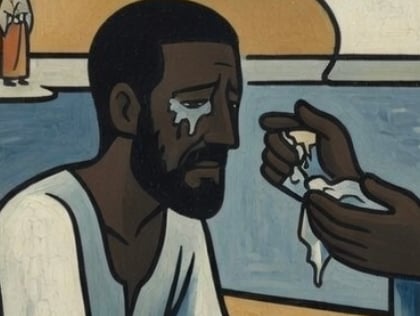
I Once Was Blind, But Now I See
I Once Was Blind, But Now I See: A Prophetic Witness for a Time of Moral Crisis
A man is sitting in the dust.
He has sat there his entire life…not by choice, but by circumstance. He was born blind, and in the world he inhabits, that means he was also born poor, born dependent, born outside the circle of the respectable. Every day, he takes his place at the edge of the road and waits for someone to show mercy. Every day, the religious and the righteous pass by with their theology already settled: this man’s suffering is his own fault. He was born in sin. God marked him. Move along.
Then Jesus comes.
In the ninth chapter of John’s Gospel, something unfolds that begins as a miracle and quickly becomes something far more dangerous: a moral crisis. Jesus kneels in the dirt, spits into the dust, forms mud with his hands, and presses it gently over the man’s eyes. He sends him to wash in the Pool of Siloam. The man obeys. When he returns, for the first time in his life, he can see.
You would think that would be the end of the story. A happy ending. A miracle affirmed and celebrated. But the Gospel of John doesn’t let us off so easily.
The miracle is not the end of the story. It is the beginning of the conflict.
I Once Was Blind, But Now I See: What the Authorities Could Not Accept
The religious leaders of the city cannot bring themselves to celebrate what has happened. A man who was blind now sees…and rather than rejoicing, they interrogate. They question the man. They question his parents. They convene hearings. They search for a technicality. The healing happened on the Sabbath, after all. The rules appear to have been broken.
Read that again slowly: a man’s sight has been restored, and the first response of the gatekeepers is to find a reason to discredit it.
This is not a story about ancient villains. This is a story about the particular danger of people who have wrapped their authority so tightly around their assumptions that they cannot recognize God moving right in front of them. They are not cruel in an obvious way. They are not twirling mustaches. They are doing what they believe is right…protecting the system, enforcing the tradition, maintaining the order. And in doing so, they miss everything.
Finally, when the healed man will not give them the answer they want, they say to him: “You were born in sin.” And they throw him out.
His testimony in response is perhaps the most disarming sentence in all of Scripture.
“I once was blind, but now I see.”
Not a theological argument. Not a defense of doctrine. Just a witness to what is undeniably, personally, bodily true. The simple declaration of someone whose world has been transformed, and who refuses to pretend otherwise…even at the cost of belonging.
The Blindness We Inherit
Every generation inherits blindness. The tragedy is that it rarely feels like blindness from the inside. It feels like common sense. It feels like the natural order. It feels like what God intended.
There was a time when churches preached slavery from the pulpit. Pastors quoted scripture in support of chains. Entire theological systems were constructed to explain why racial hierarchy reflected divine design…why some people were made to serve and others were made to rule, why the suffering of the enslaved was either their punishment or their calling. Respectable people believed this. Educated people believed this. People who prayed before meals and sang hymns on Sunday mornings believed this.
They were not all monsters. They were people whose eyes had not yet been opened.
But some people began to see differently. They read the same scriptures and heard something else…a Gospel that proclaimed liberation rather than domination, a cross that dismantled every hierarchy claiming one group of human beings was superior to another. They saw that the God revealed in Jesus did not create racial caste systems. And when that realization came, it sounded exactly like the healed man’s testimony:
I once was blind to racism. But now I see.
Every movement toward racial justice in this country began with that moment of sight…some individual or community refusing to accept the inherited blindness, insisting on what they now could not unsee.
The Poor in the Dust
It is worth slowing down to notice something the story makes easy to overlook. The man in John 9 is not only blind. He is poor. He survives by begging. He is, by every measure his society used, a nobody…someone whose suffering has been explained away so thoroughly that most people walk past him without a second thought.
The disciples’ first question when they encounter him is theological, not compassionate: “Who sinned, this man or his parents, that he was born blind?” They want to understand the accounting. They want the moral ledger to balance. If someone is suffering, there must be a reason…a fault, a failure, a sin that explains it.
Jesus refuses that framework entirely.
He does not debate the man’s worth. He does not explain the man’s condition. He kneels in the dirt beside him. The divine presence meets him exactly where he is, without requiring him to justify his existence first.
This is the scandal of the Gospel: God consistently draws near to those whom society has declared disposable. Not after they have proven themselves. Not once they have cleaned themselves up. In the dust, as they are, where they are.
Yet we live in a world that still worships wealth and still blames the poor for their poverty. The unhoused are treated as inconveniences rather than neighbors. Entire policy debates are constructed around the assumption that suffering is the result of bad choices…that if people simply worked harder, wanted better, chose differently, they would not be in their circumstances. We have theologized poverty the same way the disciples did.
When the Gospel opens your eyes to that, it is disorienting. It requires you to look at systems rather than just individuals, at structures rather than just choices, at the face of God in the person you were previously trained to walk past.
I once was blind to classism. But now I see.
“You Were Born Wrong”
There is a sentence in John 9 that should stop us cold.
When the religious authorities have exhausted their arguments and the healed man still refuses to recant his testimony, they reach for the cruelest weapon available: “You were born in sin.”
Not you have sinned. Not you have done something wrong. But your very existence is the problem. You were born wrong. You do not belong here.
That sentence has echoed across centuries with haunting persistence.
It has been spoken to LGBTQ people who came to their families and churches in vulnerability and were told that their love was incompatible with faith. It has been spoken to gay men dying of AIDS who were told their suffering was divine punishment. It has been spoken to queer teenagers lying awake in the dark, searching their Bibles for a word of hope and finding only condemnation. It has been spoken to transgender people who are today, in this very moment, facing a renewed wave of legislation designed not to protect anyone but to make clear that they are not fully welcome in public life…that their bodies are contested territory, that their existence requires special explanation and justification.
The language is always the same. You were born wrong. You do not belong. You cannot teach us anything.
And into that moment, the Gospel offers a different image.
Indeed, Christ doesn’t go stand with the gatekeepers. Christ goes and stands with the one who was expelled.
That is not a minor detail of the story. That is the heart of it. And that reality exposes as moral blindness…not moral faithfulness, but moral blindness…every use of religion to shut out, condemn, and expel queer and trans people from the table of belonging.
I once was blind to homophobia. But now I see.
I once was blind to transphobia. But now I see.
The Most Dangerous Blindness
It would be comfortable to end by locating blindness entirely in the past…in the slaveholders, in the ancient Pharisees, in people whose names we do not know. But the story of John 9 will not let us do that.
The tragedy of the text is not that a man was born blind.
The tragedy is that the religious authorities refuse to see even after the miracle unfolds directly in front of them. They have every piece of evidence they need. The man himself is standing there, testifying, offering the most straightforward account imaginable: I could not see. Now I can. And still they cannot receive it, because receiving it would require them to revise something. It would cost them something. It would mean admitting that their system, their assumptions, their authority might be wrong.
And that, it turns out, is a price they are not willing to pay.
This is the blindness that should frighten us most…not the dramatic cruelty of obvious evil, but the quiet, respectable, scripture-quoting insistence that the way things are is the way God intended them to be. Moral blindness rarely announces itself as cruelty. It disguises itself as tradition. As common sense. As protecting what matters. As faithful stewardship of what was handed down.
The question John 9 asks every reader is not only: can you see what is in front of you?
The question is: when sight arrives…when evidence comes, when testimony comes, when a living human being stands before you and says, I exist, I am here, God has touched my life…will you receive it? Or will you defend the system?
I Once Was Blind, But Now I See: The Testimony That Remains
Movements toward justice do not begin with legislation. They do not begin with policy. They begin with the moment someone’s eyes open…someone who recognizes a humanity they had previously been trained to overlook, someone who finds themselves unable to explain away what is now plainly visible.
And when that happens, there is only one honest thing to say.
Not a manifesto. Not a theological treatise. Just a witness.
I once was blind, but now I see.
That testimony has never been comfortable. The healed man was thrown out of his community for it. Those who testified against slavery risked their lives and livelihoods for it. Those who first stood up and said queer people belong at this table were dismissed, expelled, and ridiculed for it.
But once sight arrives, it cannot be undone. You cannot unsee what has been seen. You cannot return to the comfortable dark after the light has come.
And so the testimony continues…passed down through every generation that refuses to accept the inherited blindness of its age, carried forward by every person who has the courage to say: this is what I know to be true, regardless of what it costs me.
I once was blind, but now I see.
I once was blind, but now I see.
And once sight arrives, the world never looks the same again.
Catholic
Politics and Religion
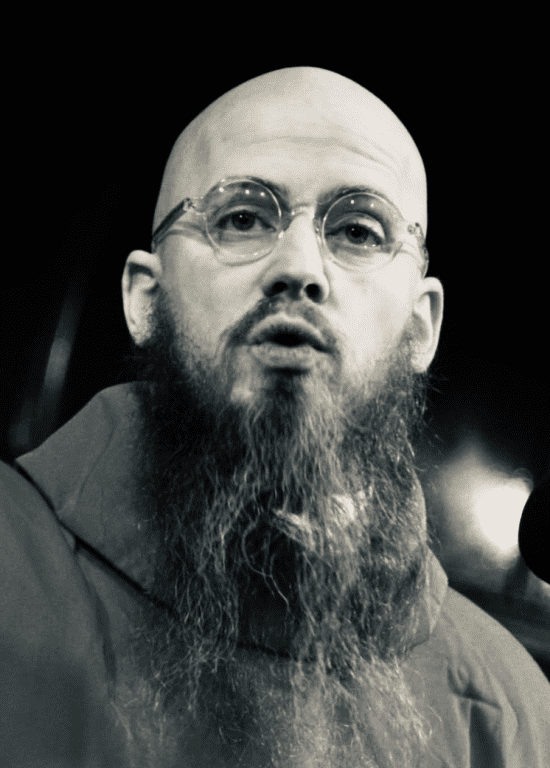
About The Rev. Dr. Jeff Hood
The Rev. Dr. Jeff Hood is a Catholic priest (Old Catholic), theologian, and nationally recognized activist based in North Little Rock, Arkansas. A spiritual advisor to death row inmates across the country, Dr. Hood has accompanied more people to their executions than any other advisor in the U.S., including the first-ever nitrogen hypoxia execution in 2024. His work sits at the intersection of justice, radical compassion, and public theology. Dr. Hood holds advanced degrees from Auburn, Emory, Southern Baptist Theological Seminary, University of Alabama, Creighton, and Brite Divinity School, among others. He also earned a PhD in metaphysical theology and founded The New Theology School, where he serves as Dean and Professor of Prophetic Theology. Author of over 100 books—including the award-winning The Courage to Be Queer—Dr. Hood’s writings and activism have been featured in The New York Times, Rolling Stone, NPR, CNN, and more. A frequent collaborator with men on death row, he sees theology as a shared, liberative act. Dr. Hood has served on the leadership teams of organizations like the Texas Coalition to Abolish the Death Penalty and the Fellowship of Reconciliation. His activism has earned multiple awards, including recognition from PFLAG and the Next Generation Action Network. On July 7, 2016, Dr. Hood led the Dallas protest against police brutality that ended in tragedy. His actions that night saved lives, and his story is now archived in the Dallas Public Library. A father of five, husband to Emily, and friend to the incarcerated, Dr. Hood rejects institutionalism in favor of a theology rooted in people, presence, and prophetic witness. You can read more about the author here.
Previous Post
March 11, 2026
A Strange Witness: Cedric Ricks Said He Wanted to Die.
Next Post
March 16, 2026 Distributed Culpability and the Execution of Michael King
Recent Comments
"'God’s Sheep on the Sidewalk' is immensely thought-provoking and conscience-stirring. Thanks. "The people out there ..."
God’s Sheep: The Ones Who Sleep ..."
"Greetings, Jeff, and bless you for your relentlessly regular fierce posts and your profound commitments ..."
Between: On the Person and Character ..."
"God as the Between, thoughts:As a child we were taught, in the blue or green ..."
Between: On the Person and Character ..."
"Sometimes we make it harder than it is. Not saying things don't bring us to ..."
Get Behind Me, Satan: A Death ..."
Browse Our Archives
Select a Category Danny & Jeff fresh writings latest poetics north texas fellowship of reconciliation Sermon theology from death row Thoughts Uncategorized
Select a Month October 2026 September 2026 August 2026 July 2026 June 2026 May 2026 April 2026 March 2026 February 2026 January 2026 December 2025 November 2025 October 2025 September 2025 August 2025 June 2025 May 2025 April 2025 March 2025 January 2025 December 2024 November 2024 October 2024 August 2024 July 2024 June 2024 May 2024 April 2024 March 2024 February 2024 January 2024 December 2023 November 2023 October 2023 September 2023 July 2023 May 2023 April 2023 March 2023 February 2023 January 2023 December 2022 November 2022 October 2022 September 2022 August 2022 July 2022 June 2022 May 2022 April 2022 March 2022 February 2022 January 2022 December 2021 November 2021 October 2021 September 2021 July 2021 June 2021 May 2021 April 2021 March 2021 February 2021 January 2021 December 2020 November 2020 October 2020 September 2020 August 2020 July 2020 June 2020 May 2020 April 2020 March 2020 February 2020 January 2020 December 2019 November 2019 October 2019 September 2019 August 2019 July 2019 May 2019 March 2019 February 2019 January 2019 December 2018 November 2018 October 2018 September 2018 August 2018 July 2018 June 2018 May 2018 April 2018 March 2018 February 2018 January 2018 December 2017 November 2017 October 2017 September 2017 August 2017 July 2017 June 2017 May 2017 April 2017 March 2017 February 2017 January 2017 December 2016 October 2016 September 2016 August 2016 July 2016 June 2016 May 2016 April 2016 March 2016 February 2016 January 2016 December 2015 November 2015 October 2015 September 2015 August 2015 July 2015 June 2015 May 2015 April 2015 March 2015 February 2015 January 2015 December 2014 November 2014 October 2014 September 2014 August 2014 July 2014 June 2014 May 2014 April 2014 March 2014 February 2014 January 2014 December 2013 November 2013 October 2013 September 2013 August 2013 July 2013 June 2013 May 2013 April 2013 March 2013
Follow Us!
TAKE THE
Religious Wisdom Quiz
What did the disciples do when Jesus asked them to stay awake in the garden?
Select your answer to see how you score.
They fell asleep They left They prayed They sang
Related posts from Jeff Hood

GOD Will Wipe Away the Tears from Every...

Why Can't Anyone Say Evil? On the Execution...

God's Sheep: The Ones Who Sleep Outside the...
Keeping the Word : Living the Word :...
TRENDING AT PATHEOS Progressive Christian

How to Make a Decision When You Can't...
Main point: It’s much more valuable to stay close to God so...

Archdiocese Hosts Military Marriage Retreat in Germany
RASTATT, Germany — The transient military lifestyle, with its frequent deployments and...

Nearly every morning, I make the drive to Detroit with my high-school-age...

The Real AI Story Is Adoption Without Trust
Artificial intelligence has crossed a political threshold. It is no longer a...

A new article, written by Jeff Lindsay and Gale L. Pooley,...

Swimfan: Forgotten Aughts Pleasures
This is a recovery effort. In 2002, My Big Fat Greek Wedding...
view all Progressive Christian blogs
What Are Your Thoughts?leave a comment
Ad-Free & Subscriber Log-In Subscription Support
- About Us
- 2026 Calendar
- Videos
- Podcasts
- Library of World Religions
- Faith In Media Tracker
- Advertise With Us
- Write for Us
- Privacy Policy
- Terms of Service
- Do Not Sell My Data
- Contact Us
- Radiant Digital
- Manage Newsletter Subscriptions
- Unsubscribe From Notifications
- Sitemap
Copyright 2008-2026, Patheos. All rights reserved.
Subscription Support Ad-Free & Subscriber Log-In
Follow Patheos