
BuddhistCatholicContemplativeEvangelicalGeneral ChristianHinduJewishLatter-day SaintMuslimNew VisionsProgressive Christian
Beliefs
- Buddhist
- Catholic
- Contemplative
- Evangelical
- General Christian
- Hindu
- Jewish
- Latter-day Saint
- More Voices
- Muslim
- New Visions
- Pagan
- Progressive Christian
Topics
- Religion News
- Food and Religion
- Sports and Religion
- Religious Art
- Religious Music and Entertainment
- Religious Events
- History and Religion
- Style and Religion
- Politics and Religion
- Women in Religion
- Recreation Outdoors and Religion
- Business Finance and Religion
- Careers Workplace and Religion
- Education and Religion
- Family Parenting and Religion
- Health Fitness and Religion
- Home and Religion
- Relationships and Religion
- Technology and Religion
- Travel and Religion
Columnists
- Buddhist Columnists
- Business Finance and Religion Columnists
- Careers Workplace and Religion Columnists
- Catholic Columnists
- Contemplative Columnists
- Education and Religion Columnists
- Evangelists Columnists
- Family Parenting and Religion Columnists
- General Christian Columnists
- Health Fitness and Religion Columnists
- Hindu Columnists
- History and Religion Columnists
- Home and Religion Columnists
- Jewish Columnists
- More Voices Columnists
- Latter Day Columnists
- Muslim Columnists
- New Visions Columnists
- Nonreligious Columnists
- Pagan Columnists
- Politics and Religion Columnists
- Progressive Columnists
- Recreation Outdoors and Religion Columnists
- Relationships and Religion Columnists
- Religion News Columnists
- Religious Art Columnists
- Religious Events Columnists
- Religious Music and Entertainment Columnists
- Sports and Religion Columnists
- Style and Religion Columnists
- Technology and Religion Columnists
- Travel and Religion Columnists
- Women in Religion Columnists
Resource Library
- 2026 Calendar
- Library of World Religions
- The 100 Most Holy Places on Earth
- Patheos Answers
- Podcasts
- Videos
- Faith Leaders Database
- Anglican Episcopalian
- Bahai
- Baptist
- Buddhism
- Christianity
- Confucianism
- Eastern Orthodoxy
- Hinduism
- Holiness and Pentecostal
- ISKCON
- Islam
- Judaism
- Lutheran
- Methodist
- The Church of Jesus Christ of Latter-day Saints
- New Age
- Paganism
- Presbytarian and Reformed
- Protestantism
- Religion Behind the Scenes
- Roman Catholic
- Scientology
- Shia Islam
- Sikhism
- Sufism
- Sunni Islam
- Taoism
- Zen
- See all religions
Research Tools
 Ad-Free & Subscriber Log-In Subscription Support
Ad-Free & Subscriber Log-In Subscription Support
Follow Patheos 

- Trending:
- Forgiveness
- |
- Marriage
- |
- Consciousness
- |
- Death Penalty
- |
- Election
- |
- Halloween

- Home
- Progressive Christian
- Religion News
- Healed: A Theological Tribute to Garth Kasimu Baker-Fletcher
Healed: A Theological Tribute to Garth Kasimu Baker-Fletcher
Last updated on: December 23, 2025 at 4:53 pm by Jeff Hood
Healed: A Theological Tribute to Garth Kasimu Baker-Fletcher 2025-12-23T16:53:52-06:00 Jeff Hood
Patheos Explore the world's faith through different perspectives on religion and spirituality! Patheos has the views of the prevalent religions and spiritualities of the world.

Garth Kasimu Baker-Fletcher / Personal Image
Healed for Good: A Theological Tribute to The Rev. Dr. Garth Kasimu Baker-Fletcher
This tribute reflects on the life, work and theological contributions of The Rev. Dr. Garth Kasimu Baker-Fletcher, drawing from a series of conversations we had. Through conversations about pain, disability and healing, Baker-Fletcher articulated a radical theology that reimagined disability not as deficit but as spiritual gift. His concepts of the “differently-abled” and the “spiritually superhuman” challenge normative frameworks that have long oppressed those whose bodies and minds do not conform to societal expectations. In death, Brother Garth has achieved the healing he so profoundly theologized, not as escape from disability but as the ultimate affirmation of the wounds that made him who he was.
Introduction: Brother Garth
There are some people who enter your life and fundamentally alter the way you see the world. The Rev. Dr. Garth Kasimu Baker-Fletcher was such a person. A Harvard-trained theologian whose scholarship ranged from Martin Luther King Jr.’s theory of dignity to the complexities of Christian ethics in a morally ambiguous world, Brother Garth was a giant in the field of practical Black religious thought. Yet for all his intellectual accomplishments, it was his capacity for friendship and his willingness to theologize from the raw material of his own suffering that made him irreplaceable. I called him Brother Garth because a Brother was exactly what he was to me.
Brother Garth’s body was a site of profound struggle. Lupus, contracted in childhood, set off a cascade of medical interventions that would define his physical existence. The medications meant to save him destroyed the ball joint in his hip, necessitating an implant that required surgery after surgery. In the first decade alone, he underwent ten operations. Eventually, he stopped counting. Pain became not an interruption to his life but its constant companion, an uninvited teacher whose lessons he could not ignore.
What follows is an expansion of conversations I was privileged to have with Brother Garth at a rehabilitation facility where he was recovering from yet another hip surgery. These conversations, conducted in the shadow of his failing body, have long festered in my mind. In them, he wrestled with questions that most theologians only approach abstractly: What is pain? How does one survive chronic suffering? What does it mean to be disabled in a world that worships ability? And perhaps most profoundly: Who heals whom?
The Theology of Pain: The Lived Reality of Garth Kasimu Baker-Fletcher
When I asked Brother Garth to define pain, he did not reach for medical terminology or philosophical abstractions. Instead, he strung together a litany of adjectives that could only come from someone who had lived what he described: “Pain is a shocking, singular, grading, raw, fierce, determined, frightening and empowering experience.” The final word is crucial. For Brother Garth, pain was not merely something to be endured but something that conferred power upon those who bore it. This was no naive optimism. It was the hard-won wisdom of a man whose body had been broken and remade countless times.
I responded that pain is “jolting and dislodging,” an experience we desperately want to escape. This is the normative understanding: pain as enemy, as aberration, as something to be conquered and eliminated. The entire medical-industrial complex is built on this premise. We spend billions of dollars annually on pain management, seeking always to return the body to some imagined state of painlessness. But what happens when pain refuses to leave? What happens when it takes up permanent residence?
Brother Garth’s answer was startling in its honesty. Chronic pain, he told me, “keeps me away from the business of life.” The isolation of repeated hospitalization compounds the physical suffering with spiritual agony. “People make the assumption that they can’t comfort you and therefore they stay away. The sense of solitude is an additional corresponding painful sickness.” Here Brother Garth identified what might be called the social dimension of suffering. Pain does not merely afflict the individual body…it severs the sufferer from community, from participation in the ordinary rhythms of human existence. The disabled person becomes, in a very real sense, an exile.
Yet Brother Garth refused to despair…”You have to develop a spirituality capable of pushing back,” he insisted. “You have to dare to believe in a God that has the strength and fortitude to carry you through.” This is not the prosperity gospel’s promise of deliverance from suffering. It is something far more radical…a theology that finds God present in the midst of unrelenting pain, a faith that does not require the cessation of suffering as proof of divine favor.
Normativism as Meta-Oppression
Our conversations turned to what Brother Garth called “social pain,” the suffering inflicted by societal expectations of normalcy. “At 59,” he told me, “I have finally come to the conclusion that I am disabled. To be disabled in this society is to be on the outside. The only way the disabled person gets to come back in on the inside is if you conform to the expectations of the society.” Then came the crucial formulation: “Normativism is the meta-ism. All other oppressions flow out of a concept of normal.”
This is a profound theological and political claim. Racism, sexism, homophobia, ableism: all are variations on a single theme, the violent enforcement of normalcy. The antinormative, Brother Garth observed, is “the greatest threat to normativity,” and therefore faces “shocking pain over and over.” Violence becomes the instrument by which the different are disciplined into conformity or punished for their refusal to conform.
Our society teaches that pain is temporary, something to be overcome. But what happens when you are not going to get over it? This is the question that chronic illness and disability force upon us. It is also the question that exposes the lie at the heart of normative culture. We are all, in various ways, broken. We are all, in the end, dying. The disabled person simply makes visible what the able-bodied spend enormous energy denying.
The Spiritually Superhuman : Garth Kasimu Baker-Fletcher on the Ability of Disability
I pushed Brother Garth toward a radical revaluation. “What happens if we start to view disability as a higher level of ability?” I asked. Those who learn to live through profound pain, I suggested, are “almost superhuman.”
Brother Garth responded with a story that had haunted him since adolescence. “When I was a teenager,” he said, “I dreamed that I carried all the pain that I had on my back. I was so strong. I looked like a superhero. I had muscles everywhere. When I looked at the rest of the world, all the people looked like stick figures.” This mystical vision revealed to him that “going through this pain was a gift that I could give the world.”
The implications are stunning. What if disability is not deficit but surplus? What if those who carry pain are not diminished but enlarged? What if the stick figures are the normative bodies, emaciated by their refusal to bear the weight of authentic human existence? Brother Garth was not romanticizing suffering. He was inverting the hierarchy that places the able-bodied at the top and the disabled at the bottom. In this inversion, the disabled become teachers, prophets, bearers of a truth the world desperately needs but cannot bear to hear.
I shared my own experience with bipolar disorder. “I have come to a place where I saw my mental disability as a mental ability.” Brother Garth and I recognized in each other fellow travelers on a path that most people cannot imagine walking. “We have that connection,” he acknowledged. The disabled know things about life, about God, about what matters, that the able-bodied can only access through relationship with those who have been forced to learn the hard way.
The Scandal of Healing : Garth Kasimu Baker-Fletcher On the Horror of Healing
Brother Garth expressed profound discomfort with how the healing miracles of Jesus have been used, “I struggle with the fact that ideas of punishment/evil and disability are so closely connected in the narratives.” He charitably attributed this to the authors rather than to Jesus himself, but the damage was done. “Our ideas of disability are always connected to healing and this is a major problem. Most often in churches, I think we use disabled persons for our own benefit.”
I named this phenomenon “disability pornography.” We roll disabled persons into our worship spaces so that everyone will feel good about themselves, inspired by the brave sufferer who keeps going despite everything. But when disabled persons begin to stretch us, to make demands, to insist on accommodation and inclusion, we roll them out. We claim we lack the means to make space for them. Brother Garth called it, “horrific.”
“We sit with our disability as a means of sustenance.” This statement inverts the typical framework entirely. We are accustomed to thinking of the church as bringing sustenance to the disabled, offering them spiritual nourishment to help them endure their suffering. But what if the disabled are the ones who nourish us? “Disabled persons bring a higher level of spirituality to church spaces,” I said. “I think we need to stop trying to heal disabled persons who walk through the door and realize that we are the ones who are healed by their presence.”
Brother Garth’s own experience confirmed this reversal. “When I started experiencing the othering of disability in my younger years, everyone assumed that I just needed to be healed. I have had no more painful of experiences than people trying to heal me.” The well-meaning prayers, the hands laid on in faith, the confident declarations that God would restore him: these were not comfort but assault. “As I have grown older, I have realized that most often I am the one that needs to be doing the healing.”
Wheelchairs in Heaven
Our conversation turned eschatological: What becomes of disability in the age to come? “I think we will all be healed. I think the lame will walk. I think the blind will see. I don’t think the wheelchairs will be there.” But then he added a crucial qualification: “With that said, I think we will still have the wounds. Remember, Jesus still had the wounds when Thomas wanted to put his hands in there.”
This is a stunning theological insight. The resurrected Christ is not restored to some pre-crucifixion state. He bears the marks of his suffering into eternity. The wounds are not erased but glorified. They become the very means by which Thomas and the other disciples recognize their Lord. If this is true for Christ, might it not also be true for those who follow him? Might we carry our wounds, our disabilities, our scars into the life to come, not as marks of shame but as badges of honor?
I suggested that “our culture is like Thomas. We are looking at persons with disabilities unsure of what to do and we cannot be made whole until we are willing to place our hands in the wounds. Disabled persons bring to us the incarnated Christ.” Brother Garth’s response was devastating: “Yet we are the ones still doubting whether disabled persons can be resurrected. We want them to prove that they have been healed. The truth is standing in front of us.”
The Disabled God : The God Garth Kasimu Baker-Fletcher Knew
“I think that God is permanently disabled. God is blinded or restricted by love. I think this is what makes us call such an entity God. I don’t want God to be healed of such blindness or restriction.”
Brother Garth affirmed this intuition. “God is with us. God feels. God experiences. God is disabled because we are disabled. God doesn’t need to be healed.” Here we arrived at a doctrine of divine disability that challenges classical theism’s emphasis on God’s perfection, omnipotence and impassibility. The God who cannot suffer, who exists in splendid isolation from the pain of creation, is not the God revealed in the wounded hands of the risen Christ. The true God is the one who chooses limitation, who embraces restriction, who becomes disabled by love.
“We are the ones who need to be healed from our false dichotomies,” I said. “I feel like ability is an illusion. Nobody is abled. Despite the lengths to which our culture goes to deny death, everyone is dying or afflicted by death. Why do we feel the need to categorize ability and disability?”
Brother Garth’s answer was simple and profound: “We are addicted to normatizing and shunning anything that is different.” The cure for this addiction is not more normativity but its abolition. The uprising Brother Garth called for was nothing less than a revolution against the tyranny of the normal, a liberation movement for all who have been oppressed by expectations they never chose and could never meet.
Healed for Good : Garth Kasimu Baker-Fletcher
Brother Garth is gone now. The hip that caused him such suffering will trouble him no more. The lupus that stalked him from childhood has lost its prey. The surgeries are finished. The pain has ended.
But I do not believe that Brother Garth is healed in the way our normative culture imagines healing. He is not restored to some pre-lupus state, as if his disability were simply an error to be corrected. That would be to deny everything he taught me about the gift of pain, the spiritually superhuman status of those who bear suffering, the wounds that remain even in resurrection.
No, I believe Brother Garth is healed for good in a different sense. He is healed for good meaning permanently, finally, irrevocably. The chronic has become eternal. But he is also healed for good…meaning for the sake of good, for the purpose of good, as a gift to the good. The healing he offered to so many of us while he walked this earth continues now from whatever place he inhabits. His wounds remain. His teaching endures. His presence persists in everyone he touched.
In that teenage dream, Brother Garth saw himself as a superhero, muscles bulging from the weight of pain he carried, surrounded by stick figures who could not comprehend his strength. I think that dream was prophecy. Brother Garth was indeed superhuman, not despite his disability but because of it. He saw what the rest of us could not see. He bore what the rest of us could not bear. He taught what the rest of us needed desperately to learn.
“Pain…That’s where God comes in,” Brother Garth often repeated. He was right. God came in through Brother Garth’s wounds, through his wheelchair, through his unrelenting physical struggles. God comes in still, through every disabled body that refuses to conform, through every chronic sufferer who dares to find meaning in meaningless agony, through every existence that defies the normal and transforms it.
Brother Garth, you taught me that our restricted normative ideas are what needs healing. You taught me that disability is gift. You taught me that God is restricted by love and does not need or want to be otherwise. You taught me that the wounds remain.
Your wounds remain with us now. They are our inheritance. They are our sustenance. They are our call to continue the uprising against all false ideas of ability.
Rest now, Brother.
Works by Garth Kasimu Baker-Fletcher
Somebodyness: Martin Luther King, Jr. and the Theory of Dignity. Minneapolis: Fortress Press, 1993.
Xodus: An African-American Male Journey. Minneapolis: Fortress Press, 1996.
My Sister, My Brother: Womanist and Xodus God-Talk. Maryknoll, NY: Orbis Books, 1997.
Black Religion After the Million Man March: Voices on the Future. Maryknoll, NY: Orbis Books, 1998.
Dirty Hands: Christian Ethics in a Morally Ambiguous World. Minneapolis: Fortress Press, 2000.
Bible Witness in Black Churches. New York: Palgrave Macmillan, 2009.
Pain, Suffering and Danger. Eugene, OR: Wipf & Stock, 2018.
Catholic
Politics and Religion
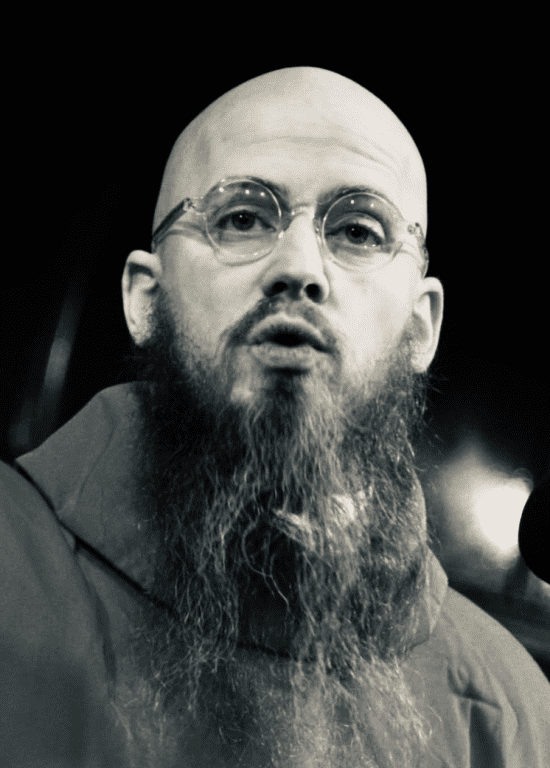
About The Rev. Dr. Jeff Hood
The Rev. Dr. Jeff Hood is a theologian, writer and activist who has spent years ministering to people on death row. As a spiritual advisor and witness to executions, he speaks out against state violence and calls for a society rooted in justice, mercy and the sacredness of life. You can read more about the author here.
Previous Post

December 23, 2025
Christmas : The Beginning of an Execution
Next Post

December 24, 2025 From 1812: John Murray's Radical Theology of Hope
Recent Comments
"'God’s Sheep on the Sidewalk' is immensely thought-provoking and conscience-stirring. Thanks. "The people out there ..."
God’s Sheep: The Ones Who Sleep ..."
"Greetings, Jeff, and bless you for your relentlessly regular fierce posts and your profound commitments ..."
Between: On the Person and Character ..."
"God as the Between, thoughts:As a child we were taught, in the blue or green ..."
Between: On the Person and Character ..."
"Sometimes we make it harder than it is. Not saying things don't bring us to ..."
Get Behind Me, Satan: A Death ..."
Browse Our Archives
Select a Category Danny & Jeff fresh writings latest poetics north texas fellowship of reconciliation Sermon theology from death row Thoughts Uncategorized
Select a Month October 2026 September 2026 August 2026 July 2026 June 2026 May 2026 April 2026 March 2026 February 2026 January 2026 December 2025 November 2025 October 2025 September 2025 August 2025 June 2025 May 2025 April 2025 March 2025 January 2025 December 2024 November 2024 October 2024 August 2024 July 2024 June 2024 May 2024 April 2024 March 2024 February 2024 January 2024 December 2023 November 2023 October 2023 September 2023 July 2023 May 2023 April 2023 March 2023 February 2023 January 2023 December 2022 November 2022 October 2022 September 2022 August 2022 July 2022 June 2022 May 2022 April 2022 March 2022 February 2022 January 2022 December 2021 November 2021 October 2021 September 2021 July 2021 June 2021 May 2021 April 2021 March 2021 February 2021 January 2021 December 2020 November 2020 October 2020 September 2020 August 2020 July 2020 June 2020 May 2020 April 2020 March 2020 February 2020 January 2020 December 2019 November 2019 October 2019 September 2019 August 2019 July 2019 May 2019 March 2019 February 2019 January 2019 December 2018 November 2018 October 2018 September 2018 August 2018 July 2018 June 2018 May 2018 April 2018 March 2018 February 2018 January 2018 December 2017 November 2017 October 2017 September 2017 August 2017 July 2017 June 2017 May 2017 April 2017 March 2017 February 2017 January 2017 December 2016 October 2016 September 2016 August 2016 July 2016 June 2016 May 2016 April 2016 March 2016 February 2016 January 2016 December 2015 November 2015 October 2015 September 2015 August 2015 July 2015 June 2015 May 2015 April 2015 March 2015 February 2015 January 2015 December 2014 November 2014 October 2014 September 2014 August 2014 July 2014 June 2014 May 2014 April 2014 March 2014 February 2014 January 2014 December 2013 November 2013 October 2013 September 2013 August 2013 July 2013 June 2013 May 2013 April 2013 March 2013
Follow Us!
TAKE THE
Religious Wisdom Quiz
In 2 Thessalonians, what does Paul say the man of lawlessness will proclaim himself to be?
Select your answer to see how you score.
God A prophet The Messiah King of the world
Related posts from Jeff Hood

GOD Will Wipe Away the Tears from Every...

Why Can't Anyone Say Evil? On the Execution...

God's Sheep: The Ones Who Sleep Outside the...

Keeping the Word : Living the Word :...
TRENDING AT PATHEOS Progressive Christian

Swimfan: Forgotten Aughts Pleasures
This is a recovery effort. In 2002, My Big Fat Greek Wedding...

Top Three Anti-Catholic Lies About Catholicism
This is my initial transcript for the video, "THE 3 WORST...

Pope Leo Celebrates Mass for Nurses & Docs...
I don't have any idea how he did it, but Pope Leo...

The Sermon on the Mount, Part I: Matthew...
The Sermon on the Mount, Part I (Matthew 4:12-5:12) St. Matthew moves...

What's up from Crossway: Reviewing some of their latest A few weeks...

Janie Learns the Way of the Cross: A...
Teaching children about Jesus' Passion can be challenging. Many parents and educators...
view all Progressive Christian blogs
What Are Your Thoughts?leave a comment
Ad-Free & Subscriber Log-In Subscription Support
- About Us
- 2026 Calendar
- Videos
- Podcasts
- Library of World Religions
- Faith In Media Tracker
- Advertise With Us
- Write for Us
- Privacy Policy
- Terms of Service
- Do Not Sell My Data
- Contact Us
- Radiant Digital
- Manage Newsletter Subscriptions
- Unsubscribe From Notifications
- Sitemap
Copyright 2008-2026, Patheos. All rights reserved.
Subscription Support Ad-Free & Subscriber Log-In
Follow Patheos