
BuddhistCatholicContemplativeEvangelicalGeneral ChristianHinduJewishLatter-day SaintMuslimNew VisionsProgressive Christian
Beliefs
- Buddhist
- Catholic
- Contemplative
- Evangelical
- General Christian
- Hindu
- Jewish
- Latter-day Saint
- More Voices
- Muslim
- New Visions
- Pagan
- Progressive Christian
Topics
- Religion News
- Food and Religion
- Sports and Religion
- Religious Art
- Religious Music and Entertainment
- Religious Events
- History and Religion
- Style and Religion
- Politics and Religion
- Women in Religion
- Recreation Outdoors and Religion
- Business Finance and Religion
- Careers Workplace and Religion
- Education and Religion
- Family Parenting and Religion
- Health Fitness and Religion
- Home and Religion
- Relationships and Religion
- Technology and Religion
- Travel and Religion
Columnists
- Buddhist Columnists
- Business Finance and Religion Columnists
- Careers Workplace and Religion Columnists
- Catholic Columnists
- Contemplative Columnists
- Education and Religion Columnists
- Evangelists Columnists
- Family Parenting and Religion Columnists
- General Christian Columnists
- Health Fitness and Religion Columnists
- Hindu Columnists
- History and Religion Columnists
- Home and Religion Columnists
- Jewish Columnists
- More Voices Columnists
- Latter Day Columnists
- Muslim Columnists
- New Visions Columnists
- Nonreligious Columnists
- Pagan Columnists
- Politics and Religion Columnists
- Progressive Columnists
- Recreation Outdoors and Religion Columnists
- Relationships and Religion Columnists
- Religion News Columnists
- Religious Art Columnists
- Religious Events Columnists
- Religious Music and Entertainment Columnists
- Sports and Religion Columnists
- Style and Religion Columnists
- Technology and Religion Columnists
- Travel and Religion Columnists
- Women in Religion Columnists
Resource Library
- 2026 Calendar
- Library of World Religions
- The 100 Most Holy Places on Earth
- Patheos Answers
- Podcasts
- Videos
- Faith Leaders Database
- Anglican Episcopalian
- Bahai
- Baptist
- Buddhism
- Christianity
- Confucianism
- Eastern Orthodoxy
- Hinduism
- Holiness and Pentecostal
- ISKCON
- Islam
- Judaism
- Lutheran
- Methodist
- The Church of Jesus Christ of Latter-day Saints
- New Age
- Paganism
- Presbytarian and Reformed
- Protestantism
- Religion Behind the Scenes
- Roman Catholic
- Scientology
- Shia Islam
- Sikhism
- Sufism
- Sunni Islam
- Taoism
- Zen
- See all religions
Research Tools
 Ad-Free & Subscriber Log-In Subscription Support
Ad-Free & Subscriber Log-In Subscription Support
Follow Patheos 

- Trending:
- Forgiveness
- |
- Marriage
- |
- Consciousness
- |
- Death Penalty
- |
- Election
- |
- Halloween

- Home
- Evangelical
- History and Religion
- Communion, pt. 10 | Discussion
Communion, pt. 10 | Discussion
Last updated on: July 13, 2023 at 9:00 am by Rev. Jared V. Ingle
Communion, pt. 10 | Discussion 2023-06-30T13:16:56-04:00 Rev. Jared V. Ingle
Patheos Explore the world's faith through different perspectives on religion and spirituality! Patheos has the views of the prevalent religions and spiritualities of the world.
Communion, pt. 10 | Discussion
For more on Communion in the Early Church from the Archives CLICK
East and West
The Eastern rite seems to offer a more adequate place for the work of the Spirit than the West, at least in the early days. As previously noted:
“The East anticipated the medieval Western doctrine of the real presence by many hundreds of years. This change is brought about by the Holy Spirit . . . the fully-developed theology of the Third Person.”[1]
Dom Gregory Dix states the church in the region of Syria invokes the Spirit in the consecration in the first three centuries. Syria is the first to do so.[2]
Hugh Wybrew says Cyril is first to develop the epiklesis, the Spirit changing the elements, which is not followed by the West.[3] Dix says that from this time on (fourth century), the East sees the Spirit “energising in the eucharist.”[4] Wybrew summarizes:
“Among the issues hotly debated between Orthodox and Latin Catholics was the precise moment of consecration in the Eucharist. The Western tradition had for centuries associated it with the narrative, and later more narrowly with the precise words, of the institution. The Eastern had come more and more to link it with the invocation of the Holy Spirit.”[5]
Charles Pinnock says the West focuses on transubstantiation, but the East focuses on the descent of the Holy Spirit.
“In the [Eastern] prayer of invocation, clergy stand before the altar with arms outstretched, imploring the Spirit to descend on the gifts, while a deacon fans the air, depicting the movement of the Spirit; the elements are also displayed after the service.”[6]
Dom Gregory Dix states that, “The authentic ‘Eastern’ formulation of doctrine is that the invocation consecrates the eucharist. By the action of the Holy Spirit upon the elements the communicants receive the Body and Blood of Christ.”[7] In reviewing ancient Eastern rites, Pinnock comes to a different conclusion:
“The effectiveness of the sacrament is not due to any magic surrounding what happens to the elements; rather, it is due to the power of the Spirit in the action itself. There must be a coming of the Spirit upon the sacrament and the people.”[8]
Pinnock says the transformed elements are not the central focus, but rather the epiklesis, the work of the Spirit.
Thanksgiving
Although the Eucharistic prayer eventually includes an epiklesis in the East, and an epiklesis and a consecration in the West, the prayer seems to find its roots in thanksgiving, a point to which Dom Gregory Dix continually returns:
“Is it possible to conceive of a primitive type of eucharistic prayer which consisted simply of a ‘Naming’ of God, followed by a series of ‘Thanksgivings’ for the New Covenant and concluding with a ‘glorifying of the Name’? . . . I can see how such a prayer as a whole could be derived directly from that jewish berakah which was used at the last supper, and in the jewish apostolic church.”[9]
Although Hugh Wybrew and Alexander Schmemann hold to the epiklesis, they attest to the centrality of thanksgiving and offering. Wybrew echoes the thought.
“Thanksgiving played an important part in the prayer. But it is probably that from an early time the bread and wine were explicitly offered to God in memory of the passion, and that God was asked to accept them at the heavenly altar.”[10]
Again, Eucharist is a thanksgiving offering seen in an eschatological light.
Alexander Schmemann says that our whole life and world is sacrament, restored by Christ through the sacrament. We respond in kind offering to Him the bread and wine, “this offering to God of bread and wine, of the food that we must eat in order to live, is our offering to Him of ourselves, of our life and of the whole world.”[11]
Reflections for Ministry
This research is challenging my views of communion as a minister. In my tradition (Protestant, Evangelical, Pentecostal) we view communion as an ordinance and memorial. Memorial may be a good term, one that can be equated with anamnesis.
However, in Protestantism we have forgotten some things that we should have never forgotten.
The symbolic is no longer evident in our rational recounting of the Lord’s Supper, or the bread and grape juice.
The mystery is now simply a memorial or memory.
Historians view Justin Martyr in different ways, but I find solace in the words of Robert Webber, to which I now return.
“Justin’s description of the bread and wine as the body and blood of the Lord was neither the later Catholic doctrine of transubstantiation nor the Protestant concept of memorialism . . . Justin’s understanding may be described as ‘real presence.’ That is, there is a mystery at work here, whereby Jesus becomes savingly present.”[12]
There is a mystery in communion.
If it is an “ordinance” that we obey, there is a blessing in the obedience.
If it is a “sacrament,” then what are the boundaries as we pray for God to bless the activity?
This research makes it clear. The Primitive Church establishes the rite of communion in prayers of thanksgiving.
In the early Edessan Eastern rite, the epiklesis calls upon the Holy Spirit to transform us so that we are able to receive the elements.
The anamnesis makes the memorial present in the here and now, but eschatologically points us to the fulfillment of Christ’s sacrifice at the Marriage Supper of the Lamb.
We can trace all of these themes back through the prayers of the earliest Christian writings. They are mysteries opening the door for the move of the Spirit.
For more on Communion in the Early Church from the Archives CLICK
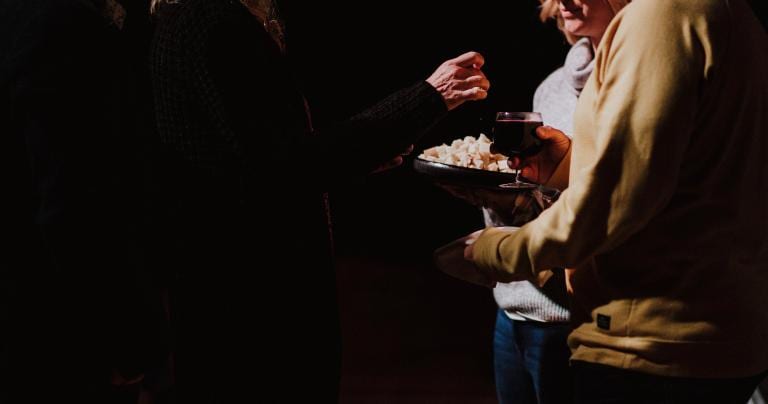
pic credit: Priscilla Du Preez | A person takes communion at a Christian church service | 11.15.18 | unsplash
notes:
- Hugh Wybrew, The Orthodox Liturgy: The Development of the Eucharistic Liturgy in the Byzantine Rite (1989; repr. London: Society for Promoting Christian Knowledge, 2013), 35.
- Dom Gregory Dix, The Shape of the Liturgy, 3rd ed. (London: Bloomsbury T&T Clark, 2015), 183.
- Wybrew, 35.
- Dix, 137.
- Wybrew, 157.
- Charles H. Pinnock, Flame of Love: A Theology of the Holy Spirit (Downers Grove, IL: IVP Academic, 1996), 128.
- Dix, 296.
- Pinnock, 127.
- Dix, 220.
- Wybrew, 19.
- Alexander Schmemann, For the Life of the World: Sacraments and Orthodoxy, 2nd ed. (Crestwood, NY: St. Vladimir’s Seminary Press, 1973), 35.
- Robert E. Webber, Worship Old and New: A Biblical, Historical, and Practical Introduction, Rev. ed. (Grand Rapids, MI: Zondervan, 1994), 239.
General Christian
History and Religion
Food and Religion
Previous Post

July 10, 2023
Communion, pt. 9 | Sarapion, St. James, and Cyril
Next Post
July 17, 2023 Communion, pt. 11 | Table of Contents
Browse Our Archives
Select a Category Communion Cruz Ingle Crystal Ingle Early Church Engaging Culture Ethics & Society Family Formation History In Dialogue Jared & Crystal Kingdom of God Majority World Church Mateo Ingle Messenger College Mission Narrative Pentecostal Church of God Prayer Shepherding The Sermon The Writings Theology Theology & Psychology Traverse City Uncategorized Vernell Ingle Word Study
Select a Month October 2026 September 2026 August 2026 July 2026 June 2026 May 2026 March 2026 February 2026 January 2026 December 2025 October 2025 September 2025 August 2025 July 2025 June 2025 May 2025 April 2025 March 2025 February 2025 January 2025 December 2024 November 2024 October 2024 September 2024 August 2024 July 2024 June 2024 May 2024 April 2024 March 2024 February 2024 January 2024 December 2023 November 2023 October 2023 September 2023 August 2023 July 2023 June 2023 May 2023 April 2023 March 2023 February 2023 January 2023 December 2022 November 2022 October 2022 September 2022 August 2022 July 2022 June 2022 May 2022 April 2022 March 2022 February 2022 January 2022 December 2021 November 2021 October 2021 September 2021 August 2021 July 2021 June 2021 May 2021 April 2021 March 2021 February 2021 January 2021 December 2020 November 2020 October 2020 September 2020 August 2020 July 2020 June 2020 May 2020 April 2020 March 2020 February 2020 January 2020 December 2019 November 2019 October 2019 September 2019 August 2019 July 2019 June 2019 May 2019 April 2019 March 2019 February 2019 January 2019 December 2018 November 2018 October 2018 September 2018 August 2018 July 2018 June 2018 May 2018 April 2018 March 2018 February 2018 May 2017 March 2017 March 2014 February 2013 January 2013 October 2012 July 2012 May 2012 April 2012 March 2012 February 2012 January 2012 December 2011 August 2010
Follow Us!
TAKE THE
Religious Wisdom Quiz
What miraculous catch did Peter witness after obeying Jesus?
Select your answer to see how you score.
A gold coin A sea turning red A boat sinking A net full of fish
Related posts from Jared Ingle

Continuing to Pray for the Future Wife

In Defense of Praying for my Future Wife

Pursuing God | Tenacity in Seeking Blessing

Table of Contents | The Fruit of the...
TRENDING AT PATHEOS Evangelical

How the author of the world's best hymn...
I've been working with John Newton for a while now. This makes...

Long before this Lectio Divina, Psalm 130 - the song - started...

What About the Trees? Another Living Parable
After I finished writing the last article about falling leaves as a...

Why Classical Education Is a Conversation, Not a...
Come and Read: Joy in Classical Education When I was a little...

Falling Leaves: A Living Parable on Letting Go
I’ve spent the vast majority of my life in the southeast corner...

Cornell University has received a great deal of negative publicity and intense...
view all Evangelical blogs
Ad-Free & Subscriber Log-In Subscription Support
- About Us
- 2026 Calendar
- Videos
- Podcasts
- Library of World Religions
- Faith In Media Tracker
- Advertise With Us
- Write for Us
- Privacy Policy
- Terms of Service
- Do Not Sell My Data
- Contact Us
- Radiant Digital
- Manage Newsletter Subscriptions
- Unsubscribe From Notifications
- Sitemap
Copyright 2008-2026, Patheos. All rights reserved.
Subscription Support Ad-Free & Subscriber Log-In
Follow Patheos