
BuddhistCatholicContemplativeEvangelicalGeneral ChristianHinduJewishLatter-day SaintMuslimNew VisionsProgressive Christian
Beliefs
- Buddhist
- Catholic
- Contemplative
- Evangelical
- General Christian
- Hindu
- Jewish
- Latter-day Saint
- More Voices
- Muslim
- New Visions
- Pagan
- Progressive Christian
Topics
- Religion News
- Food and Religion
- Sports and Religion
- Religious Art
- Religious Music and Entertainment
- Religious Events
- History and Religion
- Style and Religion
- Politics and Religion
- Women in Religion
- Recreation Outdoors and Religion
- Business Finance and Religion
- Careers Workplace and Religion
- Education and Religion
- Family Parenting and Religion
- Health Fitness and Religion
- Home and Religion
- Relationships and Religion
- Technology and Religion
- Travel and Religion
Columnists
- Buddhist Columnists
- Business Finance and Religion Columnists
- Careers Workplace and Religion Columnists
- Catholic Columnists
- Contemplative Columnists
- Education and Religion Columnists
- Evangelists Columnists
- Family Parenting and Religion Columnists
- General Christian Columnists
- Health Fitness and Religion Columnists
- Hindu Columnists
- History and Religion Columnists
- Home and Religion Columnists
- Jewish Columnists
- More Voices Columnists
- Latter Day Columnists
- Muslim Columnists
- New Visions Columnists
- Nonreligious Columnists
- Pagan Columnists
- Politics and Religion Columnists
- Progressive Columnists
- Recreation Outdoors and Religion Columnists
- Relationships and Religion Columnists
- Religion News Columnists
- Religious Art Columnists
- Religious Events Columnists
- Religious Music and Entertainment Columnists
- Sports and Religion Columnists
- Style and Religion Columnists
- Technology and Religion Columnists
- Travel and Religion Columnists
- Women in Religion Columnists
Resource Library
- 2026 Calendar
- Library of World Religions
- The 100 Most Holy Places on Earth
- Patheos Answers
- Podcasts
- Videos
- Faith Leaders Database
- Anglican Episcopalian
- Bahai
- Baptist
- Buddhism
- Christianity
- Confucianism
- Eastern Orthodoxy
- Hinduism
- Holiness and Pentecostal
- ISKCON
- Islam
- Judaism
- Lutheran
- Methodist
- The Church of Jesus Christ of Latter-day Saints
- New Age
- Paganism
- Presbytarian and Reformed
- Protestantism
- Religion Behind the Scenes
- Roman Catholic
- Scientology
- Shia Islam
- Sikhism
- Sufism
- Sunni Islam
- Taoism
- Zen
- See all religions
Research Tools
 Ad-Free & Subscriber Log-In Subscription Support
Ad-Free & Subscriber Log-In Subscription Support
Follow Patheos 

- Trending:
- Forgiveness
- |
- Marriage
- |
- Consciousness
- |
- Death Penalty
- |
- Election
- |
- Halloween

- Home
- Evangelical
- History and Religion
- Communion, pt. 3 | Early Influences, Early Church Liturgy
Communion, pt. 3 | Early Influences, Early Church Liturgy
Last updated on: June 19, 2023 at 9:00 am by Rev. Jared V. Ingle
Communion, pt. 3 | Early Influences, Early Church Liturgy 2023-06-02T12:34:55-04:00 Rev. Jared V. Ingle
Patheos Explore the world's faith through different perspectives on religion and spirituality! Patheos has the views of the prevalent religions and spiritualities of the world.
Early Influences, Early Church Liturgy
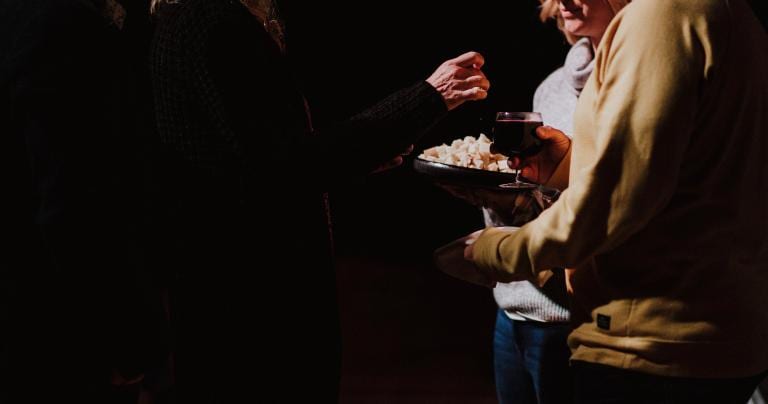
Priscilla Du Preez | A person takes communion at a Christian church service | 11.15.18 | unsplash
We know the church of Acts practices communion.
“1 Cor. expresses that tradition in a more primitive form [than Mark], roughly at the stage when S Paul first learned it – within ten years at the most of the last supper itself, perhaps within five.”[1]
chaburah, agape, and table fellowship meals
Paul’s form of communion would be recognized by the Jewish Christians as a new meaning to a chaburah meal. Earle Cairns explains the typical Sunday worship in those early days.
During the first century, two services were held on the first day of the week . . . The morning service most likely included the reading of Scripture (Col. 3:16), exhortation by the leading elder, prayers, and singing (Eph. 5:19). The love feast (1 Cor. 11:20-22), or agape [chaburah] preceded the Communion during the evening service. By the end of the first century the love feast was generally dropped and the Communion celebrated during the morning service of worship.[2]
Apart from the chaburah, agape, or what Irvin and Sunquist call table fellowship:
“followers of Jesus from the earliest days of the movement in Jerusalem gathered regularly for a special meal known as a eucharist (‘thanksgiving’). The elements at this meal were simply bread and wine. With them, believers remembered and proclaimed the death and resurrection of Jesus Christ.”[3]
Dom Gregory Dix explains the early understanding of the liturgy within the primitive church, using the four-action shape (offertory, prayer, fraction, communion). Since we see within the chaburah primarily prayers of thanksgiving, it is understandable that the same theme is followed in the Eucharist. The laity provide the elements, along with other types of food and offerings, as the offertory.[4] They each bring a little bread and wine.[5] This is important because the Eucharist is seen as a true offering. Hugh Wybrew states that in the Orthodox Church the people still bring a small loaf, a prosphora (offering) to present at the north door of the iconoscreen.[6]
berakah
The Eucharist prayer is based on the berakah.
“There were thus available two Greek words to translate the one Hebrew word berakah: eulogia = a ‘blessing’, or eucharistia = a ‘thanksgiving’ . . . S. Paul tends to use eucharistein rather than eulogein.”[7]
Dix discusses the content of the Jewish berakah. The early communion prayers follow a similar theme. The berakah thanks God for Israel’s deliverance from Egypt, entrance into Canaan, establishment of the Covenant, and the food God provides. The church thanks God for the New Canaan, the New Covenant, communion like milk and honey, and deliverance from the devil and sin.[8]
Primitive prayers, like the berakah, “gave thanks for God’s mighty work in the creation and salvation of mankind.”[9] In a real sense, these are prayers of thanksgiving, seemingly far removed from the future developments of either the consecration or epiklesis. This is the one unifying prayer of the whole rite, so its importance cannot be overstated.[10] It seems to be in the simple form of, “thanksgiving and prayer to which the people responded by an ‘Amen.’”[11]
eschatology in communion
Robert Webber says the primitive church also sees an eschatological fulfillment in the rite.
“In the early church, the central meaning of the Eucharist was to give thanks for the living, dying, and rising again of Jesus, looking forward to the coming again of Christ to establish his kingdom.”[12]
This is congruent with the Synoptic accounts (Matthew 26.29; Mark 14.25; Luke 22.18) and Paul’s concluding remark, “until he comes” (1 Corinthians 11.26, NRSV).
For more on Communion in the Early Church from the Archives CLICK
notes:
- Dom Gregory Dix, The Shape of the Liturgy, 3rd ed. (London: Bloomsbury T&T Clark, 2015), 64.
- Earle E. Cairns, Christianity Through the Centuries, 2nd ed. (Grand Rapids, MI: Academie Books, 1981), 83.
- Dale T. Irvin and Scott W. Sunquist, History of the World Christian Movement, Volume I: Earliest Christianity to 1453 (Maryknoll, NY: Orbis Books, 2009), 29.
- Dix, 78.
- Ibid., 104.
- Hugh Wybrew, The Orthodox Liturgy: The Development of the Eucharistic Liturgy in the Byzantine Rite (1989; repr. London: Society for Promoting Christian Knowledge, 2013), 4.
- Dix, 79.
- Ibid., 80.
- Wybrew, 17.
- Dix, 81.
- Cairns, 83.
- Robert E. Webber, Ancient-Future Faith: Rethinking Evangelicalism for a Postmodern World (Grand Rapids, MI: Baker Books, 2004), 110.
General Christian
History and Religion
Food and Religion
Previous Post

June 15, 2023
Communion, pt. 2 | Early Influences, Chaburah and Berakah
Next Post
June 22, 2023 Communion, pt. 4 | Early Influences, Didache, Clement of Rome, and Ignatius
Browse Our Archives
Select a Category Communion Cruz Ingle Crystal Ingle Early Church Engaging Culture Ethics & Society Family Formation History In Dialogue Jared & Crystal Kingdom of God Majority World Church Mateo Ingle Messenger College Mission Narrative Pentecostal Church of God Prayer Shepherding The Sermon The Writings Theology Theology & Psychology Traverse City Uncategorized Vernell Ingle Word Study
Select a Month October 2026 September 2026 August 2026 July 2026 June 2026 May 2026 March 2026 February 2026 January 2026 December 2025 October 2025 September 2025 August 2025 July 2025 June 2025 May 2025 April 2025 March 2025 February 2025 January 2025 December 2024 November 2024 October 2024 September 2024 August 2024 July 2024 June 2024 May 2024 April 2024 March 2024 February 2024 January 2024 December 2023 November 2023 October 2023 September 2023 August 2023 July 2023 June 2023 May 2023 April 2023 March 2023 February 2023 January 2023 December 2022 November 2022 October 2022 September 2022 August 2022 July 2022 June 2022 May 2022 April 2022 March 2022 February 2022 January 2022 December 2021 November 2021 October 2021 September 2021 August 2021 July 2021 June 2021 May 2021 April 2021 March 2021 February 2021 January 2021 December 2020 November 2020 October 2020 September 2020 August 2020 July 2020 June 2020 May 2020 April 2020 March 2020 February 2020 January 2020 December 2019 November 2019 October 2019 September 2019 August 2019 July 2019 June 2019 May 2019 April 2019 March 2019 February 2019 January 2019 December 2018 November 2018 October 2018 September 2018 August 2018 July 2018 June 2018 May 2018 April 2018 March 2018 February 2018 May 2017 March 2017 March 2014 February 2013 January 2013 October 2012 July 2012 May 2012 April 2012 March 2012 February 2012 January 2012 December 2011 August 2010
Follow Us!
TAKE THE
Religious Wisdom Quiz
I smashed a clay jar in the Valley of Ben Hinnom to illustrate coming destruction. What did this dramatic act symbolize?
Select your answer to see how you score.
Breaking the covenant The end of idolatry The breaking of Jerusalem The captivity
Related posts from Jared Ingle

Healing | Addressing Questions

List of Sins | Word Studies in Corinthians
Origen & Chrysostom on Darkness
TRENDING AT PATHEOS Evangelical

How the author of the world's best hymn...
I've been working with John Newton for a while now. This makes...

Long before this Lectio Divina, Psalm 130 - the song - started...

What About the Trees? Another Living Parable
After I finished writing the last article about falling leaves as a...

Why Classical Education Is a Conversation, Not a...
Come and Read: Joy in Classical Education When I was a little...

Falling Leaves: A Living Parable on Letting Go
I’ve spent the vast majority of my life in the southeast corner...

Cornell University has received a great deal of negative publicity and intense...
view all Evangelical blogs
Ad-Free & Subscriber Log-In Subscription Support
- About Us
- 2026 Calendar
- Videos
- Podcasts
- Library of World Religions
- Faith In Media Tracker
- Advertise With Us
- Write for Us
- Privacy Policy
- Terms of Service
- Do Not Sell My Data
- Contact Us
- Radiant Digital
- Manage Newsletter Subscriptions
- Unsubscribe From Notifications
- Sitemap
Copyright 2008-2026, Patheos. All rights reserved.
Subscription Support Ad-Free & Subscriber Log-In
Follow Patheos