
BuddhistCatholicContemplativeEvangelicalGeneral ChristianHinduJewishLatter-day SaintMuslimNew VisionsProgressive Christian
Beliefs
- Buddhist
- Catholic
- Contemplative
- Evangelical
- General Christian
- Hindu
- Jewish
- Latter-day Saint
- More Voices
- Muslim
- New Visions
- Pagan
- Progressive Christian
Topics
- Religion News
- Food and Religion
- Sports and Religion
- Religious Art
- Religious Music and Entertainment
- Religious Events
- History and Religion
- Style and Religion
- Politics and Religion
- Women in Religion
- Recreation Outdoors and Religion
- Business Finance and Religion
- Careers Workplace and Religion
- Education and Religion
- Family Parenting and Religion
- Health Fitness and Religion
- Home and Religion
- Relationships and Religion
- Technology and Religion
- Travel and Religion
Columnists
- Buddhist Columnists
- Business Finance and Religion Columnists
- Careers Workplace and Religion Columnists
- Catholic Columnists
- Contemplative Columnists
- Education and Religion Columnists
- Evangelists Columnists
- Family Parenting and Religion Columnists
- General Christian Columnists
- Health Fitness and Religion Columnists
- Hindu Columnists
- History and Religion Columnists
- Home and Religion Columnists
- Jewish Columnists
- More Voices Columnists
- Latter Day Columnists
- Muslim Columnists
- New Visions Columnists
- Nonreligious Columnists
- Pagan Columnists
- Politics and Religion Columnists
- Progressive Columnists
- Recreation Outdoors and Religion Columnists
- Relationships and Religion Columnists
- Religion News Columnists
- Religious Art Columnists
- Religious Events Columnists
- Religious Music and Entertainment Columnists
- Sports and Religion Columnists
- Style and Religion Columnists
- Technology and Religion Columnists
- Travel and Religion Columnists
- Women in Religion Columnists
Resource Library
- 2026 Calendar
- Library of World Religions
- The 100 Most Holy Places on Earth
- Patheos Answers
- Podcasts
- Videos
- Faith Leaders Database
- Anglican Episcopalian
- Bahai
- Baptist
- Buddhism
- Christianity
- Confucianism
- Eastern Orthodoxy
- Hinduism
- Holiness and Pentecostal
- ISKCON
- Islam
- Judaism
- Lutheran
- Methodist
- The Church of Jesus Christ of Latter-day Saints
- New Age
- Paganism
- Presbytarian and Reformed
- Protestantism
- Religion Behind the Scenes
- Roman Catholic
- Scientology
- Shia Islam
- Sikhism
- Sufism
- Sunni Islam
- Taoism
- Zen
- See all religions
Research Tools
 Ad-Free & Subscriber Log-In Subscription Support
Ad-Free & Subscriber Log-In Subscription Support
Follow Patheos 

- Trending:
- Forgiveness
- |
- Marriage
- |
- Consciousness
- |
- Death Penalty
- |
- Election
- |
- Halloween

- Home
- Evangelical
- Relationships and Religion
- How can people find out more about your faith online?
How can people find out more about your faith online?
Last updated on: November 28, 2022 at 9:00 am by Rev. Jared V. Ingle
How can people find out more about your faith online? 2022-11-27T18:34:00-05:00 Rev. Jared V. Ingle
Patheos Explore the world's faith through different perspectives on religion and spirituality! Patheos has the views of the prevalent religions and spiritualities of the world.
How can people find out more about your faith online?
This is a primary question being asked at this time, so I thought it would be decent to take time to address the issue.
i. setting some parameters to my faith
I’m usually considered an in-betweener, maybe a bridger. At times I’m considered Ecumenical. My Catholic Padres say if their church officially recognizes the baptism of my Ecclesial Community they can call me brother.
In short, my High Church friends often think of me as an Evangelical {an overused term in my opinion}.
On the other hand, those giants of my faith on whose shoulders I stand often think of me as Ecumenical.
High Church is a term, hopefully a non-offensive term, used to describe formal and liturgical churches.
Evangelical is a term used to describe a wide array of church denominations who are considered more doctrinally-oriented, pragmatic, and perhaps more attune to cultural shifts.
Ecumenicism is a term offered for those who seem to walk between the lines, persons who can adapt and communicate across many lines.
And if you invoke as Father him who, without respect of persons, judgeth according to every one’s work: converse in fear during the time of your sojourning here. {1 Peter i.17; Douay-Rheims}
ii. at best, we’re all sojourners here on earth
At times, some of us have the privilege of sojourning with those of another faith.
This is something I’ve done quite often in my life, and yet I’ve never taken the opportunity for granted. I do sojourn in fear, or in reverence or awe.
I’m mystified by the beauty of the church visible!
As a side note, I like this translation for using the term converse.
If I could describe myself, I would have to start with this statement. If you are looking for someone who teaches Christianity from AD 1500 forward {the time of the awakenings of the Continental Reformation} then you’ve come to the wrong person. Even Martin Luther and John Calvin quote the Church Fathers very well and very often.
Therefore, I am catholic in a general way, because there was only one church for centuries. I believe in the early Church Fathers, many of whom could trace their roots back to The Twelve.
I am catholic and Wesleyan in the Holiness-Pentecostal stream.
Of course Renewal movements, like Classical Pentecostalism, can be traced throughout Church History. This is one of the driving factors in all of my research and various ways of ministering.
iii. any online resources you recommend?
This article is birthed from a two part question.
1) How can people find out more about your faith online?
I have answered this question to a certain degree in this article posted online.
2) Any online resources you recommend?
What follows are links to particular movements within the body of Christ which do inform my faith.
iv. first of all, I did mention Catholicism
I would be a hypocrite if I didn’t offer you at least one resource I regularly consult.
I have many questions for my Catholic Padres, and am always grateful for the opportunity to sit at the table as family. Whether or not you realize it, Vatican II set in motion a series of decisions inviting the rest of us back to the table of fellowship as family, the greater body of Christ. The phrase Ecclesial Communities is not to be taken lightly, a term gifted to us as an invitation.
One question I find difficult to answer is, “Why reinvent the Christian calendar?” It’s like trying to reinvent the wheel. The United States Conference of Catholic Bishops has plenty of resources of this nature.
Click on the Daily Readings calendar, and then click on the event for each day. You’ll see a prayerful liturgy you can read: CLICK
v. Wesleyan
In all honesty, although the Wesley Brothers start Methodism with a handful of others at Oxford, John Wesley never leaves the Anglican Church. There are online Anglican resources available like the Catholic Daily Readings I mention above.
However, I would like to focus on grad school. In my 2nd master’s, I stepped outside the Pentecostal-Charismatic realm and into the realm of Confessional Community. Although I’m offering a link to what may look like a “Doctrinal Statement,” it is far more like a confession. In other words, while Evangelicals may spend their time in discipleship studying doctrines and pragmatics, a confessional community studies the great confessions of the church.
What were the great Ecumenical statements {and there are at least 7}?
What did the great Ecumenical Councils and regional Synods offer us?
How do these statements speak to us today?
The “Doctrinal Statement” becomes a confession when a community of faith adopts it together and speaks it as a unifying truth. This is one of the reasons we speak the Nicene Creed on a regular basis at countless congregations. This is why countless Christians globally bind themselves to the Nicene Creed.
For the confession at my 2nd grad school Asbury Theological Seminary CLICK
vi. Holiness-Pentecostal Stream
At this particular point in time, I’m sojourning again, walking in two denominations. Granted, they are sister denominations and both Pentecostal.
Church of God {of Cleveland} CLICK
Valley Church is part of the Church of God denomination. If you snoop around enough on the above website, you will find my local congregation. I could not be happier with the congregation and leadership. I am proud of my family and the ways each one is involved.
For the What We Believe statement of Valley Church CLICK
Pentecostal Church of God {PCG} CLICK
As stated, there is little difference between the PCG and Church of God. I have been a minister with the PCG since 1993, from local Pastor and Evangelist roles to roles as a Presbyter.
The reason I am including both is there is a stronger holiness emphasis in the Church of God, at least on paper.
vii. the doctrine of subsequence
The leaders at Valley Church define sanctification {i.e. holiness} this way:
{We believe} “In sanctification subsequent to the new birth, through faith in the blood of Christ; through the Word, + by the Holy Ghost.”
The idea of subsequence is very much in line with the Wesleyan idea of perfected love, holiness, entire sanctification, real Christianity, etc. There are many terms for this process; over 300. The idea is there is at least one work subsequent to salvation, the possibility of real holiness or sanctification.
For the record, the Wesley brothers never define sanctification as some type of superpower or invincibility. No one defines sanctification as an ability to stop sinning for the rest of one’s life.
However, we can define sanctification as a shift in desire. The desire to sin fades away completely as one desires to walk with our Lord. Sanctification then is a new, or subsequent, posture of the heart after initial salvation.
viii. gradual vs. cataclysmic sanctification
Does sanctification occur gradually or in a cataclysmic life-changing moment? John Wesley personally witnesses and writes of countless Methodists who experience a cataclysmic change. In an instant, they go through the refiner’s fire so to speak.
The beauty of the doctrinal statement from the PCG is we see that sanctification can and does happen both ways.
“The Bible teaches that without holiness no man can see the Lord (Hebrews 12:14). We believe in the doctrine of sanctification as a definite, yet progressive, work of grace, commencing at the time of regeneration and continuing until the consummation of salvation (Hebrews 13:12; 2 Thessalonians 2:13; 1 Peter 1:2; Ephesians 5:26; 1 Corinthians 6:11; John 17:17; 1 Thessalonians 5:23).”
Sanctification can occur in a definite way and in a definite moment. It can be cataclysmic so to speak. There is room in the PCG to believe in sanctification as an example of a subsequent work of salvation.
Sanctification can also be a progressive work of grace, as if the Holy Spirit takes one by the hand, walks him/her out of darkness, and into the marvelous light.
notes:
Because of the personal nature of this article, I am placing it in the Narrative category online. To read related articles from the Archive: CLICK
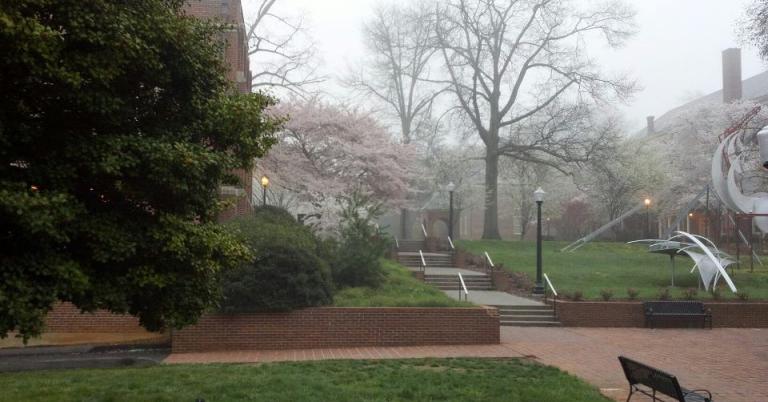
pic credit: Michael Santoroski | Springtime at Roanoke | 03.23.12 | creative commons
This is a picture of Roanoke College, the 2nd oldest Lutheran College in America. Roanoke College is devoted to Ecumenicism and to the Liberal Arts, however the school still values its Lutheran heritage.
The thumbnail featured image is the clocktower and walkways at Spring Arbor University, a truly Ecumenical school.
General Christian
Catholic
Relationships and Religion
History and Religion
Previous Post

November 21, 2022
Ways you can make an interfaith marriage work
Next Post

December 1, 2022 drawing upon good from Ecclesiastes | 14 writings
Browse Our Archives
Select a Category Communion Cruz Ingle Crystal Ingle Early Church Engaging Culture Ethics & Society Family Formation History In Dialogue Jared & Crystal Kingdom of God Majority World Church Mateo Ingle Messenger College Mission Narrative Pentecostal Church of God Prayer Shepherding The Sermon The Writings Theology Theology & Psychology Traverse City Uncategorized Vernell Ingle Word Study
Select a Month October 2026 September 2026 August 2026 July 2026 June 2026 May 2026 March 2026 February 2026 January 2026 December 2025 October 2025 September 2025 August 2025 July 2025 June 2025 May 2025 April 2025 March 2025 February 2025 January 2025 December 2024 November 2024 October 2024 September 2024 August 2024 July 2024 June 2024 May 2024 April 2024 March 2024 February 2024 January 2024 December 2023 November 2023 October 2023 September 2023 August 2023 July 2023 June 2023 May 2023 April 2023 March 2023 February 2023 January 2023 December 2022 November 2022 October 2022 September 2022 August 2022 July 2022 June 2022 May 2022 April 2022 March 2022 February 2022 January 2022 December 2021 November 2021 October 2021 September 2021 August 2021 July 2021 June 2021 May 2021 April 2021 March 2021 February 2021 January 2021 December 2020 November 2020 October 2020 September 2020 August 2020 July 2020 June 2020 May 2020 April 2020 March 2020 February 2020 January 2020 December 2019 November 2019 October 2019 September 2019 August 2019 July 2019 June 2019 May 2019 April 2019 March 2019 February 2019 January 2019 December 2018 November 2018 October 2018 September 2018 August 2018 July 2018 June 2018 May 2018 April 2018 March 2018 February 2018 May 2017 March 2017 March 2014 February 2013 January 2013 October 2012 July 2012 May 2012 April 2012 March 2012 February 2012 January 2012 December 2011 August 2010
Follow Us!
TAKE THE
Religious Wisdom Quiz
In the Parable of the Good Samaritan, who ignored the injured man before the Samaritan helped?
Select your answer to see how you score.
A farmer and a shepherd A priest and a Levite A fisherman and a tax collector A Roman soldier and a scribe
Related posts from Jared Ingle

Be Still and Know That I am God



Continuing to Pray for the Future Wife
TRENDING AT PATHEOS Evangelical

How the author of the world's best hymn...
I've been working with John Newton for a while now. This makes...

Long before this Lectio Divina, Psalm 130 - the song - started...

What About the Trees? Another Living Parable
After I finished writing the last article about falling leaves as a...

Why Classical Education Is a Conversation, Not a...
Come and Read: Joy in Classical Education When I was a little...

Falling Leaves: A Living Parable on Letting Go
I’ve spent the vast majority of my life in the southeast corner...

Cornell University has received a great deal of negative publicity and intense...
view all Evangelical blogs
Ad-Free & Subscriber Log-In Subscription Support
- About Us
- 2026 Calendar
- Videos
- Podcasts
- Library of World Religions
- Faith In Media Tracker
- Advertise With Us
- Write for Us
- Privacy Policy
- Terms of Service
- Do Not Sell My Data
- Contact Us
- Radiant Digital
- Manage Newsletter Subscriptions
- Unsubscribe From Notifications
- Sitemap
Copyright 2008-2026, Patheos. All rights reserved.
Subscription Support Ad-Free & Subscriber Log-In
Follow Patheos