
BuddhistCatholicContemplativeEvangelicalGeneral ChristianHinduJewishLatter-day SaintMuslimNew VisionsProgressive Christian
Beliefs
- Buddhist
- Catholic
- Contemplative
- Evangelical
- General Christian
- Hindu
- Jewish
- Latter-day Saint
- More Voices
- Muslim
- New Visions
- Pagan
- Progressive Christian
Topics
- Religion News
- Food and Religion
- Sports and Religion
- Religious Art
- Religious Music and Entertainment
- Religious Events
- History and Religion
- Style and Religion
- Politics and Religion
- Women in Religion
- Recreation Outdoors and Religion
- Business Finance and Religion
- Careers Workplace and Religion
- Education and Religion
- Family Parenting and Religion
- Health Fitness and Religion
- Home and Religion
- Relationships and Religion
- Technology and Religion
- Travel and Religion
Columnists
- Buddhist Columnists
- Business Finance and Religion Columnists
- Careers Workplace and Religion Columnists
- Catholic Columnists
- Contemplative Columnists
- Education and Religion Columnists
- Evangelists Columnists
- Family Parenting and Religion Columnists
- General Christian Columnists
- Health Fitness and Religion Columnists
- Hindu Columnists
- History and Religion Columnists
- Home and Religion Columnists
- Jewish Columnists
- More Voices Columnists
- Latter Day Columnists
- Muslim Columnists
- New Visions Columnists
- Nonreligious Columnists
- Pagan Columnists
- Politics and Religion Columnists
- Progressive Columnists
- Recreation Outdoors and Religion Columnists
- Relationships and Religion Columnists
- Religion News Columnists
- Religious Art Columnists
- Religious Events Columnists
- Religious Music and Entertainment Columnists
- Sports and Religion Columnists
- Style and Religion Columnists
- Technology and Religion Columnists
- Travel and Religion Columnists
- Women in Religion Columnists
Resource Library
- 2026 Calendar
- Library of World Religions
- The 100 Most Holy Places on Earth
- Patheos Answers
- Podcasts
- Videos
- Faith Leaders Database
- Anglican Episcopalian
- Bahai
- Baptist
- Buddhism
- Christianity
- Confucianism
- Eastern Orthodoxy
- Hinduism
- Holiness and Pentecostal
- ISKCON
- Islam
- Judaism
- Lutheran
- Methodist
- The Church of Jesus Christ of Latter-day Saints
- New Age
- Paganism
- Presbytarian and Reformed
- Protestantism
- Religion Behind the Scenes
- Roman Catholic
- Scientology
- Shia Islam
- Sikhism
- Sufism
- Sunni Islam
- Taoism
- Zen
- See all religions
Research Tools
 Ad-Free & Subscriber Log-In Subscription Support
Ad-Free & Subscriber Log-In Subscription Support
Follow Patheos 

- Trending:
- Forgiveness
- |
- Marriage
- |
- Consciousness
- |
- Death Penalty
- |
- Election
- |
- Halloween

- Home
- Evangelical
- Do people create a 3rd space or a 3rd order?
Do people create a 3rd space or a 3rd order?
Last updated on: May 15, 2022 at 6:53 pm by Rev. Jared V. Ingle
Do people create a 3rd space or a 3rd order? 2022-05-15T18:53:13-04:00 Rev. Jared V. Ingle
Patheos Explore the world's faith through different perspectives on religion and spirituality! Patheos has the views of the prevalent religions and spiritualities of the world.
Do people create a 3rd space or a 3rd order?
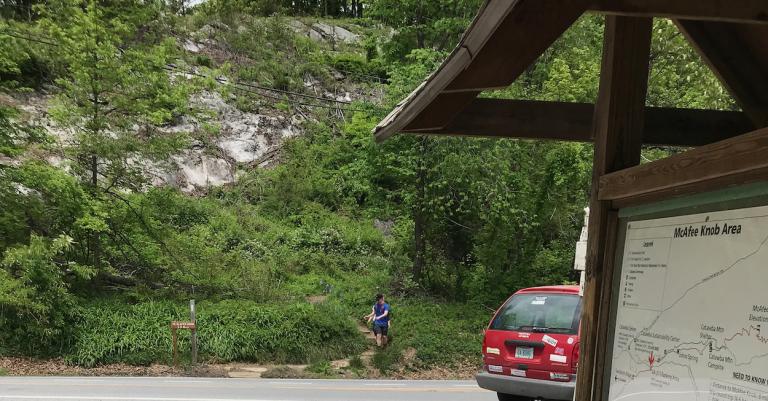
JVI | Teo & Ashley | McAfee Knob trailhead | 06.12.22
How can the practice of solitude, silence, and even a sense of communion with the natural order be separated from the decisions-miracles-dialogues which follow many of the vignettes at the beginning of Mark’s account?
Teachings usually occur in the synagogues, at the Temple Festivals, possibly at a prominent leader’s home as well. We see multiple examples of this in the Gospel. However, we see a real 3rd space or order open up (beyond the synagogue and Temple). John the Baptist and Jesus Christ draw the masses into the countryside.
i. i’ve read some rules of order, and rules from other people
Among them would be Benedict, Cassian, Athanasius re: Antony from Egypt; the Didache; and catecheses from various schools like those of Irenaeus of Lyons-Gual-France and Clement of Alexandria-N. Africa, etc.
It can be difficult for some to connect their works on Christian practices to present day, mainstream catechesis or discipleship.
ii. furthermore, we artificially lift practices today
In other words, we lift practices from the Text. We examine them separately for teaching purposes at all levels of education, in the Western World specifically.
Those who propose such means of teaching do so with an air of regret. It’s often too difficult to teach practices within their holistic context.
In the Passages that follow, how can the practice of solitude, silence, and even a sense of communion with the natural order be separated from the decisions-miracles-dialogues which follow many of these vignettes at the beginning of Mark’s account?
Mark 1.4-5, 9, 12-13, 35-36, 45; 2.13, 23; 3.7-9; 4.1, 35
iii. this does not diminish of leaders from the mid-1970’s
I am thinking especially of those who explore an ancient order, or the practices, and reintroduce them to the church, especially those in the Western Church. John Ortberg pastors not far from Stanford. Siang-Yang Tan teaches at Fuller and pastors an Asean-American congregation. Richard and John Foster oversee Renovare. Dallas Willard serves as the chair of the philosophy department at USC. Ruth Haley Barton launches a leadership institute. Cheryl Bridges-Johns develops a pedagogy for the oppressed. Virginia Holeman establishes counseling and pastoral care leaders through Asbury’s programmes.
The reason I list these people (and there are more reasons) is because they are people I have read or know, or both. They impress me in books and articles with their attention to detail and their acumen for integration. They also have ways of correlating ancient practices to current discipleship practice.
a) they display commitment to empirical research
Today, perhaps moreso than ever, empiricism is necessary with regards to the practices.
This is important in all types of pastoral care and writings with psychological implications. I’m sure now, you simply can’t publish without a little bit of support for what you say.
b) I am personally committed to the writings of the Primitive Church
Sometimes, one can tell which writers go back to the leaders from that era, and which writers rely on other writers who go back to the writings of the Primitive Church.
c) I have often tried to avoid what I call liberal Theological interpretation
However, there are some doctrines-confessions of the Primitive Church that have withstood the test of time. Apart from regional synods, global councils, and the seven confessions, some of these beliefs develop alongside the writings of the New Testament (Didache 60-120 AD and Apostle’s Creed, etc.).
Then there are doctrines – especially since the last century – that upwards of 80-90% of the church world has agreed upon (i.e. Trinity). Consider the anthropological fact that there may still be 7 billion people in the world, as of the last 10-15 years. 2 billion of those people profess some type of Christian faith (2 in every 7 people). I would say that’s a lot of unity. We have a lot more to agree about, than to disagree about.
Of course there are those who will advocate for false doctrine, and we have to eventually turn a deaf ear to them, as the church has done to heretics throughout the ages. However, the lists of names I have presented is a representation of people who teach time-honored practices.
iv. with great respect, I am bound to repeat the fact that the ancient Near East is in some ways the center of the world
Peoples connect through the aNE by overland highway networks and by maritime trade. Whether from Italy to the Eastern seaboard of the kingdoms of Africa; maritime trade from Africa to Arabia and the Indus-Pacific; the Mediterranean trade; and perhaps points north of modern day Turkey.
The aNE net of connections certainly influences our contemplative practices. We could compare the writings in the Hebrew Bible, the New Testament, and the Primitive Church.
v. once again, the 3rd space is the question at hand
In the Passages that follow, how can the practice of solitude, silence, and even a sense of communion with the natural order be separated from the decisions-miracles-dialogues which follow many of these vignettes at the beginning of Mark’s account?
Mark 1.4-5, 9, 12-13, 35-36, 45; 2.13, 23; 3.7-9; 4.1, 35
I suppose one could chase this theme throughout Mark’s brief and poignant account.
I am definitely not an expert on topography.
Geographies have continued to be an interest.
However, the reason why I mention topography is because there could be some factors making Jesus very easy to access in these days of His early ministry in Galilee.
a) Galilee is never too far from bodies of water or a river
This could be a logistical nightmare for the ancient Hebrews whose navy or coast guard equivalent is mentioned often in the Psalms and other writings.
Perhaps they have to rely heavily on their allies, like Roman keepers at the gates (i.e. the call of Levi-Matthew). There could be a lot of traffic.
b) N. Galilee is at the convergence of ancient highways
There is the King’s Highway on the East side of Palestine. Along the West coast, there is some type of Egyptian road.
There seem to be some well-trafficked maritime routes all along the west coast from the time of the Philistines and later King Hiram, and onward.
There are indications that the great Mesopotamian-Fertile Crescent Highway drops down into Palestine from the Northeast. Mt. Seir is there, where some of the Horites-Hurrians from Ur are listed in the genealogies. This is the territory of Esau.
There are also hints of Asean-Arabian roads that remain somewhat of a mystery converging in the region (desert horseman, the silk road, etc.).
c) can anything good come out of Nazareth?
Could there be misunderstandings between those who are living in the metros of Jerusalem and the surrounding cities, and those in Nazareth-Galilee?
The Sea of Galilee has at least a couple other people groups who control regions of the waterfront in the Gospel.
Are the Galileans seen as too worldly, with their maritime and overland trade?
Do those in Judah think Galileans have compromised their allegiance because of their necessary trade route gatekeepers and coast guard allies?
vi. is the question of solitude and the created order beyond me?
Possibly, but I have many personal reasons to believe that in all of the literature I’ve read on the practices (ancient and post-critical) there is a dearth of writings on engaging the natural order.
Just read the table of contents of their books, or look up their articles. The above authors are common names among seminarians.
There are other religious faiths who may be light years ahead of Christian faiths on the issue.
Is it possible those in Nazareth are more in tune with those far reaches of the world than those in Judah?
Is it possible that Jesus and his band of followers, which is at least up to 70 active evangelists at one point (more than likely male and female) knows how to live as rustic, primitive, or backcountry campers?
Would it be much of a sacrifice for fisherman who work the night shift on the Sea of Galilee?
Would it be a sacrifice for Levi-Matthew who may be traveling and camping with a Roman Legion from city gate to city gate?
vii. is the question of a 3rd space or order beyond us, or is it only a question of sacrifice?
Do we really take time to connect with the natural order, the created order?
In these times, with nations still maintaining commitments and making new ones to public health on a grand scale, I have not heard anyone say that spending time outdoors is a terrible idea.
Is it possible that beyond our normal teaching environs, like the synagogue and the tabernacle, nature beckons us?
Is it possible that beyond the home groups mentioned in these same chapters, the open air calls to us?
Summer is approaching. It’s camp time again for many. Please remember there is always a camp nurse and perhaps many others on-hand who are medically trained, and trained cooks in the mess hall. Why not consider allowing yourself or your children to attend a Christian retreat if you missed a summer or two?
As stated earlier, it is really nothing new for the Temple and synagogues to be the location of teachings.
Apart from that, the homes of leaders are often seen as locations of teachings.
The common bond is usually the Pharisees who are leaders who take the teachings of the Law to the people.
viii. one particular 3rd space is found in the natural order
There are leaders like John the Baptist, our Lord Jesus Christ, the Disciples, and their band of evangelists. Something unprecedented is recurring, not seen since the times of the Hebrew Bible.
What type of 3rd space or order may open up for us? Is it beyond us or it it simply a matter of sacrifice? Backing down from the language of sacrifice, is it merely a matter of a good trade off?
Are there ways God can speak to or through us to other people?
Are there locations that have held great meaning, that hold great meaning, or will hold great meaning in the future, if we allow God to open the door in a manner of speaking?
related archives
Previous Post

May 11, 2022
just curious, is there an etymology for curiositas?
Next Post

May 17, 2022 I've heard it too many times | 3rd space, pt. 2
Browse Our Archives
Select a Category Communion Cruz Ingle Crystal Ingle Early Church Engaging Culture Ethics & Society Family Formation History In Dialogue Jared & Crystal Kingdom of God Majority World Church Mateo Ingle Messenger College Mission Narrative Pentecostal Church of God Prayer Shepherding The Sermon The Writings Theology Theology & Psychology Traverse City Uncategorized Vernell Ingle Word Study
Select a Month October 2026 September 2026 August 2026 July 2026 June 2026 May 2026 March 2026 February 2026 January 2026 December 2025 October 2025 September 2025 August 2025 July 2025 June 2025 May 2025 April 2025 March 2025 February 2025 January 2025 December 2024 November 2024 October 2024 September 2024 August 2024 July 2024 June 2024 May 2024 April 2024 March 2024 February 2024 January 2024 December 2023 November 2023 October 2023 September 2023 August 2023 July 2023 June 2023 May 2023 April 2023 March 2023 February 2023 January 2023 December 2022 November 2022 October 2022 September 2022 August 2022 July 2022 June 2022 May 2022 April 2022 March 2022 February 2022 January 2022 December 2021 November 2021 October 2021 September 2021 August 2021 July 2021 June 2021 May 2021 April 2021 March 2021 February 2021 January 2021 December 2020 November 2020 October 2020 September 2020 August 2020 July 2020 June 2020 May 2020 April 2020 March 2020 February 2020 January 2020 December 2019 November 2019 October 2019 September 2019 August 2019 July 2019 June 2019 May 2019 April 2019 March 2019 February 2019 January 2019 December 2018 November 2018 October 2018 September 2018 August 2018 July 2018 June 2018 May 2018 April 2018 March 2018 February 2018 May 2017 March 2017 March 2014 February 2013 January 2013 October 2012 July 2012 May 2012 April 2012 March 2012 February 2012 January 2012 December 2011 August 2010
Follow Us!
TAKE THE
Religious Wisdom Quiz
Which letter addresses the "fruit of the Spirit"?
Select your answer to see how you score.
Colossians Hebrews Romans Galatians
Related posts from Jared Ingle


Fully Human vs. Sub-Human | Children vs. Dogs


TRENDING AT PATHEOS Evangelical

How the author of the world's best hymn...
I've been working with John Newton for a while now. This makes...

Long before this Lectio Divina, Psalm 130 - the song - started...

What About the Trees? Another Living Parable
After I finished writing the last article about falling leaves as a...

Why Classical Education Is a Conversation, Not a...
Come and Read: Joy in Classical Education When I was a little...

Falling Leaves: A Living Parable on Letting Go
I’ve spent the vast majority of my life in the southeast corner...

Cornell University has received a great deal of negative publicity and intense...
view all Evangelical blogs
Ad-Free & Subscriber Log-In Subscription Support
- About Us
- 2026 Calendar
- Videos
- Podcasts
- Library of World Religions
- Faith In Media Tracker
- Advertise With Us
- Write for Us
- Privacy Policy
- Terms of Service
- Do Not Sell My Data
- Contact Us
- Radiant Digital
- Manage Newsletter Subscriptions
- Unsubscribe From Notifications
- Sitemap
Copyright 2008-2026, Patheos. All rights reserved.
Subscription Support Ad-Free & Subscriber Log-In
Follow Patheos