
BuddhistCatholicContemplativeEvangelicalGeneral ChristianHinduJewishLatter-day SaintMuslimNew VisionsProgressive Christian
Beliefs
- Buddhist
- Catholic
- Contemplative
- Evangelical
- General Christian
- Hindu
- Jewish
- Latter-day Saint
- More Voices
- Muslim
- New Visions
- Pagan
- Progressive Christian
Topics
- Religion News
- Food and Religion
- Sports and Religion
- Religious Art
- Religious Music and Entertainment
- Religious Events
- History and Religion
- Style and Religion
- Politics and Religion
- Women in Religion
- Recreation Outdoors and Religion
- Business Finance and Religion
- Careers Workplace and Religion
- Education and Religion
- Family Parenting and Religion
- Health Fitness and Religion
- Home and Religion
- Relationships and Religion
- Technology and Religion
- Travel and Religion
Columnists
- Buddhist Columnists
- Business Finance and Religion Columnists
- Careers Workplace and Religion Columnists
- Catholic Columnists
- Contemplative Columnists
- Education and Religion Columnists
- Evangelists Columnists
- Family Parenting and Religion Columnists
- General Christian Columnists
- Health Fitness and Religion Columnists
- Hindu Columnists
- History and Religion Columnists
- Home and Religion Columnists
- Jewish Columnists
- More Voices Columnists
- Latter Day Columnists
- Muslim Columnists
- New Visions Columnists
- Nonreligious Columnists
- Pagan Columnists
- Politics and Religion Columnists
- Progressive Columnists
- Recreation Outdoors and Religion Columnists
- Relationships and Religion Columnists
- Religion News Columnists
- Religious Art Columnists
- Religious Events Columnists
- Religious Music and Entertainment Columnists
- Sports and Religion Columnists
- Style and Religion Columnists
- Technology and Religion Columnists
- Travel and Religion Columnists
- Women in Religion Columnists
Resource Library
- 2026 Calendar
- Library of World Religions
- The 100 Most Holy Places on Earth
- Patheos Answers
- Podcasts
- Videos
- Faith Leaders Database
- Anglican Episcopalian
- Bahai
- Baptist
- Buddhism
- Christianity
- Confucianism
- Eastern Orthodoxy
- Hinduism
- Holiness and Pentecostal
- ISKCON
- Islam
- Judaism
- Lutheran
- Methodist
- The Church of Jesus Christ of Latter-day Saints
- New Age
- Paganism
- Presbytarian and Reformed
- Protestantism
- Religion Behind the Scenes
- Roman Catholic
- Scientology
- Shia Islam
- Sikhism
- Sufism
- Sunni Islam
- Taoism
- Zen
- See all religions
Research Tools
 Ad-Free & Subscriber Log-In Subscription Support
Ad-Free & Subscriber Log-In Subscription Support
Follow Patheos 

- Trending:
- Forgiveness
- |
- Marriage
- |
- Consciousness
- |
- Death Penalty
- |
- Election
- |
- Halloween

- Home
- Evangelical
- Koheleth draws our eyes to abuses of power
Koheleth draws our eyes to abuses of power
Last updated on: October 5, 2021 at 4:15 pm by Rev. Jared V. Ingle
Koheleth draws our eyes to abuses of power 2021-10-05T16:15:33-04:00 Rev. Jared V. Ingle
Patheos Explore the world's faith through different perspectives on religion and spirituality! Patheos has the views of the prevalent religions and spiritualities of the world.
Koheleth draws our eyes to abuses of power. The oppressed often have no one to comfort them, no one by their side, no advocate, no one to plead their case.
I have started a series on select passages from Ecclesiastes, offering a couple different approaches so far.
- regarding Solomon and the authorship of Ecclesiastes CLICK HERE
- knowing the times | an introduction to Ecclesiastes 3 CLICK HERE
- resonating in awe with the presence of God in Ecclesiastes CLICK HERE
- peace, love, and good questions in Ecclesiastes 3 CLICK HERE
- will of God vs. “what God has done” CLICK HERE
- “the good life” & its attraction CLICK HERE
- God’s hand holds all life CLICK HERE
i. one of Koheleth’s common threads in Ecclesiastes
Wisdom strengthen the wise
More than ten rulers of the city. Ecclesiastes 7.19, NKJV
The wisdom of the sage focuses on man in relation to others. In this new series of writings, we consider what he has to say about injustice, authority, and companionship.
We often have a tendency to compare ourselves with others. While some of what Koheleth relays may be seen as a trivial comparison, he is really driving at an underlying wisdom that we can develop in our daily relations. Godly wisdom is needed in our relationships with authorities and friends.
The Scripture for this article is Ecclesiastes 3.16-17; 4.1-6 CLICK HERE
ii. day of reckoning
Koheleth sees or perceives a truth “under the sun” (Eccl 3.16).
“The book of Eccl frequently repeats the phrase ‘under the sun’ to emphasize that this earthly life is lived in monotonous drudgery with little meaning when viewed from a godless perspective” (R. Laird Harris, Gleason L. Archer, and Bruce K. Waltke, eds., Theological Wordbook of the Old Testament, vol. 2, Moody Press, p. 940).
Koheleth sees wickedness flourish in places where justice and righteousness ought to rule (Eccl 3.16). We tend to equate the place of judgment with the courts. In fact, one translation states:
I also noticed that under the sun there is evil in the courtroom. Yes, even the courts of law are corrupt! Eccl 3.16, NLT
However, judgment is a term that not only includes the judicial branch of government, but any and all activities of civil authorities. Where there should be proper civil action, where there should be righteous and Godly ethical behavior, there is wickedness.
Here, Koheleth is talking about the civil government, but remember Israel is a Theocracy, not a Democracy. It is a government ruled by priests and kings. In our society, Koheleth might speak of great churches or denominations, wielding great power in society.
iii. are there ever abuses of power within the church?
How can we develop or encourage proper Biblical church authority?
What is one to do when he witnesses this type of corruption?
Koheleth reminds himself that there is a day of reckoning. There is a day when everyone will stand before God’s judgment seat, “there is a time,” or there is a “due season” (Eccl 3.17, NKJV and NLT).
Once again, the poet refers to the sacredness of time. However, the divine appointment he speaks of now will not be so welcomed by everyone.
I said to myself,
“God will bring into judgment
both the righteous and the wicked,
for there will be a time for every activity,
a time to judge every deed.” Eccl 3.17, NIV
For those who serve God, the day of reckoning is a welcomed event, a rite of passage into everlasting life. For the wicked, this is a terrifying moment, a pronouncement of damnation, a point of entrance into everlasting torment.
All will be revealed.
We can either take comfort in this thought, as Koheleth does, or we can be terrified by it.
iv. plight of the oppressed
The eyes of Koheleth are opened to the world around him, and to true suffering. If Koheleth is indeed Solomon, then he has lived his entire life in the courts of the king. There are a completely different set of troubles that someone like Solomon faces, but in the following statements he appears to be moved with compassion for the needs of others.
No matter how difficult our times may be, we can usually find someone who is suffering to a greater degree. May our eyes be turned ever outward, not merely inward.
James L. Kugel, a Hebrew Bible scholar masterfully translates Koheleth’s statement of compassion from Eccl 4.1:
“But I reconsidered and saw all the oppression that is done on this earth – look, there are the tears of the oppressed, who have no one on their side. Their oppressors have the power, but they have no one on their side.” (The Great Poems of the Bible: A Reader’s Companion with New Translations, Free Press, pgs. 317-318)
Koheleth takes a closer look at the oppressed who are crying out. His main concern is not simply that they do not have enough, but that they are oppressed by others.
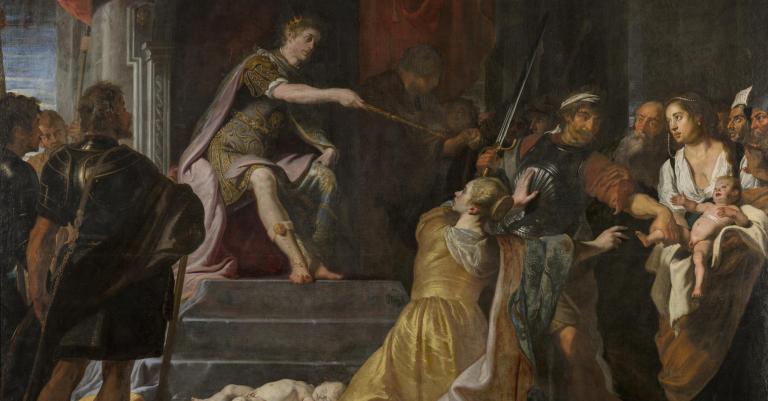
Gaspar de Crayer | Het Oordeel van Salomo | circa 1620-1622 | creative commons
“The verbal root ‘ashaq [oppressed] is concerned with acts of abuse of power or authority, the burdening, trampling, and crushing of those lower in station.” (R. Laird Harris, Gleason L. Archer, and Bruce K. Waltke, eds., Theological Wordbook of the Old Testament, vol. 2, Moody Press, p. 705)
There are those who maliciously take advantage of people under their influence.
v. Koheleth draws our eyes to abuses of power
The oppressed often have no one to comfort them, no one by their side, no advocate, no one to plead their case.
“The point is the powerlessness of man in the face of these disorders, his inability to right himself, the incompetence of others to aid him.” (W.J. Deane, “Ecclesiastes,” The Pulpit Commentary: Proverbs, Ecclesiastes, Song of Solomon, vol. 9, ed. H.D.M. Spence and Joseph S. Exell, Wm. B. Eerdmans, p. 87)
Koheleth exclaims it would be better to die than to continue to face this type of suffering, or rather that those who are dead do not have these concerns any longer (Eccl 4.2).
He goes one step further and says that it would be better for someone to not be born, than to face these troubles (Eccl 4.3).
vi. are we authentically connecting with the oppressed?
How often do we look at suffering and offer trite, Christian-sounding answers?
Koheleth offers no surface-level response. He leans in, connects with, and validates the oppressed.
Sometimes we suffer in this life and there is no apparent answer or reward. Koheleth does not say suffering is pointless, or God is not involved. He simply joins with the oppressed.
How would others feel if we authentically reached out to them and joined them in the point of their need?
How would they feel if we genuinely comforted them, walked by their side, advocated for them, took up their cause?
What is our typical response when we engage those who are suffering?
Do we join them at the point of their need, or do we try to cheer them up with a trite thought?
Rejoice with those who rejoice, and weep with those who weep. Romans 12.15
Previous Post

October 2, 2021
the university guides us through Dante's "Divine Comedy"
Next Post
October 7, 2021 more on abuse | R. Kelly, Thema Bryant-Davis, Sarah Reeves, & Job
Browse Our Archives
Select a Category Communion Cruz Ingle Crystal Ingle Early Church Engaging Culture Ethics & Society Family Formation History In Dialogue Jared & Crystal Kingdom of God Majority World Church Mateo Ingle Messenger College Mission Narrative Pentecostal Church of God Prayer Shepherding The Sermon The Writings Theology Theology & Psychology Traverse City Uncategorized Vernell Ingle Word Study
Select a Month October 2026 September 2026 August 2026 July 2026 June 2026 May 2026 March 2026 February 2026 January 2026 December 2025 October 2025 September 2025 August 2025 July 2025 June 2025 May 2025 April 2025 March 2025 February 2025 January 2025 December 2024 November 2024 October 2024 September 2024 August 2024 July 2024 June 2024 May 2024 April 2024 March 2024 February 2024 January 2024 December 2023 November 2023 October 2023 September 2023 August 2023 July 2023 June 2023 May 2023 April 2023 March 2023 February 2023 January 2023 December 2022 November 2022 October 2022 September 2022 August 2022 July 2022 June 2022 May 2022 April 2022 March 2022 February 2022 January 2022 December 2021 November 2021 October 2021 September 2021 August 2021 July 2021 June 2021 May 2021 April 2021 March 2021 February 2021 January 2021 December 2020 November 2020 October 2020 September 2020 August 2020 July 2020 June 2020 May 2020 April 2020 March 2020 February 2020 January 2020 December 2019 November 2019 October 2019 September 2019 August 2019 July 2019 June 2019 May 2019 April 2019 March 2019 February 2019 January 2019 December 2018 November 2018 October 2018 September 2018 August 2018 July 2018 June 2018 May 2018 April 2018 March 2018 February 2018 May 2017 March 2017 March 2014 February 2013 January 2013 October 2012 July 2012 May 2012 April 2012 March 2012 February 2012 January 2012 December 2011 August 2010
Follow Us!
TAKE THE
Religious Wisdom Quiz
True or False: Hebrews states that it is appointed for men to die once, and after this comes judgment.
Select your answer to see how you score.
TRUE FALSE
Related posts from Jared Ingle

Be Still and Know That I am God

Fully Human vs. Sub-Human | Children vs. Dogs


Subjective Experiences with Peace
TRENDING AT PATHEOS Evangelical

The REST of Your Life: A Creative Wrestles...
This week I had a conversation with a good friend from church....

How the author of the world's best hymn...
I've been working with John Newton for a while now. This makes...

Long before this Lectio Divina, Psalm 130 - the song - started...

What About the Trees? Another Living Parable
After I finished writing the last article about falling leaves as a...

Why Classical Education Is a Conversation, Not a...
Come and Read: Joy in Classical Education When I was a little...

Cornell University has received a great deal of negative publicity and intense...
view all Evangelical blogs
Ad-Free & Subscriber Log-In Subscription Support
- About Us
- 2026 Calendar
- Videos
- Podcasts
- Library of World Religions
- Faith In Media Tracker
- Advertise With Us
- Write for Us
- Privacy Policy
- Terms of Service
- Do Not Sell My Data
- Contact Us
- Radiant Digital
- Manage Newsletter Subscriptions
- Unsubscribe From Notifications
- Sitemap
Copyright 2008-2026, Patheos. All rights reserved.
Subscription Support Ad-Free & Subscriber Log-In
Follow Patheos