
BuddhistCatholicContemplativeEvangelicalGeneral ChristianHinduJewishLatter-day SaintMuslimNew VisionsProgressive Christian
Beliefs
- Buddhist
- Catholic
- Contemplative
- Evangelical
- General Christian
- Hindu
- Jewish
- Latter-day Saint
- More Voices
- Muslim
- New Visions
- Pagan
- Progressive Christian
Topics
- Religion News
- Food and Religion
- Sports and Religion
- Religious Art
- Religious Music and Entertainment
- Religious Events
- History and Religion
- Style and Religion
- Politics and Religion
- Women in Religion
- Recreation Outdoors and Religion
- Business Finance and Religion
- Careers Workplace and Religion
- Education and Religion
- Family Parenting and Religion
- Health Fitness and Religion
- Home and Religion
- Relationships and Religion
- Technology and Religion
- Travel and Religion
Columnists
- Buddhist Columnists
- Business Finance and Religion Columnists
- Careers Workplace and Religion Columnists
- Catholic Columnists
- Contemplative Columnists
- Education and Religion Columnists
- Evangelists Columnists
- Family Parenting and Religion Columnists
- General Christian Columnists
- Health Fitness and Religion Columnists
- Hindu Columnists
- History and Religion Columnists
- Home and Religion Columnists
- Jewish Columnists
- More Voices Columnists
- Latter Day Columnists
- Muslim Columnists
- New Visions Columnists
- Nonreligious Columnists
- Pagan Columnists
- Politics and Religion Columnists
- Progressive Columnists
- Recreation Outdoors and Religion Columnists
- Relationships and Religion Columnists
- Religion News Columnists
- Religious Art Columnists
- Religious Events Columnists
- Religious Music and Entertainment Columnists
- Sports and Religion Columnists
- Style and Religion Columnists
- Technology and Religion Columnists
- Travel and Religion Columnists
- Women in Religion Columnists
Resource Library
- 2026 Calendar
- Library of World Religions
- The 100 Most Holy Places on Earth
- Patheos Answers
- Podcasts
- Videos
- Faith Leaders Database
- Anglican Episcopalian
- Bahai
- Baptist
- Buddhism
- Christianity
- Confucianism
- Eastern Orthodoxy
- Hinduism
- Holiness and Pentecostal
- ISKCON
- Islam
- Judaism
- Lutheran
- Methodist
- The Church of Jesus Christ of Latter-day Saints
- New Age
- Paganism
- Presbytarian and Reformed
- Protestantism
- Religion Behind the Scenes
- Roman Catholic
- Scientology
- Shia Islam
- Sikhism
- Sufism
- Sunni Islam
- Taoism
- Zen
- See all religions
Research Tools
 Ad-Free & Subscriber Log-In Subscription Support
Ad-Free & Subscriber Log-In Subscription Support
Follow Patheos 

- Trending:
- Forgiveness
- |
- Marriage
- |
- Consciousness
- |
- Death Penalty
- |
- Election
- |
- Halloween

- Home
- Evangelical
- Ephesians 6 | Children & Parents
Ephesians 6 | Children & Parents
Last updated on: February 17, 2020 at 12:07 pm by Rev. Jared V. Ingle
Ephesians 6 | Children & Parents 2020-02-17T12:07:52-05:00 Rev. Jared V. Ingle
Patheos Explore the world's faith through different perspectives on religion and spirituality! Patheos has the views of the prevalent religions and spiritualities of the world.
Some people elevate the parental relationship so high that they seem to forget how to engage in the marital relationship. In a healthy family, the parents are a dyad, and the children are not on the same level. However, if the parents blur the boundaries with their children, an unhealthy triangulation occurs. Any time there is a triangulation that comes between the marital dyad, there is dysfunction.
Wherefore they are no more twain, but one flesh. What therefore God hath joined together, let not man put asunder. – Matthew 19.6, KJV
i. Guard the dyad
Someone else outside of the marriage is not always the one who comes in between the dyad. Many times, the parents blur the boundaries with their own children, and lose track of the marital bliss that makes them tick as a couple. One of the marks of a healthy family is that it guards the marital dyad.
Children & Parents
Do we want to be parents or buddies with our children? There is room for both, but the Scripture is clear that at the end of the day, we’re parents. Our key passage in Ephesians 6 is clearly divided between children (verses 1-3) and parents (verse 4).
Children, obey your parents in the Lord, for this is right. “Honor your father and mother”—this is the first commandment with a promise: “so that it may be well with you and you may live long on the earth.” – Ephesians 6.1-3, NRSV
And, fathers, do not provoke your children to anger, but bring them up in the discipline and instruction of the Lord. – verse 4
ii. Implications for the church
Sometimes we have to ask this type of question at work or in the congregation. Do we want to be buddies with everyone or are there specific roles and functions that are needed? I can speak for the congregation more than the marketplace. If we take a look at passages like Acts 6.1-6; Romans 12.4-8, 1 Corinthians 12.27-28; and Ephesians 4.11-12 we see that there are roles among the people of God.
As leadership, we want to empower people to share the Gifts that God has given them. These are endowments of virtue from the Holy Spirit. So our pneumatology may need to include a robust treatment of our participation in God’s good work.
On the other hand, we are not defined merely by our roles in the home or congregation. The relationships in the NT Church are probably a lot more organic than we can imagine today.
In the same way, the boundaries in the home empower the parents to be parents who empower their children to grow and mature into the people God has created them to be.
iii. Recognizing distinct roles in the home
In some ways, families in the ancient Near East (aNE) reflect the greater class or caste systems of their times. The Jewish philosopher Philo, who is a contemporary of our Lord and The Twelve, writes a Household Code based on the 10 Commandments (De Decalogo). He points out that there are class distinctions in the aNE home.
For parents belong to the superior class of the above-mentioned pairs, that which comprises senior, ruler, benefactors and masters, while children occupy the lower position with juniors, subjects, receivers of benefits, slaves.[1]
In some ways, Paul seems to agree with this distinction between parents and children. He clearly demonstrates that there is a chain of command, and a level of honor that must be maintained in the home. Paul and Philo are both basing this portion of their code off of the 10 Commandments.
The term “obedience” is made up of the preposition hupo in the Greek, which means “under” and the word akuo which means “to hear.” Thus the word means to listen with a submissive attitude.[2]
Couple the word obey with honor, which is a lifelong commitment to treat your parents with respect and reverence, and you have a very strong command for children. At the very least, we can teach children to obey while in the home, and to honor for a lifetime.
iv. Respect your elders?
We live in a culture that is largely driven by youth. For instance, how often do we see marketing that is directed at the elderly? How often are wise old sages the main characters in our movies? How many bands are there who have aged gracefully, while remaining a driving force in the music industry? Certainly we’re not living in an age when we can watch a young Frank Sinatra mature over time into an older Sinatra who is still packing out the largest venues.
Have our priorities changed? Do we still listen to the voice of the wise old sage? Is the old maxim respect your elders another saying that has faded with yesteryear? Or as a culture, have we left the elders at the gate of the city in our quest for the elusive fountain of youth?
v. Paul’s unique Household Code
There are instructions to children in the aNE Household Codes, but they are generally addressed to adult children who are caring for their aging parents. Although this may be partly implied from Paul’s writing, Paul is not addressing adult children (Ephesians 6.1-3). He is addressing children directly. This is a unique addition to Paul’s Household Code.
Paul’s message assumes that children are welcome in the reading community and that they are actually present in the congregation. This also assumes that they have the ability to become Christians as children. Paul is appealing to them not only as children, but also as children of God
Despite the prevailing culture that appeals primarily to the adults, it is unique that Paul begins this part of the Household Code by addressing children.
vi. All powerful fathers
Paul changes the role of the father in the Household Code, another unique addition that sets it apart from other aNE literature.
“The authority of the Roman father was legendary in the Greco-Roman world.”[3] The father has ability to choose to keep children, sell them, or put them up for adoption. He has the ability to approve or disapprove of the marriages of his children. He is in charge of all of his children’s educational pursuits and everything that crafts them into full-fledged citizens.
The father is all-powerful in the aNE Household Code, but Paul’s Household Code says do not exasperate your children . . . “fathers, do not provoke your children to anger” (Ephesians 6.4). Today we could say, do not neglect, do not micromanage their development, do not set the bar too high, do not fail to offer support, do not show favoritism, etc.[4] In all of these ways and more, we are capable of making life difficult for our children.
Apply the verse however you want, because that is exactly what Paul is commanding the fathers in the Primitive Church to do. This is a revolutionary statement that elevates the status of children, as a primary consideration for the all-powerful fathers of that age.
vii. Paideia
Although the all-powerful role of the father is weighed in the balance, the power of the father finds new ground in the church. In the aNE Household Codes, one of the roles of the fathers is to oversee the educational pursuits of their children. In ancient Greco-Roman society the education is of utmost importance. Education is a communal effort, usually overseen by the men of the local society. It’s called the paideia.
The paideia is more than just instruction in classroom settings, reading, writing, and arithmetic. It is the way that youth are molded into adults and responsible citizens. The paideia includes work outside of the classroom in apprenticeships. It includes athletics. In Greece it also includes a tour in the military. It includes training in philosophy, morality, ethics, and the classical Greek virtues.
Youth are crafted into thinkers, workers, warriors, and citizens who contribute to society. Society looks to the fathers, the heads of households, the businessmen, the warriors, to train the youth within the greater scope of the paideia.
viii. Why is this important?
Because this is exactly the term Paul uses. He not only uses the term “instruction” (Ephesians 6.4). He also uses the term “discipline,” or paideia in the Greek. Now we can define paideia however we like, looking back at the language. But how does the Primitive Church that speaks Koine Greek define paideia? They see it as it is being used by the Greco-Roman world. It is the commonweal for the education of the whole person.
Greek society looks to the fathers of their cities to oversee the paideia. Paul calls on the fathers of the Primitive Church to oversee a new paideia, one that raises up spiritual children to be responsible citizens of a new Kingdom.
This is not only about the home. This is not just about 1 father in 1 home. Paul is seldom uses the term father in that way. First and foremost, he uses the term father in relation to our Heavenly Father. Secondly, he uses the term father or fathers in the same way we would use our term founding fathers. He often uses father to refer to the role of an elder, or a great father of the faith like Abraham. Therefore, it is likely that Paul is calling on the fathers to rise up and pour a foundation for a new paideia, one that will raise up children and disciples for our Lord.
Are the lines blurred in the home or is the parental dyad protected?
Are children welcome, not only as family, but in the congregation as fellow believers?
Paul makes children welcome among the people of God, do we?
Is Paul also calling for education in the home and church through mentoring relationships?
Rev. Jared Ingle
Pastor: Long Lake Friends Church
Supervised Therapist: personal, couples, families
Traverse City, MI
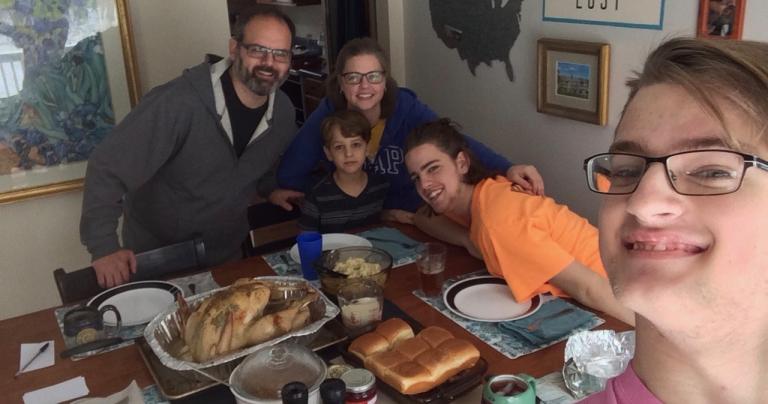
DCI | Thanksgiving with the Ingle5 | 11.28.19
series articles:
Submission CLICK HERE
Submission in the House of God CLICK HERE
The Sanctity of Water & the Word CLICK HERE
The Husband as Kephale CLICK HERE
Paul on the Role of Husband & Savior CLICK HERE
Revisiting the Wife’s Role as Help Meet CLICK HERE
Love CLICK HERE
Respect CLICK HERE
series sermons:
Submission CLICK HERE
Sanctification CLICK HERE
Sexuality CLICK HERE
Husband, Head & Savior CLICK HERE
Revisiting the Wife’s Role as Help Meet CLICK HERE
Love CLICK HERE
Respect CLICK HERE
notes:
[1] Philo quoted in Paul J. Achtemeier, Joel B. Green, and Marianne Meye Thompson, Introducing the New Testament: It’s Literature and Theology (Grand Rapids, MI: Wm. B. Eerdmans, 2001), 525. [2] Vernell Ingle, The Truth About The Family: Biblical Patterns And Principles (Joplin, MO: Messenger Publishing House, 2005), 104. [3] Achtemeier, Green, and Thompson, 47. [4] Frederick J. Long, OneBook Daily-Weekly: The Letter to the Ephesians (Franklin, TN: Seedbed Publishing, 2017), 125.
JC Ingle, Inc.
Previous Post

February 11, 2020
Themes & Memes | Christian Readings
Next Post

February 20, 2020 Infographics? | adding a little wisdom & definition
Browse Our Archives
Select a Category Communion Cruz Ingle Crystal Ingle Early Church Engaging Culture Ethics & Society Family Formation History In Dialogue Jared & Crystal Kingdom of God Majority World Church Mateo Ingle Messenger College Mission Narrative Pentecostal Church of God Prayer Shepherding The Sermon The Writings Theology Theology & Psychology Traverse City Uncategorized Vernell Ingle Word Study
Select a Month October 2026 September 2026 August 2026 July 2026 June 2026 May 2026 March 2026 February 2026 January 2026 December 2025 October 2025 September 2025 August 2025 July 2025 June 2025 May 2025 April 2025 March 2025 February 2025 January 2025 December 2024 November 2024 October 2024 September 2024 August 2024 July 2024 June 2024 May 2024 April 2024 March 2024 February 2024 January 2024 December 2023 November 2023 October 2023 September 2023 August 2023 July 2023 June 2023 May 2023 April 2023 March 2023 February 2023 January 2023 December 2022 November 2022 October 2022 September 2022 August 2022 July 2022 June 2022 May 2022 April 2022 March 2022 February 2022 January 2022 December 2021 November 2021 October 2021 September 2021 August 2021 July 2021 June 2021 May 2021 April 2021 March 2021 February 2021 January 2021 December 2020 November 2020 October 2020 September 2020 August 2020 July 2020 June 2020 May 2020 April 2020 March 2020 February 2020 January 2020 December 2019 November 2019 October 2019 September 2019 August 2019 July 2019 June 2019 May 2019 April 2019 March 2019 February 2019 January 2019 December 2018 November 2018 October 2018 September 2018 August 2018 July 2018 June 2018 May 2018 April 2018 March 2018 February 2018 May 2017 March 2017 March 2014 February 2013 January 2013 October 2012 July 2012 May 2012 April 2012 March 2012 February 2012 January 2012 December 2011 August 2010
Follow Us!
TAKE THE
Religious Wisdom Quiz
What does "Jericho" mean in Hebrew?
Select your answer to see how you score.
Place of fragrance Mount of olives Place of salt Dry ground
Related posts from Jared Ingle

Valentine’s Day | To Pray for What Seems...

The Business of Doing New Things
Rejoice | Reflections on Vacation
TRENDING AT PATHEOS Evangelical

How the author of the world's best hymn...
I've been working with John Newton for a while now. This makes...

Long before this Lectio Divina, Psalm 130 - the song - started...

What About the Trees? Another Living Parable
After I finished writing the last article about falling leaves as a...

Why Classical Education Is a Conversation, Not a...
Come and Read: Joy in Classical Education When I was a little...

Falling Leaves: A Living Parable on Letting Go
I’ve spent the vast majority of my life in the southeast corner...

Cornell University has received a great deal of negative publicity and intense...
view all Evangelical blogs
Ad-Free & Subscriber Log-In Subscription Support
- About Us
- 2026 Calendar
- Videos
- Podcasts
- Library of World Religions
- Faith In Media Tracker
- Advertise With Us
- Write for Us
- Privacy Policy
- Terms of Service
- Do Not Sell My Data
- Contact Us
- Radiant Digital
- Manage Newsletter Subscriptions
- Unsubscribe From Notifications
- Sitemap
Copyright 2008-2026, Patheos. All rights reserved.
Subscription Support Ad-Free & Subscriber Log-In
Follow Patheos