
BuddhistCatholicContemplativeEvangelicalGeneral ChristianHinduJewishLatter-day SaintMuslimNew VisionsProgressive Christian
Beliefs
- Buddhist
- Catholic
- Contemplative
- Evangelical
- General Christian
- Hindu
- Jewish
- Latter-day Saint
- More Voices
- Muslim
- New Visions
- Pagan
- Progressive Christian
Topics
- Religion News
- Food and Religion
- Sports and Religion
- Religious Art
- Religious Music and Entertainment
- Religious Events
- History and Religion
- Style and Religion
- Politics and Religion
- Women in Religion
- Recreation Outdoors and Religion
- Business Finance and Religion
- Careers Workplace and Religion
- Education and Religion
- Family Parenting and Religion
- Health Fitness and Religion
- Home and Religion
- Relationships and Religion
- Technology and Religion
- Travel and Religion
Columnists
- Buddhist Columnists
- Business Finance and Religion Columnists
- Careers Workplace and Religion Columnists
- Catholic Columnists
- Contemplative Columnists
- Education and Religion Columnists
- Evangelists Columnists
- Family Parenting and Religion Columnists
- General Christian Columnists
- Health Fitness and Religion Columnists
- Hindu Columnists
- History and Religion Columnists
- Home and Religion Columnists
- Jewish Columnists
- More Voices Columnists
- Latter Day Columnists
- Muslim Columnists
- New Visions Columnists
- Nonreligious Columnists
- Pagan Columnists
- Politics and Religion Columnists
- Progressive Columnists
- Recreation Outdoors and Religion Columnists
- Relationships and Religion Columnists
- Religion News Columnists
- Religious Art Columnists
- Religious Events Columnists
- Religious Music and Entertainment Columnists
- Sports and Religion Columnists
- Style and Religion Columnists
- Technology and Religion Columnists
- Travel and Religion Columnists
- Women in Religion Columnists
Resource Library
- 2026 Calendar
- Library of World Religions
- The 100 Most Holy Places on Earth
- Patheos Answers
- Podcasts
- Videos
- Faith Leaders Database
- Anglican Episcopalian
- Bahai
- Baptist
- Buddhism
- Christianity
- Confucianism
- Eastern Orthodoxy
- Hinduism
- Holiness and Pentecostal
- ISKCON
- Islam
- Judaism
- Lutheran
- Methodist
- The Church of Jesus Christ of Latter-day Saints
- New Age
- Paganism
- Presbytarian and Reformed
- Protestantism
- Religion Behind the Scenes
- Roman Catholic
- Scientology
- Shia Islam
- Sikhism
- Sufism
- Sunni Islam
- Taoism
- Zen
- See all religions
Research Tools
 Ad-Free & Subscriber Log-In Subscription Support
Ad-Free & Subscriber Log-In Subscription Support
Follow Patheos 

- Trending:
- Forgiveness
- |
- Marriage
- |
- Consciousness
- |
- Death Penalty
- |
- Election
- |
- Halloween

- Home
- Evangelical
- John Cassian on Ephesians 4.26-27
John Cassian on Ephesians 4.26-27
Last updated on: August 1, 2019 at 10:00 am by Rev. Jared V. Ingle
John Cassian on Ephesians 4.26-27 2019-07-31T19:27:46-04:00 Rev. Jared V. Ingle
Patheos Explore the world's faith through different perspectives on religion and spirituality! Patheos has the views of the prevalent religions and spiritualities of the world.
Last week, I explored what could be Hebrew parallelism in Paul’s writings to the Primitive Church in this portion of Ephesians. I showed the method, and how it might color our interpretation of Paul’s message. To read the article “Beauty in Paul’s Literature: Poet, Prophet, or Oracle,” CLICK HERE
This week, I pick up where I left off, with Ephesians 4.26-27. Generally, with what we are looking at in this passage, the 2nd line compliments the 1st line. The 3rd line then is a climax, or an axiom.
Although I seldom do this, every once in awhile I am attempting to write longreads. At times longer articles are good for SEO. On a personal note, there are times when I just enjoy a good article, or a good discussion. I almost added this to my In Dialogue category on Patheos – “In Dialogue with Paul and John Cassian.” However, I really can’t say I’m sitting down at the Grand Traverse Pie Company with them, discussing their homilies and practical applications. I’m not even in the Primitive Church, where Christians may have known these men, or at least some of their disciples. However, Paul and John Cassian are among the cloud of witnesses, so I hope I do not misrepresent them this week and next (Hebrews 12.1).
Cassian on Ephesians 4.26-27
Be angry and do not sin;
do not let the sun go down on your anger,
and give no opportunity to the devil.
Once again I include Ephesians 4.26-27 because it may be the hinge on which the last half of Ephesians 4 turns. Above this verse, there seems to be a swirling storm of virtues vs. vices, Christian vs. non-Christian, and Christian vs. carnal Christian. After this verse, there seems to be a settling of the waters. The following verses almost seem like Paul is writing Proverbs, wisdom literature, or pithy sayings. After our decision to give no room to the devil, everything seems to change, so this may be a climactic statement.
i. Enter John Cassian
John Cassian is from the East but he descends to the West. When all is said and done in his life, he is not perceived as a saint by the West, but he remains a saint in the East. Maybe it’s because he and Augustine aren’t exactly pen pals, but they are corresponding . . . more like debating. I don’t know if that’s the reason the East saints him and the West doesn’t.
Maybe Cassian is just misunderstood in the West. There are some things that are lost in translation for many years because the Primitive Church writes in Greek, and the West transitions into Latin. That may also explain why Origen is perceived as good . . . then bad . . . then good again by the West. However, Origen is always good in the East.
Augustine doesn’t even speak Greek, so there may be a language barrier between him and Cassian if Latin is not Cassian’s first language. More than likely according to history, Cassian disagrees with Augustine’s views which we now call predestination. Whatever the case, John Cassian leaves his mark on the Primitive Church and church history, and it is a very good mark indeed.
ii. Cassian may be on par with the Church Doctors
Cassian becomes a disciple of John Chrysostom. John Cassian writes The Institutes long before another John borrows the book title. Among all the elements of Cassian’s good work, he is probably the first to spell out the 8 deadly sins in detail. Later, Pope Gregory the Great combines a couple of the deadly sins, shortening the list to 7. However, Cassian’s work remains a landmark treatise in history.
I’m summarizing his thoughts on Ephesians 4.26-27 from a Christian readings course.[1] Today, John Cassian would ask us probing questions like:
What is the goal of your anger?
What is the end of your anger?
Do you wish to harm someone?
Do you wish for reciprocal harm?
Reciprocal means that you want to strike out at someone because you want to be hurt back.
Why would you want to be hurt in return?
Perhaps if you’re stuck back, then you’ll have an excuse to keep the divisiveness alive.
We are dastardly complex humans at times, bent on Hollywood scandals, media brawls in the fake news, and too much drama. Why do we keep engaging in petty battles?
I would say that Cassian may be on par with the Church Doctors, at least those in the Primitive Church. His story, although I can’t share all the details, certainly qualifies him.
iii. He ministers to and trains thousands
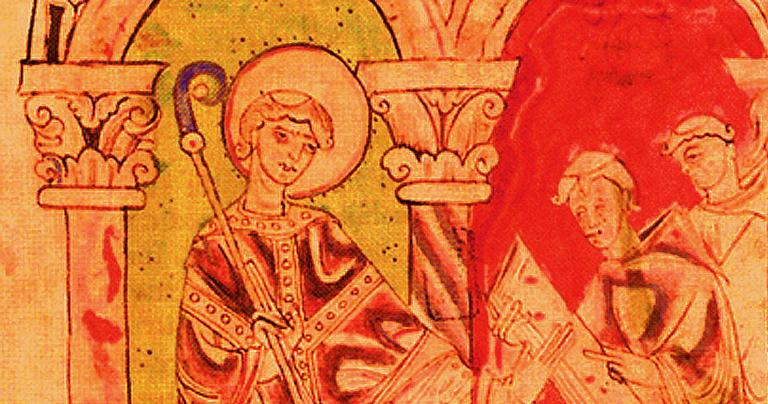
Jean Cassien | miniature médiévale | Public Domain
His questions could be asked anywhere from a marriage and family therapy session, to a discipleship meeting, to a Pentecostal altar call, etc. Take time to read, and perhaps reread, what he writes about Ephesians 4.26-27. Cassian says:
If it is dangerous to let the sun of righteousness go down on our anger, and if we immediately give room to the devil in our heart when we are angry, why did he [Paul] previously command us to get angry, when he said: ‘Be angry, and do not sin’? Does he not clearly mean that you should be angry at your vices and your rage lest you grow dark on account of your wrath and Christ, the sun of righteousness, begin to go down in your dusky minds and, once he departs, you offer room in your hearts to the devil?[3]
If we consistently give in to anger, then our narrative can become a little dark. Therefore, we cannot simply free ourselves from the symptoms of our anger. Cassian would say that simply modifying our behavior does not remove the roots of this deadly sin from our soul.
And history bears out that John Cassian practices what he preaches. In Cassian’s communities (a vast network of very primitive monasteries) people are tossed. In effect they are excommunicated, people like: fornicators, or those who flit from one community to another, or those who cause division, etc. Those who cause physical harm are considered to be apostate. In my faith tribe we say that someone who is apostate has backslidden. They were saved but they are no longer in a state of grace.
iv. Cassian is tough without anger
We are not comfortable with calling out sin and holding the people of God to a higher standard. Cassian did so as part of his leadership role, but he did so without the vengeance of anger.
And Paul would concur: Be angry and do not sin . . . and give no opportunity to the devil.
Out of all of the disciplining – and restoring! – that Cassian has to do overseeing thousands of servants of God, how does he do it without anger? He is definitely tough on his monks, extremely tough at times, by our standards today. However, I believe he may have truly purged anger from his interior life. Anger becomes too hot to handle for very long.
v. What about righteous indignation?!
Hey there’s some sort of injustice going on. Let’s all get together and rally the masses for the Storming of the Bastille!
You may feel like you are justified because you have righteous indignation. Maybe you feel venerated because you can rally a following that is bent on some type of injustice – Storm the Bastille! Just know that your righteous indignation will eventually eat at you the same way anger does.
Storming the Bastille, rallying a group bent on anger over some social injustice, will eventually cause more social problems. The Storming of the Bastille seems great at the time, but it is a very early marker of the onset of deconstructionism and postmodernism. However, this is not the place for a French philosophy lesson, because I’m trying to stay on track with Paul, Cassian, Ephesians, and the Primitive Church.
If you rally the troops based on anger , your followers will burnout because anger is emotionally draining, or they will form some type of coup d’état that makes matters worse, or it will all just turn into another witch hunt.
A “noble” cause based on anger alone, will only cause your followers to burnout.
On the other hand Paul, John Cassian, and the Primitive Church plunge their followers into baptismal waters that are the culmination of a rich catechesis that reforms both the person and community through Christian practices and charity.
vi. Pseudo-spiritual warfare
Cassian says there are only a couple motivations that explain why we attempt to march out on the spiritual battlefield in anger. There are truly times when there are real spiritual battles to be won, but we’re not talking about that.
First of all, Cassian says to the Primitive Church, “as long as we attribute our own wrongdoing to other people, we shall never be able to get near to patience and perfection.”[4] He lives long before Sigmund Freud, but this is Freud’s classic Defense Mechanism called Projection.
You project you faults on me, or perhaps your best wishes, but they’re usually your faults. That way, you don’t have to look in the mirror.
Cassian and Freud are on the same page. Cassian correctly diagnoses the problem, and does so extensively. In effect, Cassian says:
You’re angry at me because of what you’re avoiding about yourself.
Secondly, Cassian says that there is the possibility that:
You may not have the same problem as someone else after all. So you think you’re engaging them in spiritual warfare, but you’re really just mad. Unfortunately, you’ve blurred the lines between hating the sin and loving the sinner. You may not really hate both, but you strongly dislike both the sin . . . and the sinner.
In this case, Cassian’s diagnosis is worse.
You are operating in pride.
vii. I’m Pentecostal in the Arminian-Wesleyan stream
We have a lot of holiness tributaries to our stream. I can’t even guess how often I hear us Pentecostals make hilarious psuedo-holiness statements. And our leaders are not always exempt, because we may misunderstand how holiness is developed.
None of us has his problem.
I’m glad God delivered me from her issues.
I have to bite my tongue to keep from laughing at times, but I’ve heard people go so far as to say:
Oh I’ve got sins just like everyone else . . . but I don’t have his sin.
viii. Are these oxymorons, or are we the oxy-morons?
I think we’re all guilty of making these types of statements from time to time, unless we’re very cautious. We get used to being Christian! We take for granted the great grace by which we are saved.
He also told this parable to some who trusted in themselves that they were righteous, and treated others with contempt . . .
The Pharisee, standing by himself, prayed thus: ‘God, I thank you that I am not like other men . . . – Luke 18.9, 11, ESV
Wasn’t pride the sin of Lucifer, higher than all of God’s creatures, who was cast down by Michael and fell like lightning (Luke 10.17-20; Revelation 12.7-12)?
John Cassian deals with this quite extensively, boldly saying that our righteous anger is actually counterproductive to the work of the Holy Spirit in our lives.[5] We can inhibit the Spirit from developing patience and perfection in our lives – perfection being holistic, wholeness, or holiness.[6]
Do you think you can brandish the sword of the wrath of God in your situation, provide justice, scream out Avengers Assemble, and right all the wrongs?
Paul and Cassian would tell you: You cannot wield it!
Perspective and Prayers
They both had a different approach. However, no one can deny that both Paul and John Cassian changed their corner of the world for the cause of Christ, established the primitive church in righteousness and true Biblical justice, and also left sweeping social changes in their wake.
Cassian references Ephesians 4.26-27 in his book within his book The Institutes. The smaller book vividly describes one of the deadly sins known as The Spirit of Anger. We root it out through a variety of means like patience and perfection, but also through powerful prayers.
I would like to suggest a prayer or blessing for this week and next, in which I invoke the name of the Trinity. It’s a prayer that is also modeled after classic prayers.
If there is a spiritual battle to be fought, may the Hosts of Heaven protect us, even if they protect us from our own brothers and sisters in Jesus Christ, or from ourselves. If the enemy plays his hand, may we remember that he has been cast down like lightning by Michael, who also declares to him “The Lord rebuke you” (Jude 9). May the Spirit empower us to declare the same to the devil and his imps. If the enemy seeks to ruin us through anger, or by stealing from us (our family, our resources, our good name, or our joy) may we remember that God has already caused us to triumph (2 Corinthians 2.14). Amen
notes:
- Look to hear from John Cassian again next week right here at the same time. If you happen to find out he’s sitting down at tea time with Paul at the Grand Traverse Pie Company to discuss homilies and practical applications, give me a ring.
- Once again, if you want to consider the possible poetic structure of these verses in light of the surrounding passage, you can read my previous blog. To read “Beauty in Paul’s Literature: Poet, Prophet, or Oracle,” CLICK HERE
[1] Many themes in this article are adapted from, Stephen Martyn, “Cassian Guide,” Readings in Christian Spirituality (Lecture, Asbury Theological Seminary, Wilmore, KY, January 20, 2015). [2] John Cassian, The Institutes, trans. Boniface Ramsey, vol. 58 of Ancient Christian Writers: The Works of the Fathers in Translation, ed. Dennis D. McManus (New York: The Newman Press, 2000), book viii.9. [4] Ibid*.viii.26*. [5] Ibid*.viii.12.* [6] Ibid*.viii.16*.
Previous Post

July 30, 2019
Best of 2019: JCIngle year in review so far
Next Post

August 6, 2019 Prayer Series: Interconnected Summer Lights
Browse Our Archives
Select a Category Communion Cruz Ingle Crystal Ingle Early Church Engaging Culture Ethics & Society Family Formation History In Dialogue Jared & Crystal Kingdom of God Majority World Church Mateo Ingle Messenger College Mission Narrative Pentecostal Church of God Prayer Shepherding The Sermon The Writings Theology Theology & Psychology Traverse City Uncategorized Vernell Ingle Word Study
Select a Month October 2026 September 2026 August 2026 July 2026 June 2026 May 2026 March 2026 February 2026 January 2026 December 2025 October 2025 September 2025 August 2025 July 2025 June 2025 May 2025 April 2025 March 2025 February 2025 January 2025 December 2024 November 2024 October 2024 September 2024 August 2024 July 2024 June 2024 May 2024 April 2024 March 2024 February 2024 January 2024 December 2023 November 2023 October 2023 September 2023 August 2023 July 2023 June 2023 May 2023 April 2023 March 2023 February 2023 January 2023 December 2022 November 2022 October 2022 September 2022 August 2022 July 2022 June 2022 May 2022 April 2022 March 2022 February 2022 January 2022 December 2021 November 2021 October 2021 September 2021 August 2021 July 2021 June 2021 May 2021 April 2021 March 2021 February 2021 January 2021 December 2020 November 2020 October 2020 September 2020 August 2020 July 2020 June 2020 May 2020 April 2020 March 2020 February 2020 January 2020 December 2019 November 2019 October 2019 September 2019 August 2019 July 2019 June 2019 May 2019 April 2019 March 2019 February 2019 January 2019 December 2018 November 2018 October 2018 September 2018 August 2018 July 2018 June 2018 May 2018 April 2018 March 2018 February 2018 May 2017 March 2017 March 2014 February 2013 January 2013 October 2012 July 2012 May 2012 April 2012 March 2012 February 2012 January 2012 December 2011 August 2010
Follow Us!
TAKE THE
Religious Wisdom Quiz
What does the Bible warn about "idle chatter"?
Select your answer to see how you score.
Leads to poverty Is entertaining Is educational Is holy
Related posts from Jared Ingle




List of Sins | Word Studies in Corinthians
TRENDING AT PATHEOS Evangelical

How the author of the world's best hymn...
I've been working with John Newton for a while now. This makes...

Long before this Lectio Divina, Psalm 130 - the song - started...

What About the Trees? Another Living Parable
After I finished writing the last article about falling leaves as a...

Why Classical Education Is a Conversation, Not a...
Come and Read: Joy in Classical Education When I was a little...

Falling Leaves: A Living Parable on Letting Go
I’ve spent the vast majority of my life in the southeast corner...

Cornell University has received a great deal of negative publicity and intense...
view all Evangelical blogs
Ad-Free & Subscriber Log-In Subscription Support
- About Us
- 2026 Calendar
- Videos
- Podcasts
- Library of World Religions
- Faith In Media Tracker
- Advertise With Us
- Write for Us
- Privacy Policy
- Terms of Service
- Do Not Sell My Data
- Contact Us
- Radiant Digital
- Manage Newsletter Subscriptions
- Unsubscribe From Notifications
- Sitemap
Copyright 2008-2026, Patheos. All rights reserved.
Subscription Support Ad-Free & Subscriber Log-In
Follow Patheos