
BuddhistCatholicContemplativeEvangelicalGeneral ChristianHinduJewishLatter-day SaintMuslimNew VisionsProgressive Christian
Beliefs
- Buddhist
- Catholic
- Contemplative
- Evangelical
- General Christian
- Hindu
- Jewish
- Latter-day Saint
- More Voices
- Muslim
- New Visions
- Pagan
- Progressive Christian
Topics
- Religion News
- Food and Religion
- Sports and Religion
- Religious Art
- Religious Music and Entertainment
- Religious Events
- History and Religion
- Style and Religion
- Politics and Religion
- Women in Religion
- Recreation Outdoors and Religion
- Business Finance and Religion
- Careers Workplace and Religion
- Education and Religion
- Family Parenting and Religion
- Health Fitness and Religion
- Home and Religion
- Relationships and Religion
- Technology and Religion
- Travel and Religion
Columnists
- Buddhist Columnists
- Business Finance and Religion Columnists
- Careers Workplace and Religion Columnists
- Catholic Columnists
- Contemplative Columnists
- Education and Religion Columnists
- Evangelists Columnists
- Family Parenting and Religion Columnists
- General Christian Columnists
- Health Fitness and Religion Columnists
- Hindu Columnists
- History and Religion Columnists
- Home and Religion Columnists
- Jewish Columnists
- More Voices Columnists
- Latter Day Columnists
- Muslim Columnists
- New Visions Columnists
- Nonreligious Columnists
- Pagan Columnists
- Politics and Religion Columnists
- Progressive Columnists
- Recreation Outdoors and Religion Columnists
- Relationships and Religion Columnists
- Religion News Columnists
- Religious Art Columnists
- Religious Events Columnists
- Religious Music and Entertainment Columnists
- Sports and Religion Columnists
- Style and Religion Columnists
- Technology and Religion Columnists
- Travel and Religion Columnists
- Women in Religion Columnists
Resource Library
- 2026 Calendar
- Library of World Religions
- The 100 Most Holy Places on Earth
- Patheos Answers
- Podcasts
- Videos
- Faith Leaders Database
- Anglican Episcopalian
- Bahai
- Baptist
- Buddhism
- Christianity
- Confucianism
- Eastern Orthodoxy
- Hinduism
- Holiness and Pentecostal
- ISKCON
- Islam
- Judaism
- Lutheran
- Methodist
- The Church of Jesus Christ of Latter-day Saints
- New Age
- Paganism
- Presbytarian and Reformed
- Protestantism
- Religion Behind the Scenes
- Roman Catholic
- Scientology
- Shia Islam
- Sikhism
- Sufism
- Sunni Islam
- Taoism
- Zen
- See all religions
Research Tools
 Ad-Free & Subscriber Log-In Subscription Support
Ad-Free & Subscriber Log-In Subscription Support
Follow Patheos 

- Trending:
- Forgiveness
- |
- Marriage
- |
- Consciousness
- |
- Death Penalty
- |
- Election
- |
- Halloween

- Home
- Evangelical
- Ephesians 4 in light of shame-based culture
Ephesians 4 in light of shame-based culture
Last updated on: July 4, 2019 at 4:27 pm by Rev. Jared V. Ingle
Ephesians 4 in light of shame-based culture 2019-07-04T16:27:48-04:00 Rev. Jared V. Ingle
Patheos Explore the world's faith through different perspectives on religion and spirituality! Patheos has the views of the prevalent religions and spiritualities of the world.
Ephesians 4.17: Now this I affirm and insist on in the Lord: you must no longer live as the Gentiles live, in the futility of their minds.
We tend to look at passages like this, analyze them, and preach and teach them based on our understanding. We often preach about processes of personal maturity or integrity. People just need to become what they believe. However, this passage is not so easily understood, if we take into account the life and times of Paul, and other similar cultures today.
i. Shame-based culture
Many cultures in the world (i.e. from Africa to Japan) hinge on the constructs of public honor vs. public shame. These are called shame-based cultures, in contrast to cultures in the West that function because of guilt. Guilt is internal. Shame is external. I can sense guilt, even if no one else knows what I have done wrong. Shame comes from my peer group, my context, those around me, from the public. I lose my honor. I lose face in my social network.[1]
A simple word count in the Bible reveals that the ancient Near East was home to shame-based cultures. “The term guilt and its various derivatives occur 145 times in the Old Testament and 10 times in the New Testament, whereas the term shame and its derivatives occur nearly 300 times in the Old Testament and 45 times in the New Testament.”[2]
Not only are individuals honored or shamed, whole groups can be ostracized. For instance, anytime, there is a “we,” then there is a “they” by default. Religions like Judaism, Islam, and Christianity are therefore often called exclusivist religions. We have standards.
The Hebrew Bible is full of what we might call boundary making. These standards reveal what it takes, not only to be an Israelite, but also to be an Israelite walking in the favor of the Lord. These boundaries also set a line between the Israelites and the Gentiles (all other nations).
ii. The non-Christian Gentiles are being shamed
Paul does the same thing in this passage. He writes to Jewish and Gentile Christians, but he speaks against non-Christian Gentiles.
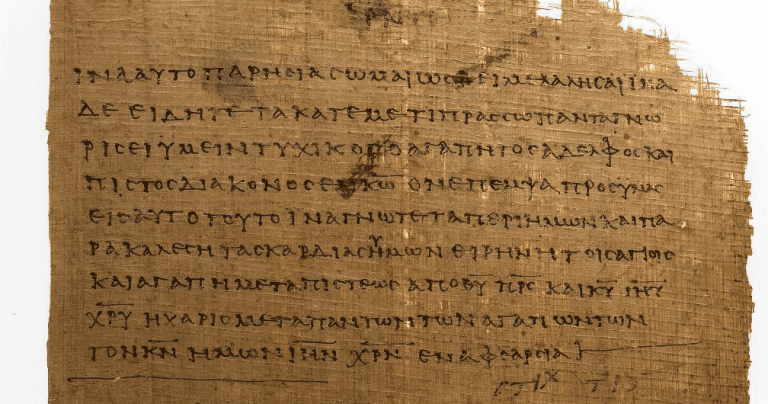
Christophenave | Ephesians 6.20-24 dated 150-250 AD | 05.07.18 | Public Domain
In a way, the non-Christian Gentiles are being shamed. This is clear from the start. Paul says they live “in the futility of their minds” meaning that their minds are subject to the devil or to the vanities of this life.[3]
Ephesians 4.18-19: They are darkened in their understanding, alienated from the life of God because of their ignorance and hardness of heart. They have lost all sensitivity and have abandoned themselves to licentiousness, greedy to practice every kind of impurity.
Paul specifically shames the non-Christian Gentiles
First of all, “They are darkened in their understanding” (verse 18). They don’t have the ability or the faith to make decisions about right and wrong. They’re not in the light.[4]
Secondly, they have started down a slippery slope. This is a digression. First, they turn a deaf ear toward God and harden their hearts. Second, they lose “all sensitivity,” or become desensitized. Because they are overexposed to sin, they are no longer sensitive to its evil. Third, they give themselves over to various impurities. Fourth, this results in a further hardening of the heart, and a complete lack of remorse.[5]
I believe this is really a cycle of sin, making their hearts harder and harder. As a result of this sin cycle, they are shamed, banished from fellowship, and “alienated from the life of God” (verse 18).
Paul writes about sexual sins
Paul could have chosen any sin, and he does list other sins in other places. However, Paul writes about sexual sins. Instantly, those who are Jews understand because they must keep themselves pure as a race.
They “have abandoned themselves to licentiousness” (verse 19). This is sometimes translated as lasciviousness, which is an eagerness for lustful pleasure. It is not always the lust of the eyes or flesh, but can also be found in many forms. I think our music industry makes a lot of money off of licentiousness. Our music is saturated with it.
They are “greedy to practice every kind of impurity” (verse 19). Greedy can also be translated as coveting, like when we covet a forbidden desire. Practice and impurity are both words that refer to the physical. Impurity can be translated as unclean. They toy with various lusts (licentiousness). Then they covet what they can’t have, make some plans, and put them into action.
iii. This is purity language like we find in the Hebrew Bible
Lines have already been drawn, setting Israel apart from pagans and sin, and apart unto God. Now Paul also forms a boundary for Gentile Christians. These sins separate them from their old life and from their pagan neighbors. When Paul names these types of sins, he draws a line in the sand.
Paul’s boundary-making strategy works for the Gentile Christians. First, they realize that they can’t go back to those types of sexual sins. Second, they realize that they must maintain the purity of their new life. Third, and perhaps most importantly, they realize that if someone allows sin into the group, it brings shame upon the whole congregation.[6]
iv. Ephesians 4.20: That is not the way you learned Christ!
This brief verse stands in contrast to all the wicked ways of the Gentiles.
First, the word “you” sets us apart as the readers. Any time there’s a “we” then there is by implication a “they.” We’re not in that other group, although we came out of that group.
Second, although we once were ignorant and in darkness (verse 17-18) we have now begun to learn. Our minds have been opened to the Spirit. This is salvation language!
Third, we are restored to fellowship, no longer alienated (verse 18). We are learning about Christ the person, while in relationship with Him. This also means that we are learning in the community of Christians.
v. Revolutionize society or reform Christian culture?
Paul’s answer is not to try and cause a revolution to overthrow the Gentile culture and world. It is a shame-based culture, a system that exists based on group honor and norms that are held so highly, that individuals simply conform.
Paul’s answer is not to revolutionize society, but to reform Christian culture. What does Christian education, discipleship, and community look like, if we draw some lines in the sand, and if our minds are opened to Christ?
notes:
[1] Timothy C. Tennent, Theology in the Context of World Christianity: How the Global Church is Influencing the Way We Think About and Discuss Theology (Grand Rapids, MI: Zondervan, 2007), 78-79. [2] Ibid., 92. [3] Origen, Catena on Psalm cxviii.37; Chrysostom, Homily on Ephesians xii.iv.17. [4] David A. deSilva, Honor, Patronage, Kinship & Purity: Unlocking New Testament Culture (Downers Grove, IL: IVP Academic, 2000), 62. [5] Theodoret, Epistle to the Ephesians iv.18-19; Chrysostom, Homily on Ephesians xii.iv.17-19. [6] deSilva, 295, 299.
Previous Post

July 1, 2019
Prayer Series: John Wesley in relation to Ephesians 4.11-12
Next Post

July 8, 2019 Ingle Brothers in Action
Browse Our Archives
Select a Category Communion Cruz Ingle Crystal Ingle Early Church Engaging Culture Ethics & Society Family Formation History In Dialogue Jared & Crystal Kingdom of God Majority World Church Mateo Ingle Messenger College Mission Narrative Pentecostal Church of God Prayer Shepherding The Sermon The Writings Theology Theology & Psychology Traverse City Uncategorized Vernell Ingle Word Study
Select a Month October 2026 September 2026 August 2026 July 2026 June 2026 May 2026 March 2026 February 2026 January 2026 December 2025 October 2025 September 2025 August 2025 July 2025 June 2025 May 2025 April 2025 March 2025 February 2025 January 2025 December 2024 November 2024 October 2024 September 2024 August 2024 July 2024 June 2024 May 2024 April 2024 March 2024 February 2024 January 2024 December 2023 November 2023 October 2023 September 2023 August 2023 July 2023 June 2023 May 2023 April 2023 March 2023 February 2023 January 2023 December 2022 November 2022 October 2022 September 2022 August 2022 July 2022 June 2022 May 2022 April 2022 March 2022 February 2022 January 2022 December 2021 November 2021 October 2021 September 2021 August 2021 July 2021 June 2021 May 2021 April 2021 March 2021 February 2021 January 2021 December 2020 November 2020 October 2020 September 2020 August 2020 July 2020 June 2020 May 2020 April 2020 March 2020 February 2020 January 2020 December 2019 November 2019 October 2019 September 2019 August 2019 July 2019 June 2019 May 2019 April 2019 March 2019 February 2019 January 2019 December 2018 November 2018 October 2018 September 2018 August 2018 July 2018 June 2018 May 2018 April 2018 March 2018 February 2018 May 2017 March 2017 March 2014 February 2013 January 2013 October 2012 July 2012 May 2012 April 2012 March 2012 February 2012 January 2012 December 2011 August 2010
Follow Us!
TAKE THE
Religious Wisdom Quiz
Who was the first appointed deacon?
Select your answer to see how you score.
Nicolas Philip Barnabas Stephen
Related posts from Jared Ingle


Be Still and Know That I am God


TRENDING AT PATHEOS Evangelical

How the author of the world's best hymn...
I've been working with John Newton for a while now. This makes...

Long before this Lectio Divina, Psalm 130 - the song - started...

What About the Trees? Another Living Parable
After I finished writing the last article about falling leaves as a...

Why Classical Education Is a Conversation, Not a...
Come and Read: Joy in Classical Education When I was a little...

Falling Leaves: A Living Parable on Letting Go
I’ve spent the vast majority of my life in the southeast corner...

Cornell University has received a great deal of negative publicity and intense...
view all Evangelical blogs
Ad-Free & Subscriber Log-In Subscription Support
- About Us
- 2026 Calendar
- Videos
- Podcasts
- Library of World Religions
- Faith In Media Tracker
- Advertise With Us
- Write for Us
- Privacy Policy
- Terms of Service
- Do Not Sell My Data
- Contact Us
- Radiant Digital
- Manage Newsletter Subscriptions
- Unsubscribe From Notifications
- Sitemap
Copyright 2008-2026, Patheos. All rights reserved.
Subscription Support Ad-Free & Subscriber Log-In
Follow Patheos