
BuddhistCatholicContemplativeEvangelicalGeneral ChristianHinduJewishLatter-day SaintMuslimNew VisionsProgressive Christian
Beliefs
- Buddhist
- Catholic
- Contemplative
- Evangelical
- General Christian
- Hindu
- Jewish
- Latter-day Saint
- More Voices
- Muslim
- New Visions
- Pagan
- Progressive Christian
Topics
- Religion News
- Food and Religion
- Sports and Religion
- Religious Art
- Religious Music and Entertainment
- Religious Events
- History and Religion
- Style and Religion
- Politics and Religion
- Women in Religion
- Recreation Outdoors and Religion
- Business Finance and Religion
- Careers Workplace and Religion
- Education and Religion
- Family Parenting and Religion
- Health Fitness and Religion
- Home and Religion
- Relationships and Religion
- Technology and Religion
- Travel and Religion
Columnists
- Buddhist Columnists
- Business Finance and Religion Columnists
- Careers Workplace and Religion Columnists
- Catholic Columnists
- Contemplative Columnists
- Education and Religion Columnists
- Evangelists Columnists
- Family Parenting and Religion Columnists
- General Christian Columnists
- Health Fitness and Religion Columnists
- Hindu Columnists
- History and Religion Columnists
- Home and Religion Columnists
- Jewish Columnists
- More Voices Columnists
- Latter Day Columnists
- Muslim Columnists
- New Visions Columnists
- Nonreligious Columnists
- Pagan Columnists
- Politics and Religion Columnists
- Progressive Columnists
- Recreation Outdoors and Religion Columnists
- Relationships and Religion Columnists
- Religion News Columnists
- Religious Art Columnists
- Religious Events Columnists
- Religious Music and Entertainment Columnists
- Sports and Religion Columnists
- Style and Religion Columnists
- Technology and Religion Columnists
- Travel and Religion Columnists
- Women in Religion Columnists
Resource Library
- 2026 Calendar
- Library of World Religions
- The 100 Most Holy Places on Earth
- Patheos Answers
- Podcasts
- Videos
- Faith Leaders Database
- Anglican Episcopalian
- Bahai
- Baptist
- Buddhism
- Christianity
- Confucianism
- Eastern Orthodoxy
- Hinduism
- Holiness and Pentecostal
- ISKCON
- Islam
- Judaism
- Lutheran
- Methodist
- The Church of Jesus Christ of Latter-day Saints
- New Age
- Paganism
- Presbytarian and Reformed
- Protestantism
- Religion Behind the Scenes
- Roman Catholic
- Scientology
- Shia Islam
- Sikhism
- Sufism
- Sunni Islam
- Taoism
- Zen
- See all religions
Research Tools
 Ad-Free & Subscriber Log-In Subscription Support
Ad-Free & Subscriber Log-In Subscription Support
Follow Patheos 

- Trending:
- Forgiveness
- |
- Marriage
- |
- Consciousness
- |
- Death Penalty
- |
- Election
- |
- Halloween

- Home
- Evangelical
- Beauty in Paul’s Literature: Poet, Prophet, or Oracle
Beauty in Paul’s Literature: Poet, Prophet, or Oracle
Last updated on: July 25, 2019 at 3:09 pm by Rev. Jared V. Ingle
Beauty in Paul’s Literature: Poet, Prophet, or Oracle 2019-07-25T15:09:57-04:00 Rev. Jared V. Ingle
Patheos Explore the world's faith through different perspectives on religion and spirituality! Patheos has the views of the prevalent religions and spiritualities of the world.
I’ve been waiting for an opportune time to speak of beauty in in my series on Ephesians 4. I would like to propose that Paul is using a form of parallelism which can be found in various forms of ancient Near East poetry (aNE).
i. Recognizing aNE Poetry
In this case, Paul uses a triple repetition for each saying or stanza. The second line offers a parallel thought to the first line (one type of parallelism). The third line of each stanza offers a final point in-line with the two above it, or in contrast to the two above it.
There are many facets to this writing, but Paul also uses a technique known as a climax. Paul builds up to, “But that is not the way you learned Christ” (verses 17-20, ESV). Then Paul builds up again to the statement, “created after the likeness of God in true righteousness and holiness” (verses 21-24). Once more he builds up again to the injunction, “and give no opportunity to the devil” (verses 25-27). Because of this pattern, this is not only like poetry, but also like proverbs or wisdom literature.
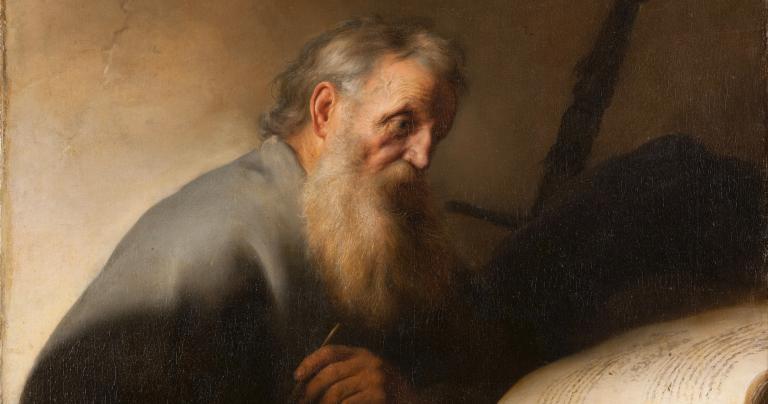
Jan Lievens | Aposteln Paulus | 1627 | Public Domain
Poet, Prophet, or Oracle: Beauty in Paul’s Literature
Take a look at the Ephesians 4.17-27 again, now that I’ve organized it into my proposed stanzas that reflect aNE parallelism. I have italicized the three proposed climaxes.
Now this I say and testify in the Lord,
that you must no longer walk as the Gentiles do,
in the futility of their minds.
They are darkened in their understanding,
alienated from the life of God because of the ignorance that is in them,
due to their hardness of heart.
They have become callous and have given themselves up to sensuality,
greedy to practice every kind of impurity.
But that is not the way you learned Christ!—
assuming that you have heard about him
and were taught in him,
as the truth is in Jesus,
to put off your old self,
which belongs to your former manner of life
and is corrupt through deceitful desires,
and to be renewed in the spirit of your minds,
and to put on the new self,
created after the likeness of God in true righteousness and holiness.
Therefore, having put away falsehood,
let each one of you speak the truth with his neighbor,
for we are members one of another.
Be angry and do not sin;
do not let the sun go down on your anger,
and give no opportunity to the devil.
Some Bibles show this type of pattern clearly, especially in the Hebrew Bible where Psalms, Proverbs, and Prophets abound. However, in the English New Testament, you will seldom find stanzas in print unless the version is highlighting a specific song of the New Testament, or perhaps a prophetic word. However, once one learns a little bit about Hebrew poetry, these patterns are easier to see. After all, Hebrew Christians write the New Testament.
ii. The beauty of Paul’s poetry
a. Paul has a Hebrew audience
There are still plenty of Hebrews in the synagogues, even though Paul is preaching across the Roman Empire. They would instantly recognize this type of poetry, and would receive it on the same level as the Proverbs. Hebrew Christians see Paul as an authority. Paul is a Christian Rabbi, a unique voice.
b. Greeks recognize good poetry
The Greeks may have different types of poetry, but one of their classic virtues is indeed beauty in the arts. Their philosophers often use poetry of various types to relay their message. However, their love for beauty often makes their message that much more profound.
Paul is considered a Rabbi to the Hebrew Christians. However, he would be considered a philosopher and poet to the Greeks, and there is only a fine line between the two roles because of their love for the virtue of beauty. In fact, the roles of poet, philosopher, and prophet are often intermingled in the beautiful writings of Classic Greek literature.
c. Paul’s poetic gift seems effortless
Paul’s poetry seems to be profound because Paul does not seem to be trying. It does not seem to be a strain for him to write large portions of Ephesians with a poetic rhythm and refrain.
Isaiah does the same. Most of Isaiah’s book is divided into poetic stanzas. Not only is Isaiah writing poetically, it is possible that he is prophesying extemporaneously in beautiful poetry. The written words of Isaiah are more than likely from his disciples who are recording his sermons in the moment.
This speaks to me of something greater than human effort. This is a divine utterance. At times Paul, Isaiah, and others seem to be operating in a higher virtue, that of beauty, not stumbling over their words, but flowing.
iii. Implications of speaking as an Oracle
For the record, there are a couple of ways that the term Oracle is used in the aNE. In most of the Biblical literature, at least how it is translated into English, an Oracle represents some sort of unquestionable word from the Lord. However, in other aNE countries, the term Oracle is also used to refer to the person, who stands as an intermediary between God and man (i.e. priest, priestess, prophet, etc.). It is this definition of the Oracle as person, or the role of the person, to which I am referring in the following paragraphs. I also believe there are instances in the Bible where there is a fine line between the Oracle as a divine message and the Oracle as the messenger.
a. Some utterances are spoken by Oracles
If Paul’s sustained poetic and prophetic speech is not possible for the normal human mind, then I must deduce that there are utterances in the holy writ that are entirely inspired by the Holy Spirit.
This is not only prophecy. It is poetry that the Spirit uses to capture the mind of those in the aNE.
It is more than the Spirit divinely inspiring the prophet or apostle to speak, thereby utilizing the personality and speech of the prophet. This poetry occurs in real-time, far too quickly for someone to be a wordsmith and toil over every word.
Think of ancient Israelite prophets with their traveling bands of minstrels, prophesying the exact words that the Spirit wants to speak to the nation, in perfect poetry, rhythm, and song.
In these types of scenarios, we have reason to believe that the prophet is not expounding on an inspired thought from the Spirit. No, the prophet becomes the Oracle of the Spirit in the moment.
b. The Pentecostal sign is not the end, it’s the means to the end
Another implication is that the chief reason for the baptism of the Holy Spirit is not speaking in tongues, as much as we Pentecostals would like believe.
Just like water baptism is in some way a divine ordinance initiating us into the church and Kingdom, baptism in the Spirit is an initiation into something more.
Water is the symbol of baptism into Christ’s death and resurrection. Tongues is the symbol of initiation into something greater.
The Spirit has a greater purpose, to clothe us with power, to give us a supernatural ability to witness. I think we see evidences of power to witness in this excerpt from Paul’s writings. The Spirit not only wants to gain a hearing, He will captivate His listeners with beauty if they’ll allow Him. He has the ability to do so through us, earthen vessels of His glory.
We can become an Oracle at times. However, we can’t expect to allow God to fully control our utterance, if we seldom yield it to Him in our prayer language.
c. God touches our pursuit of excellence
Finally, we fine-tune our gifts, talents, and skills because we want to be used by the Spirit of God. Paul is a strong pharisee before he becomes a Christian. Gamaliel trains him. At that time, there are only two Jewish ministry schools that surpass all the other schools by far, the schools of Hillel and Gamaliel. So Paul has the equivalent of an ivy-league divinity education, the best Israel can offer. Paul also exemplifies stability and commitment on a professional level.
However, God confronts Paul on the road to Damascus and redirects his misguided pursuit of the people of God. Yet it is Paul’s drive and pursuit of excellence that God touches, uses in the Kingdom of God in new ways, and makes him a mouthpiece to the whole Mediterranean world.
In the same way, God touches our pursuit of excellence, making us shine His light in the dark world that surrounds us. This dark world is the bleak background, upon which Paul paints brilliant rays of hope in the latter half of Ephesians 4.
So it should be with us, whether a solitary candle lighting the whole room, or a city on a hill lighting up the night sky for miles around. May our words be as light that commands darkness to flee and miraculously calls souls to awaken.
notes:
points of contact
Jared Ingle AAMFT Therapist Locator
American Association for Marriage and Family Therapy
see related articles from Ephesians 4
in light of shame-based culture
on honesty and anger management
Previous Post
July 22, 2019
Prayer Series: Travailing for the Ekklesia
Next Post

July 30, 2019 Best of 2019: JCIngle year in review so far
Browse Our Archives
Select a Category Communion Cruz Ingle Crystal Ingle Early Church Engaging Culture Ethics & Society Family Formation History In Dialogue Jared & Crystal Kingdom of God Majority World Church Mateo Ingle Messenger College Mission Narrative Pentecostal Church of God Prayer Shepherding The Sermon The Writings Theology Theology & Psychology Traverse City Uncategorized Vernell Ingle Word Study
Select a Month October 2026 September 2026 August 2026 July 2026 June 2026 May 2026 March 2026 February 2026 January 2026 December 2025 October 2025 September 2025 August 2025 July 2025 June 2025 May 2025 April 2025 March 2025 February 2025 January 2025 December 2024 November 2024 October 2024 September 2024 August 2024 July 2024 June 2024 May 2024 April 2024 March 2024 February 2024 January 2024 December 2023 November 2023 October 2023 September 2023 August 2023 July 2023 June 2023 May 2023 April 2023 March 2023 February 2023 January 2023 December 2022 November 2022 October 2022 September 2022 August 2022 July 2022 June 2022 May 2022 April 2022 March 2022 February 2022 January 2022 December 2021 November 2021 October 2021 September 2021 August 2021 July 2021 June 2021 May 2021 April 2021 March 2021 February 2021 January 2021 December 2020 November 2020 October 2020 September 2020 August 2020 July 2020 June 2020 May 2020 April 2020 March 2020 February 2020 January 2020 December 2019 November 2019 October 2019 September 2019 August 2019 July 2019 June 2019 May 2019 April 2019 March 2019 February 2019 January 2019 December 2018 November 2018 October 2018 September 2018 August 2018 July 2018 June 2018 May 2018 April 2018 March 2018 February 2018 May 2017 March 2017 March 2014 February 2013 January 2013 October 2012 July 2012 May 2012 April 2012 March 2012 February 2012 January 2012 December 2011 August 2010
Follow Us!
TAKE THE
Religious Wisdom Quiz
What famous prayer did Jesus teach his followers?
Select your answer to see how you score.
The Hail Mary The Jesus Prayer The Lord's Prayer The Prayer of Jabez
Related posts from Jared Ingle


Be Still and Know That I am God


TRENDING AT PATHEOS Evangelical

How the author of the world's best hymn...
I've been working with John Newton for a while now. This makes...

Long before this Lectio Divina, Psalm 130 - the song - started...

What About the Trees? Another Living Parable
After I finished writing the last article about falling leaves as a...

Why Classical Education Is a Conversation, Not a...
Come and Read: Joy in Classical Education When I was a little...

Falling Leaves: A Living Parable on Letting Go
I’ve spent the vast majority of my life in the southeast corner...

Cornell University has received a great deal of negative publicity and intense...
view all Evangelical blogs
Ad-Free & Subscriber Log-In Subscription Support
- About Us
- 2026 Calendar
- Videos
- Podcasts
- Library of World Religions
- Faith In Media Tracker
- Advertise With Us
- Write for Us
- Privacy Policy
- Terms of Service
- Do Not Sell My Data
- Contact Us
- Radiant Digital
- Manage Newsletter Subscriptions
- Unsubscribe From Notifications
- Sitemap
Copyright 2008-2026, Patheos. All rights reserved.
Subscription Support Ad-Free & Subscriber Log-In
Follow Patheos