
BuddhistCatholicContemplativeEvangelicalGeneral ChristianHinduJewishLatter-day SaintMuslimNew VisionsProgressive Christian
Beliefs
- Buddhist
- Catholic
- Contemplative
- Evangelical
- General Christian
- Hindu
- Jewish
- Latter-day Saint
- More Voices
- Muslim
- New Visions
- Pagan
- Progressive Christian
Topics
- Religion News
- Food and Religion
- Sports and Religion
- Religious Art
- Religious Music and Entertainment
- Religious Events
- History and Religion
- Style and Religion
- Politics and Religion
- Women in Religion
- Recreation Outdoors and Religion
- Business Finance and Religion
- Careers Workplace and Religion
- Education and Religion
- Family Parenting and Religion
- Health Fitness and Religion
- Home and Religion
- Relationships and Religion
- Technology and Religion
- Travel and Religion
Columnists
- Buddhist Columnists
- Business Finance and Religion Columnists
- Careers Workplace and Religion Columnists
- Catholic Columnists
- Contemplative Columnists
- Education and Religion Columnists
- Evangelists Columnists
- Family Parenting and Religion Columnists
- General Christian Columnists
- Health Fitness and Religion Columnists
- Hindu Columnists
- History and Religion Columnists
- Home and Religion Columnists
- Jewish Columnists
- More Voices Columnists
- Latter Day Columnists
- Muslim Columnists
- New Visions Columnists
- Nonreligious Columnists
- Pagan Columnists
- Politics and Religion Columnists
- Progressive Columnists
- Recreation Outdoors and Religion Columnists
- Relationships and Religion Columnists
- Religion News Columnists
- Religious Art Columnists
- Religious Events Columnists
- Religious Music and Entertainment Columnists
- Sports and Religion Columnists
- Style and Religion Columnists
- Technology and Religion Columnists
- Travel and Religion Columnists
- Women in Religion Columnists
Resource Library
- 2026 Calendar
- Library of World Religions
- The 100 Most Holy Places on Earth
- Patheos Answers
- Podcasts
- Videos
- Faith Leaders Database
- Anglican Episcopalian
- Bahai
- Baptist
- Buddhism
- Christianity
- Confucianism
- Eastern Orthodoxy
- Hinduism
- Holiness and Pentecostal
- ISKCON
- Islam
- Judaism
- Lutheran
- Methodist
- The Church of Jesus Christ of Latter-day Saints
- New Age
- Paganism
- Presbytarian and Reformed
- Protestantism
- Religion Behind the Scenes
- Roman Catholic
- Scientology
- Shia Islam
- Sikhism
- Sufism
- Sunni Islam
- Taoism
- Zen
- See all religions
Research Tools
 Ad-Free & Subscriber Log-In Subscription Support
Follow Patheos 

- Trending:
- Advent
- |
- Forgiveness
- |
- Thanksgiving
- |
- Election
- |
- Seasonal Holidays
- |
- Marriage

- Home
- Evangelical
- Ashkenazi Scroll & 6 Points on the Reliability of Scripture
Ashkenazi Scroll & 6 Points on the Reliability of Scripture
Last updated on: April 24, 2019 at 7:49 pm by Rev. Jared V. Ingle
Ashkenazi Scroll & 6 Points on the Reliability of Scripture 2019-04-24T19:49:44-04:00 Rev. Jared V. Ingle
Patheos Explore the world's faith through different perspectives on religion and spirituality! Patheos has the views of the prevalent religions and spiritualities of the world.
When it comes to the discussion about the reliability of the Scriptures, there are experts who are at the leading edge of apologetic debates. Ratio Christi is a campus apologetics alliance defending truth and Christianity at the university. Bob Clapper is the Regional Supervisor for Ratio Christi over Illinois, Michigan, Minnesota, and Wisconsin. He recently visited Northwestern Michigan College with an Ashkenazi Scroll and gave a presentation on the reliability of Scripture (03.20.19).
What are the major questions that skeptics have?
Do we have an authentic book, since it has been handed down?
What about all the mistakes?
What about other stories that have been handed down? Are stories like the Da Vinci Code true?
In Bob Clapper’s presentation, he deals with two major categories of questions. 1) How do we know the copies have not been changed? 2) How do we know the copies we have are true?
6 Points on the Reliability of Scripture
First, I would like to offer a brief snapshot of my methodology. I am not a journalist. On a good day, I can type rather quickly though. I adapted this article from Bob Clapper’s presentation and from dialogue with Bob Clapper and Tony Feiger, who is the Regional Representative for Ratio Christi, Northwestern Michigan College.[1] With all that said, I may not have recorded anything “verbatim.” On the other hand, it is possible that I drank enough coffee to type rather quickly. I could be presenting a very authentic representation of what took place on March 20th.
Secondly, other than the “Featured Image,” I do not try to scale these photos. I would like everyone to have as much access to these pictures as my family and I have. This truly was a once-in-a-lifetime for us. It is not everyday that you get to view a Torah from 1750.
1. The Bible is forensically sound
How do we examine the past? There are two types of science: empirical and forensic. Practically speaking, we can’t use empirical science, so we have to use forensics to study the past. We look at evidence, chase inferences, review documentation, and draw conclusions.
Variants are copies from the original autographs. Variations are manuscripts that make a mistake. These mistakes are usually found in only one line an do not constitute a majority.
There are 48 papyri surviving from the 1st-2nd Centuries. These are hand-written scrolls of the New Testament (NT). We can find 43% of the NT in the 2nd Century. There are 300 manuscripts from the 3rd Century. Overall, there are 5,000 surviving Greek manuscripts of NT literature.
This may not seem like a lot, unless we compare this literature to other ancient documents. For instance, Homer wrote the Iliad around 800 B.C. The earliest surviving copies are from 400 B.C., a gap of 400 years. There are only 643 copies.
On the other hand, with the Bible we have thousands of ancient manuscripts.
Considering the mistakes, we have such an abundance of manuscripts that the variants are small by comparison.
2. Textual criticism: science, art, and academic discipline
Textual Criticism is used for any old document, not only the Hebrew Bible or NT. Scholars consider any differences in the structure of the writing and find the probable explanations.
When applied to all of the ancient manuscripts, there is a 90% accuracy rate. This may not sound great, but 75% of the mistakes are only spelling or grammatical errors. That sounds a little better. Furthermore, none of the variants challenge or affect any essential Christian doctrine.
The conclusion is that the NT is 99.5 – 99.75% accurate!
What about the Hebrew Bible?
Ashkenazi Torah Scroll
In our region Ratio Christi has three scrolls (IL, MI, MN, WI). This particular Ashkenazi Scroll was on display at our event (Ashkenazi means Eastern Europe). This scroll survived Kristallnacht (11.09.38 – 11.10.38). For two days in 1938, Nazis required all of the Hebrews to stay out of all of the synagogues in Germany.

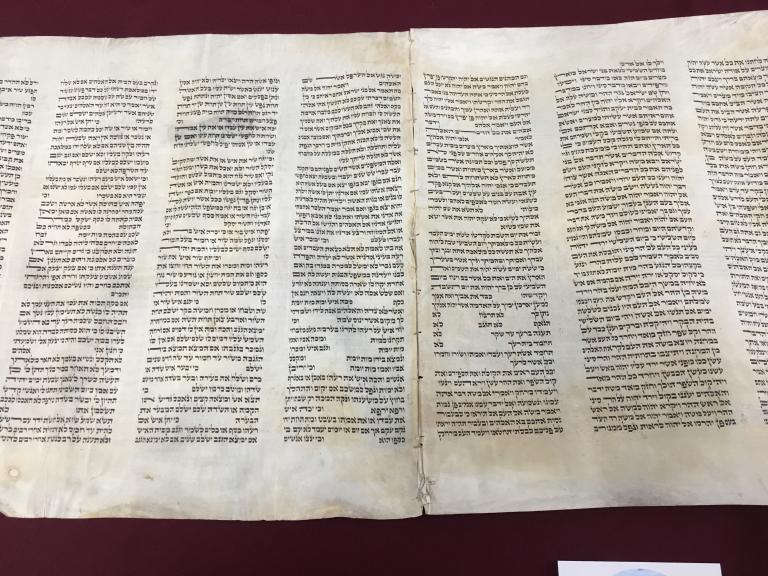

I asked Bob Clapper how this scroll could have survived the holocaust
He replied that a Rabbi could have handed the scroll out of a synagogue window to another Rabbi, who ran away with it into the woods. Then countless Hebrews returned to Israel in 1948 when they formed a new nation. Many of them travelled home with scrolls from other lands.
Then he added that his story could all just be conjecture . . .
I had a feeling it may be more true than anyone could openly speak of.
Faithful scribes handcrafted this particular Ashkenazi Scroll in Germany in 1750. Someone eventually purchased the scroll in Jerusalem. That estate later donated it to Ratio Christi.


The Masoretic Sect produced scrolls under very strict conditions. For instance, they would throw the whole scroll away because of one mistake.
This is not a Masoretic scroll
If there was a mistake, they would scrape the ink off this type of scroll. At points, they have cut the mistaken part out, and patched it with the right correction.
This Ashkenazi Scroll has 304,805 letters. It has 5,845 verses, although there are no chapters or verses in the ancient Hebrew. The letters cannot touch. These types of scrolls took 1 year to write on average. It was written with a quill from a turkey or goose. There are no vowels, punctuation marks, chapters, or verses, so it is an old form of Hebrew. It is written from right to left.
This Ashkenazi Scroll is only the Torah, but it is 90 feet long (Genesis – Deuteronomy). It is handwritten on calfskins – 100 calfskins!

There are perfect columns because the calfskins have been scored with light, vertical lines. The letters are also “justified,” so words or letters are written in a longer form on some lines to fill up the width of the column. Horizontal lines are used to write on, much like lines on our writing paper. However, the letters do not rest on top of the lines. The letters hang from the lines. Jesus uses an idiom describing this form of writing when He says all of the Law and Prophets hang on the Two Greatest Commands (Matthew 22.34-40).

*Here I am using a traditional Torah pointer or Yad to point to where we believe the Ten Commandments begin. This is a very difficult scroll to read, even for a Jew who visited the exhibit, because it is written in ancient Hebrew with no vowels.
3. Isaiah and the Dead Sea Scrolls
Before the Dead Sea Scrolls, the oldest Hebrew scroll was dated 935 A.D. Once the Dead Sea Scrolls were found, a few things changed. In the 935 A.D. version of Isaiah, there are so many prophecies of the Messiah, that skeptics believed Isaiah was written after the time of Jesus Christ. In effect, they claimed that Isaiah fabricated prophecies to validate Jesus after the fact. However, one of the Dead Sea Scrolls is an Isaiah scroll, written circa 100 B.C. Examination has shown that the 100 B.C. scroll and the 935 A.D. scroll are practically identical.
We can offer a couple of conclusions from this historical finding.
First, the Dead Sea Scrolls prove that Messianic prophecies predate Jesus Christ.
Second, Scriptures today represent the real words of the authors. 1,935 years passed between the two Isaiah scrolls with virtually no differences.
4. We can draw some conclusions from the NT itself
There are some answers we can draw from the NT itself to attest to the reliability of the Bible. We’re rounding these dates off at the nearest decade for the sake of simplicity.
Jesus Christ’s death is around 30 A.D.
Paul’s letters are written between 50-66 A.D.
The first three Gospels are written between 50-70 A.D.
John’s Gospel is believed to be about 80-90 A.D.[2]
The Jerusalem Temple is destroyed by the Roman invasion in 70 A.D.
If the NT is written from 30-90 A.D. that is 60 years with no major discrepancies. The authors have no doctrinal disputes. The story of Christ is upheld throughout.
5. extra-Biblical arguments
Looking outside of Scripture, there are 31 historical persons from the Bible that have been confirmed by extra-Biblical writings and archaeology. Among them are Pilate, David, and the Hittites.
From a literary standpoint, it is true that there are a lot of embarrassing moments recorded in the Bible. Other ancient authors would omit embarrassing moments from their tales of their heroes. The fact that the characters in the Bible seem extremely human is one proof that the Bible is real.
In the Roman world, with every religion available in the public marketplace, what do the NT writers have to gain by making up a new religion?
Why has no writing ever confirmed that people denied that Jesus died and rose again?
6. extra-Biblical evidence about Jesus Christ
Outside of the NT, we can investigate and find out:
Jesus lived in the time of Tiberius Caesar
Jesus lived a virtuous life
He was a wonder-worker
His brother was James
People acclaimed Him as the Messiah
He was crucified under Pontius Pilate
There are also plenty of other testimonies about Christ that have been handed down from non-Biblical, non-Christian sources.
2 major questions on the reliability of the Scriptures
Bob Clapper shared some focused thoughts on the reliability of Scripture, not attempting to answer every question. However, he did tackle a couple questions fairly well. How do we know the copies have not been changed? How do we know the copies we have are true?
I think in our age we would do well to glean from his approach. For those who have genuine questions, we may not be able to answer all of them. But if they are authentically seeking answers, how can we measure the value of just one well-answered question? Could our well-answered question lead a seeker just one step closer to saving faith?
notes:
[1] After the talk, Bob Clapper informed me that he relied on sources from Josh and Sean McDowell, including Sean McDowell’s Ph.D. dissertation. He also referenced a work by Frank Turek. [2] Bob Clapper diverged from his PowerPoint at this time to discuss the possibility of an earlier date for John’s Gospel. John 5.2 refers to the Sheep Gate by the Pool of Bethesda. The Greek language indicates that John is saying the Sheep Gate is still standing. However, historically we know that the Sheep Gate was destroyed by the Roman Invasion in 70 A.D. Therefore, the Gospel of John could have very well been written before 70 A.D., instead of by 80-90 A.D.
Previous Post

March 31, 2019
Guest Post, Crystal Ingle: Don't Doubt His Promises
Next Post

April 10, 2019 Prophetic: Let it Happen in His Life
Browse Our Archives
Select a Category Communion Cruz Ingle Crystal Ingle Early Church Engaging Culture Ethics & Society Family Formation History In Dialogue Jared & Crystal Kingdom of God Majority World Church Mateo Ingle Messenger College Mission Narrative Pentecostal Church of God Prayer Shepherding The Sermon The Writings Theology Theology & Psychology Traverse City Uncategorized Vernell Ingle Word Study
Select a Month October 2026 September 2026 August 2026 July 2026 June 2026 May 2026 March 2026 February 2026 January 2026 December 2025 October 2025 September 2025 August 2025 July 2025 June 2025 May 2025 April 2025 March 2025 February 2025 January 2025 December 2024 November 2024 October 2024 September 2024 August 2024 July 2024 June 2024 May 2024 April 2024 March 2024 February 2024 January 2024 December 2023 November 2023 October 2023 September 2023 August 2023 July 2023 June 2023 May 2023 April 2023 March 2023 February 2023 January 2023 December 2022 November 2022 October 2022 September 2022 August 2022 July 2022 June 2022 May 2022 April 2022 March 2022 February 2022 January 2022 December 2021 November 2021 October 2021 September 2021 August 2021 July 2021 June 2021 May 2021 April 2021 March 2021 February 2021 January 2021 December 2020 November 2020 October 2020 September 2020 August 2020 July 2020 June 2020 May 2020 April 2020 March 2020 February 2020 January 2020 December 2019 November 2019 October 2019 September 2019 August 2019 July 2019 June 2019 May 2019 April 2019 March 2019 February 2019 January 2019 December 2018 November 2018 October 2018 September 2018 August 2018 July 2018 June 2018 May 2018 April 2018 March 2018 February 2018 May 2017 March 2017 March 2014 February 2013 January 2013 October 2012 July 2012 May 2012 April 2012 March 2012 February 2012 January 2012 December 2011 August 2010
Follow Us!
TAKE THE
Religious Wisdom Quiz
Which New Testament book has the "Hall of Faith" listing heroes like Abraham and Moses?
Select your answer to see how you score.
Hebrews 1 Peter Galatians James
Related posts from Jared Ingle



Bible Reading daté par procuration
TRENDING AT PATHEOS Evangelical

When you hear the word riches, what comes to mind? For most...

Don’t Miss the Parents: A Creative Christmas Meditation
As we enter the Advent Season, I see many people trying to...

Making Stones Into Bread: Choosing the “Right” Work
I was on my online arts ministry Zoom meeting with the International...

Ukraine’s exhausted Christians face fifth winter of war
By Julian Lukins The full-scale war in Ukraine is taking “a serious...

Russell Brand's Conviction is not anti-Christian Persecution
How do we shed the reputation that the Church is OK with...

Have you ever caught yourself saying, “I’ll do it tomorrow,” or “Now...
view all Evangelical blogs
Ad-Free & Subscriber Log-In Subscription Support
- About Us
- 2026 Calendar
- Videos
- Podcasts
- Library of World Religions
- Faith In Media Tracker
- Advertise With Us
- Write for Us
- Privacy Policy
- Terms of Service
- Do Not Sell My Data
- Contact Us
- Radiant Digital
- Manage Newsletter Subscriptions
- Unsubscribe From Notifications
- Sitemap
Copyright 2008-2026, Patheos, part of the Radiant Digital network of media brands. All rights reserved.
Subscription Support Ad-Free & Subscriber Log-In
Follow Patheos