
BuddhistCatholicContemplativeEvangelicalGeneral ChristianHinduJewishLatter-day SaintMuslimNew VisionsProgressive Christian
Beliefs
- Buddhist
- Catholic
- Contemplative
- Evangelical
- General Christian
- Hindu
- Jewish
- Latter-day Saint
- More Voices
- Muslim
- New Visions
- Pagan
- Progressive Christian
Topics
- Religion News
- Food and Religion
- Sports and Religion
- Religious Art
- Religious Music and Entertainment
- Religious Events
- History and Religion
- Style and Religion
- Politics and Religion
- Women in Religion
- Recreation Outdoors and Religion
- Business Finance and Religion
- Careers Workplace and Religion
- Education and Religion
- Family Parenting and Religion
- Health Fitness and Religion
- Home and Religion
- Relationships and Religion
- Technology and Religion
- Travel and Religion
Columnists
- Buddhist Columnists
- Business Finance and Religion Columnists
- Careers Workplace and Religion Columnists
- Catholic Columnists
- Contemplative Columnists
- Education and Religion Columnists
- Evangelists Columnists
- Family Parenting and Religion Columnists
- General Christian Columnists
- Health Fitness and Religion Columnists
- Hindu Columnists
- History and Religion Columnists
- Home and Religion Columnists
- Jewish Columnists
- More Voices Columnists
- Latter Day Columnists
- Muslim Columnists
- New Visions Columnists
- Nonreligious Columnists
- Pagan Columnists
- Politics and Religion Columnists
- Progressive Columnists
- Recreation Outdoors and Religion Columnists
- Relationships and Religion Columnists
- Religion News Columnists
- Religious Art Columnists
- Religious Events Columnists
- Religious Music and Entertainment Columnists
- Sports and Religion Columnists
- Style and Religion Columnists
- Technology and Religion Columnists
- Travel and Religion Columnists
- Women in Religion Columnists
Resource Library
- 2026 Calendar
- Library of World Religions
- The 100 Most Holy Places on Earth
- Patheos Answers
- Podcasts
- Videos
- Faith Leaders Database
- Anglican Episcopalian
- Bahai
- Baptist
- Buddhism
- Christianity
- Confucianism
- Eastern Orthodoxy
- Hinduism
- Holiness and Pentecostal
- ISKCON
- Islam
- Judaism
- Lutheran
- Methodist
- The Church of Jesus Christ of Latter-day Saints
- New Age
- Paganism
- Presbytarian and Reformed
- Protestantism
- Religion Behind the Scenes
- Roman Catholic
- Scientology
- Shia Islam
- Sikhism
- Sufism
- Sunni Islam
- Taoism
- Zen
- See all religions
Research Tools
 Ad-Free & Subscriber Log-In Subscription Support
Ad-Free & Subscriber Log-In Subscription Support
Follow Patheos 

- Trending:
- Forgiveness
- |
- Marriage
- |
- Consciousness
- |
- Death Penalty
- |
- Election
- |
- Halloween

- Home
- Evangelical
- imago Dei: Qualities and Nature
imago Dei: Qualities and Nature
Last updated on: April 26, 2019 at 4:23 pm by Rev. Jared V. Ingle
imago Dei: Qualities and Nature 2019-04-26T16:23:23-04:00 Rev. Jared V. Ingle
Patheos Explore the world's faith through different perspectives on religion and spirituality! Patheos has the views of the prevalent religions and spiritualities of the world.
Last autumn, I began to share some writings on a view of persons from a Christian perspective. This encompassed writings from a psychological standpoint, integrating Theology. This also included writings from a Theological standpoint, incorporating multiple disciplines. As I forge ahead, I have been looking forward to a point when I could share some research on the image of God, or imago Dei. I am adapting this series from some previous research, but will also include adaptations which reflect the dialogue I had with Professor Brian G. Edgar, Ph.D. This post will begin our series with the qualities and nature of the imago Dei.
Then God said, “Let Us make man in Our image, according to Our likeness; let them have dominion over the fish of the sea, over the birds of the air, and over the cattle, over all the earth and over every creeping thing that creeps on the earth.” So God created man in His own image; in the image of God He created him; male and female He created them. (Genesis 1.26-27, New King James Version)
What implications does a Theological understanding of imago Dei hold for a contemporary scientific understanding of human nature? The purpose of these writings is to pursue this question through readings in partial fulfillment of the course The Human Person: Multi-Disciplinary Perspectives.[1] I explore aspects of human nature and science in light of our readings and various writers.
“Human beings have intrinsic value by virtue of being made in God’s image (Gen. 1:26-27), which distinguishes human beings from animals. The image of God, a doctrine often referred to in Latin as imago dei, is fundamental to the notion of human nature, which grounds personal identity through time and change.”[2]
Multiple scholars through time have emphasized the Theological concept of imago Dei. What makes the human unique? Does anything set him apart from other forms of created life? What connects him to the Creator? We do not often find the answers in one view or another, but rather in the tension between them.
For instance, is man merely a fully functioning body, as proposed by physicalists or monism? Or is man a complex entity consisting of a body, soul, and even a spirit? For the monist, how is the imago Dei sustained over the years (continuity), in spite of the fact that our cells continually reproduce themselves? For the one who subscribes to a dualist or tripartite view of human nature, how is the imago Dei truly embodied and the whole person redeemed? This paper explores questions like these.
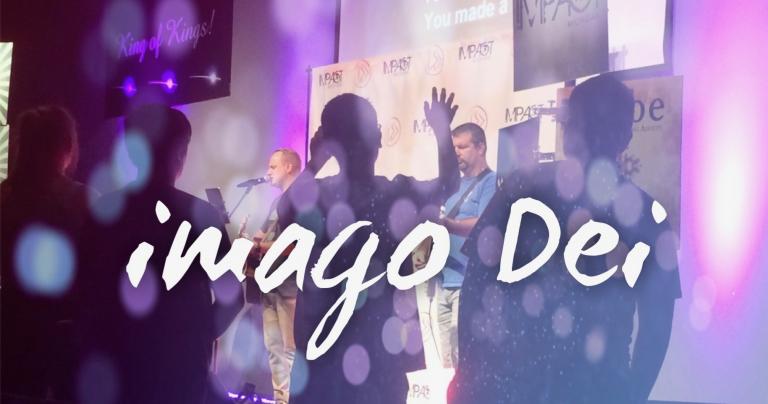
JVI | Cruz worshipping | PCG Michigan District Convention | 09.22.17
Qualities and Nature
“Image and likeness were contrasted in differences between ‘natural qualities’ such as reason and ‘supernatural graces’ such as spiritual qualities (Irenaeus *c.*130-*c.*200). Tertullian (*c.*160-*c.*220) suggested that the image of God was retained after sinning, while the lost likeness was restored through the renewing activity of the Spirit after conversion. However, there is little support for such exegetical distinctions.”[3]
Irenaeus of Lyons and Tertullian, a couple of Early Church Fathers, offer a couple of the basic views about imago Dei. Irenaeus says there are certain qualities we possess that prove God has made us in His image. We will refer to his concept as a standard. For Tertullian, imago Dei is always present in humans, but the likeness of God is fully restored upon salvation, a view of the status of man. Either as a status or standard, the human being has God-given dignity.
As for Murray and Wilkinson’s critique of Irenaeus and Tertullian at the end of this quote, I think it proves a point. We feel that with modern science and all of our advances in the various disciplines, that ancient voices may no longer have the bearing they once had. After all, we have developed since then. However, I would never be so quick to dismiss the voice of early Patristrics, especially those who are within a couple generations of Christ Himself. What better commentators on Scripture do we have than those who have passed on a tradition that probably stems from the New Testament Church?
Status
The simplest, and perhaps the most profound, understanding of imago Dei is that it is a gift given by God to all humanity. “Imaging God is a gift, an office given to us by God, not a set of functional attributes that human beings may define, or define away, according to our fickle and selfish ends.”[4] People bear the image of God only because they are in fact people. In a sovereign act, God bestows His image on individuals. This is the simplest and clearest understanding we have from Scripture.
Standard
“Whereas all human beings have the status of images of God, human beings vary considerably in the degree to which they measure up to the standard of the image of God.”[5] This is not a particular set of characteristics, but rather a standard of how humans are to reflect God’s character and will. In some branches of Theology, we understand redemption in terms of becoming fully human. What has God designed man to live up to? The standard of imago Dei is not to be confused with particular traits, such as rationale or morality. Rather the standard reflects the renewed life. We are being conformed to Christ’s image (Romans 8.29; 1 Corinthians 14.45-49; Colossians 3.9-10).
Utilitarianism
Against the status and standard of imago Dei stands utilitarianism. This is a modern philosophy that undergirds some of the ethics in our time. Consequently, utilitarianism may have an influence on science as well.
“According to a utilitarian perspective, what ultimately matters is the benefit itself (e.g., pleasure or preference satisfaction), not the individuals who benefit. Individuals whose existence impose a burden on the whole – whether that whole is understood, for instance, in terms of society or of the family – must be eliminated to improve the well-being of the whole.”[6]
Is Mitchell painting in black and white? Do various factors and people color the issues? Utilitarians may object to Mitchell on two grounds. First, they believe they are trying to provide real benefits for people. Secondly, certainly not all utilitarians would state that those who are a “burden” must be eliminated.
In response to the first objection of a utilitarian, I have two questions. 1) How do we define benefits? 2) How do we decide who benefits? As for the second objection, I concede that not all utilitarians carry this philosophy out to the nth degree . . . but some do.
In all reality, there is an element of truth in Mitchell’s critique. If someone subscribes to utilitarianism, the philosophy measures a human’s worth by his ability to contribute to society. When this is no longer possible, by some nebulous measure, then the person’s life is no longer worth living.
Toward renewal
If Irenaeus and Tertullian were to discuss the matter further, they might conclude that both status and standard are fundamental to the understanding of imago Dei.
Like Irenaeus, I believe that we possess certain aspects of the image of God simply because we are human. “From Genesis onward, the fact that a being is human rather than not human is what identifies that being as in the image of God.”[7] Regardless of socioeconomic status, health, development, etc., people bear God’s image and they are worthy of protection. This line of thinking about the imago Dei is diametrically opposed to utilitarianism.
I would also have to agree with Tertullian. Although we bear the image of God, we are marred representatives. We are marred by the Fall, by Original Sin, and by our own conceits. Once we become Christians and start living unto righteousness, the imago Dei is renewed within us, as Paul points out multiple times (see above). We are becoming fully human, and journeying toward renewal.
notes:
[1] adapted from Jared V. Ingle, “imago Dei: At the Intersection of Science and Human Nature” (paper presented in, The Human Person: Multi-Disciplinary Perspectives, Asbury Theological Seminary, May 8, 2011). [2] C. Ben Mitchell, Edmund D. Pellegrino, Jean Bethke Elshtain, John F. Kilner, and Scott B. Rae, Biotechnology and the Human Good (Washington D.C.: Georgetown University Press, 2007), 55. [3] Paul D. Murray and David Wilkinson, “The Significance of the Theology of Creation within Christian Tradition: Systematic Considerations,” in God, Humanity and the Cosmos, ed. Christopher Southgate (New York: T&T Clark International, 2005), 45. [4] Mitchell et al., 145. [5] Ibid., 70. [6] Ibid., 61. [7] Ibid., 76.
Previous Post

April 18, 2019
Prophetic: So that the Church can Come to Restoration
Next Post

May 2, 2019 Prophetic: Speak the Mind of God
Browse Our Archives
Select a Category Communion Cruz Ingle Crystal Ingle Early Church Engaging Culture Ethics & Society Family Formation History In Dialogue Jared & Crystal Kingdom of God Majority World Church Mateo Ingle Messenger College Mission Narrative Pentecostal Church of God Prayer Shepherding The Sermon The Writings Theology Theology & Psychology Traverse City Uncategorized Vernell Ingle Word Study
Select a Month October 2026 September 2026 August 2026 July 2026 June 2026 May 2026 March 2026 February 2026 January 2026 December 2025 October 2025 September 2025 August 2025 July 2025 June 2025 May 2025 April 2025 March 2025 February 2025 January 2025 December 2024 November 2024 October 2024 September 2024 August 2024 July 2024 June 2024 May 2024 April 2024 March 2024 February 2024 January 2024 December 2023 November 2023 October 2023 September 2023 August 2023 July 2023 June 2023 May 2023 April 2023 March 2023 February 2023 January 2023 December 2022 November 2022 October 2022 September 2022 August 2022 July 2022 June 2022 May 2022 April 2022 March 2022 February 2022 January 2022 December 2021 November 2021 October 2021 September 2021 August 2021 July 2021 June 2021 May 2021 April 2021 March 2021 February 2021 January 2021 December 2020 November 2020 October 2020 September 2020 August 2020 July 2020 June 2020 May 2020 April 2020 March 2020 February 2020 January 2020 December 2019 November 2019 October 2019 September 2019 August 2019 July 2019 June 2019 May 2019 April 2019 March 2019 February 2019 January 2019 December 2018 November 2018 October 2018 September 2018 August 2018 July 2018 June 2018 May 2018 April 2018 March 2018 February 2018 May 2017 March 2017 March 2014 February 2013 January 2013 October 2012 July 2012 May 2012 April 2012 March 2012 February 2012 January 2012 December 2011 August 2010
Follow Us!
TAKE THE
Religious Wisdom Quiz
Who said, "I am the Alpha and the Omega"?
Select your answer to see how you score.
Paul John Moses Jesus
Related posts from Jared Ingle

Fully Human vs. Sub-Human | Children vs. Dogs


Table of Contents | The Fruit of the...
TRENDING AT PATHEOS Evangelical

The REST of Your Life: A Creative Wrestles...
This week I had a conversation with a good friend from church....

How the author of the world's best hymn...
I've been working with John Newton for a while now. This makes...

Long before this Lectio Divina, Psalm 130 - the song - started...

What About the Trees? Another Living Parable
After I finished writing the last article about falling leaves as a...

Why Classical Education Is a Conversation, Not a...
Come and Read: Joy in Classical Education When I was a little...

Cornell University has received a great deal of negative publicity and intense...
view all Evangelical blogs
Ad-Free & Subscriber Log-In Subscription Support
- About Us
- 2026 Calendar
- Videos
- Podcasts
- Library of World Religions
- Faith In Media Tracker
- Advertise With Us
- Write for Us
- Privacy Policy
- Terms of Service
- Do Not Sell My Data
- Contact Us
- Radiant Digital
- Manage Newsletter Subscriptions
- Unsubscribe From Notifications
- Sitemap
Copyright 2008-2026, Patheos. All rights reserved.
Subscription Support Ad-Free & Subscriber Log-In
Follow Patheos