
BuddhistCatholicContemplativeEvangelicalGeneral ChristianHinduJewishLatter-day SaintMuslimNew VisionsProgressive Christian
Beliefs
- Buddhist
- Catholic
- Contemplative
- Evangelical
- General Christian
- Hindu
- Jewish
- Latter-day Saint
- More Voices
- Muslim
- New Visions
- Pagan
- Progressive Christian
Topics
- Religion News
- Food and Religion
- Sports and Religion
- Religious Art
- Religious Music and Entertainment
- Religious Events
- History and Religion
- Style and Religion
- Politics and Religion
- Women in Religion
- Recreation Outdoors and Religion
- Business Finance and Religion
- Careers Workplace and Religion
- Education and Religion
- Family Parenting and Religion
- Health Fitness and Religion
- Home and Religion
- Relationships and Religion
- Technology and Religion
- Travel and Religion
Columnists
- Buddhist Columnists
- Business Finance and Religion Columnists
- Careers Workplace and Religion Columnists
- Catholic Columnists
- Contemplative Columnists
- Education and Religion Columnists
- Evangelists Columnists
- Family Parenting and Religion Columnists
- General Christian Columnists
- Health Fitness and Religion Columnists
- Hindu Columnists
- History and Religion Columnists
- Home and Religion Columnists
- Jewish Columnists
- More Voices Columnists
- Latter Day Columnists
- Muslim Columnists
- New Visions Columnists
- Nonreligious Columnists
- Pagan Columnists
- Politics and Religion Columnists
- Progressive Columnists
- Recreation Outdoors and Religion Columnists
- Relationships and Religion Columnists
- Religion News Columnists
- Religious Art Columnists
- Religious Events Columnists
- Religious Music and Entertainment Columnists
- Sports and Religion Columnists
- Style and Religion Columnists
- Technology and Religion Columnists
- Travel and Religion Columnists
- Women in Religion Columnists
Resource Library
- 2026 Calendar
- Library of World Religions
- The 100 Most Holy Places on Earth
- Patheos Answers
- Podcasts
- Videos
- Faith Leaders Database
- Anglican Episcopalian
- Bahai
- Baptist
- Buddhism
- Christianity
- Confucianism
- Eastern Orthodoxy
- Hinduism
- Holiness and Pentecostal
- ISKCON
- Islam
- Judaism
- Lutheran
- Methodist
- The Church of Jesus Christ of Latter-day Saints
- New Age
- Paganism
- Presbytarian and Reformed
- Protestantism
- Religion Behind the Scenes
- Roman Catholic
- Scientology
- Shia Islam
- Sikhism
- Sufism
- Sunni Islam
- Taoism
- Zen
- See all religions
Research Tools
 Ad-Free & Subscriber Log-In Subscription Support
Ad-Free & Subscriber Log-In Subscription Support
Follow Patheos 

- Trending:
- Forgiveness
- |
- Marriage
- |
- Consciousness
- |
- Death Penalty
- |
- Election
- |
- Halloween

- Home
- Evangelical
- On Holism, Holiness, and Wholeness
On Holism, Holiness, and Wholeness
Last updated on: October 4, 2018 at 4:27 pm by Rev. Jared V. Ingle
On Holism, Holiness, and Wholeness 2018-10-04T16:27:14-04:00 Rev. Jared V. Ingle
Patheos Explore the world's faith through different perspectives on religion and spirituality! Patheos has the views of the prevalent religions and spiritualities of the world.
Have you ever wondered about what the Bible says about humanity? What did God create man to be? In what ways did The Fall affect us? Did our Lord restore some sort of wholeness that we had lost?
These questions were at the core of a seminary project I undertook. I found I was not alone in my curiosity. Many scholars were chasing these questions, including those in the social science fields.[1]
i. Adam: Wholeness
Likeness
And God said, Let us make man in our image, after our likeness. (Genesis 1.26, King James Version)
James Strong defines the word likeness as, “resemblance; concretely model, shape.”[2]
Stanley Horton reveals that, “the image and likeness have to do with the spiritual and moral nature of man.”[3]
J.H. Hertz states, “Man is made in the ‘image’ and ‘likeness’ of God: his character is potentially Divine.”[4]
Therefore, it seems like the word likeness refers to the whole human being as the only creation that resembles the Creator.
Communion
We see the likeness of God in man’s ability to have communion or fellowship with God.
God’s greatest gift to us at the beginning was not the order of creation or the beauty of the Garden, but the fellowship of his own person and the capability to enter into that fellowship.[5]
No other creature has the distinction of being called God’s friend (Exodus 33.11; John 15.15).
God’s Word
Adam is commanded to stay away from the forbidden fruit so that he can maintain fellowship with God.
But of the tree of the knowledge of good and evil, thou shalt not eat of it: for in the day that thou eatest thereof thou shalt surely die. (Genesis 2.17)
Consequently, man seems to be capable of making choices based on God’s revealed will or Word. This is, “the one eternal and unfailing guide as to what constitutes good and evil – and not man’s instincts, or even his Reason, which in the hour of temptation often call light darkness and darkness light.”[6]
Holiness
God calls creation good. Then He creates Adam and Eve and, “it was very good” (Genesis 1.31). Man shares his dignity with creation, but seems to be the first or greatest of creation. However, the Creator is who gives man his true dignity.
Holiness describes this concept. Holiness means sacred. The root word of holiness means ceremonially clean.[7] Holiness means set apart or sacred. God is holy, set apart. God makes us in His image, sets us apart, makes us holy.
Jones and Butman state that the term holy, “literally means being set apart to God’s purposes and manifesting his righteous character.”[8] So man’s holiness comes from being set apart from creation to the Creator.
Holistic
Horace and Ava English define holism as a, “doctrine that a living being has properties which pertain to the whole rather than to its constituent parts, and that the dynamics of a living whole cannot be explained as resulting from independent elements.”[9]
Similarly, Jones and Butman use the term heart in a holistic manner: “The scriptural emphasis on heart teaches us the importance of understanding ourselves as a unity.”[10] Although holism, holiness, and wholeness are related terms, they are not the same.
For instance, a holistic approach that does not link man to God does not fully address what makes a man whole.
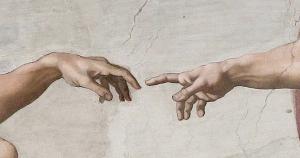 Michelangelo Buonarroti | Creation of Adam
Sistine Chapel, 1508-1512 | Public Domain
God makes Adam whole as He makes Adam in His likeness. Adam communes with God and obeys God’s Word. He is God’s unique, holy creature.
ii. Adam’s Fall: from Wholeness to Insecurity
In Genesis 3.1-5, the serpent does not try to dispute the fact that there is a God. Eck and Moon report that, “95% of Americans report that they believe in God.”[11] For the serpent to convince Eve to become an atheist would have been a long shot.
The serpent tries to distort what Eve believes about God. Perhaps the serpent is saying something like, “The forbidden fruit is an attempt by God to keep you and Adam down!” Although they are perfectly whole, they begin to believe that they can be better. This makes them insecure in their present state, the first incident of low self-esteem.
This insecurity is common to man. “82% [of Americans] report they pray for health or success.”[12] Why does man pray for these things?
Man believes that perfect health or great success can improve the self, or make one whole. Success or performance-based goals can lead to perfectionism. Unmet goals lead to discouragement. Even if one does meet his goals, he often finds that achievements do not make one whole. Depression often results.
iii. The 2nd Adam: from Insecurity to Perfection
Be ye therefore perfect, even as your Father which is in heaven is perfect. (Matthew 5.48)
Jesus commands a perfection that is not based on performance or flawlessness. The word perfection literally means, “complete.”[13] Man’s wholeness is restored through the sacrifice of Jesus Christ.
Since this wholeness is based on God’s love, He restores security as well. God offers us the security of being, “loved without needing to change in order to win love, loved by a love that is freely given, that cannot be earned and therefore cannot be lost.”[14]
The minister or therapist who identifies with God, can be a tool that God uses to minister to the individual and restore wholeness first.
Jones and Butman state that we can work with the Holy Spirit, “by being paracletes ourselves, drawing alongside another with hope and comfort.”[15] As a result, the unconditional love of God that restores wholeness can be expressed through the relationship.
Footnotes:
[1] Jared V. Ingle, “Nine Biblical Factors of Personality, Abnormality, and Change in the Creation Account,” (paper presented in Interpersonal Techniques in Helping Relationships, Assemblies of God Theological Seminary, Springfield, MO, December 9, 2003).
Toward a Biblical Concept of Personality
[2] James Strong, The Exhaustive Concordance of the Bible (Peabody, MA: Hendrickson Publishers, 1961), 31.
Amazon: Strong’s Concordance
[3] Stanley Horton, What the Bible says about the Holy Spirit (Springfield, MO: Gospel Publishing House, 1976), 21.
Amazon: What the Bible Says About the Holy Spirit
Amazon: Pentateuch and Haftorahs
Amazon: Modern Psychotherapies
Amazon: Dictionary of Psychological Terms
[12] Ibid., 267-268.
[13] Strong, 71. [14] Larry Crabb, The Marriage Builder: A Blueprint for Couples and Counselors (Grand Rapids, MI: Zondervan Publishing House, 1992), 29.
Amazon: The Marriage Builder
Previous Post

October 1, 2018
If We're Not Bad, We're Good . . . Right?
Next Post
October 9, 2018 The Dilemma of the Sin of Omission
Browse Our Archives
Select a Category Communion Cruz Ingle Crystal Ingle Early Church Engaging Culture Ethics & Society Family Formation History In Dialogue Jared & Crystal Kingdom of God Majority World Church Mateo Ingle Messenger College Mission Narrative Pentecostal Church of God Prayer Shepherding The Sermon The Writings Theology Theology & Psychology Traverse City Uncategorized Vernell Ingle Word Study
Select a Month October 2026 September 2026 August 2026 July 2026 June 2026 May 2026 March 2026 February 2026 January 2026 December 2025 October 2025 September 2025 August 2025 July 2025 June 2025 May 2025 April 2025 March 2025 February 2025 January 2025 December 2024 November 2024 October 2024 September 2024 August 2024 July 2024 June 2024 May 2024 April 2024 March 2024 February 2024 January 2024 December 2023 November 2023 October 2023 September 2023 August 2023 July 2023 June 2023 May 2023 April 2023 March 2023 February 2023 January 2023 December 2022 November 2022 October 2022 September 2022 August 2022 July 2022 June 2022 May 2022 April 2022 March 2022 February 2022 January 2022 December 2021 November 2021 October 2021 September 2021 August 2021 July 2021 June 2021 May 2021 April 2021 March 2021 February 2021 January 2021 December 2020 November 2020 October 2020 September 2020 August 2020 July 2020 June 2020 May 2020 April 2020 March 2020 February 2020 January 2020 December 2019 November 2019 October 2019 September 2019 August 2019 July 2019 June 2019 May 2019 April 2019 March 2019 February 2019 January 2019 December 2018 November 2018 October 2018 September 2018 August 2018 July 2018 June 2018 May 2018 April 2018 March 2018 February 2018 May 2017 March 2017 March 2014 February 2013 January 2013 October 2012 July 2012 May 2012 April 2012 March 2012 February 2012 January 2012 December 2011 August 2010
Follow Us!
TAKE THE
Religious Wisdom Quiz
Who said, "All things work together for good"?
Select your answer to see how you score.
James John Peter Paul
Related posts from Jared Ingle

Why I Am Not a Reformed Protestant

Purity of Heart | Guest Post, Vernell Ingle


charting the main trajectory; ethics pt. 8 revised
TRENDING AT PATHEOS Evangelical

The REST of Your Life: A Creative Wrestles...
This week I had a conversation with a good friend from church....

How the author of the world's best hymn...
I've been working with John Newton for a while now. This makes...

Long before this Lectio Divina, Psalm 130 - the song - started...

What About the Trees? Another Living Parable
After I finished writing the last article about falling leaves as a...

Why Classical Education Is a Conversation, Not a...
Come and Read: Joy in Classical Education When I was a little...

Cornell University has received a great deal of negative publicity and intense...
view all Evangelical blogs
Ad-Free & Subscriber Log-In Subscription Support
- About Us
- 2026 Calendar
- Videos
- Podcasts
- Library of World Religions
- Faith In Media Tracker
- Advertise With Us
- Write for Us
- Privacy Policy
- Terms of Service
- Do Not Sell My Data
- Contact Us
- Radiant Digital
- Manage Newsletter Subscriptions
- Unsubscribe From Notifications
- Sitemap
Copyright 2008-2026, Patheos. All rights reserved.
Subscription Support Ad-Free & Subscriber Log-In
Follow Patheos