
BuddhistCatholicContemplativeEvangelicalGeneral ChristianHinduJewishLatter-day SaintMuslimNew VisionsProgressive Christian
Beliefs
- Buddhist
- Catholic
- Contemplative
- Evangelical
- General Christian
- Hindu
- Jewish
- Latter-day Saint
- More Voices
- Muslim
- New Visions
- Pagan
- Progressive Christian
Topics
- Religion News
- Food and Religion
- Sports and Religion
- Religious Art
- Religious Music and Entertainment
- Religious Events
- History and Religion
- Style and Religion
- Politics and Religion
- Women in Religion
- Recreation Outdoors and Religion
- Business Finance and Religion
- Careers Workplace and Religion
- Education and Religion
- Family Parenting and Religion
- Health Fitness and Religion
- Home and Religion
- Relationships and Religion
- Technology and Religion
- Travel and Religion
Columnists
- Buddhist Columnists
- Business Finance and Religion Columnists
- Careers Workplace and Religion Columnists
- Catholic Columnists
- Contemplative Columnists
- Education and Religion Columnists
- Evangelists Columnists
- Family Parenting and Religion Columnists
- General Christian Columnists
- Health Fitness and Religion Columnists
- Hindu Columnists
- History and Religion Columnists
- Home and Religion Columnists
- Jewish Columnists
- More Voices Columnists
- Latter Day Columnists
- Muslim Columnists
- New Visions Columnists
- Nonreligious Columnists
- Pagan Columnists
- Politics and Religion Columnists
- Progressive Columnists
- Recreation Outdoors and Religion Columnists
- Relationships and Religion Columnists
- Religion News Columnists
- Religious Art Columnists
- Religious Events Columnists
- Religious Music and Entertainment Columnists
- Sports and Religion Columnists
- Style and Religion Columnists
- Technology and Religion Columnists
- Travel and Religion Columnists
- Women in Religion Columnists
Resource Library
- 2026 Calendar
- Library of World Religions
- The 100 Most Holy Places on Earth
- Patheos Answers
- Podcasts
- Videos
- Faith Leaders Database
- Anglican Episcopalian
- Bahai
- Baptist
- Buddhism
- Christianity
- Confucianism
- Eastern Orthodoxy
- Hinduism
- Holiness and Pentecostal
- ISKCON
- Islam
- Judaism
- Lutheran
- Methodist
- The Church of Jesus Christ of Latter-day Saints
- New Age
- Paganism
- Presbytarian and Reformed
- Protestantism
- Religion Behind the Scenes
- Roman Catholic
- Scientology
- Shia Islam
- Sikhism
- Sufism
- Sunni Islam
- Taoism
- Zen
- See all religions
Research Tools
 Ad-Free & Subscriber Log-In Subscription Support
Ad-Free & Subscriber Log-In Subscription Support
Follow Patheos 

- Trending:
- Forgiveness
- |
- Marriage
- |
- Consciousness
- |
- Death Penalty
- |
- Election
- |
- Halloween

- Home
- Evangelical
- The Image, the Body, and Renewal
The Image, the Body, and Renewal
Last updated on: October 12, 2018 at 4:37 pm by Rev. Jared V. Ingle
The Image, the Body, and Renewal 2018-10-12T16:37:29-04:00 Rev. Jared V. Ingle
Patheos Explore the world's faith through different perspectives on religion and spirituality! Patheos has the views of the prevalent religions and spiritualities of the world.
What can we glean from the Creation accounts about the body? Does the Word of God speak concretely about the physical body? How far do we go in applying the terms image and likeness of God (the imago Dei)?
Do we practically apply scriptural principles to our everyday?
Could we incorporate these views into our approach as ministers, therapists, etc.?
I simply cannot tackle all these questions (and those following) in this portion of the series.[1] However, sometimes it’s better to raise a few questions for people to grapple with, rather than to provide all the answers.
i. Adam: The Body
Image
Man is the being, but the image and the likeness are God’s (Genesis 1.26-27). James Strong simply defines image as a, “a representative figure, especially an idol”[2] An idol represents something spiritual, like a demon. It is an inanimate object that looks like the “god” it represents.
In the same way, man is the image or representation of God (imago Dei). “We have special value in that we are the only aspect of creation specifically said to be created in God’s ‘image.’”[3] The image represents God, but is also handcrafted by God from the clay. He speaks all of creation into existence except for man, who He makes by hand and gives His very breath to.
Distinctions of the human body
Although some gender differences can be attributed to culture, God creates male and female (Genesis 1.27; 2.18-22). In the garden, these differences are complimentary, not divisive (Genesis 2.18).
The body is able to perceive and to respond to its surroundings through the five senses. The body is able to perform behavior. Adam’s first behavior is to take care of the garden (Genesis 2.15).
The body is able to communicate meaning. God brought all of the animals to Adam, “to see what he would call them” (Genesis 2.19). “Man alone has language, and can give birth to languages. In giving names to earth’s creatures, he would establish his dominion over them.”[4]
The body is also capable of rest, which is a sanctified activity (Genesis 2.2-3).
ii. Adam’s Fall: from God’s Image to Man’s
The original couple is unashamed of their naked bodies (Genesis 2.25, 3.7). After they eat the fruit, they experience shame. They cover themselves and hide their bodies from God. The image is marred. Eventually, the fallen image is reproduced.
And Adam lived an hundred and thirty years, and begat a son in his own likeness, and after his image; and called his name Seth. (Genesis 5.3)
Does this mean that man no longer bears God’s image?
“Old Testament writers spoke of the brevity of life and humanity’s relative physical insignificance, they affirm that our glory is found in the fact that we are in the image of God.”[5] God’s image is still within man. However, man is unable to reproduce the whole image of God. So man is now a distorted image and likeness of God, in need of redemption.
iii. The 2nd Adam: from Man’s Image to Renewal
John Ingram states that, “the body, or the actual physical flesh, is not inherently evil, although it can be used instrumentally for either positive or negative purposes.”[6]
The body is not capable of living forever, and eventually dies.
On the cross, Jesus Christ sacrifices His body to restore ours. God not only grants us healing now, but eventually a new body, a renewal of the image of God that will live forever.
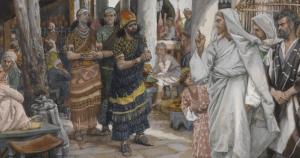 James Tissot | The Healing of the Officer’s Son
circa 1886 | Brooklyn Museum | Public Domain
The minister and counselor can participate in the healing process with the client.
Perhaps the client suffers from a poor body image or is in need of physical healing. Certainly, God has the power to provide emotional or physical healing.
Perhaps other interventions are necessary. A note of caution is that we can risk harm to a client’s body by, “applying only religious interventions to problems that may require medication or other medical or psychological treatments.”[7]
Ultimately, counselors and ministers who help people find appropriate medical treatment are still participating in a form of God’s healing processes.
Questions to Consider:
1) How would we practically apply scriptural principles to our everyday?
2) What is you view about physical healing? Does your congregation have an official statement about divine healing?
3) Do you hold a view about emotional healing?
4) How could these Scriptures speak to those with body image issues? What about other physical issues?
5) Do you consider medical/health intervention as a grace of wisdom for the body? Of course, many treatments are reactive, but there are also proactive ways we can become healthier.
6) Do we have a responsibility as ministers and therapists to consider the overall health of the body? How do we form an approach as ministers, therapists, etc.?
Footnotes:
[1] Jared V. Ingle, “Nine Biblical Factors of Personality, Abnormality, and Change in the Creation Account,” (paper presented in Interpersonal Techniques in Helping Relationships, Assemblies of God Theological Seminary, Springfield, MO, December 9, 2003).
Toward a Biblical Concept of Personality
On Holism, Holiness, and Wholeness
[2] James Strong, The Exhaustive Concordance of the Bible (Peabody, MA: Hendrickson Publishers, 1961), 99.
Amazon: Strong’s Concordance [3] Stanton Jones and Richard Butman, Modern Psychotherapies: A Comprehensive Christian Appraisal (Downers Grove, IL: InterVarsity Press, 1991), 42.
Amazon: Modern Psychotherapies [4] J.H. Hertz, The Pentateuch and Haftorahs, 2nd ed. (London: Soncino Press, 1960), 9.
Amazon: Pentateuch and Haftorahs [5] John D. Carter and S. Bruce Narramore, The Integration of Psychology and Theology: An Introduction (Grand Rapids, MI: Zondervan, 1979), 21.
Amazon:Integration of Psychology and Theology
Previous Post
October 9, 2018
The Dilemma of the Sin of Omission
Next Post
October 16, 2018 The Deadly Sin of Acedia
Browse Our Archives
Select a Category Communion Cruz Ingle Crystal Ingle Early Church Engaging Culture Ethics & Society Family Formation History In Dialogue Jared & Crystal Kingdom of God Majority World Church Mateo Ingle Messenger College Mission Narrative Pentecostal Church of God Prayer Shepherding The Sermon The Writings Theology Theology & Psychology Traverse City Uncategorized Vernell Ingle Word Study
Select a Month October 2026 September 2026 August 2026 July 2026 June 2026 May 2026 March 2026 February 2026 January 2026 December 2025 October 2025 September 2025 August 2025 July 2025 June 2025 May 2025 April 2025 March 2025 February 2025 January 2025 December 2024 November 2024 October 2024 September 2024 August 2024 July 2024 June 2024 May 2024 April 2024 March 2024 February 2024 January 2024 December 2023 November 2023 October 2023 September 2023 August 2023 July 2023 June 2023 May 2023 April 2023 March 2023 February 2023 January 2023 December 2022 November 2022 October 2022 September 2022 August 2022 July 2022 June 2022 May 2022 April 2022 March 2022 February 2022 January 2022 December 2021 November 2021 October 2021 September 2021 August 2021 July 2021 June 2021 May 2021 April 2021 March 2021 February 2021 January 2021 December 2020 November 2020 October 2020 September 2020 August 2020 July 2020 June 2020 May 2020 April 2020 March 2020 February 2020 January 2020 December 2019 November 2019 October 2019 September 2019 August 2019 July 2019 June 2019 May 2019 April 2019 March 2019 February 2019 January 2019 December 2018 November 2018 October 2018 September 2018 August 2018 July 2018 June 2018 May 2018 April 2018 March 2018 February 2018 May 2017 March 2017 March 2014 February 2013 January 2013 October 2012 July 2012 May 2012 April 2012 March 2012 February 2012 January 2012 December 2011 August 2010
Follow Us!
TAKE THE
Religious Wisdom Quiz
Who was the cupbearer to the king who fasted and prayed for Jerusalem?
Select your answer to see how you score.
Nehemiah Zerubbabel Haggai Ezra
Related posts from Jared Ingle

Why I Am Not a Reformed Protestant

Purity of Heart | Guest Post, Vernell Ingle


charting the main trajectory; ethics pt. 8 revised
TRENDING AT PATHEOS Evangelical

How the author of the world's best hymn...
I've been working with John Newton for a while now. This makes...

Long before this Lectio Divina, Psalm 130 - the song - started...

What About the Trees? Another Living Parable
After I finished writing the last article about falling leaves as a...

Why Classical Education Is a Conversation, Not a...
Come and Read: Joy in Classical Education When I was a little...

Falling Leaves: A Living Parable on Letting Go
I’ve spent the vast majority of my life in the southeast corner...

Cornell University has received a great deal of negative publicity and intense...
view all Evangelical blogs
Ad-Free & Subscriber Log-In Subscription Support
- About Us
- 2026 Calendar
- Videos
- Podcasts
- Library of World Religions
- Faith In Media Tracker
- Advertise With Us
- Write for Us
- Privacy Policy
- Terms of Service
- Do Not Sell My Data
- Contact Us
- Radiant Digital
- Manage Newsletter Subscriptions
- Unsubscribe From Notifications
- Sitemap
Copyright 2008-2026, Patheos. All rights reserved.
Subscription Support Ad-Free & Subscriber Log-In
Follow Patheos