
BuddhistCatholicContemplativeEvangelicalGeneral ChristianHinduJewishLatter-day SaintMuslimNew VisionsProgressive Christian
Beliefs
- Buddhist
- Catholic
- Contemplative
- Evangelical
- General Christian
- Hindu
- Jewish
- Latter-day Saint
- More Voices
- Muslim
- New Visions
- Pagan
- Progressive Christian
Topics
- Religion News
- Food and Religion
- Sports and Religion
- Religious Art
- Religious Music and Entertainment
- Religious Events
- History and Religion
- Style and Religion
- Politics and Religion
- Women in Religion
- Recreation Outdoors and Religion
- Business Finance and Religion
- Careers Workplace and Religion
- Education and Religion
- Family Parenting and Religion
- Health Fitness and Religion
- Home and Religion
- Relationships and Religion
- Technology and Religion
- Travel and Religion
Columnists
- Buddhist Columnists
- Business Finance and Religion Columnists
- Careers Workplace and Religion Columnists
- Catholic Columnists
- Contemplative Columnists
- Education and Religion Columnists
- Evangelists Columnists
- Family Parenting and Religion Columnists
- General Christian Columnists
- Health Fitness and Religion Columnists
- Hindu Columnists
- History and Religion Columnists
- Home and Religion Columnists
- Jewish Columnists
- More Voices Columnists
- Latter Day Columnists
- Muslim Columnists
- New Visions Columnists
- Nonreligious Columnists
- Pagan Columnists
- Politics and Religion Columnists
- Progressive Columnists
- Recreation Outdoors and Religion Columnists
- Relationships and Religion Columnists
- Religion News Columnists
- Religious Art Columnists
- Religious Events Columnists
- Religious Music and Entertainment Columnists
- Sports and Religion Columnists
- Style and Religion Columnists
- Technology and Religion Columnists
- Travel and Religion Columnists
- Women in Religion Columnists
Resource Library
- 2026 Calendar
- Library of World Religions
- The 100 Most Holy Places on Earth
- Patheos Answers
- Podcasts
- Videos
- Faith Leaders Database
- Anglican Episcopalian
- Bahai
- Baptist
- Buddhism
- Christianity
- Confucianism
- Eastern Orthodoxy
- Hinduism
- Holiness and Pentecostal
- ISKCON
- Islam
- Judaism
- Lutheran
- Methodist
- The Church of Jesus Christ of Latter-day Saints
- New Age
- Paganism
- Presbytarian and Reformed
- Protestantism
- Religion Behind the Scenes
- Roman Catholic
- Scientology
- Shia Islam
- Sikhism
- Sufism
- Sunni Islam
- Taoism
- Zen
- See all religions
Research Tools
 Ad-Free & Subscriber Log-In Subscription Support
Ad-Free & Subscriber Log-In Subscription Support
Follow Patheos 

- Trending:
- Forgiveness
- |
- Marriage
- |
- Consciousness
- |
- Death Penalty
- |
- Election
- |
- Halloween

- Home
- Evangelical
- Vernell Ingle reflects on the works of C.S. Lewis, pt. 5
Vernell Ingle reflects on the works of C.S. Lewis, pt. 5
Last updated on: September 11, 2018 at 8:25 am by Rev. Jared V. Ingle
Vernell Ingle reflects on the works of C.S. Lewis, pt. 5 2018-09-11T08:25:29-04:00 Rev. Jared V. Ingle
Patheos Explore the world's faith through different perspectives on religion and spirituality! Patheos has the views of the prevalent religions and spiritualities of the world.
Now we turn our attention to the centerpiece of the Narnia series, The Stone Table.
We’re continuing this unique series on C.S. Lewis, birthed out of some seminary research by Rev. Vernell Ingle, Faculty Chair at Messenger College.
Most importantly, he has read C.S. Lewis books to us children and his grandchildren over the years, truly making them part of our tribal spiritual formation, if you will.
Each week, we’re offering a writing and some type of audio/visual piece that runs a parallel track. Take some time to explore the writings so far.[1]
The Stone Table
The Chronicles of Narnia is a wonderful, magical, mystical, fantastic adventure series written for children, but certainly enjoyed by adults as well. In the movie Shadowlands, colleagues criticize and jest with Lewis for being preoccupied with writing children’s fantasy tales.
There are seven books to this series. They all center around a certain family in which the brothers, sisters, and cousins enter, inadvertently, a new land-dimension known as Narnia. Lewis wittingly interweaves into his stories an analogy of Biblical truth.
The hero of the series is a strong, powerful, majestic, fearful, and yet tender lion known as Aslan
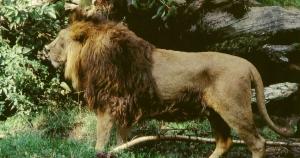 Jochen Ackermann | Panthera leo persica | Nurnberg | 2004
Aslan appears and disappears at will throughout the series. He always has a profound and positive effect on those who follow Him, and His enemies have no power against Him.
In the first book, The Lion, the Witch and the Wardrobe, Lewis sets the tone for the series of Narnia. The children enter the world of Narnia, inadvertently, through the door of a wardrobe. Immediately they realize that there are good people (or talking creatures) and evil ones. Aslan is good. There are rumors that He has returned to break the winter spell of the White Witch.
The curse of the White Witch is that it is always winter but it never gets to be Christmas, until Aslan returns. The winter dissipates. Christmas arrives. But one of the four children has come under the influence of the evil witch and becomes entrapped. The only way to break that spell is for someone who is worthy to surrender to the White Witch.
A significant meeting is arranged at the Stone Table
Aslan is there, and the four children, along with all of the good creatures. The White Witch is there with all of her evil hordes. She is there to claim the rights over Edmund, who has come under her influence.
The White Witch and Aslan confer. Everyone expected a battle between the two, that Aslan would obviously gain the victory, and all the wrong would be set right. But much to everyone’s dismay, Aslan surrenders to the White Witch. She has her hordes tie Him to the Stone Table. His mane is shorn away. He ends up looking like a huge helpless rat.
Then Aslan’s followers are horrified when the knife is plunged into His chest and He is murdered by the witch
The following day a strange magic takes place as the two sisters, Lucy and Susan, approach the Stone Table:
The rising of the sun had made everything look so different – all the colours and shadows were changed – that for a moment they didn’t see the important thing. Then they did. The Stone Table was broken into two pieces by a great crack that ran down it from end to end; and there was no Aslan.
“Oh, oh, oh!” cried the two girls rushing back to the Table. “Oh, it’s too bad,” sobbed Lucy; “they might have left the body alone.”
“Who’s done it?” cried Susan. “What does it mean?” Is it more magic?”
“Yes!” said a great voice behind their backs. “It is more magic.” They looked round. There, shining in the sunrise, larger than they had seen him before, shaking his man (for it had apparently grown again) stood Aslan himself.[2]
The story finishes with Aslan and the children, who are now considered kings and queens
They and the good creatures rid the land of Narnia of the White Witch. The White Witch has captured other good creatures and turned them into stone statues. When Aslan breaks her evil spell, He returns these statues to life.
Lewis’ imagination is captivating. The premies of these books are all too obvious to the Christian reader.
Questions to Consider:
1) Are Lewis’ analogies “all too obvious?”
How do you view them as a means of communication Christian truths?
Have you used them in family or church settings for this purpose?
2) Consider the nature of sacrifice. There are laws that must be followed, and punishment when they are broken, even spiritually speaking . . . “without the shedding of blood there is no forgiveness of sins” (Hebrews 9.22).
Does this analogy enliven your understanding, or remind you, of the purpose and depth of Christ’s sacrifice?
[1] Series titles to date:
Aslan Acrostic: Dr. Thomas Woodward shares the story of C.S. Lewis
Vernell Ingle reflects on the works of C.S. Lewis
Vernell Ingle reflects on the works of C.S. Lewis, pt. 2
A Distinction in Ancient Literature (a/v)
Vernell Ingle reflects on the works of C.S. Lewis, pt. 3
On the Supernatural as the Natural Life (a/v)
Vernell Ingle reflects on the works of C.S. Lewis, pt. 4
Language Acquisition (a/v): LEWIS, TOLKIEN, & PIAGET(?)
[2] C.S. Lewis, The Lion, the Witch and the Wardrobe, vol. 2 of The Chronicles of Narnia (New York: Collier Books, 1950), 158-159.
Amazon: The Lion, the Witch and the Wardrobe

Previous Post
September 5, 2018
Language Acquisition (a/v): LEWIS, TOLKIEN, & PIAGET(?)
Next Post

September 12, 2018 Jared & Mateo: Hearing the Story for the 1st Time (a/v)
Browse Our Archives
Select a Category Communion Cruz Ingle Crystal Ingle Early Church Engaging Culture Ethics & Society Family Formation History In Dialogue Jared & Crystal Kingdom of God Majority World Church Mateo Ingle Messenger College Mission Narrative Pentecostal Church of God Prayer Shepherding The Sermon The Writings Theology Theology & Psychology Traverse City Uncategorized Vernell Ingle Word Study
Select a Month October 2026 September 2026 August 2026 July 2026 June 2026 May 2026 March 2026 February 2026 January 2026 December 2025 October 2025 September 2025 August 2025 July 2025 June 2025 May 2025 April 2025 March 2025 February 2025 January 2025 December 2024 November 2024 October 2024 September 2024 August 2024 July 2024 June 2024 May 2024 April 2024 March 2024 February 2024 January 2024 December 2023 November 2023 October 2023 September 2023 August 2023 July 2023 June 2023 May 2023 April 2023 March 2023 February 2023 January 2023 December 2022 November 2022 October 2022 September 2022 August 2022 July 2022 June 2022 May 2022 April 2022 March 2022 February 2022 January 2022 December 2021 November 2021 October 2021 September 2021 August 2021 July 2021 June 2021 May 2021 April 2021 March 2021 February 2021 January 2021 December 2020 November 2020 October 2020 September 2020 August 2020 July 2020 June 2020 May 2020 April 2020 March 2020 February 2020 January 2020 December 2019 November 2019 October 2019 September 2019 August 2019 July 2019 June 2019 May 2019 April 2019 March 2019 February 2019 January 2019 December 2018 November 2018 October 2018 September 2018 August 2018 July 2018 June 2018 May 2018 April 2018 March 2018 February 2018 May 2017 March 2017 March 2014 February 2013 January 2013 October 2012 July 2012 May 2012 April 2012 March 2012 February 2012 January 2012 December 2011 August 2010
Follow Us!
TAKE THE
Religious Wisdom Quiz
Who was the first person raised from the dead by Jesus?
Select your answer to see how you score.
Jairus' daughter Lazarus The Centurion's servant Widow's son
Related posts from Jared Ingle
Vernell Ingle | I've Just Called to Encourage...

Why I Am Not a Reformed Protestant

2 Timothy 1.7 | Scripture Interpreted in Community,...

Purity of Heart | Guest Post, Vernell Ingle
TRENDING AT PATHEOS Evangelical

The REST of Your Life: A Creative Wrestles...
This week I had a conversation with a good friend from church....

How the author of the world's best hymn...
I've been working with John Newton for a while now. This makes...

Long before this Lectio Divina, Psalm 130 - the song - started...

What About the Trees? Another Living Parable
After I finished writing the last article about falling leaves as a...

Why Classical Education Is a Conversation, Not a...
Come and Read: Joy in Classical Education When I was a little...

Cornell University has received a great deal of negative publicity and intense...
view all Evangelical blogs
Ad-Free & Subscriber Log-In Subscription Support
- About Us
- 2026 Calendar
- Videos
- Podcasts
- Library of World Religions
- Faith In Media Tracker
- Advertise With Us
- Write for Us
- Privacy Policy
- Terms of Service
- Do Not Sell My Data
- Contact Us
- Radiant Digital
- Manage Newsletter Subscriptions
- Unsubscribe From Notifications
- Sitemap
Copyright 2008-2026, Patheos. All rights reserved.
Subscription Support Ad-Free & Subscriber Log-In
Follow Patheos