
BuddhistCatholicContemplativeEvangelicalGeneral ChristianHinduJewishLatter-day SaintMuslimNew VisionsProgressive Christian
Beliefs
- Buddhist
- Catholic
- Contemplative
- Evangelical
- General Christian
- Hindu
- Jewish
- Latter-day Saint
- More Voices
- Muslim
- New Visions
- Pagan
- Progressive Christian
Topics
- Religion News
- Food and Religion
- Sports and Religion
- Religious Art
- Religious Music and Entertainment
- Religious Events
- History and Religion
- Style and Religion
- Politics and Religion
- Women in Religion
- Recreation Outdoors and Religion
- Business Finance and Religion
- Careers Workplace and Religion
- Education and Religion
- Family Parenting and Religion
- Health Fitness and Religion
- Home and Religion
- Relationships and Religion
- Technology and Religion
- Travel and Religion
Columnists
- Buddhist Columnists
- Business Finance and Religion Columnists
- Careers Workplace and Religion Columnists
- Catholic Columnists
- Contemplative Columnists
- Education and Religion Columnists
- Evangelists Columnists
- Family Parenting and Religion Columnists
- General Christian Columnists
- Health Fitness and Religion Columnists
- Hindu Columnists
- History and Religion Columnists
- Home and Religion Columnists
- Jewish Columnists
- More Voices Columnists
- Latter Day Columnists
- Muslim Columnists
- New Visions Columnists
- Nonreligious Columnists
- Pagan Columnists
- Politics and Religion Columnists
- Progressive Columnists
- Recreation Outdoors and Religion Columnists
- Relationships and Religion Columnists
- Religion News Columnists
- Religious Art Columnists
- Religious Events Columnists
- Religious Music and Entertainment Columnists
- Sports and Religion Columnists
- Style and Religion Columnists
- Technology and Religion Columnists
- Travel and Religion Columnists
- Women in Religion Columnists
Resource Library
- 2026 Calendar
- Library of World Religions
- The 100 Most Holy Places on Earth
- Patheos Answers
- Podcasts
- Videos
- Faith Leaders Database
- Anglican Episcopalian
- Bahai
- Baptist
- Buddhism
- Christianity
- Confucianism
- Eastern Orthodoxy
- Hinduism
- Holiness and Pentecostal
- ISKCON
- Islam
- Judaism
- Lutheran
- Methodist
- The Church of Jesus Christ of Latter-day Saints
- New Age
- Paganism
- Presbytarian and Reformed
- Protestantism
- Religion Behind the Scenes
- Roman Catholic
- Scientology
- Shia Islam
- Sikhism
- Sufism
- Sunni Islam
- Taoism
- Zen
- See all religions
Research Tools
 Ad-Free & Subscriber Log-In Subscription Support
Ad-Free & Subscriber Log-In Subscription Support
Follow Patheos 

- Trending:
- Forgiveness
- |
- Marriage
- |
- Consciousness
- |
- Death Penalty
- |
- Election
- |
- Halloween

- Home
- Evangelical
- Aslan Acrostic: Dr. Thomas Woodward shares the story of C.S. Lewis
Aslan Acrostic: Dr. Thomas Woodward shares the story of C.S. Lewis
Last updated on: April 24, 2019 at 7:56 pm by Rev. Jared V. Ingle
Aslan Acrostic: Dr. Thomas Woodward shares the story of C.S. Lewis 2019-04-24T19:56:23-04:00 Rev. Jared V. Ingle
Patheos Explore the world's faith through different perspectives on religion and spirituality! Patheos has the views of the prevalent religions and spiritualities of the world.
On April 10, 2017, I strolled into a large venue with my two older sons Mateo and Cruz. Before even seeing that there were between 250 – 300 people getting seated, we were met with loud chatter. There were various refreshments. I enjoyed a good cup of coffee and we settled in for the talk, with my tablet ready for notes.
My family had discovered that Ratio Christi Ministries, in cooperation with Northwestern Michigan College, was hosting a talk by Dr. Thomas Woodward. Dr. Woodward studied history at Princeton, holds a Th.M. from Dallas Theological Seminary, has a Ph.D. in the Rhetoric of Science from the University of South Florida, and is a historian of the theory of Intelligent Design.
Dr. Thomas Woodward is also the President of the C.S. Lewis Society. The session that night was on “C.S. Lewis and the God Hypothesis.”[1]
“You could probably tell this story better than me!”
As the presentation began, Tony Feiger of Ratio Christi made the introductions, stating that Dr. Woodward would share first. Then there would be a microphone for questions afterwards.
Dr. Woodward began to lecture and to engage his large audience with the history of Lewis and stories of Narnia. He asked questions, fielded answers, and masterfully captivated the crowd of primarily collegians. I was quite surprised.
On a couple occasions, when someone answered correctly, Dr. Woodward would teasingly reply, “Oh, you could probably tell this story better than me!” This is the answer I received from him when I had the correct answer for the man who played the role of C.S. Lewis in the movie Shadowlands (1999).
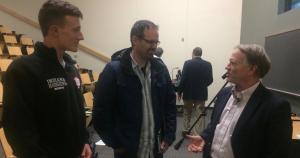 JVI, in conversation with Dr. Thomas Woodward
Ratio Christi & NMC | 04.10.17
Do you know who that actor was? You’ve probably heard of him.
One caveat about that movie from someone who has sat at the desk of C.S. Lewis. The suffering of C.S. Lewis, as portrayed in Shadowlands, precedes that season in his life. It stems from his earlier days in the Great War, a point to which Dr. Woodward offered some insight.
The story of my interest in Lewis and Tolkien
My dad has read all of the Narnia books to my siblings and I, complete with theatrical voices, since we were children, and long before any movies (including B.B.C. productions). He has now carried on this tradition with his grandchildren.
I’ve worked through the books with our oldest son. Our middle son has heard everything through The Silver Chair. Our youngest is already looking forward to the readings. I’ve also read The Hobbit on a couple occasions to our two older sons, especially as we waited for the film series. My dad and I have also read the The Silmarillion.
Our interest may be nothing extraordinary for fans of Lewis or John Ronald Reuel Tolkien (J.R.R. Tolkien). One college student, who gave me my first couple of Tolkien books, along with some books on writing, had read through the Lord of the Rings trilogy every year since he was a child.
I had heard of the connection between Lewis and Tolkien and spoken with avid readers who knew parts of their stories. I once discovered a book in Ashland, Kentucky, The Letters of J.R.R. Tolkien. Since it was in a private library, I had to make a quick decision as to what letters I would read, because I tentatively had 3-5 days there.
I jotted down notes and citations, some used later in papers and sermons, on every letter I could between Tolkien and Lewis, who was apparently one of his close friends. Dr. Woodward sheds some light on their relationship.
Aslan Acrostic
It may be a little known fact that C.S. Lewis was, for quite some time, an atheist. Dr. Woodward shared an Aslan Acrostic as a basis for his narrative.
- C.S. Lewis is an Atheist from the ages of 9-20.
- He becomes a Seeker.
- He’s a Literary Genius as a follower of Christ, in English Literature and many other genres, including science fiction.
- Then he becomes an Apostle, moving out to engage the world with writings like The Screwtape Letters, The Problem of Pain, etc.
- Finally, Lewis becomes a Narnian.
A – theist
S – eeker
L – iterary Genius
A – postle
N – arnian
Athiest
C.S. Lewis has a troubled childhood. His mom dies of cancer. He has a distant father and a terrible prep school. He does have one bright spot in high school – a mentor who houses and tutors him – like an amazing home school.
Lewis serves in World War I and is badly injured. Afterwards, he is admitted into Oxford. He experiences a growing pessimism:
“I did not believe God existed, and I was angry at him for not existing . . .”
Seeker
There are two experiences of transcendent joy that Lewis has as a child and growing up, that he describes as almost painful joy. This joy seems to be just out of his reach. He believes these joy moments point to a God. These are found in his autobiography, Surprised by Joy: The Shape of My Early Life.
As a teacher at Oxford, Lewis remains an atheist, however the tide begins to turn. Another colleague, an atheist historian drops in to Lewis’s office one day and talks to him about the Gospels.
As a historian, the atheist begins to share with Lewis that the history of the Gospels is actually very good history
When discussing the resurrection, he states that something could have actually happened. It may have not been just another historic, cultural myth.
Lewis seems to be shaken somewhat by this conversation. Are the Gospels possibly actual history? Could a resurrection have literally happened once in reality, not only in mythology? Another atheist had sat down in his office and argued in favor of the Gospels.
Later, Lewis says that he was basically dragged “kicking and screaming” to the altar.
The crux of the dialogues: Lewis and Tolkien, 1931
Lewis’ office still stands at Oxford. I believe Dr. Woodward said that people still feed deer out of their hand near the woods behind the building, as they did in Lewis’ day. As you walk out of the front of the doors and take and left, you head toward Addison’s Walk at Oxford.
On Addison’s Walk, Lewis and Tolkien discuss the great questions that Lewis is grappling with. It is a clear night with a starry sky.
Some may not realize it, but Tolkien is what we now call a philologist, understanding ancient languages, and unlocking keys to histories, myths, etc. He certainly shows unique abilities and skills to create languages in his writings.
So Lewis seems stuck on Addison Walk, in between history and mythology. Tolkien basically asks Lewis a simple question.
“Could it possibly be that the line of mythology and history intersect at this one point?”
In effect, Tolkien asks, is the Christ event the crux of mythology and history?
Did the trajectories of mythologies and histories ever connect?
Lewis goes home, prays, and chooses to believe in Jesus that night!
The impact of their friendship
Since some people that I have talked to are so interested in the relationship of Tolkien and Lewis, I’ll offer one example of the impact of their friendship on society.
In the early 1940’s, citizens begin to press for more legal freedom to divorce in England. Some see this as a sign of the times, the unraveling of society.
Although some press for freedom to divorce, others, including the church, stand opposed. Tolkien and Lewis turn their gaze to the issue at hand. In a letter in 1943, Tolkien write to Lewis:
“The battle may be a losing one, but I cannot help suspecting that those who fight against the divorce in this case of law and religion are in the right. Sentire cum ecclesia: how often one finds that this is a true guide.”[2]
In Latin, sentire cum ecclesia basically means to hold an opinion, or to side with the church.
What do Tolkien and Lewis think? First of all, they side with the ecclesia (and may I add, historic Scriptural interpretation and tradition of the church, not modern trends of their age). The courts of England are allowing far more than what God intends, and who can argue with Lewis or Tolkien on Theology or language interpretation?!
Secondly, Tolkien upholds the ecclesia’s right to speak to the issue!
First, we can learn from this brief vignette of Tolkien and Lewis, who rally support for proper Biblical understanding, that Christians can depend on God’s Word for answers to ethical questions.
Secondly, we have a right (or rite) to speak to these issues. Having a Biblical understanding about ethics is one thing. Taking a stand is another!
Literary Genius
One of the books that Dr. Woodward says that he loves is Perelandra. Since that time my oldest son has read the Space Trilogy, which includes Perelandra; he thoroughly enjoyed the series.
For those who like audio books, The Four Loves is still available. I believe it’s the only audio book read by Lewis himself. He explores the four classic Greek words for love.
Apostle
In 1947, C.S. Lewis makes the cover of Time, three years before the Chronicles of Narnia. He’s called a heretic by Time because of his apostolic writings on classic Christianity. He writes The Screwtape Letters (another book my family enjoyed) and The Problem of Pain.
At times, Dr. Woodward explores these topics in depth on the site Apologetics.org – C.S. Lewis Society.
About the book Mere Christianity, Dr. Woodward addressed the question:
“What are we to make of Jesus Christ?”
Lewis never meets G.K. Chesterton, but reads his works extensively. Chesterton declares that Jesus Christ is the Lord, or a lunatic, or a liar!
What do we think of His claims? They’re either true or false.
If the claims of Christ are true . . . then He is Lord.
If they’re false . . . He knew . . . and was therefore a liar.
If they’re false . . . and He didn’t know . . . then He was a lunatic.
If Jesus Christ is Lord, even if it’s a possibility, then that should lead us to consider His claims.
Dr. Woodward says that C.S. Lewis adapts Chesterton’s line of rationale in Mere Christianity: Book 2, What Christians Believe (and I believe in God in the Dock as well). It is Lewis’ most famous argument.
In my seminary experience, Mere Christianity is highly regarded, not only Theologically but also philosophically. Lewis has an uncanny ability to speak to various streams of Theology. However, he is doing apologetics, offering a philosophical approach for our belief in God that builds up to our Christian way of life.
Narnian
C.S. Lewis starts “The Kilns,” a home where he welcomes children suffering after World War II. He begins developing the idea of Narnia from this time with those children and his wife, Joy.
Eventually, C.S. Lewis shifts to Cambridge University.
Lewis tours are offered by Christian Heritage: London. At times Dr. Thomas Woodward still participates in the London, Oxford & Cambridge national tour, which includes a stroll on Addison Walk.
[1] adapted from conversation and the teaching of Thomas Woodward, “C.S. Lewis & the God Hypothesis” (presentation, Ratio Christi Campus Apologetics Alliance: Northwestern Michigan College Chapter, Traverse City, MI, April 10, 2017). [2] J.R.R. Tolkien, The Letters of J.R.R. Tolkien, ed. Humphrey Carpenter and Christopher Tolkien (Boston, MA: Houghton Mifflin, 2000), 62.
Amazon: The Letters of JRR Tolkien


Next Post
July 31, 2018 Reformation 500th Anniversary: Ideals of the Magisterial Reformers (a/v)
Browse Our Archives
Select a Category Communion Cruz Ingle Crystal Ingle Early Church Engaging Culture Ethics & Society Family Formation History In Dialogue Jared & Crystal Kingdom of God Majority World Church Mateo Ingle Messenger College Mission Narrative Pentecostal Church of God Prayer Shepherding The Sermon The Writings Theology Theology & Psychology Traverse City Uncategorized Vernell Ingle Word Study
Select a Month October 2026 September 2026 August 2026 July 2026 June 2026 May 2026 March 2026 February 2026 January 2026 December 2025 October 2025 September 2025 August 2025 July 2025 June 2025 May 2025 April 2025 March 2025 February 2025 January 2025 December 2024 November 2024 October 2024 September 2024 August 2024 July 2024 June 2024 May 2024 April 2024 March 2024 February 2024 January 2024 December 2023 November 2023 October 2023 September 2023 August 2023 July 2023 June 2023 May 2023 April 2023 March 2023 February 2023 January 2023 December 2022 November 2022 October 2022 September 2022 August 2022 July 2022 June 2022 May 2022 April 2022 March 2022 February 2022 January 2022 December 2021 November 2021 October 2021 September 2021 August 2021 July 2021 June 2021 May 2021 April 2021 March 2021 February 2021 January 2021 December 2020 November 2020 October 2020 September 2020 August 2020 July 2020 June 2020 May 2020 April 2020 March 2020 February 2020 January 2020 December 2019 November 2019 October 2019 September 2019 August 2019 July 2019 June 2019 May 2019 April 2019 March 2019 February 2019 January 2019 December 2018 November 2018 October 2018 September 2018 August 2018 July 2018 June 2018 May 2018 April 2018 March 2018 February 2018 May 2017 March 2017 March 2014 February 2013 January 2013 October 2012 July 2012 May 2012 April 2012 March 2012 February 2012 January 2012 December 2011 August 2010
Follow Us!
TAKE THE
Religious Wisdom Quiz
What does "Ebenezer" mean in Hebrew?
Select your answer to see how you score.
Stone of Help Gift from God City of Refuge House of the Lord
Related posts from Jared Ingle



Othismos.org | Michigan Pastors Alliance

TRENDING AT PATHEOS Evangelical

How the author of the world's best hymn...
I've been working with John Newton for a while now. This makes...

Long before this Lectio Divina, Psalm 130 - the song - started...

What About the Trees? Another Living Parable
After I finished writing the last article about falling leaves as a...

Why Classical Education Is a Conversation, Not a...
Come and Read: Joy in Classical Education When I was a little...

Falling Leaves: A Living Parable on Letting Go
I’ve spent the vast majority of my life in the southeast corner...

Cornell University has received a great deal of negative publicity and intense...
view all Evangelical blogs
Ad-Free & Subscriber Log-In Subscription Support
- About Us
- 2026 Calendar
- Videos
- Podcasts
- Library of World Religions
- Faith In Media Tracker
- Advertise With Us
- Write for Us
- Privacy Policy
- Terms of Service
- Do Not Sell My Data
- Contact Us
- Radiant Digital
- Manage Newsletter Subscriptions
- Unsubscribe From Notifications
- Sitemap
Copyright 2008-2026, Patheos. All rights reserved.
Subscription Support Ad-Free & Subscriber Log-In
Follow Patheos