
BuddhistCatholicContemplativeEvangelicalGeneral ChristianHinduJewishLatter-day SaintMuslimNew VisionsProgressive Christian
Beliefs
- Buddhist
- Catholic
- Contemplative
- Evangelical
- General Christian
- Hindu
- Jewish
- Latter-day Saint
- More Voices
- Muslim
- New Visions
- Pagan
- Progressive Christian
Topics
- Religion News
- Food and Religion
- Sports and Religion
- Religious Art
- Religious Music and Entertainment
- Religious Events
- History and Religion
- Style and Religion
- Politics and Religion
- Women in Religion
- Recreation Outdoors and Religion
- Business Finance and Religion
- Careers Workplace and Religion
- Education and Religion
- Family Parenting and Religion
- Health Fitness and Religion
- Home and Religion
- Relationships and Religion
- Technology and Religion
- Travel and Religion
Columnists
- Buddhist Columnists
- Business Finance and Religion Columnists
- Careers Workplace and Religion Columnists
- Catholic Columnists
- Contemplative Columnists
- Education and Religion Columnists
- Evangelists Columnists
- Family Parenting and Religion Columnists
- General Christian Columnists
- Health Fitness and Religion Columnists
- Hindu Columnists
- History and Religion Columnists
- Home and Religion Columnists
- Jewish Columnists
- More Voices Columnists
- Latter Day Columnists
- Muslim Columnists
- New Visions Columnists
- Nonreligious Columnists
- Pagan Columnists
- Politics and Religion Columnists
- Progressive Columnists
- Recreation Outdoors and Religion Columnists
- Relationships and Religion Columnists
- Religion News Columnists
- Religious Art Columnists
- Religious Events Columnists
- Religious Music and Entertainment Columnists
- Sports and Religion Columnists
- Style and Religion Columnists
- Technology and Religion Columnists
- Travel and Religion Columnists
- Women in Religion Columnists
Resource Library
- 2026 Calendar
- Library of World Religions
- The 100 Most Holy Places on Earth
- Patheos Answers
- Podcasts
- Videos
- Faith Leaders Database
- Anglican Episcopalian
- Bahai
- Baptist
- Buddhism
- Christianity
- Confucianism
- Eastern Orthodoxy
- Hinduism
- Holiness and Pentecostal
- ISKCON
- Islam
- Judaism
- Lutheran
- Methodist
- The Church of Jesus Christ of Latter-day Saints
- New Age
- Paganism
- Presbytarian and Reformed
- Protestantism
- Religion Behind the Scenes
- Roman Catholic
- Scientology
- Shia Islam
- Sikhism
- Sufism
- Sunni Islam
- Taoism
- Zen
- See all religions
Research Tools
 Ad-Free & Subscriber Log-In Subscription Support
Ad-Free & Subscriber Log-In Subscription Support
Follow Patheos 

- Trending:
- Forgiveness
- |
- Marriage
- |
- Consciousness
- |
- Death Penalty
- |
- Election
- |
- Halloween

- Home
- Evangelical
- The Trinity: Recognizing Beauty in Doctrine
The Trinity: Recognizing Beauty in Doctrine
Last updated on: June 21, 2018 at 11:38 am by Rev. Jared V. Ingle
The Trinity: Recognizing Beauty in Doctrine 2018-06-21T11:38:46-04:00 Rev. Jared V. Ingle
Patheos Explore the world's faith through different perspectives on religion and spirituality! Patheos has the views of the prevalent religions and spiritualities of the world.
There is a revealed beauty in the language that God gives us to describe Him, as we enter into the processes of understanding Him more.
Joel Green, a Theologian, says:
“The texts of the NT were formed in the cauldron of community formation and witness; as a consequence, interpretation of those texts that does not lead to vital discipleship and mission hardly has a claim to being New Testament interpretation.”[1]
This is a modern-day Theologian from the Ivy League telling us that if our Bible does not lead us to disciple others, and lead us to form a community of faith, then we’re not interpreting it right.
Video, The Trinity: Recognizing Beauty in Doctrine
i. Consider a doctrinal statement in the New Testament
This is a passage that I call a doctrinal statement in the NT community, Galatians 3.27-28:
for all of you who were baptized into Christ have clothed yourselves with Christ. There is neither Jew nor Greek, slave nor free, male nor female, for you are all one in Christ Jesus. (NIV, 1999)
We are going to consider a Pentecostal Church of God (PCG) point of doctrine, in light of the Early Church.
ii. Part of the current Doctrinal Statement of the PCG is on the Godhead or the Trinity
2. The Godhead
“We believe there is but one true and living God, who is everlasting, infinite in power, wisdom and goodness; that He is the Creator of all things, visible and invisible, and Preserver of all things (Romans 1:20; Colossians 1:16). In the unity of this Godhead, there are three persons of one individual essence, who are co-equal, co-existent and co-eternal; namely, the Father, the Son and the Holy Ghost (Matthew 3:16, 17; 28:18, 19; 2 Corinthians 13:14; John 1:1,2, 18; 10:33; 14:26; 15:26; Philippians 2:6; Hebrews 9:14).”[2]
In the unity of this Godhead, there are three persons of one individual essence
iii. Our Doctrinal Statement supports the Nicene Creed
The Nicene Creed is a summarizing work, completed in the Niceno-Constantinopolitan Creed (381 AD). It goes back before this date to the Theologians who were working on it. One of them was Athanasius. Then there were three (four if we include one of the sisters) called the Cappadocian Fathers. Athanasius is a forerunner.
They argue for a couple of terms in describing the Trinity. Think about these terms in relation to our doctrine:
In the unity of this Godhead, there are three persons of one individual essence
The phrase three persons comes from the Greek word that is used at that time: hypostases, actual personalities or persons.
There are three hypostases, but there is one individual essence: homoousios, one substance.
There are many ways to describe the Trinity, like an egg, or a three-leaf clover. However, when you think about essence, and three distinct things at the same time, consider water, ice, and vapor. They’re all three H20, all one essence, but they’re just three different forms.
iv. Athanasius is using these terms before people are talking about the Trinity
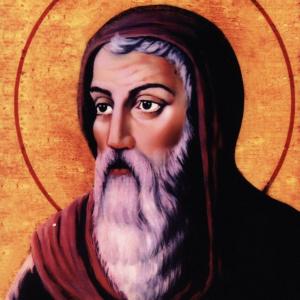 St. Athanasius the Apostolic | Coptic Church | Public Domain
Athanasius is using these terms to fight a heresy in his area. He calls a gathering of church leaders in his region to work on it. The heresy he’s fighting is known as Sabellianism.
Today we call it modalism: Unitarians, Oneness, and some Apostolics. Some of these groups have a slight problem with the doctrine of the Trinity.
One example of modalism is that God shows up in different ways in different times. Maybe God is wearing a different mask at various times. Some believe that God in the Old Testament, becomes Jesus in the Gospels, and then the Holy Spirit now. So there is a progression, a further revelation of who God is, but He is one.
This is not exactly Trinitarian Theology. Athanasius develops a Trinitarian doctrine directly from the Greek.
“The purpose of putting forth this new idea was to contradict Sabellian modalism by making clear that Father, Son, and Holy Spirit, though one substance (homoousios), are not the same identical person or subsistence. They are three distinct persons (hypostases) and not merely three masks or manifestations or aspects of the one personal God, as Sabellianism averred.”[3]
v. If you only relate to God from the Old Testament, do you really know Jesus?
Can you really know Jesus if you think He is somehow God the Father?
Can you really understand half of what Jesus says when He says, all I’m doing is the will of the Father (Matthew 7.21; 12.50; John 5.30; 8.28)?
Can you understand what Jesus says when He says, not my will, but Yours be done (Matthew 26.39, 42; Mark 14.35, Luke 22.42)?
Can you really understand that He was sent by the Trinity? God sent forth His Son as the ambassador, or the apostle, to Earth (Galatians 4.4).
These Scriptures simply don’t make sense if you hold to a doctrine like Sabellianism, or modern-day modalism.
vi. The sheer beauty of this PCG doctrinal statement is amazing:
In the unity of this Godhead, there are three persons of one individual essence
We affirm thoughts that go back to the early creeds that hold all Christians together.
[1] Joel B. Green, “The Practice of Reading the New Testament,” in Hearing the New Testament: Strategies for Interpretation, ed. Joel B. Green (Grand Rapids, MI: Wm. B. Eerdmans, 1995), 413. [2] “PCG Beliefs: Doctrinal Statement,” Pentecostal Church of God, last modified 2013, accessed March 25, 2017, http://www.pcg.org/beliefs. [3] Roger E. Olson, The Story of Christian Theology: Twenty Centuries of Tradition & Reform (Downers Grove, IL: IVP Academic, 1999), 166.
Previous Post

June 16, 2018
On the Spirit's Gifts, Strengths-Based, and Integrative Approaches
Next Post

June 23, 2018 Doctrine in the Greater Christian Community
Browse Our Archives
Select a Category Communion Cruz Ingle Crystal Ingle Early Church Engaging Culture Ethics & Society Family Formation History In Dialogue Jared & Crystal Kingdom of God Majority World Church Mateo Ingle Messenger College Mission Narrative Pentecostal Church of God Prayer Shepherding The Sermon The Writings Theology Theology & Psychology Traverse City Uncategorized Vernell Ingle Word Study
Select a Month October 2026 September 2026 August 2026 July 2026 June 2026 May 2026 March 2026 February 2026 January 2026 December 2025 October 2025 September 2025 August 2025 July 2025 June 2025 May 2025 April 2025 March 2025 February 2025 January 2025 December 2024 November 2024 October 2024 September 2024 August 2024 July 2024 June 2024 May 2024 April 2024 March 2024 February 2024 January 2024 December 2023 November 2023 October 2023 September 2023 August 2023 July 2023 June 2023 May 2023 April 2023 March 2023 February 2023 January 2023 December 2022 November 2022 October 2022 September 2022 August 2022 July 2022 June 2022 May 2022 April 2022 March 2022 February 2022 January 2022 December 2021 November 2021 October 2021 September 2021 August 2021 July 2021 June 2021 May 2021 April 2021 March 2021 February 2021 January 2021 December 2020 November 2020 October 2020 September 2020 August 2020 July 2020 June 2020 May 2020 April 2020 March 2020 February 2020 January 2020 December 2019 November 2019 October 2019 September 2019 August 2019 July 2019 June 2019 May 2019 April 2019 March 2019 February 2019 January 2019 December 2018 November 2018 October 2018 September 2018 August 2018 July 2018 June 2018 May 2018 April 2018 March 2018 February 2018 May 2017 March 2017 March 2014 February 2013 January 2013 October 2012 July 2012 May 2012 April 2012 March 2012 February 2012 January 2012 December 2011 August 2010
Follow Us!
TAKE THE
Religious Wisdom Quiz
Which book comes immediately after the Gospels in the New Testament?
Select your answer to see how you score.
Acts 1 Corinthians Romans Hebrews
Related posts from Jared Ingle

Why I Am Not a Reformed Protestant

List of Sins | Word Studies in Corinthians
Origen & Chrysostom on Darkness
TRENDING AT PATHEOS Evangelical

How the author of the world's best hymn...
I've been working with John Newton for a while now. This makes...

Long before this Lectio Divina, Psalm 130 - the song - started...

What About the Trees? Another Living Parable
After I finished writing the last article about falling leaves as a...

Why Classical Education Is a Conversation, Not a...
Come and Read: Joy in Classical Education When I was a little...

Falling Leaves: A Living Parable on Letting Go
I’ve spent the vast majority of my life in the southeast corner...

Cornell University has received a great deal of negative publicity and intense...
view all Evangelical blogs
Ad-Free & Subscriber Log-In Subscription Support
- About Us
- 2026 Calendar
- Videos
- Podcasts
- Library of World Religions
- Faith In Media Tracker
- Advertise With Us
- Write for Us
- Privacy Policy
- Terms of Service
- Do Not Sell My Data
- Contact Us
- Radiant Digital
- Manage Newsletter Subscriptions
- Unsubscribe From Notifications
- Sitemap
Copyright 2008-2026, Patheos. All rights reserved.
Subscription Support Ad-Free & Subscriber Log-In
Follow Patheos