
BuddhistCatholicContemplativeEvangelicalGeneral ChristianHinduJewishLatter-day SaintMuslimNew VisionsProgressive Christian
Beliefs
- Buddhist
- Catholic
- Contemplative
- Evangelical
- General Christian
- Hindu
- Jewish
- Latter-day Saint
- More Voices
- Muslim
- New Visions
- Pagan
- Progressive Christian
Topics
- Religion News
- Food and Religion
- Sports and Religion
- Religious Art
- Religious Music and Entertainment
- Religious Events
- History and Religion
- Style and Religion
- Politics and Religion
- Women in Religion
- Recreation Outdoors and Religion
- Business Finance and Religion
- Careers Workplace and Religion
- Education and Religion
- Family Parenting and Religion
- Health Fitness and Religion
- Home and Religion
- Relationships and Religion
- Technology and Religion
- Travel and Religion
Columnists
- Buddhist Columnists
- Business Finance and Religion Columnists
- Careers Workplace and Religion Columnists
- Catholic Columnists
- Contemplative Columnists
- Education and Religion Columnists
- Evangelists Columnists
- Family Parenting and Religion Columnists
- General Christian Columnists
- Health Fitness and Religion Columnists
- Hindu Columnists
- History and Religion Columnists
- Home and Religion Columnists
- Jewish Columnists
- More Voices Columnists
- Latter Day Columnists
- Muslim Columnists
- New Visions Columnists
- Nonreligious Columnists
- Pagan Columnists
- Politics and Religion Columnists
- Progressive Columnists
- Recreation Outdoors and Religion Columnists
- Relationships and Religion Columnists
- Religion News Columnists
- Religious Art Columnists
- Religious Events Columnists
- Religious Music and Entertainment Columnists
- Sports and Religion Columnists
- Style and Religion Columnists
- Technology and Religion Columnists
- Travel and Religion Columnists
- Women in Religion Columnists
Resource Library
- 2026 Calendar
- Library of World Religions
- The 100 Most Holy Places on Earth
- Patheos Answers
- Podcasts
- Videos
- Faith Leaders Database
- Anglican Episcopalian
- Bahai
- Baptist
- Buddhism
- Christianity
- Confucianism
- Eastern Orthodoxy
- Hinduism
- Holiness and Pentecostal
- ISKCON
- Islam
- Judaism
- Lutheran
- Methodist
- The Church of Jesus Christ of Latter-day Saints
- New Age
- Paganism
- Presbytarian and Reformed
- Protestantism
- Religion Behind the Scenes
- Roman Catholic
- Scientology
- Shia Islam
- Sikhism
- Sufism
- Sunni Islam
- Taoism
- Zen
- See all religions
Research Tools
 Ad-Free & Subscriber Log-In Subscription Support
Ad-Free & Subscriber Log-In Subscription Support
Follow Patheos 

- Trending:
- Forgiveness
- |
- Marriage
- |
- Consciousness
- |
- Death Penalty
- |
- Election
- |
- Halloween

- Home
- Evangelical
- On Integration, Psychology, Theology, and Clam Chowder
On Integration, Psychology, Theology, and Clam Chowder
Last updated on: July 1, 2018 at 9:24 am by Rev. Jared V. Ingle
On Integration, Psychology, Theology, and Clam Chowder 2018-07-01T09:24:44-04:00 Rev. Jared V. Ingle
Patheos Explore the world's faith through different perspectives on religion and spirituality! Patheos has the views of the prevalent religions and spiritualities of the world.
In Doctrine in the Greater Christian Community, I hope to challenge our approach to doctrine. Do we white-knuckle secondary doctrines at the expense of our unity with the Body of Christ? Are there primary doctrines that bind us to other Christians regardless of our brand? Once we understand our doctrine, nearly everything else is integration.
We integrate our faith and life, our faith and beliefs, our faith and vocations, etc. Integration is a way of drawing from various disciplines in the search for truth, with the conviction that if something is truly true, then it probably comes from God.[1]
i. One of the issues that muddies the water in our society is pluralism
Are all of my doctrines still important in light of other Christian beliefs?
Among Christians, we often struggle with our dogmas. There are doctrines that Christians hold to, which are at the core of who we are. For instance, I hail from a Full-Gospel background. Over time, I have also waded into an Arminian/Wesleyan stream.
From this backdrop, I can develop a rule of life for family, ministry, teaching, counseling, etc. Does this backdrop fill in all the details? No, but if one is to paint on canvas, one always starts with the background. The details follow in complimentary creativity.
Is Christianity just one of many religions? Are all religions equal?
What sets us apart as Christians is that we have a common bond. With pluralism, this is not the case. In his classic work, Lesslie Newbigin writes:
“Religious pluralism, on the other hand, is the belief that the differences between the religions are not a matter of truth and falsehood, but of different perceptions of the one truth; that to speak of religious beliefs as true or false is inadmissible. Religious belief is a private matter. Each of us is entitled to have – as we say – a faith of our own. This is religious pluralism, and it is a widely held opinion in contemporary British society.”[2]
The world seems tolerant of every religion except for exclusivists, because they claim to have The Answer. Unfortunately, we Christians are considered exclusivists. So we have a hurdle to overcome before we even attempt to integrate our Christian beliefs with theories or practice. Our religion isn’t often accepted at the table.
ii. My background in integration . . . in brief
At youth camps when I was a teen, I often wound up talking with other teens about life issues. My dad preached at up to four youth camps every summer. I knew that other teens approached me, hoping to glean some glimpse of his wisdom from me. Consequently, I showed an interest in talking with others, something my dad referred to as Christian counseling. He spoke to me about colleges like Biola who specialize in it.
My wife Crystal and I graduated from Bethany College (Scotts Valley, CA). I have a B.A. in ministry and psychology. We eventually made the leap to Missouri, where I entered the counseling program at the Assemblies of God Theological Seminary (AGTS).
In those days, the primary problem with integration was that there were very few texts on the subject. To fulfill state licensure requirements, almost every course had a primary textbook. The shelves of my library began to fill up with books that were written with little or no reference to anything spiritual, much less Christian.
I thought I was not only going to learn a Christian theory of counseling, but a Spirit-filled one
I was surprised to find that there were not many Christian theorists at that time. Thankfully, teachers in both my Christian undergrad and seminary exhibited an honest reverence for Theology. They recognized the issue and made us students do the difficult work of integration with our faith.
Although few textbooks were being written by Christians back then, our teachers recommended, and often required readings, in books and journals by tremendous Christian practitioners. Integration was required in our projects and in our class discussions. This focus on integration taught us to do interdisciplinary study.
iii. Integration and good food
When thinking about integration, there are good models to choose from, how-to and D-I-Y books. I can recommend what was required reading for me.
I would recommend Carter and Narramore’s, The Integration of Psychology and Theology: An Introduction.[3] The book is a small, easy to read, modern day classic. Another simple read is by Harold Faw, Psychology in Christian Perspective: An Analysis of Key Issues.[4]
Clyde and Narramore focus on integration. Faw covers integration, but branches out into other areas of psychology as well. Each proposes various levels of integration.
For some reason, I seem to think in terms of food when I think of levels of integration. Is Christianity and psychology like good old fashioned meat and potatoes? We can understand a good steak, but how are the potatoes cooked? Are they mashed, baked, scalloped, fried, french fries, etc.? We can be pretty picky about our potatoes, as many Christians can be about what type of psychology we wish to imbibe.
The meat and potatoes are neatly separated, albeit on the same plate. Perhaps another level of integration is to think about a good tossed salad, various whole pieces of food, all mixed up in one bowl. It seems that a lot of what we call integration is like tossed salad.
Now consider a good meal
I borrow directly from the thought of one of my professors who says he can’t stand it when he serves a meal and his guests automatically start salting the food. Have they helped him prepare the meal? Do they know what spices he has already added, including just the right amount of salt? Have they stopped to think about what is already prepared for them? Must they really add salt?
How often do we approach an interdisciplinary study in the same way? Are we critical of the work before considering how much salt and light has already been included? Of course my professor’s example serves as a critique for Christians who have a slight bias against integration.
I like to think about good foods that are cooked down together by a master chef. For those who like meat and potatoes, what is better than a thick, brothy stew? I like hispanic foods. There is no sweet salsa I have ever tasted that’s better than my wife’s. It’s a perfect combination of fresh vegetables and ingredients cooked down all day long.
With the good meal served by the professor, or my wife’s salsa, a master is at work. We may not be able to perceive every ingredient, or the exact measure of salt, but we can eat with thankfulness knowing that it is delicious and nourishing. Good integration seems to operate in a similar way.
iv. If only integration were this simple
There are dialogues at higher levels that affect our collegians and grad students, not always for the better. What books do we choose? How will they affect our accreditation? At the master’s level in the social sciences, what courses and books will fulfill the state educational requirements for licensure?
Who can write the necessary materials from a Christian perspective? How well-versed is a Theologian in the social sciences? How pure is the Theology of a psychologist? Can we truly teach or write in more than one discipline?
Even if one has all the credentials, what is his theory? What stream of Theology is he in? What are his research interests?
These are just a few dilemmas of integration that are really out of our hands before we ever begin.
v. Integration is like clam chowder
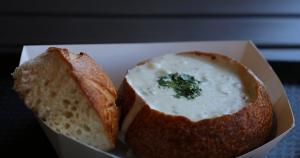 Tobias Kleinlercher, Clam chowder in a Boudin sourdough bowl at Pier 39 | 2016
One last food illustration, if you’ll allow it. Good integration is like clam chowder. Crystal and I both love clam chowder, but for various reasons.
I was raised closer to the ocean and excellent seafood. I like seafood and like tasting the clams in the chowder. She likes potato soup. For her, good clam chowder is like seafood flavored potato soup, with a limited amount of clams.
We both agree that it is best served in a sourdough bowl, particularly San Francisco sourdough. The best clam chowder, perfectly balanced for both of us, is at Chowders at Fisherman’s Wharf in Frisco.
We have some close friends with their own criteria for chowder. They believe there is no better chowder than what is served at Ivar’s in Seattle.
We all love SF and Seattle, Chowders and Ivar’s Chowder, but each couple has their own preference. In both places the chowder is phenomenal, prepared by fresh seafood culinary artisans. We are simply lost in a common meal with each other, in the moment, in the atmosphere.
Good integration is capable of something similar.
vi. Questions to Consider
Is it okay for Christians not only to integrate well, but to captivate us with what they’ve prepared?
Does Christian thought only amount to hermeneutics or a branch of Theology?
Is psychology only social scientific research?
Or is there a masterful level of artistry to aspire to?
Can we weave together the truths of our ancient Kingdom with social scientific advances within the last ten years?
Perhaps Jesus would answer . . . “Therefore every scribe who has been trained for the kingdom of heaven is like the master of a household who brings out of his treasure what is new and what is old” (Matthew 13.52, NRSV).
[1] Paul talks about God’s revealed truths in creation, especially in Romans 1. A related discipline, Natural Law perhaps finds its roots in Thomist philosophy/doctrine. Even Calvin consistently says things like all truth is God’s truth. For a classic discussion on the unity of truth, for Christians who are also interested in psychology, see the small book: John D. Carter and S. Bruce Narramore, The Integration of Psychology and Theology: An Introduction (Grand Rapids, MI: Zondervan, 1979). [2] Lesslie Newbigin, The Gospel in a Pluralist Society (Grand Rapids, MI: Wm. B. Eerdmans, 1989), 14. [3] Carter and Narramore (see note 1). [4] Harold Faw, Psychology in Christian Perspective: An Analysis of Key Issues (Grand Rapids, MI: Baker Academic, 1995).
Previous Post

June 27, 2018
Mystery & Wonder, pt. 1: Sensing our need for the supernatural
Next Post

July 4, 2018 Character and Community Development in America
Browse Our Archives
Select a Category Communion Cruz Ingle Crystal Ingle Early Church Engaging Culture Ethics & Society Family Formation History In Dialogue Jared & Crystal Kingdom of God Majority World Church Mateo Ingle Messenger College Mission Narrative Pentecostal Church of God Prayer Shepherding The Sermon The Writings Theology Theology & Psychology Traverse City Uncategorized Vernell Ingle Word Study
Select a Month October 2026 September 2026 August 2026 July 2026 June 2026 May 2026 March 2026 February 2026 January 2026 December 2025 October 2025 September 2025 August 2025 July 2025 June 2025 May 2025 April 2025 March 2025 February 2025 January 2025 December 2024 November 2024 October 2024 September 2024 August 2024 July 2024 June 2024 May 2024 April 2024 March 2024 February 2024 January 2024 December 2023 November 2023 October 2023 September 2023 August 2023 July 2023 June 2023 May 2023 April 2023 March 2023 February 2023 January 2023 December 2022 November 2022 October 2022 September 2022 August 2022 July 2022 June 2022 May 2022 April 2022 March 2022 February 2022 January 2022 December 2021 November 2021 October 2021 September 2021 August 2021 July 2021 June 2021 May 2021 April 2021 March 2021 February 2021 January 2021 December 2020 November 2020 October 2020 September 2020 August 2020 July 2020 June 2020 May 2020 April 2020 March 2020 February 2020 January 2020 December 2019 November 2019 October 2019 September 2019 August 2019 July 2019 June 2019 May 2019 April 2019 March 2019 February 2019 January 2019 December 2018 November 2018 October 2018 September 2018 August 2018 July 2018 June 2018 May 2018 April 2018 March 2018 February 2018 May 2017 March 2017 March 2014 February 2013 January 2013 October 2012 July 2012 May 2012 April 2012 March 2012 February 2012 January 2012 December 2011 August 2010
Follow Us!
TAKE THE
Religious Wisdom Quiz
True or False: Nehemiah rebuilt the walls of Jerusalem in 52 days.
Select your answer to see how you score.
FALSE TRUE
Related posts from Jared Ingle

Fully Human vs. Sub-Human | Children vs. Dogs


Bro. Wesley | Preach the Word!

TRENDING AT PATHEOS Evangelical

The REST of Your Life: A Creative Wrestles...
This week I had a conversation with a good friend from church....

How the author of the world's best hymn...
I've been working with John Newton for a while now. This makes...

Long before this Lectio Divina, Psalm 130 - the song - started...

What About the Trees? Another Living Parable
After I finished writing the last article about falling leaves as a...

Why Classical Education Is a Conversation, Not a...
Come and Read: Joy in Classical Education When I was a little...

Cornell University has received a great deal of negative publicity and intense...
view all Evangelical blogs
Ad-Free & Subscriber Log-In Subscription Support
- About Us
- 2026 Calendar
- Videos
- Podcasts
- Library of World Religions
- Faith In Media Tracker
- Advertise With Us
- Write for Us
- Privacy Policy
- Terms of Service
- Do Not Sell My Data
- Contact Us
- Radiant Digital
- Manage Newsletter Subscriptions
- Unsubscribe From Notifications
- Sitemap
Copyright 2008-2026, Patheos. All rights reserved.
Subscription Support Ad-Free & Subscriber Log-In
Follow Patheos