
BuddhistCatholicContemplativeEvangelicalGeneral ChristianHinduJewishLatter-day SaintMuslimNew VisionsProgressive Christian
Beliefs
- Buddhist
- Catholic
- Contemplative
- Evangelical
- General Christian
- Hindu
- Jewish
- Latter-day Saint
- More Voices
- Muslim
- New Visions
- Pagan
- Progressive Christian
Topics
- Religion News
- Food and Religion
- Sports and Religion
- Religious Art
- Religious Music and Entertainment
- Religious Events
- History and Religion
- Style and Religion
- Politics and Religion
- Women in Religion
- Recreation Outdoors and Religion
- Business Finance and Religion
- Careers Workplace and Religion
- Education and Religion
- Family Parenting and Religion
- Health Fitness and Religion
- Home and Religion
- Relationships and Religion
- Technology and Religion
- Travel and Religion
Columnists
- Buddhist Columnists
- Business Finance and Religion Columnists
- Careers Workplace and Religion Columnists
- Catholic Columnists
- Contemplative Columnists
- Education and Religion Columnists
- Evangelists Columnists
- Family Parenting and Religion Columnists
- General Christian Columnists
- Health Fitness and Religion Columnists
- Hindu Columnists
- History and Religion Columnists
- Home and Religion Columnists
- Jewish Columnists
- More Voices Columnists
- Latter Day Columnists
- Muslim Columnists
- New Visions Columnists
- Nonreligious Columnists
- Pagan Columnists
- Politics and Religion Columnists
- Progressive Columnists
- Recreation Outdoors and Religion Columnists
- Relationships and Religion Columnists
- Religion News Columnists
- Religious Art Columnists
- Religious Events Columnists
- Religious Music and Entertainment Columnists
- Sports and Religion Columnists
- Style and Religion Columnists
- Technology and Religion Columnists
- Travel and Religion Columnists
- Women in Religion Columnists
Resource Library
- 2026 Calendar
- Library of World Religions
- The 100 Most Holy Places on Earth
- Patheos Answers
- Podcasts
- Videos
- Faith Leaders Database
- Anglican Episcopalian
- Bahai
- Baptist
- Buddhism
- Christianity
- Confucianism
- Eastern Orthodoxy
- Hinduism
- Holiness and Pentecostal
- ISKCON
- Islam
- Judaism
- Lutheran
- Methodist
- The Church of Jesus Christ of Latter-day Saints
- New Age
- Paganism
- Presbytarian and Reformed
- Protestantism
- Religion Behind the Scenes
- Roman Catholic
- Scientology
- Shia Islam
- Sikhism
- Sufism
- Sunni Islam
- Taoism
- Zen
- See all religions
Research Tools
 Ad-Free & Subscriber Log-In Subscription Support
Ad-Free & Subscriber Log-In Subscription Support
Follow Patheos 

- Trending:
- Forgiveness
- |
- Marriage
- |
- Consciousness
- |
- Death Penalty
- |
- Election
- |
- Halloween

- Home
- Evangelical
- Doctrine in the Greater Christian Community
Doctrine in the Greater Christian Community
Last updated on: June 24, 2018 at 6:39 pm by Rev. Jared V. Ingle
Doctrine in the Greater Christian Community 2018-06-24T18:39:23-04:00 Rev. Jared V. Ingle
Patheos Explore the world's faith through different perspectives on religion and spirituality! Patheos has the views of the prevalent religions and spiritualities of the world.
In the writing On the Spirit’s Gifts, Strengths-Based, and Integrative Approaches I blend our story with a little integration of doctrines and social science. Naturally, from that post, the question may arise, What is my basis for doctrine?
i. Doctrinal Considerations
I begin to answer this question in the post, The Trinity: Recognizing Beauty in Doctrine. First, we may want to consider our approach to doctrine. Is Scripture and Theology a link to the One who is Other? God is not easily packaged in a set of beliefs. Do we approach doctrine with a sense of wonder?
Second, there is a beauty in interpreting Scripture . . . and living it out in community. Therefore, true doctrine is embodied doctrine. One of my favorite New Testament passages that uses the term doctrine is Acts 2.42: And they continued steadfastly in the apostles’ doctrine and fellowship, in the breaking of bread, and in prayers (NKJV). Here, doctrine is embedded in the daily life, the intentional spiritual formation, of the believers.
Third, there is something to be said for our understanding of God, that flows from our stories within His greater story. All Christians are called by Christ to be witnesses (Acts 1.8). We have the power to overcome by our testimony (Revelation 12.11). Our stories reveal our beliefs, but they may also unleash the Spirit’s power.
ii. A Doctrinal Vignette
Doctrinal differences or dialogue?
Allow me to offer a vignette that may reflect our approach to doctrine with wonder, in community, and as part of the greater story.
Last year, the whole world celebrated the Reformation 500th Anniversary marked by the nailing of Luther’s 95 Theses on the Wittenberg Church door (10.31.1517 – 10.31.2017).
Let’s consider common Protestant and Catholic ideals.
We Evangelicals must admit that catholic means universal, as in the universal church (not to be confused with universalism). We are the universal Body of Christ (1 Corinthians 10.16). Every real Christian is at least small-c catholic.
I don’t know how many times I’ve heard this logic, and to what end? Our doctrinal differences often impede our conversations anyway.
On the other hand, according to Ecumenical terminology, we’re all big-C Catholic. Of course, there is ongoing dialogue about who is the big-C Church. However, those in Roman Catholicism, with an Ecumenical bent, at least recognize Evangelical and Mainstream denominations as Ecclesial Communities.
We Evangelicals may not be aware of the Ecumenical dialogue that exists in other circles, especially since Vatican II.
Reformation or revolution?
Do we think of the Reformation as a schism? Perhaps the 500th anniversary last year was a rallying cry for Protestants. Luther nailed the 95 Theses to the door of the Wittenberg Church and we all broke-it-off with the Mother Church . . . or did we?
Remember, the Reformers were just that . . . Reformers. The Magisterial Reformers did not set out to be Revolutionaries. Luther, Zwingli, and Calvin would prefer the term Reformer over Revolutionary, at least at the beginning of their campaigns.
This may be the acid test of the openness of an Evangelical minister to Ecumenical dialogue. Do we consider the Reformation to be a Revolt? Perhaps a little historical context will serve as a corrective.
Historic Reformation and current Ecumenism
The Magisterial Reformers may have been glad to witness the Ecumenism of the 500th Anniversary.
On October 31, 2016, Roman Catholic and Lutheran leaders gathered in Lund, Sweden. The occasion was a combined prayer service to commemorate the beginning of the 500th year, and to call upon Catholics and Lutherans worldwide to pray together. Pope Francis offered a homily. Consequently, a Joint Statement and prayer was released.[1]
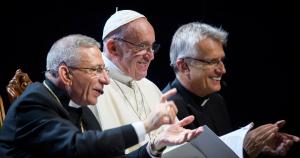
Bishop Munib Younan, President of the Lutheran World Federation; Pope Francis; Reverend Martin Junge, General Secretary of the Lutheral World Federation | Foto Magnus Aronson-3580 | The Lutheran World Federation on Flickr, 10.31.16
I didn’t know this was taking place until I discovered news feeds of congregations that were joining efforts to commemorate the Reformation. The two Bishops of the Lutheran Synod and the Catholic Diocese in Salt Lake City, Utah organized a prayer service and events at various churches. They celebrated the Reformation and the current freedom in dialogue we’re experiencing.[2]
Combined events happened in various communities worldwide. Would these type of celebrations have been possible before Vatican II? Would they have been possible without the call for joint prayer from the Lutheran and Catholic leaders in Lund?
The wave of Ecumenicism that we all witnessed now seems to be ebbing away. Will bridges be built and sustained, or is this a passing moment in Church History? Dare I mention the hopes that the Catholic and Lutheran leaders propose for welcoming each other to the Lord’s Table?[3]
iii. The Question
The original question is, what is my basis for doctrine?
I would ask, what of Doctrine in the greater Christian community? Are there primary doctrines that bind us as the Body of Christ?
The Greater Body of Christ
Are we big-C Catholic or or small-c catholic? What about Ecumenicism versus Evangelicalism?
Are we trying to follow the “none of the above” trend by claiming to only be a “Christ follower”?
“We’re an independent church!”
“I don’t have a religion. I have a relationship!”
“We love God, but don’t like the church!”
What do these statements mean? Do we mean we can do whatever we want and call ourselves Christian? Do we mean big religion is bad? Now we can start our own sect.
If we are pointing out the pride of those who affiliate with denominations, then haven’t we made it a point of pride to declare we don’t need that . . . therefore defeating our own purpose?
Can we ever truly split from the greater Body of Christ, or what some call the communion of saints? Galatians 6.10 places before us the higher way, the sacred opportunity to be good to each other.
Doctrine and small-o orthodox
It’s the same way with doctrine. Just as we may be small-c catholics, we could say we’re small-o orthodox. We share the time honored doctrines of the faith that have been handed down.
Some of us affirm the great Creeds. Others have doctrinal points based on our common heritage and creeds. To engage in orthodox dialogue is to have in-house discussions.
In fact, the above section on the Doctrinal Vignette leading up to now, has been based on research. It has also been based on multiple, personal in-house discussions in a variety of Christian contexts.
The fellowship I’m affiliated with, the Pentecostal Church of God (PCG), operates with a 17-point Doctrinal Statement and General Bylaws. Our governing documents share our ethics and guidelines in more detail.
We, in the PCG, also take our seat at broader tables which include multiple fellowships, like the Pentecostal/Charismatic Churches of North America (PCCNA). I’m honored to be a PCG Representative on the Pentecostal-Charismatic Curriculum Commission. We have representatives and writers from five organizations who develop discipleship materials.
We’re not alone in our beliefs.
iv. My Story Revisited
Evangelicals have accused me of being a little too Ecumenical. Some of my high church friends see that I’m Evangelical, but at least give me an “E” for my Ecumenical Effort.
The truth is, I wasn’t in these types of dialogues years ago. My story has been broadened and revisited. College Heights Christian School (CHCS) helped tremendously. I went to college, seminary, and worked in the Assemblies of God (AG), another formative factor.
While at Asbury Theological Seminary, I developed a great appreciation for Confessional Communities. Some hold to the Seven Ecumenical Councils. Others state that Protestantism does not only include history after the 1500’s, but also doctrine leading up to about 400 A.D. Some share truths in illustrations, like the Chalcedonian Box, developed by Biola’s Fred Sanders.[4] These communities are bound together by common confessions of faith, almost like modern day creeds.
I was welcomed to the table, along with my fellowship’s doctrine, as I learned ancient ways of engaging faith and doctrine. Full-Gospel views are here, and here to stay. We are making contributions to Theology and ongoing doctrinal development. Timothy Tennent, Asbury’s President, writes, “the overwhelming majority of Pentecostal groups are solidly within the boundaries of historic Christian orthodoxy.”[5] I find nothing in my belief system to suggest otherwise.
v. The Question Reframed
What is my basis for doctrine?
What of Doctrine in the greater Christian community? Are there primary doctrines that bind us as the Body of Christ?
When we survey the Christian landscape, do we measure it by our doctrinal differences, or do we discover common ground for dialogue?
Can we engage without giving in to classic pitfalls (heresy, syncretism, compromise, etc.)?
[1] The Holy See, “Apostolic Journey of His Holiness Pope Francis to Sweden: Common Ecumenical Prayer at the Lutheran Cathedral of Lund,” Daily Bulletin of the Holy See Press Office (October 31-November 1, 2016), accessed June 23, 2018, http://w2.vatican.va/content/francesco/en/homilies/2016/documents/papa-francesco_20161031_omelia-svezia-lund.html. [2] Bob Mims, “Common Ground: Utah Catholics, Lutherans to pray side by side 500 years after Protestant Reformation,” The Salt Lake Tribune (October 6, 2017), accessed June 23, 2018, https://www.sltrib.com/news/2017/10/06/together-again-utah-lutherans-catholics-to-worship-side-by-side-500-years-after-protestant-reformation/. [3] The Holy See, “Apostolic Journey” (referenced above). See Section Joint Statement on the occasion of the Joint Catholic-Lutheran Commemoration of the Reformation, Subsection Our commitment to common witness, Paragraph 2. [4] Fred Sanders, “Gratitude for the Council of Chalcedon,” The Scriptorium Daily (October 8, 2009), accessed June 23, 2018, http://scriptoriumdaily.com/gratitude-for-the-council-of-chalcedon/. [5] Timothy C. Tennent, Theology in the Context of World Christianity: How the Global Church is Influencing the Way We Think About and Discuss Theology (Grand Rapids, MI: Zondervan, 2007), 165.
Previous Post
June 20, 2018
The Trinity: Recognizing Beauty in Doctrine
Next Post
June 27, 2018 Mystery & Wonder, pt. 1: Sensing our need for the supernatural
Browse Our Archives
Select a Category Communion Cruz Ingle Crystal Ingle Early Church Engaging Culture Ethics & Society Family Formation History In Dialogue Jared & Crystal Kingdom of God Majority World Church Mateo Ingle Messenger College Mission Narrative Pentecostal Church of God Prayer Shepherding The Sermon The Writings Theology Theology & Psychology Traverse City Uncategorized Vernell Ingle Word Study
Select a Month October 2026 September 2026 August 2026 July 2026 June 2026 May 2026 March 2026 February 2026 January 2026 December 2025 October 2025 September 2025 August 2025 July 2025 June 2025 May 2025 April 2025 March 2025 February 2025 January 2025 December 2024 November 2024 October 2024 September 2024 August 2024 July 2024 June 2024 May 2024 April 2024 March 2024 February 2024 January 2024 December 2023 November 2023 October 2023 September 2023 August 2023 July 2023 June 2023 May 2023 April 2023 March 2023 February 2023 January 2023 December 2022 November 2022 October 2022 September 2022 August 2022 July 2022 June 2022 May 2022 April 2022 March 2022 February 2022 January 2022 December 2021 November 2021 October 2021 September 2021 August 2021 July 2021 June 2021 May 2021 April 2021 March 2021 February 2021 January 2021 December 2020 November 2020 October 2020 September 2020 August 2020 July 2020 June 2020 May 2020 April 2020 March 2020 February 2020 January 2020 December 2019 November 2019 October 2019 September 2019 August 2019 July 2019 June 2019 May 2019 April 2019 March 2019 February 2019 January 2019 December 2018 November 2018 October 2018 September 2018 August 2018 July 2018 June 2018 May 2018 April 2018 March 2018 February 2018 May 2017 March 2017 March 2014 February 2013 January 2013 October 2012 July 2012 May 2012 April 2012 March 2012 February 2012 January 2012 December 2011 August 2010
Follow Us!
TAKE THE
Religious Wisdom Quiz
At my dedication prayer, fire came down from heaven and God's glory filled the house.
Select your answer to see how you score.
The temple The tabernacle The prophet's home The Palace
Related posts from Jared Ingle

Fully Human vs. Sub-Human | Children vs. Dogs

Bro. Wesley | Preach the Word!
TRENDING AT PATHEOS Evangelical

How the author of the world's best hymn...
I've been working with John Newton for a while now. This makes...

Long before this Lectio Divina, Psalm 130 - the song - started...

What About the Trees? Another Living Parable
After I finished writing the last article about falling leaves as a...

Why Classical Education Is a Conversation, Not a...
Come and Read: Joy in Classical Education When I was a little...

Falling Leaves: A Living Parable on Letting Go
I’ve spent the vast majority of my life in the southeast corner...

Cornell University has received a great deal of negative publicity and intense...
view all Evangelical blogs
Ad-Free & Subscriber Log-In Subscription Support
- About Us
- 2026 Calendar
- Videos
- Podcasts
- Library of World Religions
- Faith In Media Tracker
- Advertise With Us
- Write for Us
- Privacy Policy
- Terms of Service
- Do Not Sell My Data
- Contact Us
- Radiant Digital
- Manage Newsletter Subscriptions
- Unsubscribe From Notifications
- Sitemap
Copyright 2008-2026, Patheos. All rights reserved.
Subscription Support Ad-Free & Subscriber Log-In
Follow Patheos