
BuddhistCatholicContemplativeEvangelicalGeneral ChristianHinduJewishLatter-day SaintMuslimNew VisionsProgressive Christian
Beliefs
- Buddhist
- Catholic
- Contemplative
- Evangelical
- General Christian
- Hindu
- Jewish
- Latter-day Saint
- More Voices
- Muslim
- New Visions
- Pagan
- Progressive Christian
Topics
- Religion News
- Food and Religion
- Sports and Religion
- Religious Art
- Religious Music and Entertainment
- Religious Events
- History and Religion
- Style and Religion
- Politics and Religion
- Women in Religion
- Recreation Outdoors and Religion
- Business Finance and Religion
- Careers Workplace and Religion
- Education and Religion
- Family Parenting and Religion
- Health Fitness and Religion
- Home and Religion
- Relationships and Religion
- Technology and Religion
- Travel and Religion
Columnists
- Buddhist Columnists
- Business Finance and Religion Columnists
- Careers Workplace and Religion Columnists
- Catholic Columnists
- Contemplative Columnists
- Education and Religion Columnists
- Evangelists Columnists
- Family Parenting and Religion Columnists
- General Christian Columnists
- Health Fitness and Religion Columnists
- Hindu Columnists
- History and Religion Columnists
- Home and Religion Columnists
- Jewish Columnists
- More Voices Columnists
- Latter Day Columnists
- Muslim Columnists
- New Visions Columnists
- Nonreligious Columnists
- Pagan Columnists
- Politics and Religion Columnists
- Progressive Columnists
- Recreation Outdoors and Religion Columnists
- Relationships and Religion Columnists
- Religion News Columnists
- Religious Art Columnists
- Religious Events Columnists
- Religious Music and Entertainment Columnists
- Sports and Religion Columnists
- Style and Religion Columnists
- Technology and Religion Columnists
- Travel and Religion Columnists
- Women in Religion Columnists
Resource Library
- 2026 Calendar
- Library of World Religions
- The 100 Most Holy Places on Earth
- Patheos Answers
- Podcasts
- Videos
- Faith Leaders Database
- Anglican Episcopalian
- Bahai
- Baptist
- Buddhism
- Christianity
- Confucianism
- Eastern Orthodoxy
- Hinduism
- Holiness and Pentecostal
- ISKCON
- Islam
- Judaism
- Lutheran
- Methodist
- The Church of Jesus Christ of Latter-day Saints
- New Age
- Paganism
- Presbytarian and Reformed
- Protestantism
- Religion Behind the Scenes
- Roman Catholic
- Scientology
- Shia Islam
- Sikhism
- Sufism
- Sunni Islam
- Taoism
- Zen
- See all religions
Research Tools
 Ad-Free & Subscriber Log-In Subscription Support
Ad-Free & Subscriber Log-In Subscription Support
Follow Patheos 

- Trending:
- Forgiveness
- |
- Marriage
- |
- Consciousness
- |
- Death Penalty
- |
- Election
- |
- Halloween

- Home
- Evangelical
- The Call of Ambrose
The Call of Ambrose
Last updated on: May 9, 2018 at 2:14 pm by Rev. Jared V. Ingle
The Call of Ambrose 2018-05-09T14:14:29-04:00 Rev. Jared V. Ingle
Patheos Explore the world's faith through different perspectives on religion and spirituality! Patheos has the views of the prevalent religions and spiritualities of the world.
Text, NKJV: John 1:43-48a
Nathanael is Reluctant and Has His Q’s
We see Jesus meeting some of the Disciples here in John 1. For that sake, it might be one of the earliest conversations with the Disciples. We’re going to start with verse 43.
43: The following day Jesus wanted to go to Galilee, and He found Philip and said to him, “Follow Me.” 44: Now Philip was from Bethsaida, the city of Andrew and Peter. 45: Philip found Nathanael and said to him, “We have found Him of whom Moses in the law, and also the prophets, wrote – Jesus of Nazareth, the son of Joseph.”
46: And Nathanael said to him, “Can anything good come out of Nazareth?”
Philip said to him, “Come and see.”
47: Jesus saw Nathanael coming toward Him, and said of him, “Behold, an Israelite indeed, in whom is no deceit!”
48a: Nathanael said to Him, “How do You know me?” (John 1.43-48a)
I want to point out something about Nathaniel that is common among others throughout the Old and New Testaments. A lot of them are reluctant – the reluctant minister.
They have questions. They don’t always know what’s going on. For example, is this really Christ calling me into a position?
Church History Reveals Similar Patterns of Reluctance
I’m just going to pick one story to share. There are similar patterns of reluctance among some of the great names throughout Church History. Some of them were slow to respond to the call.
Video: The Call of Ambrose https://www.youtube.com/watch?v=q1tQcMSP5AE
When we think about reluctance, we may ask “Why didn’t they just obey or do what God wanted them to do?” The flip-side is that when you’re the person being called, it is very, very humbling. We can’t just misinterpret everything as reluctance or disobedience. On the flip-side of that coin is great humility. “Why would God want to use me to lead and to do anything?” I’m going to pick one historical character as an example.
What About Ambrose?
You may ask, “Who is Ambrose?” He’s the Governor of Milan, Italy. Milan is the HQ of the Roman Empire at that time. The church has great freedom at that point, so Bishops are more popular and influential than Governors.
In AD 375 the Bishop of Milan dies. Because it’s under Roman rule at the HQ, Emperor Valentinian steps in. He is going to appoint someone, but the people are calling for an election.
Ambrose is so highly respected that everyone votes for him. There are a couple of problems. 1) Ambrose is only a “catechumen” in the process of discipleship, but has not fully become a member or been baptized. 2) Ambrose doesn’t want the position.
As Ambrose is trying to make this clear, the legend of history says a child starts to chant, “Ambrose Bishop!” Then the crowd starts chanting “Ambrose Bishop!”
Their voices rise up. The Emperor can’t do anything about it, so he declares Ambrose as the Bishop . . . and Ambrose runs. He literally flees the scene.

The Emperor, in all of his wisdom, says that anyone who hides Ambrose will be punished. After 8 days, Ambrose comes out of hiding, accepts the post, and is baptized. He becomes Bishop. He’s only 35 years old and he serves for 23 years in the seat of Rome.[1]
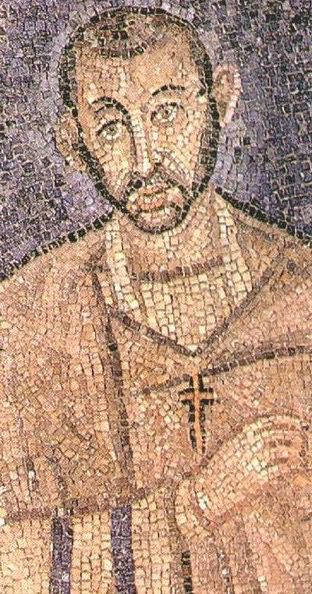 Saint Ambrose, St. Ambrosio Church, Milan, actual portrait? / Public Domain
History remembers Ambrose, the reluctant bishop, for many reasons, writings, and accomplishments.[2] One accomplishment is that he slowly reels-in a young man who occasionally drops into church.
This young man is a highly educated. He is also a philosopher. He knows every philosophy in the Roman Empire and beyond. He knows some of the philosophers who started the philosophies. He is a brilliant man. He’s also the Chief Orator of Milan, the spokesman for the entire Roman Empire.
Because of the patience of Ambrose with this young man, he eventually but reluctantly becomes a Christian, and later in life a Bishop as well.
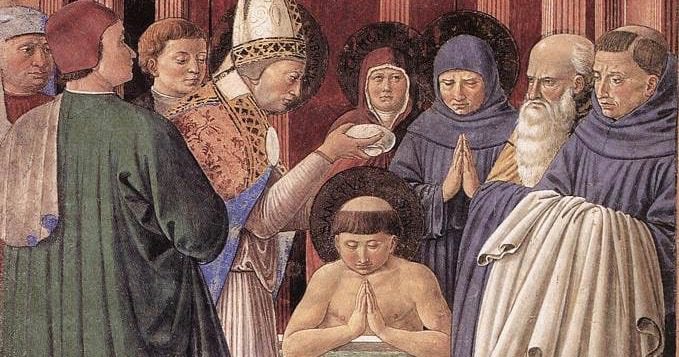 Benozzo Gozzoli, Baptism of St. Augustine [by Ambrose], 1464-65 / Public Domain
You may know this young disciple of Ambrose as Augustine.
Before his salvation, Augustine loves to slip into the back of the church and listen to Ambrose. He does not like the Gospel, but he loves to hear the Bishop’s eloquence. Philosophically, he begins to see real truth in the Gospel.
Augustine does not care about Ambrose’s status as a Bishop, but he cares that Ambrose is kind to him as a person. Augustine dislikes the Message, but he loves the Bishop’s eloquence and friendship.
Think about his words which describe the Gospel as it slowly penetrates a heart. Augustine says, “Nonetheless as his [Ambrose’s] words, which I enjoyed, penetrated my mind, the substance, which I overlooked, seeped in with them, for I could not separate the two. As I opened my heart to appreciate how skillfully he spoke, the recognition that he was speaking the truth crept in at the same time.”[3]
The substance of the Gospel came across with the words of the Gospel.
Honestly, think about how many people know about Augustine. Yet, how many have heard of Ambrose? Of course we need more preachers and prophets like Augustine.
Maybe We Need Many More People Like Ambrose
Maybe we need people who are patient with young philosophical minds, young thinkers.
Maybe we need men and women who aren’t always correcting the next generation, but who are patiently engaging them, and answering their great questions.
We come from a generation where it’s okay to line out the doctrine in 20 points, memorize it, and hand it off like a tract. If someone doesn’t believe it, then we’ll go to all the Scriptures and correct them.
That’s not why Augustine came to Ambrose. He came to Ambrose because he belonged. Ambrose made a place for him before he believed. Do we see the difference?
Who is Ambrose?
You might ask, “Who is Ambrose?” Why don’t you ask Augustine because he would credit everything he does to Ambrose, the reluctant Bishop.
* adapted from JVI, Preachers & Prophets, 10.08.17
[1] Adapted from: James Loughlin, “St. Ambrose,” The Catholic Encyclopedia (New York: Robert Appleton, 1907), accessed October 4, 2017, http://www.newadvent.org/cathen/01383c.htm. [2] Ambrose, the reluctant bishop, is not an official title and is not meant to be disrespectful in any way. The story of his call simply lends itself to the overall flow of the message, as does the reluctance of Nathanael and Augustine to their callings. [3] Maria Boulding, Trans., The Confessions Saint Augustine (Hyde Park, New York: New City Press, 1997), 132.
Previous Post

May 2, 2018
We All Have Callings
Next Post

May 23, 2018 Ptr. Peter: Points of Opportunity in a Post-Christian Culture
Recent Comments
Browse Our Archives
Select a Category Communion Cruz Ingle Crystal Ingle Early Church Engaging Culture Ethics & Society Family Formation History In Dialogue Jared & Crystal Kingdom of God Majority World Church Mateo Ingle Messenger College Mission Narrative Pentecostal Church of God Prayer Shepherding The Sermon The Writings Theology Theology & Psychology Traverse City Uncategorized Vernell Ingle Word Study
Select a Month October 2026 September 2026 August 2026 July 2026 June 2026 May 2026 March 2026 February 2026 January 2026 December 2025 October 2025 September 2025 August 2025 July 2025 June 2025 May 2025 April 2025 March 2025 February 2025 January 2025 December 2024 November 2024 October 2024 September 2024 August 2024 July 2024 June 2024 May 2024 April 2024 March 2024 February 2024 January 2024 December 2023 November 2023 October 2023 September 2023 August 2023 July 2023 June 2023 May 2023 April 2023 March 2023 February 2023 January 2023 December 2022 November 2022 October 2022 September 2022 August 2022 July 2022 June 2022 May 2022 April 2022 March 2022 February 2022 January 2022 December 2021 November 2021 October 2021 September 2021 August 2021 July 2021 June 2021 May 2021 April 2021 March 2021 February 2021 January 2021 December 2020 November 2020 October 2020 September 2020 August 2020 July 2020 June 2020 May 2020 April 2020 March 2020 February 2020 January 2020 December 2019 November 2019 October 2019 September 2019 August 2019 July 2019 June 2019 May 2019 April 2019 March 2019 February 2019 January 2019 December 2018 November 2018 October 2018 September 2018 August 2018 July 2018 June 2018 May 2018 April 2018 March 2018 February 2018 May 2017 March 2017 March 2014 February 2013 January 2013 October 2012 July 2012 May 2012 April 2012 March 2012 February 2012 January 2012 December 2011 August 2010
Follow Us!
TAKE THE
Religious Wisdom Quiz
What is the effect of the Red Horse's arrival in revelations?
Select your answer to see how you score.
People fall into a deep sleep Peace is taken from the earth The sun turns black Plagues spread across the land
Related posts from Jared Ingle



The Call | Inwardly Drawn vs. Outwardly Pulled

List of Sins | Word Studies in Corinthians
TRENDING AT PATHEOS Evangelical

How the author of the world's best hymn...
I've been working with John Newton for a while now. This makes...

Long before this Lectio Divina, Psalm 130 - the song - started...

What About the Trees? Another Living Parable
After I finished writing the last article about falling leaves as a...

Why Classical Education Is a Conversation, Not a...
Come and Read: Joy in Classical Education When I was a little...

Falling Leaves: A Living Parable on Letting Go
I’ve spent the vast majority of my life in the southeast corner...

Cornell University has received a great deal of negative publicity and intense...
view all Evangelical blogs
Ad-Free & Subscriber Log-In Subscription Support
- About Us
- 2026 Calendar
- Videos
- Podcasts
- Library of World Religions
- Faith In Media Tracker
- Advertise With Us
- Write for Us
- Privacy Policy
- Terms of Service
- Do Not Sell My Data
- Contact Us
- Radiant Digital
- Manage Newsletter Subscriptions
- Unsubscribe From Notifications
- Sitemap
Copyright 2008-2026, Patheos. All rights reserved.
Subscription Support Ad-Free & Subscriber Log-In
Follow Patheos