
BuddhistCatholicContemplativeEvangelicalGeneral ChristianHinduJewishLatter-day SaintMuslimNew VisionsProgressive Christian
Beliefs
- Buddhist
- Catholic
- Contemplative
- Evangelical
- General Christian
- Hindu
- Jewish
- Latter-day Saint
- More Voices
- Muslim
- New Visions
- Pagan
- Progressive Christian
Topics
- Religion News
- Food and Religion
- Sports and Religion
- Religious Art
- Religious Music and Entertainment
- Religious Events
- History and Religion
- Style and Religion
- Politics and Religion
- Women in Religion
- Recreation Outdoors and Religion
- Business Finance and Religion
- Careers Workplace and Religion
- Education and Religion
- Family Parenting and Religion
- Health Fitness and Religion
- Home and Religion
- Relationships and Religion
- Technology and Religion
- Travel and Religion
Columnists
- Buddhist Columnists
- Business Finance and Religion Columnists
- Careers Workplace and Religion Columnists
- Catholic Columnists
- Contemplative Columnists
- Education and Religion Columnists
- Evangelists Columnists
- Family Parenting and Religion Columnists
- General Christian Columnists
- Health Fitness and Religion Columnists
- Hindu Columnists
- History and Religion Columnists
- Home and Religion Columnists
- Jewish Columnists
- More Voices Columnists
- Latter Day Columnists
- Muslim Columnists
- New Visions Columnists
- Nonreligious Columnists
- Pagan Columnists
- Politics and Religion Columnists
- Progressive Columnists
- Recreation Outdoors and Religion Columnists
- Relationships and Religion Columnists
- Religion News Columnists
- Religious Art Columnists
- Religious Events Columnists
- Religious Music and Entertainment Columnists
- Sports and Religion Columnists
- Style and Religion Columnists
- Technology and Religion Columnists
- Travel and Religion Columnists
- Women in Religion Columnists
Resource Library
- 2026 Calendar
- Library of World Religions
- The 100 Most Holy Places on Earth
- Patheos Answers
- Podcasts
- Videos
- Faith Leaders Database
- Anglican Episcopalian
- Bahai
- Baptist
- Buddhism
- Christianity
- Confucianism
- Eastern Orthodoxy
- Hinduism
- Holiness and Pentecostal
- ISKCON
- Islam
- Judaism
- Lutheran
- Methodist
- The Church of Jesus Christ of Latter-day Saints
- New Age
- Paganism
- Presbytarian and Reformed
- Protestantism
- Religion Behind the Scenes
- Roman Catholic
- Scientology
- Shia Islam
- Sikhism
- Sufism
- Sunni Islam
- Taoism
- Zen
- See all religions
Research Tools
 Ad-Free & Subscriber Log-In Subscription Support
Ad-Free & Subscriber Log-In Subscription Support
Follow Patheos 

- Trending:
- Forgiveness
- |
- Marriage
- |
- Consciousness
- |
- Death Penalty
- |
- Election
- |
- Halloween

- Home
- Evangelical
- How Do We Measure Success?
How Do We Measure Success?
Last updated on: April 10, 2018 at 11:29 am by Rev. Jared V. Ingle
How Do We Measure Success? 2018-04-10T11:29:06-04:00 Rev. Jared V. Ingle
Patheos Explore the world's faith through different perspectives on religion and spirituality! Patheos has the views of the prevalent religions and spiritualities of the world.
Texts, KJV: John 6; Acts 4.4; 3.8; 4.1-4
I enjoy group dynamics, especially groups from about 5-8 where people really get to know each other. By the way, these are excellent numbers for any small group, or even for group counseling. Over the last 4 years, I have had the privilege of sitting-in on a prayer group of local pastors. I love having true accountability and encouragement from these men of God.
Every once in awhile, they start chipping away at a topic from different angles. So I usually sit back and listen to these wise sages speak. Recently, they started talking about success. Their conversation was pretty close to recent posts I have made, so I’m wondering if our Lord isn’t stirring some ideas up, at least around here.
Video: How Do We Measure Success?
https://www.youtube.com/watch?v=7hqxm6RHY9Y
In the Kingdom, is it simply a matter of adding up the right combination of critical success factors, like we do in the workplace? Maybe or maybe not. Maybe it’s a matter of perspective.
First, it’s interesting that the world takes notice of the big numbers. I recently discovered a piece by CBS on the largest congregations in America. There is no way around the fact that Jesus and His disciples ministered to the masses at times, as we are in our age. There is also no way around the fact that God wants to reach everyone (note 1).
Secondly, we should be interested in numbers too, but we also have a responsibility to measure the health of the congregation. Karl Vaters writes for CT to smaller congregations, and focuses on discipleship. He shows how Jesus starts with discipleship and the crowds are a result, not the other way around (i.e. Karl would probably be interested in the way our little band of prayer-warrior pastors turn around and affect our city, note 2).
As previously published in Jesus Leads Us into Mystery, Jesus faces this tension between the masses and the few. John 6 may be part of the transitional season between what some call Christ’s “Year of Popularity” and the “Year of Opposition.” Whether or not we can categorize His first two years this way is beside the point. The point is, there are times when ministry is received by many, and times when it is only received by a few.
In this sermon, the Apostles face their first test of opposition in Acts, yet witness a harvest at the same time. They face the same tension that Christ does. How do we measure success?
May we find ourselves struggling with this tension as well, faithful to His Word despite any odds, yet reaching out to as many as possible.
Acts 4.4: Howbeit many of them which heard the word believed; and the number of the men was about five thousand.
What is going on is a response to what happened miraculously
If you want to know what happened miraculously, it’s in the chapter before, the lame man who received healing. Acts 3.8: The lame man “went walking and leaping and praising God.”
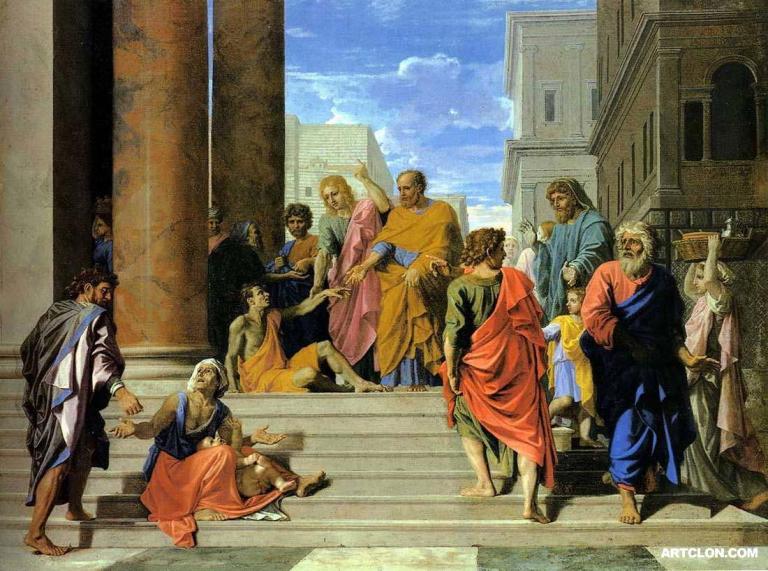 Saints Peter and John Healing the Lame Man, Nicholas Poussin, 1655
The power of God is the power for healing. The lame man was begging, but Peter and John gave him something that he did not expect, and that was healing.
This man was known to be the lame man at the gate. When he went walking and leaping and praising God, everyone said, “Oh isn’t that so and so. What’s going on?” It causes a great commotion because he’s giving glory to God for a healing and he’s walking, which is something nobody expected.
Certainly, the world takes notice when miracles begin to happen. The miracle doesn’t even have to coincide, or be an illustration for, the sermon. I don’t think Peter’s sermon had that much to do with the miracle that just happened. Nonetheless, it catches the eye and is a sign to the unbeliever.
But there is something else going on in between these two verses
There is a response that happens to persecution. Acts 4.1-4: We have the first real taste of persecution, and 5,000 people are saved. Why were that many people saved? Was it all because of the miracle? I have a feeling that it might also be because of the persecution.
 Peter and John before the Sanhedrin, Bible Historiale, Petrus Comestor, 1372
Have you ever been told that you can’t do something? What does it make you want to do? Now I may not be doing this justice and completely oversimplifying. In the West, in the USA we do not see persecution at all. In this passage, everyone sees that the Apostles not only believe the Gospel, but they are willing to lay down their lives for it. That witnesses to them in a very profound way.
They see how much the Gospel requires of us. They respond by rising up to truly pledge their all to Jesus Christ. They’re going to do what’s right, no matter what comes against them.
We have become so spoiled living in Western society. We think the Christian life is about lining up for God, and then He just blesses us the rest of our lives. We pray about this and get it, or pray about that and get it. We just “blab it and grab it” or “name it and claim it.” We believe we can just have whatever we desire simply because we’re living a Christian life.
We paint the Christian life out to be a bed of roses don’t we?
* adapted from JVI, Marks of the Spirit-Filled Community: Growth for Today, 05.22.16.
note 1: CBS, “Americas biggest megachurches, ranked,” CBS Interactive Inc., 2018, accessed March 31, 2018, https://www.cbsnews.com/pictures/30-biggest-american-megachurches-ranked/.
note 2: Karl Vaters, “Does Attracting A Crowd Make Discipleship Harder? Going along with the crowd has never been the Jesus way. Standing apart from the crowd? Now that sounds like Jesus,” Christianity Today: Pivot Blog, March 22, 2018, Accessed April 7, 2018, https://www.christianitytoday.com/karl-vaters/2018/february/crowd-discipleship.html.
Previous Post

March 25, 2018
Jesus Leads Us into Mystery
Next Post

April 18, 2018 On Persecution & Rejection
Recent Comments
Browse Our Archives
Select a Category Communion Cruz Ingle Crystal Ingle Early Church Engaging Culture Ethics & Society Family Formation History In Dialogue Jared & Crystal Kingdom of God Majority World Church Mateo Ingle Messenger College Mission Narrative Pentecostal Church of God Prayer Shepherding The Sermon The Writings Theology Theology & Psychology Traverse City Uncategorized Vernell Ingle Word Study
Select a Month October 2026 September 2026 August 2026 July 2026 June 2026 May 2026 March 2026 February 2026 January 2026 December 2025 October 2025 September 2025 August 2025 July 2025 June 2025 May 2025 April 2025 March 2025 February 2025 January 2025 December 2024 November 2024 October 2024 September 2024 August 2024 July 2024 June 2024 May 2024 April 2024 March 2024 February 2024 January 2024 December 2023 November 2023 October 2023 September 2023 August 2023 July 2023 June 2023 May 2023 April 2023 March 2023 February 2023 January 2023 December 2022 November 2022 October 2022 September 2022 August 2022 July 2022 June 2022 May 2022 April 2022 March 2022 February 2022 January 2022 December 2021 November 2021 October 2021 September 2021 August 2021 July 2021 June 2021 May 2021 April 2021 March 2021 February 2021 January 2021 December 2020 November 2020 October 2020 September 2020 August 2020 July 2020 June 2020 May 2020 April 2020 March 2020 February 2020 January 2020 December 2019 November 2019 October 2019 September 2019 August 2019 July 2019 June 2019 May 2019 April 2019 March 2019 February 2019 January 2019 December 2018 November 2018 October 2018 September 2018 August 2018 July 2018 June 2018 May 2018 April 2018 March 2018 February 2018 May 2017 March 2017 March 2014 February 2013 January 2013 October 2012 July 2012 May 2012 April 2012 March 2012 February 2012 January 2012 December 2011 August 2010
Follow Us!
TAKE THE
Religious Wisdom Quiz
Which disciple was known as "the beloved"?
Select your answer to see how you score.
Peter Matthew John Andrew
Related posts from Jared Ingle


Be Still and Know That I am God


TRENDING AT PATHEOS Evangelical

How the author of the world's best hymn...
I've been working with John Newton for a while now. This makes...

Long before this Lectio Divina, Psalm 130 - the song - started...

What About the Trees? Another Living Parable
After I finished writing the last article about falling leaves as a...

Why Classical Education Is a Conversation, Not a...
Come and Read: Joy in Classical Education When I was a little...

Falling Leaves: A Living Parable on Letting Go
I’ve spent the vast majority of my life in the southeast corner...

Cornell University has received a great deal of negative publicity and intense...
view all Evangelical blogs
Ad-Free & Subscriber Log-In Subscription Support
- About Us
- 2026 Calendar
- Videos
- Podcasts
- Library of World Religions
- Faith In Media Tracker
- Advertise With Us
- Write for Us
- Privacy Policy
- Terms of Service
- Do Not Sell My Data
- Contact Us
- Radiant Digital
- Manage Newsletter Subscriptions
- Unsubscribe From Notifications
- Sitemap
Copyright 2008-2026, Patheos. All rights reserved.
Subscription Support Ad-Free & Subscriber Log-In
Follow Patheos