
BuddhistCatholicContemplativeEvangelicalGeneral ChristianHinduJewishLatter-day SaintMuslimNew VisionsProgressive Christian
Beliefs
- Buddhist
- Catholic
- Contemplative
- Evangelical
- General Christian
- Hindu
- Jewish
- Latter-day Saint
- More Voices
- Muslim
- New Visions
- Pagan
- Progressive Christian
Topics
- Religion News
- Food and Religion
- Sports and Religion
- Religious Art
- Religious Music and Entertainment
- Religious Events
- History and Religion
- Style and Religion
- Politics and Religion
- Women in Religion
- Recreation Outdoors and Religion
- Business Finance and Religion
- Careers Workplace and Religion
- Education and Religion
- Family Parenting and Religion
- Health Fitness and Religion
- Home and Religion
- Relationships and Religion
- Technology and Religion
- Travel and Religion
Columnists
- Buddhist Columnists
- Business Finance and Religion Columnists
- Careers Workplace and Religion Columnists
- Catholic Columnists
- Contemplative Columnists
- Education and Religion Columnists
- Evangelists Columnists
- Family Parenting and Religion Columnists
- General Christian Columnists
- Health Fitness and Religion Columnists
- Hindu Columnists
- History and Religion Columnists
- Home and Religion Columnists
- Jewish Columnists
- More Voices Columnists
- Latter Day Columnists
- Muslim Columnists
- New Visions Columnists
- Nonreligious Columnists
- Pagan Columnists
- Politics and Religion Columnists
- Progressive Columnists
- Recreation Outdoors and Religion Columnists
- Relationships and Religion Columnists
- Religion News Columnists
- Religious Art Columnists
- Religious Events Columnists
- Religious Music and Entertainment Columnists
- Sports and Religion Columnists
- Style and Religion Columnists
- Technology and Religion Columnists
- Travel and Religion Columnists
- Women in Religion Columnists
Resource Library
- 2026 Calendar
- Library of World Religions
- The 100 Most Holy Places on Earth
- Patheos Answers
- Podcasts
- Videos
- Faith Leaders Database
- Anglican Episcopalian
- Bahai
- Baptist
- Buddhism
- Christianity
- Confucianism
- Eastern Orthodoxy
- Hinduism
- Holiness and Pentecostal
- ISKCON
- Islam
- Judaism
- Lutheran
- Methodist
- The Church of Jesus Christ of Latter-day Saints
- New Age
- Paganism
- Presbytarian and Reformed
- Protestantism
- Religion Behind the Scenes
- Roman Catholic
- Scientology
- Shia Islam
- Sikhism
- Sufism
- Sunni Islam
- Taoism
- Zen
- See all religions
Research Tools
 Ad-Free & Subscriber Log-In Subscription Support
Ad-Free & Subscriber Log-In Subscription Support
Follow Patheos 

- Trending:
- Forgiveness
- |
- Marriage
- |
- Consciousness
- |
- Death Penalty
- |
- Election
- |
- Halloween

- Home
- Catholic
- Religious Music and Entertainment
- Salò and the Libidinal Horror of Fascist Power
Salò and the Libidinal Horror of Fascist Power
Last updated on: March 5, 2025 at 12:51 pm by Chase Padusniak
Salò and the Libidinal Horror of Fascist Power 2025-03-05T12:51:44-04:00 Chase Padusniak
Patheos Explore the world's faith through different perspectives on religion and spirituality! Patheos has the views of the prevalent religions and spiritualities of the world.
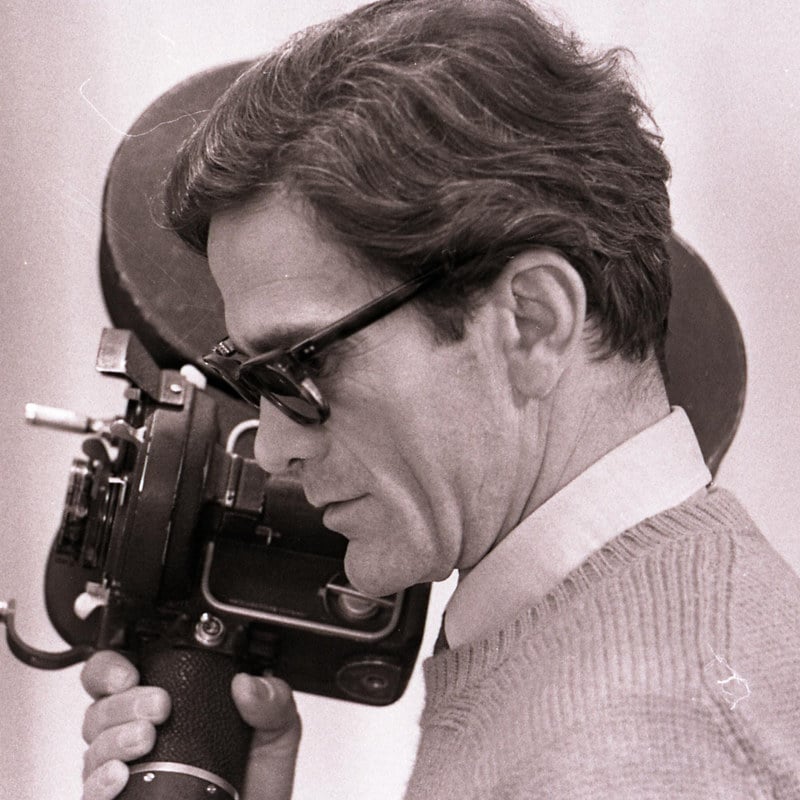
Pasolini
Source: Flickr user 九间
License
Salò, or the Circles of Hell
During a break from a graduate seminar, I once expressed an interest in watching Pier Paolo Pasolini’s Salò, or the 120 Days of Sodom (1975). My professor snickered nervously. It’s not that I wasn’t aware of its reputation. I knew to expect graphic violence, constant nudity, and general perversion. But I have never been one for moralism in filmmaking. As long the film wasn’t merely exploitative, what was there to laugh at or avoid? Ironically, Pasolini’s film is one of the most moralistic—one of the most effective in its didacticism—that I’ve ever seen.
The movie follows a mass of nigh anonymous boys and girls as they are systematically selected, captured, and transported to a mansion somewhere in the fascist Italian rump state based at Salò. Once inside, they are manhandled by a group of fascist paramilitaries, soldiers, and four eminent leaders—all older men, each disgusting in their own way. The President (Aldo Viletti) is cross eyed and constantly cracks obscene jokes. The Duke (Paolo Bonacalli) wears a carapace-like beard and drones on about how fascism is the anarchy of power, the only true way to rule. These men subject the teens to acts too graphic for this sort of public blog post. But imagine what might have made my professor raise an eyebrow. Now double the intensity.
Libertine Impulses
In the world of the manor, chaos reigns. That is by our standards anyway. The four rulers bark orders and promulgate strict rules. The teens will get naked, bark like dogs, and eat scraps or their names will go in a book and they will be punished. Each day everyone will gather in the “orgy room” or “justice” will be meted out. In these ways, Pasolini takes the hedonistic pleasures of the Marquis de Sade’s The 120 Days of Sodom, or the School of Libertinage (1785; 1904), which praises libertine impulses and reveals them as extensions of fascist dominance.
Desire to Dominate
Above all, this insight shines forth and is (for lack of a better term) the “point” in watching something so unabashedly depraved. Most often, we imagine fascism as at best a lurid form of extreme conservatism, one filled with repression and a kind of eugenicist dedication to sexual fecundity. But this was not true of the actual Nazis [see The Damned (1969) or Madame Kitty (1976)], nor is true of many authoritarian dictatorships (that’s what all the jeweled palaces and fancy clothes are about, after all). The desire to dominate is itself libidinal. Control is never far from pleasure. Aristotle’s tyrant is a slave to his own desire.
Powerless and Alone
Pasolini saves the film from its own potential excesses by restraining his camera. He never holds for that long. Anyone looking for prurience or fascination will not find it here. We see just enough to be disgusted, but his camera never lingers. When we cannot take it anymore, he cuts. Naked people become nothing more than bare, vulnerable commodities—they are not sexually interesting or even really “naked” in our typical meaning [“The naked and the nude / (By lexicographers construed / As synonyms that should express / the same deficiency of dress / Or shelter”)]. This world stands on consumption. Bare skin is just another way to feel powerless and alone.
Reduced to Mere Engines
Indeed, Pasolini suggests that we continue to live under the dominance of such modes of consumption. Even if Mussolini is gone, our rulers and way of being remain, he seems to think, perverse. People are bodies made for consumption—sexually, physically, economically, psychologically. Our leaders—whether the overt offenders like Epstein or more monetarily avaricious like Elon Musk—lord themselves over vast populations of nobodies. There is no obvious way to resist. We’re naked and afraid, locked in the mansion with a gang of perverts. Worst of all, even we, the writhing masses, find ourselves reduced to mere engines of further consumption. Such is life under this cycle of predation.
Pasolini also hated television, among many other things. He died three weeks before the film was released, murdered by mafiosi/fascist thugs. In this film, the victims appeal to Christ and Mary. The fascists appeal to naked power and sexual gratification. Pasolini was an atheist. So was the Marquis de Sade. Make of that what you will. We’re not done with Salò yet.
Catholic
Religious Art
Previous Post

February 23, 2025
The Cremator: Neat, Orderly, Fascist
Next Post

March 11, 2025 Mickey 17: The Art of Literalism
Recent Comments
"Do The Right Thing was a terrible movie, with a terrible message, a man owns ..."
Do the Right Thing: What Can ..."
"NOT the experience of those who actually lived through those years. Let's not forget that.Too ..."
"Your accurate assessment of where the Blockbuster and the studios have ended up reminded me ..."
"Another Dementia experience: https://youtube.com/playlist?list=PLkbxNibXiLx_ak8IuhZiutd2Fxe7_KAon&si=VhOYNUIBV3CTlyDf"
Browse Our Archives
Select a Category Academia Culture Politics Reviews Theology Uncategorized
Select a Month October 2026 September 2026 August 2026 July 2026 June 2026 May 2026 April 2026 March 2026 February 2026 January 2026 December 2025 November 2025 October 2025 September 2025 August 2025 July 2025 June 2025 May 2025 April 2025 March 2025 February 2025 January 2025 December 2024 November 2024 October 2024 September 2024 August 2024 July 2024 June 2024 May 2024 April 2024 March 2024 February 2024 January 2024 December 2023 November 2023 October 2023 September 2023 August 2023 July 2023 June 2023 May 2023 April 2023 March 2023 February 2023 January 2023 November 2022 October 2022 September 2022 August 2022 July 2022 June 2022 May 2022 April 2022 March 2022 February 2022 July 2021 December 2020 November 2020 July 2020 May 2020 April 2020 February 2020 January 2020 December 2019 November 2019 October 2019 August 2019 July 2019 April 2019 March 2019 December 2018 August 2018 July 2018 June 2018 May 2018 April 2018 March 2018 January 2018 December 2017 November 2017 September 2017 August 2017 July 2017 June 2017 May 2017 April 2017 March 2017 February 2017 January 2017 December 2016 November 2016 October 2016 September 2016 August 2016 July 2016 June 2016 May 2016 April 2016 March 2016 February 2016
Follow Us!
TAKE THE
Religious Wisdom Quiz
According to Hebrews, what two things cannot be shaken?
Select your answer to see how you score.
The word and Spirit A kingdom that cannot be shaken Heaven and earth Faith and love
Related posts from Jappers and Janglers

Swimfan: Forgotten Aughts Pleasures

Other Mommy: Jump Scares for None

Death by Hanging: From 1968 to 2026

TRENDING AT PATHEOS Religious Music and Entertainment

Emotion in Early Christianity by Andrew Crislip
Andrew Crislip’s Emotion in Early Christianity examines an often overlooked dimension of...

16 Spiritual Touchstones for a More Grounded Life
After decades of spiritual study, here are 16 principles I try...

Catholic Evangelization: Sharing Your Faith Every Day
Welcome back to the Graceful Awakening mini-series called, “From Faith to Mission.” ...

The Pillar of the Boatmen: the Ancient Monument...
The Pillar of the Boatmen is a Romano-Gaulish sculpture that dates from...

In one sense walking into Westminster Abbey is like walking down the...

'Super Scam Me' Exposes AI Jon Bon Jovi...
Leslie Pickett believed she was in a relationship with Jon Bon Jovi....
view all Religious Music and Entertainment blogs
What Are Your Thoughts?leave a comment
Ad-Free & Subscriber Log-In Subscription Support
- About Us
- 2026 Calendar
- Videos
- Podcasts
- Library of World Religions
- Faith In Media Tracker
- Advertise With Us
- Write for Us
- Privacy Policy
- Terms of Service
- Do Not Sell My Data
- Contact Us
- Radiant Digital
- Manage Newsletter Subscriptions
- Unsubscribe From Notifications
- Sitemap
Copyright 2008-2026, Patheos. All rights reserved.
Subscription Support Ad-Free & Subscriber Log-In
Follow Patheos