
BuddhistCatholicContemplativeEvangelicalGeneral ChristianHinduJewishLatter-day SaintMuslimNew VisionsProgressive Christian
Beliefs
- Buddhist
- Catholic
- Contemplative
- Evangelical
- General Christian
- Hindu
- Jewish
- Latter-day Saint
- More Voices
- Muslim
- New Visions
- Pagan
- Progressive Christian
Topics
- Religion News
- Food and Religion
- Sports and Religion
- Religious Art
- Religious Music and Entertainment
- Religious Events
- History and Religion
- Style and Religion
- Politics and Religion
- Women in Religion
- Recreation Outdoors and Religion
- Business Finance and Religion
- Careers Workplace and Religion
- Education and Religion
- Family Parenting and Religion
- Health Fitness and Religion
- Home and Religion
- Relationships and Religion
- Technology and Religion
- Travel and Religion
Columnists
- Buddhist Columnists
- Business Finance and Religion Columnists
- Careers Workplace and Religion Columnists
- Catholic Columnists
- Contemplative Columnists
- Education and Religion Columnists
- Evangelists Columnists
- Family Parenting and Religion Columnists
- General Christian Columnists
- Health Fitness and Religion Columnists
- Hindu Columnists
- History and Religion Columnists
- Home and Religion Columnists
- Jewish Columnists
- More Voices Columnists
- Latter Day Columnists
- Muslim Columnists
- New Visions Columnists
- Nonreligious Columnists
- Pagan Columnists
- Politics and Religion Columnists
- Progressive Columnists
- Recreation Outdoors and Religion Columnists
- Relationships and Religion Columnists
- Religion News Columnists
- Religious Art Columnists
- Religious Events Columnists
- Religious Music and Entertainment Columnists
- Sports and Religion Columnists
- Style and Religion Columnists
- Technology and Religion Columnists
- Travel and Religion Columnists
- Women in Religion Columnists
Resource Library
- 2026 Calendar
- Library of World Religions
- The 100 Most Holy Places on Earth
- Patheos Answers
- Podcasts
- Videos
- Faith Leaders Database
- Anglican Episcopalian
- Bahai
- Baptist
- Buddhism
- Christianity
- Confucianism
- Eastern Orthodoxy
- Hinduism
- Holiness and Pentecostal
- ISKCON
- Islam
- Judaism
- Lutheran
- Methodist
- The Church of Jesus Christ of Latter-day Saints
- New Age
- Paganism
- Presbytarian and Reformed
- Protestantism
- Religion Behind the Scenes
- Roman Catholic
- Scientology
- Shia Islam
- Sikhism
- Sufism
- Sunni Islam
- Taoism
- Zen
- See all religions
Research Tools
 Ad-Free & Subscriber Log-In Subscription Support
Ad-Free & Subscriber Log-In Subscription Support
Follow Patheos 

- Trending:
- Forgiveness
- |
- Marriage
- |
- Consciousness
- |
- Death Penalty
- |
- Election
- |
- Halloween

- Home
- Religious Music and Entertainment
- Picturing Bare Life
Picturing Bare Life
Last updated on: April 1, 2024 at 1:56 pm by Chase Padusniak
Picturing Bare Life 2024-04-01T13:56:59-04:00 Chase Padusniak
Patheos Explore the world's faith through different perspectives on religion and spirituality! Patheos has the views of the prevalent religions and spiritualities of the world.
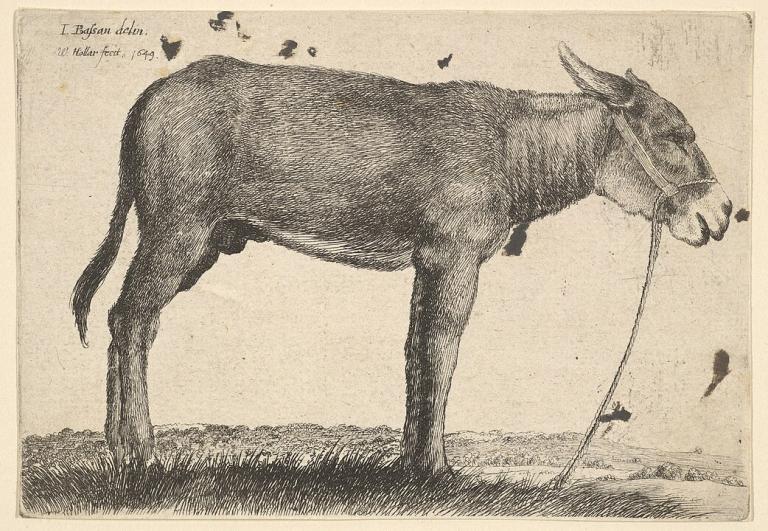
Wenceslaus Hollar’s etching of a donkey (1649, after Jacopo Bassano).
Source: Wikimedia
License

I’m a word person. This is, I think, a sound investment. The word is the structure of our most common communication, whether spoken or written; it is the form which most often gives shape to our needs, desires, and losses. No greater technology (save perhaps penicillin—itself dependent on words as much as on chemical experimentation) has yet existed. Even the artificial intelligences that haunt us often speak in words. Their ersatz thinking is a language denuded of ambiguity, language reduced to precision and thus dullness. Nothing seems yet to be giving words (or their equivalents—shapes, characters) a run for their money.
Though I love movies, this is all to say that I am not a picture person. I can imagine an apple in some detail, but I am a mid-rank contender at best when it comes to rotating it, biting it, digesting it all in my mind’s eye. I am not, however, hopeless.
This I learned while watching Robert Bresson’s Au Hasard Balthazar (1966). The film concerns the life of the eponymous donkey. He hee-haws in pain and satisfaction, wanders away from owners of all kinds. Some are abusive, others merely neglectful. Some love him, though in the incomplete way humans have mastered. Bresson shows us Balthazar from birth to death, a triumphantly saintly beast of burden, one who endures and abides. Balthazar is the Dude’s dude.
The film works only because Bresson makes such powerful use of the medium. What might sound trite—that this is a movie made up of pictures—asserts itself as something greater here. Au Hasard Balthazar made me weep because its images assert themselves independent of words, even if these do show up occasionally.
When a cruel local boy ties a newspaper to Balthazar’s tail and lights it on fire, we are not allowed to look away. When Balthazar shivers in the snow, Bresson holds his camera on the purity of his freezing, gaseous breath, the snow stuck to his fur. Balthazar has a dignity we rarely see in our fellow human beings, mutilated as they are by language and prejudice (think of a phrase that annoys you—“I did a thing,” perhaps—and tell me that language cannot mutilate).
Balthazar is a victim of great cruelty. He is also, as one of his owners says, a saint. We see him baptized by children, see him adorned with a crown of flowers, see him carry a relic atop his back. We watch him, grow immersed in his life, his silence, his ability to love and endure. He simply lives. Usually, I find donkeys off putting; Balthazar is beautiful. As I realized this simple fact, I knew the film was working.
Forgive me for sounding trite again, but the bare succession of images forced me to think. Sometimes quiet, slow-moving movies (looking at you, Antonioni) bore me, occasion little reflection and much yawning. Not so here. Au Hasard Balthazar does not tell us characters’ intentions, nor does it spell out exactly why people react as they do. Balthazar’s first owner, a young woman, falls for a bad boy who initially sexually assaults her. Why? We can make a few inferences. But the film never speaks them. It is as if the characters feel no need to justify themselves. They simply act. We are miles from Woody Allen’s New York and a veritable continent from my own neurotic inner monologue.
How refreshing. I’m still not very good at rotating and eating that incorporeal apple. I, however, respect its power more than ever. The word remains with me, even as I feel drawn—even subjected to—the power of the bare image.
Religious Art
Previous Post
March 25, 2024
Barbed and Dangerous
Next Post
April 8, 2024 85 and Still Kicking
Recent Comments
"Do The Right Thing was a terrible movie, with a terrible message, a man owns ..."
Do the Right Thing: What Can ..."
"NOT the experience of those who actually lived through those years. Let's not forget that.Too ..."
"Your accurate assessment of where the Blockbuster and the studios have ended up reminded me ..."
"Another Dementia experience: https://youtube.com/playlist?list=PLkbxNibXiLx_ak8IuhZiutd2Fxe7_KAon&si=VhOYNUIBV3CTlyDf"
Browse Our Archives
Select a Category Academia Culture Politics Reviews Theology Uncategorized
Select a Month October 2026 September 2026 August 2026 July 2026 June 2026 May 2026 April 2026 March 2026 February 2026 January 2026 December 2025 November 2025 October 2025 September 2025 August 2025 July 2025 June 2025 May 2025 April 2025 March 2025 February 2025 January 2025 December 2024 November 2024 October 2024 September 2024 August 2024 July 2024 June 2024 May 2024 April 2024 March 2024 February 2024 January 2024 December 2023 November 2023 October 2023 September 2023 August 2023 July 2023 June 2023 May 2023 April 2023 March 2023 February 2023 January 2023 November 2022 October 2022 September 2022 August 2022 July 2022 June 2022 May 2022 April 2022 March 2022 February 2022 July 2021 December 2020 November 2020 July 2020 May 2020 April 2020 February 2020 January 2020 December 2019 November 2019 October 2019 August 2019 July 2019 April 2019 March 2019 December 2018 August 2018 July 2018 June 2018 May 2018 April 2018 March 2018 January 2018 December 2017 November 2017 September 2017 August 2017 July 2017 June 2017 May 2017 April 2017 March 2017 February 2017 January 2017 December 2016 November 2016 October 2016 September 2016 August 2016 July 2016 June 2016 May 2016 April 2016 March 2016 February 2016
Follow Us!
TAKE THE
Religious Wisdom Quiz
What was the primary musical instrument in the Temple?
Select your answer to see how you score.
Lyre Trumpet Drums Harp
Related posts from Jappers and Janglers

Swimfan: Forgotten Aughts Pleasures

Other Mommy: Jump Scares for None
Death by Hanging: From 1968 to 2026

TRENDING AT PATHEOS Religious Music and Entertainment

Letters on Living the Faith by C.S. Lewis
Most of us met C.S. Lewis as a public intellectual. Mere Christianity....

When Halloween Unmasks Married Hearts
Written by Dr. David K. Ewen from Eternal Truth Bible College Behind...

Aristotle. He’s been called the father of logic, the father of the...

Methodist Central Hall and Westminster Abbey
Situated on the same square is Methodist Central Hall and Westminster Abbey. ...

57th Dove Awards Honor Dolly Parton, Crown New...
On gospel music’s biggest night, the 57th annual GMA Dove Awards honored...

The First Eucharistic Controversy: Christ’s Real Presence
For Catholics, the Eucharist is the source and summit of the Christian...
view all Religious Music and Entertainment blogs
What Are Your Thoughts?leave a comment
Ad-Free & Subscriber Log-In Subscription Support
- About Us
- 2026 Calendar
- Videos
- Podcasts
- Library of World Religions
- Faith In Media Tracker
- Advertise With Us
- Write for Us
- Privacy Policy
- Terms of Service
- Do Not Sell My Data
- Contact Us
- Radiant Digital
- Manage Newsletter Subscriptions
- Unsubscribe From Notifications
- Sitemap
Copyright 2008-2026, Patheos. All rights reserved.
Subscription Support Ad-Free & Subscriber Log-In
Follow Patheos