
BuddhistCatholicContemplativeEvangelicalGeneral ChristianHinduJewishLatter-day SaintMuslimNew VisionsProgressive Christian
Beliefs
- Buddhist
- Catholic
- Contemplative
- Evangelical
- General Christian
- Hindu
- Jewish
- Latter-day Saint
- More Voices
- Muslim
- New Visions
- Pagan
- Progressive Christian
Topics
- Religion News
- Food and Religion
- Sports and Religion
- Religious Art
- Religious Music and Entertainment
- Religious Events
- History and Religion
- Style and Religion
- Politics and Religion
- Women in Religion
- Recreation Outdoors and Religion
- Business Finance and Religion
- Careers Workplace and Religion
- Education and Religion
- Family Parenting and Religion
- Health Fitness and Religion
- Home and Religion
- Relationships and Religion
- Technology and Religion
- Travel and Religion
Columnists
- Buddhist Columnists
- Business Finance and Religion Columnists
- Careers Workplace and Religion Columnists
- Catholic Columnists
- Contemplative Columnists
- Education and Religion Columnists
- Evangelists Columnists
- Family Parenting and Religion Columnists
- General Christian Columnists
- Health Fitness and Religion Columnists
- Hindu Columnists
- History and Religion Columnists
- Home and Religion Columnists
- Jewish Columnists
- More Voices Columnists
- Latter Day Columnists
- Muslim Columnists
- New Visions Columnists
- Nonreligious Columnists
- Pagan Columnists
- Politics and Religion Columnists
- Progressive Columnists
- Recreation Outdoors and Religion Columnists
- Relationships and Religion Columnists
- Religion News Columnists
- Religious Art Columnists
- Religious Events Columnists
- Religious Music and Entertainment Columnists
- Sports and Religion Columnists
- Style and Religion Columnists
- Technology and Religion Columnists
- Travel and Religion Columnists
- Women in Religion Columnists
Resource Library
- 2026 Calendar
- Library of World Religions
- The 100 Most Holy Places on Earth
- Patheos Answers
- Podcasts
- Videos
- Faith Leaders Database
- Anglican Episcopalian
- Bahai
- Baptist
- Buddhism
- Christianity
- Confucianism
- Eastern Orthodoxy
- Hinduism
- Holiness and Pentecostal
- ISKCON
- Islam
- Judaism
- Lutheran
- Methodist
- The Church of Jesus Christ of Latter-day Saints
- New Age
- Paganism
- Presbytarian and Reformed
- Protestantism
- Religion Behind the Scenes
- Roman Catholic
- Scientology
- Shia Islam
- Sikhism
- Sufism
- Sunni Islam
- Taoism
- Zen
- See all religions
Research Tools
 Ad-Free & Subscriber Log-In Subscription Support
Ad-Free & Subscriber Log-In Subscription Support
Follow Patheos 

- Trending:
- Forgiveness
- |
- Marriage
- |
- Consciousness
- |
- Death Penalty
- |
- Election
- |
- Halloween

- Home
- Religious Music and Entertainment
- Blankly Staring at the Past
Blankly Staring at the Past
Last updated on: October 5, 2023 at 3:02 pm by Chase Padusniak
Blankly Staring at the Past 2023-10-05T15:02:32-04:00 Chase Padusniak
Patheos Explore the world's faith through different perspectives on religion and spirituality! Patheos has the views of the prevalent religions and spiritualities of the world.
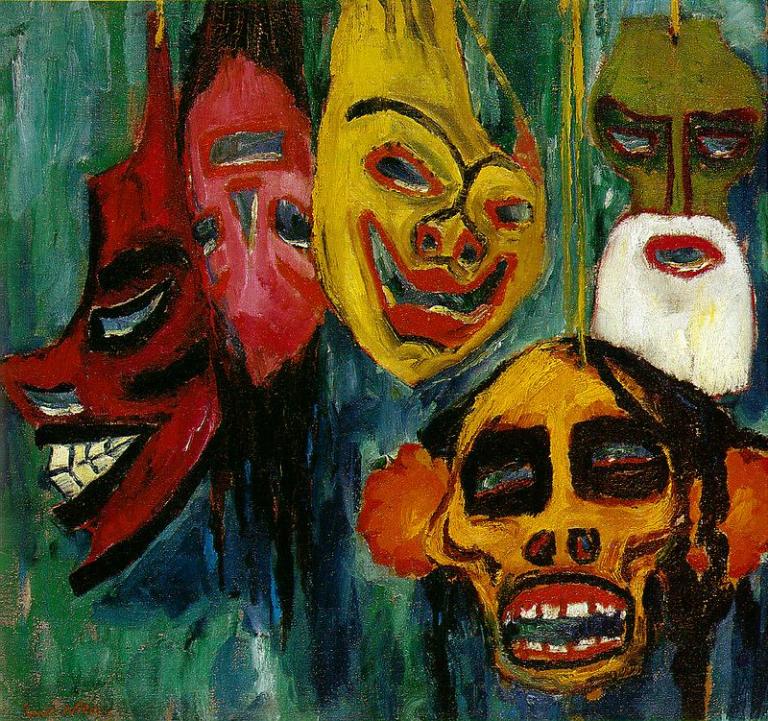
Emil Nolde, Masks (1911)
Source: Flickr user Breve Storia del Cinema
Public Domain
I don’t like saying movies age poorly. It feels impolite like asking a lady her age or inquiring about that Argentinian friend with a German last name’s grandpa. You just don’t do it.
But even I have to be honest with myself sometimes. It ain’t easy. I’ve spent a lifetime convincing loved ones that just because a movie is black and white or silent or slow that it’s still worth seeing. Throw in that I’m a “medievalist” and it’s built into my whole shtick: uphold the old. Just because it’s a little dusty doesn’t mean it isn’t better than your shiny new whatever.
Let me get this off my chest: Georges Franju’s Eyes Without a Face (1960) has aged poorly. But, before I get there, let me sing its praises.
As we know from Dead Ringers (1988), nothing is scarier than a surgeon who has lost his (yes, his) mind. In Cronenberg’s film, the twin chop doctors work in reproduction. At first, they exert their power by drawing life where it otherwise refuses to be. By the end, the two twist themselves and their patients’ bodies, reforming what it means to be a human being (and especially a woman). In Eyes Without a Face, our lead is Dr. Génessier (Pierre Brasseur), a square-headed, bearded lug of a man who promises great leaps in the science of heterograft surgeries. He is a cosmetic surgeon bent on remaking science and human possibilities not (merely) on account of self-aggrandizement but because his own daughter, Christiane (Édith Scob), has been horrifically disfigured (in a car accident he caused, but never mind that…). As a result, she wanders his suburban mansion in the mask that inspired Mike Meyers’ own famous blankness. He spends his days researching while his assistant lures women to the house so that he can try to remove their faces to graft onto his own daughter. He keeps failing. Oh well. Time for more experiments.
Isn’t that spooky? It’s got it all: the troubled, sympathetic mad scientist whose pursuit of progress manifests barbarism (an impulse and result that seem to undergird most “innovation” today—a prescient idea from Franju’s source material). The lonely, masked woman skulking candle-lit halls, yearning for freedom and not trusting her own father, her maimer. We’ve got murder, intrigue, and a terminal sadness that hovers over the whole film.
The score is phenomenal. We open in a car, the camera looking out at blank trees jutting into a bleak, nighttime horizon as the vehicle drives on. What sounds like circus music blares over the receding night, a darkness that keeps disappearing and coming again, an inescapable fact. Wherever we are it is both far out “there” and not far enough from whatever evil lurks in these half-forested hills.
While the film’s producers saw it as an early Italo-French horror venture, Franju disagreed. For him, Eyes Without a Face was a nightmare, yes. But a nightmare is a kind of dream. His vision was for a fantastique style haunting, small doses of horror drawn out across stretches of anxious restlessness. Unsurprisingly, Franju’s description is closer to the truth. So much of the movie is characters walking or driving, skulking the halls of the doctor’s mansion, making their way down long roads between Paris and this suburb, that it takes on a hypnotic quality. In some cases, this dreamlike plodding builds tension in the viewer (e.g., when we first meet Christiane and are unsure if we will see her scarred face, her mask, or both). Often these long sequences are gorgeously shot and lit, unnerving in their tranquil, silent beauty.
But that’s also the problem: the film is largely composed of these sequences, and, when they aren’t building to anything, they induce something else associated with dreams: sleep. Franju so successfully accomplished his vision that the movie’s quiet anxiety sometimes passes into a hypnotizing lullaby. The Doctor creeps. Christiane skulks. Louise (Alida Valli) drives. All in silence. There’s horror based on mood, and then there’s Eyes Without a Face.
Maybe I have been spoiled by the manic pace of so many modern scary movies (heck, movies in general). But I don’t think so. I’ve got a taste for the slow and the deliberate. What I need, though, is for that capaciousness, that willingness to sit with the material, to build from or toward something. Eyes Without a Face seems to relish these long pauses more than the horrors themselves; it draws you in, lets you know what’s going on, and then keeps tracking its characters slowly even though we already know the score.
Audiences at the time were reportedly scared by the film. And why not? Some of its images are seared into my brain (not least Christiane’s blank expression, the impenetrability of that mask). Its first song makes my skin crawl. But the quietness of silent films, the excitement produced by watching a person walk the same steps lit by moon- and candlelight, has faded with time. Progress? I’m unsure. But, in this case, Dr. Génessier’s vision might just have won out.
Religious Art
Style and Religion
Previous Post
October 5, 2023
Childlike Melancholy
Next Post

October 5, 2023 Screeches in the Night, What Music They Make
Recent Comments
"Do The Right Thing was a terrible movie, with a terrible message, a man owns ..."
Do the Right Thing: What Can ..."
"NOT the experience of those who actually lived through those years. Let's not forget that.Too ..."
"Your accurate assessment of where the Blockbuster and the studios have ended up reminded me ..."
"Another Dementia experience: https://youtube.com/playlist?list=PLkbxNibXiLx_ak8IuhZiutd2Fxe7_KAon&si=VhOYNUIBV3CTlyDf"
Browse Our Archives
Select a Category Academia Culture Politics Reviews Theology Uncategorized
Select a Month October 2026 September 2026 August 2026 July 2026 June 2026 May 2026 April 2026 March 2026 February 2026 January 2026 December 2025 November 2025 October 2025 September 2025 August 2025 July 2025 June 2025 May 2025 April 2025 March 2025 February 2025 January 2025 December 2024 November 2024 October 2024 September 2024 August 2024 July 2024 June 2024 May 2024 April 2024 March 2024 February 2024 January 2024 December 2023 November 2023 October 2023 September 2023 August 2023 July 2023 June 2023 May 2023 April 2023 March 2023 February 2023 January 2023 November 2022 October 2022 September 2022 August 2022 July 2022 June 2022 May 2022 April 2022 March 2022 February 2022 July 2021 December 2020 November 2020 July 2020 May 2020 April 2020 February 2020 January 2020 December 2019 November 2019 October 2019 August 2019 July 2019 April 2019 March 2019 December 2018 August 2018 July 2018 June 2018 May 2018 April 2018 March 2018 January 2018 December 2017 November 2017 September 2017 August 2017 July 2017 June 2017 May 2017 April 2017 March 2017 February 2017 January 2017 December 2016 November 2016 October 2016 September 2016 August 2016 July 2016 June 2016 May 2016 April 2016 March 2016 February 2016
Follow Us!
TAKE THE
Religious Wisdom Quiz
Which parable teaches about praying persistently, like a widow before a judge?
Select your answer to see how you score.
The Sower The Talents The Mustard Seed The Persistent Widow
Related posts from Jappers and Janglers

Swimfan: Forgotten Aughts Pleasures

Other Mommy: Jump Scares for None

Death by Hanging: From 1968 to 2026

TRENDING AT PATHEOS Religious Music and Entertainment

Dolly Parton’s Last Song Wins Dove Award with...
Bluegrass band The Grascals, speaking on the red carpet at the 57th...

The Image: On the Horror of Capitalism and...
The Image Then went the Pharisees, and took counsel how they might...

We are approaching the date of our new American national holiday: October...

Letters on Living the Faith by C.S. Lewis
Most of us met C.S. Lewis as a public intellectual. Mere Christianity....

When Halloween Unmasks Married Hearts
Written by Dr. David K. Ewen from Eternal Truth Bible College Behind...

Aristotle. He’s been called the father of logic, the father of the...
view all Religious Music and Entertainment blogs
What Are Your Thoughts?leave a comment
Ad-Free & Subscriber Log-In Subscription Support
- About Us
- 2026 Calendar
- Videos
- Podcasts
- Library of World Religions
- Faith In Media Tracker
- Advertise With Us
- Write for Us
- Privacy Policy
- Terms of Service
- Do Not Sell My Data
- Contact Us
- Radiant Digital
- Manage Newsletter Subscriptions
- Unsubscribe From Notifications
- Sitemap
Copyright 2008-2026, Patheos. All rights reserved.
Subscription Support Ad-Free & Subscriber Log-In
Follow Patheos