
BuddhistCatholicContemplativeEvangelicalGeneral ChristianHinduJewishLatter-day SaintMuslimNew VisionsProgressive Christian
Beliefs
- Buddhist
- Catholic
- Contemplative
- Evangelical
- General Christian
- Hindu
- Jewish
- Latter-day Saint
- More Voices
- Muslim
- New Visions
- Pagan
- Progressive Christian
Topics
- Religion News
- Food and Religion
- Sports and Religion
- Religious Art
- Religious Music and Entertainment
- Religious Events
- History and Religion
- Style and Religion
- Politics and Religion
- Women in Religion
- Recreation Outdoors and Religion
- Business Finance and Religion
- Careers Workplace and Religion
- Education and Religion
- Family Parenting and Religion
- Health Fitness and Religion
- Home and Religion
- Relationships and Religion
- Technology and Religion
- Travel and Religion
Columnists
- Buddhist Columnists
- Business Finance and Religion Columnists
- Careers Workplace and Religion Columnists
- Catholic Columnists
- Contemplative Columnists
- Education and Religion Columnists
- Evangelists Columnists
- Family Parenting and Religion Columnists
- General Christian Columnists
- Health Fitness and Religion Columnists
- Hindu Columnists
- History and Religion Columnists
- Home and Religion Columnists
- Jewish Columnists
- More Voices Columnists
- Latter Day Columnists
- Muslim Columnists
- New Visions Columnists
- Nonreligious Columnists
- Pagan Columnists
- Politics and Religion Columnists
- Progressive Columnists
- Recreation Outdoors and Religion Columnists
- Relationships and Religion Columnists
- Religion News Columnists
- Religious Art Columnists
- Religious Events Columnists
- Religious Music and Entertainment Columnists
- Sports and Religion Columnists
- Style and Religion Columnists
- Technology and Religion Columnists
- Travel and Religion Columnists
- Women in Religion Columnists
Resource Library
- 2026 Calendar
- Library of World Religions
- The 100 Most Holy Places on Earth
- Patheos Answers
- Podcasts
- Videos
- Faith Leaders Database
- Anglican Episcopalian
- Bahai
- Baptist
- Buddhism
- Christianity
- Confucianism
- Eastern Orthodoxy
- Hinduism
- Holiness and Pentecostal
- ISKCON
- Islam
- Judaism
- Lutheran
- Methodist
- The Church of Jesus Christ of Latter-day Saints
- New Age
- Paganism
- Presbytarian and Reformed
- Protestantism
- Religion Behind the Scenes
- Roman Catholic
- Scientology
- Shia Islam
- Sikhism
- Sufism
- Sunni Islam
- Taoism
- Zen
- See all religions
Research Tools
 Ad-Free & Subscriber Log-In Subscription Support
Ad-Free & Subscriber Log-In Subscription Support
Follow Patheos 

- Trending:
- Forgiveness
- |
- Marriage
- |
- Consciousness
- |
- Death Penalty
- |
- Election
- |
- Halloween

- Home
- Religious Music and Entertainment
- Who Founded the Catholic Church?
Who Founded the Catholic Church?
Last updated on: August 17, 2022 at 6:44 pm by Chase Padusniak
Who Founded the Catholic Church? 2022-08-17T18:44:19-04:00 Chase Padusniak
Patheos Explore the world's faith through different perspectives on religion and spirituality! Patheos has the views of the prevalent religions and spiritualities of the world.
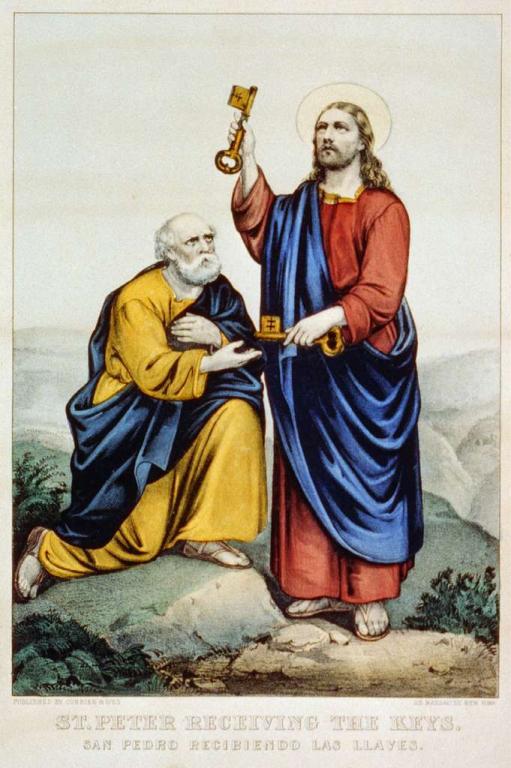
A Currier & Ives print of St. Peter receiving the keys to the kingdom (1856).
Source: picryl
Essentially every self-described Christian group sees Jesus as its founder, either literally and historically or spiritually. So, while George Fox would acknowledge that Quakerism was an innovation of the 17th century, undoubtedly he saw Jesus as the departure point for his discovery of the Inner Light. No Bible, no George Fox. No Jesus, no Bible. Even Mormons, whose sacred texts radically rewrite salvation history, call themselves “the Church of Jesus Christ of Latter-day Saints.” Sure, they may be “latter-day,” but Jesus is right there up front.
A problem arises when other groups, typically for polemical reasons, decide who founded some competing group. Catholics might trace the Anglican Communion to Henry VIII or the Lutheran Church to Martin Luther. Anglicans might snipe that John Wesley invented Methodism. A Southern Baptist pretending to be a non-denom might say Pentecostalism has nothing to do with Pentecost and everything to do with the Azusa Street Revival (or worse, the British Israelism of Charles Fox Parham).
And so, when investigating who founded the Catholic Church, a Catholic will—inevitably—respond “Jesus,” while the outsider, depending on background and agenda, might respond anything from “Paul” to “Constantine” to “Cardinal Humbert of Silva Candida.” What I’d like to do for the remainder of this post is attempt a historical answer (as best one can based on the evidence that survives). I am Catholic. Of course, I have my biases. But I’ve also taught courses on the historical Jesus and the formation of early Christianity. I hope my arguments might, if rooted in a tradition, still transcend pure partisanship.
The first place we can point to and find the foundation of a church body is the Gospel According to St. Matthew, namely 16:18-19: “And so, I say to you, you are Peter, and upon this rock I will build my church, and the gates of the netherworld shall not prevail against it. I will give you the keys to the kingdom of heaven. Whatever you bind on earth shall be bound in heaven; and whatever you loose on earth shall be loosed in heaven.” Matthew was likely written somewhere between 70 and 110 A.D., most probably within the period 80-90. The word translated “church” is the Greek, “ekklesia,” meaning “assembly” or “congregation.” In other words, we know that by 80 or so A.D. the Christian community had a sense of itself as a corporate body (or “church”) with Peter, designated by Jesus Himself, as its fundament. This origin point seems to carry with it power and authority (“whatever you bind…”).
It’s possible that early audiences, assuming the imminent end of the world wouldn’t have thought much about how that power might be handed on. What we do know per Acts and early martyrdom accounts and other texts (like those of or by Polycarp, Ignatius, and Justin) is that some system of investment developed during this early period, likely prior even to the writing of Matthew’s Gospel. This set of roles includes deacons, presbyters, and bishops (“overseers”). While it would take some time for these titles to grow into the medieval (and then modern) versions of these offices (and this is where people will say Constantine “founded” the Catholic Church by uniting these positions to certain imperial functions), the basics were in place by at least this early period. By the time Peter and Paul died, that is, by the time of the drafting of the Synoptic Gospels, some official structure tracing itself through Peter and the other Apostles to Jesus existed.
Other groups existed too. This is often forgotten. There were various gnostic sects and quasi-Christian groups like the Manicheans and the Valentinians. What’s fascinating about the more explicitly Christian of these communities is that they too seem to have placed an emphasis on both Jesus and the Apostles. So, for example, the Gospel of Mary, a gnostic text found at Nag Hammadi, has Mary Magdalene argue with the Twelve (especially Peter), laying emphasis on how intimately she knew Jesus. She claims to have received His secret teachings. Here, then, we can see that various competing early Christian (and heretical) groups looked back to Christ and those immediately around Him.
But the question posed at the top does not most often come from partisans of early gnostic sects; rather, it tends to come from non-Catholic groups grounded in what we now call “the Bible.” What bears noting here, then, is that the community that canonized the texts (including Matthew) that we now call “the Bible” is, by its own partisans, called “catholic,” most obviously and explicitly in the Nicene Creed. A couple hundred years passed between the drafting of the Synoptic Gospels and Nicaea, but much of that period was spent defending this self-definition against encroachment and counterclaims by the sorts of sects mentioned above. It’s only with legalization and eventually institutionalization that this Petrine ekklesia could begin to fully agree upon a canon and various rules. Persecution had occupied them otherwise. This body was “catholic,” meaning “universal,” and it promulgated an “acceptable” version of the Scriptures.
As any Eastern or Oriental Orthodox commentator will tell you, that “catholic,” needn’t be with a capital “C.” The Armenians, Ethiopians, Greeks, and St. Thomas Christians all recite the Nicene Creed without subscribing to the papacy in Rome (what “Catholic” has come to mean). But there’s a problem with too vigorously applying this logic here: all these groups were in communion at the time of Nicaea. They all made up this “catholic” group, even if they differed in certain ritual customs or even used different recensions of the Biblical canon. They recognized one another as part of the group, the one that traced its origins to Matthew 16, the one that had argued with gnostic sects about the nature of authority and faith. They saw each other as one in baptism and in framework, with deacons, priests, bishops, and the institution of a Eucharist, traditions grounded in their now agreed upon minimum creed.
So how do you pick which one of these was really founded by Jesus? Detractors of the modern Catholic Church will say that that body split off from this original communion either on account of its bad Christology as annunciated at Chalcedon, or on account of its adoption of a doctrine of papal supremacy. Catholics will retort that its all there in Matthew 16. Peter was the first bishop of Rome after all. The Antiochene Orthodox and Syriac Orthodox won’t then fail to mention that St. Peter was also the first overseer of Antioch (and that he was there long before he was anywhere near Rome!).
And so how can one decide? Well, as a Catholic (though a Byzantine one), I tend to think that the universalizing primacy of Rome makes for the fullness of communion. But I think anyone from any Apostolic tradition (most especially Eastern and Oriental Orthodox) shares a claim on this original (and hopefully future) universal ekklesia that met at Nicaea.
Regardless of one’s view on that arcane question, the above suggests that most any Christian who accepts the authority of the Bible has to accept that the Catholic Church was founded, at least, by the Jesus of Matthew’s Gospel, if not by Jesus Christ Himself (and if one accepts the validity of Matthew’s Gospel, then the two are one and the same). One might think, for example, as a Lutheran that something eventually went wrong in that body and that it somehow lost its way. But even holding this belief, it’s clear that a historical connection exists between the modern Catholic Church (or the medieval one, for that matter) and the Council of Nicaea. Further, it’s clear that those who met at that council identified with the group that spent two centuries defining its identity over and against various heterodox and heretical groups by appealing to Matthew’s Gospel. In this sense, Jesus founded the Catholic Church—there are no ifs, ands, or buts about it.
History and Religion
Previous Post
June 28, 2022
Is Biden Catholic?
Next Post
July 2, 2022 Words, Words, Words
Browse Our Archives
Select a Category Academia Culture Politics Reviews Theology Uncategorized
Select a Month October 2026 September 2026 August 2026 July 2026 June 2026 May 2026 April 2026 March 2026 February 2026 January 2026 December 2025 November 2025 October 2025 September 2025 August 2025 July 2025 June 2025 May 2025 April 2025 March 2025 February 2025 January 2025 December 2024 November 2024 October 2024 September 2024 August 2024 July 2024 June 2024 May 2024 April 2024 March 2024 February 2024 January 2024 December 2023 November 2023 October 2023 September 2023 August 2023 July 2023 June 2023 May 2023 April 2023 March 2023 February 2023 January 2023 November 2022 October 2022 September 2022 August 2022 July 2022 June 2022 May 2022 April 2022 March 2022 February 2022 July 2021 December 2020 November 2020 July 2020 May 2020 April 2020 February 2020 January 2020 December 2019 November 2019 October 2019 August 2019 July 2019 April 2019 March 2019 December 2018 August 2018 July 2018 June 2018 May 2018 April 2018 March 2018 January 2018 December 2017 November 2017 September 2017 August 2017 July 2017 June 2017 May 2017 April 2017 March 2017 February 2017 January 2017 December 2016 November 2016 October 2016 September 2016 August 2016 July 2016 June 2016 May 2016 April 2016 March 2016 February 2016
Follow Us!
TAKE THE
Religious Wisdom Quiz
Who wrote the Book of Acts?
Select your answer to see how you score.
Luke Paul Peter Mark
Related posts from Jappers and Janglers
Death by Hanging: From 1968 to 2026

American Movie: The Beauty of the Chuds
Shimmering Opacity in a Country Church
TRENDING AT PATHEOS Religious Music and Entertainment

Emotion in Early Christianity by Andrew Crislip
Andrew Crislip’s Emotion in Early Christianity examines an often overlooked dimension of...

16 Spiritual Touchstones for a More Grounded Life
After decades of spiritual study, here are 16 principles I try...

Catholic Evangelization: Sharing Your Faith Every Day
Welcome back to the Graceful Awakening mini-series called, “From Faith to Mission.” ...

The Pillar of the Boatmen: the Ancient Monument...
The Pillar of the Boatmen is a Romano-Gaulish sculpture that dates from...

In one sense walking into Westminster Abbey is like walking down the...

'Super Scam Me' Exposes AI Jon Bon Jovi...
Leslie Pickett believed she was in a relationship with Jon Bon Jovi....
view all Religious Music and Entertainment blogs
Ad-Free & Subscriber Log-In Subscription Support
- About Us
- 2026 Calendar
- Videos
- Podcasts
- Library of World Religions
- Faith In Media Tracker
- Advertise With Us
- Write for Us
- Privacy Policy
- Terms of Service
- Do Not Sell My Data
- Contact Us
- Radiant Digital
- Manage Newsletter Subscriptions
- Unsubscribe From Notifications
- Sitemap
Copyright 2008-2026, Patheos. All rights reserved.
Subscription Support Ad-Free & Subscriber Log-In
Follow Patheos