
BuddhistCatholicContemplativeEvangelicalGeneral ChristianHinduJewishLatter-day SaintMuslimNew VisionsProgressive Christian
Beliefs
- Buddhist
- Catholic
- Contemplative
- Evangelical
- General Christian
- Hindu
- Jewish
- Latter-day Saint
- More Voices
- Muslim
- New Visions
- Pagan
- Progressive Christian
Topics
- Religion News
- Food and Religion
- Sports and Religion
- Religious Art
- Religious Music and Entertainment
- Religious Events
- History and Religion
- Style and Religion
- Politics and Religion
- Women in Religion
- Recreation Outdoors and Religion
- Business Finance and Religion
- Careers Workplace and Religion
- Education and Religion
- Family Parenting and Religion
- Health Fitness and Religion
- Home and Religion
- Relationships and Religion
- Technology and Religion
- Travel and Religion
Columnists
- Buddhist Columnists
- Business Finance and Religion Columnists
- Careers Workplace and Religion Columnists
- Catholic Columnists
- Contemplative Columnists
- Education and Religion Columnists
- Evangelists Columnists
- Family Parenting and Religion Columnists
- General Christian Columnists
- Health Fitness and Religion Columnists
- Hindu Columnists
- History and Religion Columnists
- Home and Religion Columnists
- Jewish Columnists
- More Voices Columnists
- Latter Day Columnists
- Muslim Columnists
- New Visions Columnists
- Nonreligious Columnists
- Pagan Columnists
- Politics and Religion Columnists
- Progressive Columnists
- Recreation Outdoors and Religion Columnists
- Relationships and Religion Columnists
- Religion News Columnists
- Religious Art Columnists
- Religious Events Columnists
- Religious Music and Entertainment Columnists
- Sports and Religion Columnists
- Style and Religion Columnists
- Technology and Religion Columnists
- Travel and Religion Columnists
- Women in Religion Columnists
Resource Library
- 2026 Calendar
- Library of World Religions
- The 100 Most Holy Places on Earth
- Patheos Answers
- Podcasts
- Videos
- Faith Leaders Database
- Anglican Episcopalian
- Bahai
- Baptist
- Buddhism
- Christianity
- Confucianism
- Eastern Orthodoxy
- Hinduism
- Holiness and Pentecostal
- ISKCON
- Islam
- Judaism
- Lutheran
- Methodist
- The Church of Jesus Christ of Latter-day Saints
- New Age
- Paganism
- Presbytarian and Reformed
- Protestantism
- Religion Behind the Scenes
- Roman Catholic
- Scientology
- Shia Islam
- Sikhism
- Sufism
- Sunni Islam
- Taoism
- Zen
- See all religions
Research Tools
 Ad-Free & Subscriber Log-In Subscription Support
Ad-Free & Subscriber Log-In Subscription Support
Follow Patheos 

- Trending:
- Forgiveness
- |
- Marriage
- |
- Consciousness
- |
- Death Penalty
- |
- Election
- |
- Halloween

- Home
- Religious Music and Entertainment
- Only the Bad Sleep Well
Only the Bad Sleep Well
Last updated on: August 17, 2022 at 6:45 pm by Chase Padusniak
Only the Bad Sleep Well 2022-08-17T18:45:13-04:00 Chase Padusniak
Patheos Explore the world's faith through different perspectives on religion and spirituality! Patheos has the views of the prevalent religions and spiritualities of the world.
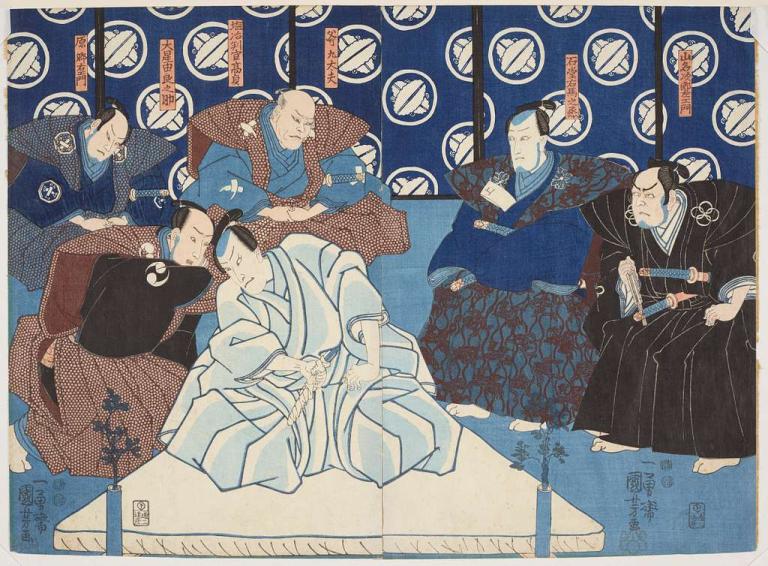
A depiction of the seppuku of Lord En’ya from chapter IV of Kanadehon Chūshingura (1860).
The more things change…
Source: picryl
In 1921 at eleven years old, Yoshio Kodama was unhappily living with his sister and her husband in Korea, beating steel into sheets at a nearby mill. By 1929, he had attempted to hand the emperor a direct appeal for greater patriotism. Kodama was stopped by security forces, though that didn’t stop him from spending the better part of the next decade plotting (and occasionally succeeding in) assassinations against major political figures. By the early 50s, only 20 or so years since imperial guards slammed his boyish face into the ground for approaching Japan’s supreme leader, Kodama was among the most powerful political fixers in Japan. Fast forward to 1976 and a fascist porn actor flew a plane into Kodama’s house. But that’s beyond the scope of this essay.
Kodama’s buddy, Nobusuke Kishi spent the mid-1930s as the chief economic architect of the Japanese puppet state of Manchukuo. What that meant in practice was partnering with the founder of Nissan to impress locals into industrial and sexual slavery. After the war ended—and much like his friend—the Allies didn’t hold him long. By 1957, he was Japan’s prime minister, working hand-in-glove with Kodama and the newly established Liberal Democratic Party (which continues to govern Japan today).
Two fascist war criminals—one out front and one in the shadows—ruling post-Imperial Japan. Who woulda thunk it?
Well, the United States of America for one thing. But again, that’s beyond the scope of this essay.
Instead, I’d like to consider one of Akira Kurosawa’s lesser-appreciated films, The Bad Sleep Well (1960), a movie about corporate corruption and vengeance in post-war Japan made while Kishi was prime minister. When people do discuss the film, it’s often on account of its elaborate opening sequence, which concerns a ritzy wedding between the daughter of the Public Development Corporation’s vice president and that boss’s secretary, a man named Nishi (played by the inimitable Toshiro Mifune). Reporters dressed in gray rush in and, like a Greek Chorus, introduce the characters, whisper about scandals in the company, and generally provide some relief from the awkward toasts and strained smiles of those seated in the banquet hall. The sequence is indeed gorgeous and, on my first viewing, convinced me the cinematic arc ahead was destined to be a masterpiece.
Though it sets up the intrigue and for all its grandeur, the sequence I’ve never been able to forget comes a bit later. Nishi, it turns out, is the son of a man made to commit suicide, part of a limited hangout for a scandal within the Public Development Corporation. His quest is simple: revenge. He wants to punish and eliminate every corrupt coward who runs the company, hence his marrying his boss’s daughter—she’s (at least initially) no more than a way to get at the fat cats who killed his father. Part of Nishi’s plan is saving a lower-ranking official from a compeled suicide, turning him into a ghost who can haunt (and drive insane) another underling at the corporation. This faux-phantom, Wada (Kamatari Fujiwara) is unsure about whether to participate in this scheme, at least until Nishi takes him to his own funeral, where he listens in as his co-workers and boss publicly cry, even as they talk secretly about how good it is that he’s gone. His wife wails and his children are reduced to tears—his life meant something to them. His bosses mourn publicly but toast his demise in private. In that brief scene, Nishi assimilates him not only into his plan, but into his experience. Our hero becomes a necromancer, destroying and resurrecting a man on his quest to take down the dirty rotten system that murdered his father.
That scene captures the whole problem of post-war Japan. Like Kurosawa’s other quasi-noirs about life after the atom bomb [e.g., Drunken Angel (1948) and Stray Dog (1949)], The Bad Sleep Well is about the toxic combination of new and old, Eastern and Western produced (or accelerated) by the demise of Imperial Japan. Wada gets a Shinto funeral. Nishi’s father dies like a samurai for his daimyo. But the real prestige lies in classic industrial corruption clothed in suits and clouded by cigar smoke. It’s no accident that the company in question is the Public Development Corporation, a nasty blend of the public and private. Indeed, the whole thing feels like a distillation of Japan in 1960, a snapshot of the ultra-modern reformed fascist Kishi and the Yakuza powerbroking of a thug like Kodama. Nishi’s story for revenge is not simply Hamlet (as some have contended); it’s the concentration of rage at failed reform, Kurosawa’s dramatic strike at the jugular of US-backed corruption. In the 30s, Kishi sold Manchukuo out to Nissan—how much really changed?
As the title all but screams, the film ends on a dour note. The future wasn’t looking all that bright for Japan in 1960, at least not from Kurosawa’s perspective. And despite its electronics dominance in the 80s, much the same could be said now, with the Liberal Democrats, the party of Kishi and Kodama, still mostly unchallenged. For me, as a US citizen, it’s hard not to feel the parallels. The promise of the post-war moment obscured matters for some time; injustice (or chaos if you prefer for any von Trier fans out there) reigns. But the mask is now all but ripped off. What we did to Japan we now seem hellbent on doing to ourselves. The movie’s name may as well by our mantra, a slogan for 2022, though with a slight addition: only the bad sleep well.
Religious Art
Previous Post

June 20, 2022
If Ray Liotta’s Her Ex, Get Out of Dodge
Next Post

June 28, 2022 Is Biden Catholic?
Browse Our Archives
Select a Category Academia Culture Politics Reviews Theology Uncategorized
Select a Month October 2026 September 2026 August 2026 July 2026 June 2026 May 2026 April 2026 March 2026 February 2026 January 2026 December 2025 November 2025 October 2025 September 2025 August 2025 July 2025 June 2025 May 2025 April 2025 March 2025 February 2025 January 2025 December 2024 November 2024 October 2024 September 2024 August 2024 July 2024 June 2024 May 2024 April 2024 March 2024 February 2024 January 2024 December 2023 November 2023 October 2023 September 2023 August 2023 July 2023 June 2023 May 2023 April 2023 March 2023 February 2023 January 2023 November 2022 October 2022 September 2022 August 2022 July 2022 June 2022 May 2022 April 2022 March 2022 February 2022 July 2021 December 2020 November 2020 July 2020 May 2020 April 2020 February 2020 January 2020 December 2019 November 2019 October 2019 August 2019 July 2019 April 2019 March 2019 December 2018 August 2018 July 2018 June 2018 May 2018 April 2018 March 2018 January 2018 December 2017 November 2017 September 2017 August 2017 July 2017 June 2017 May 2017 April 2017 March 2017 February 2017 January 2017 December 2016 November 2016 October 2016 September 2016 August 2016 July 2016 June 2016 May 2016 April 2016 March 2016 February 2016
Follow Us!
TAKE THE
Religious Wisdom Quiz
True or False: Ananias and Sapphira died after lying to the Holy Spirit about their offering.
Select your answer to see how you score.
FALSE TRUE
Related posts from Jappers and Janglers

Swimfan: Forgotten Aughts Pleasures

Other Mommy: Jump Scares for None

Death by Hanging: From 1968 to 2026

TRENDING AT PATHEOS Religious Music and Entertainment

The Iron Gates and the Lion of the...
Yesterday, I didn't finish my report about, well, yesterday. So I'll...

Dolly Parton’s Last Song Wins Dove Award with...
Bluegrass band The Grascals, speaking on the red carpet at the 57th...

The Image: On the Horror of Capitalism and...
The Image Then went the Pharisees, and took counsel how they might...

We are approaching the date of our new American national holiday: October...

Letters on Living the Faith by C.S. Lewis
Most of us met C.S. Lewis as a public intellectual. Mere Christianity....

When Halloween Unmasks Married Hearts
Written by Dr. David K. Ewen from Eternal Truth Bible College Behind...
view all Religious Music and Entertainment blogs
Ad-Free & Subscriber Log-In Subscription Support
- About Us
- 2026 Calendar
- Videos
- Podcasts
- Library of World Religions
- Faith In Media Tracker
- Advertise With Us
- Write for Us
- Privacy Policy
- Terms of Service
- Do Not Sell My Data
- Contact Us
- Radiant Digital
- Manage Newsletter Subscriptions
- Unsubscribe From Notifications
- Sitemap
Copyright 2008-2026, Patheos. All rights reserved.
Subscription Support Ad-Free & Subscriber Log-In
Follow Patheos