
BuddhistCatholicContemplativeEvangelicalGeneral ChristianHinduJewishLatter-day SaintMuslimNew VisionsProgressive Christian
Beliefs
- Buddhist
- Catholic
- Contemplative
- Evangelical
- General Christian
- Hindu
- Jewish
- Latter-day Saint
- More Voices
- Muslim
- New Visions
- Pagan
- Progressive Christian
Topics
- Religion News
- Food and Religion
- Sports and Religion
- Religious Art
- Religious Music and Entertainment
- Religious Events
- History and Religion
- Style and Religion
- Politics and Religion
- Women in Religion
- Recreation Outdoors and Religion
- Business Finance and Religion
- Careers Workplace and Religion
- Education and Religion
- Family Parenting and Religion
- Health Fitness and Religion
- Home and Religion
- Relationships and Religion
- Technology and Religion
- Travel and Religion
Columnists
- Buddhist Columnists
- Business Finance and Religion Columnists
- Careers Workplace and Religion Columnists
- Catholic Columnists
- Contemplative Columnists
- Education and Religion Columnists
- Evangelists Columnists
- Family Parenting and Religion Columnists
- General Christian Columnists
- Health Fitness and Religion Columnists
- Hindu Columnists
- History and Religion Columnists
- Home and Religion Columnists
- Jewish Columnists
- More Voices Columnists
- Latter Day Columnists
- Muslim Columnists
- New Visions Columnists
- Nonreligious Columnists
- Pagan Columnists
- Politics and Religion Columnists
- Progressive Columnists
- Recreation Outdoors and Religion Columnists
- Relationships and Religion Columnists
- Religion News Columnists
- Religious Art Columnists
- Religious Events Columnists
- Religious Music and Entertainment Columnists
- Sports and Religion Columnists
- Style and Religion Columnists
- Technology and Religion Columnists
- Travel and Religion Columnists
- Women in Religion Columnists
Resource Library
- 2026 Calendar
- Library of World Religions
- The 100 Most Holy Places on Earth
- Patheos Answers
- Podcasts
- Videos
- Faith Leaders Database
- Anglican Episcopalian
- Bahai
- Baptist
- Buddhism
- Christianity
- Confucianism
- Eastern Orthodoxy
- Hinduism
- Holiness and Pentecostal
- ISKCON
- Islam
- Judaism
- Lutheran
- Methodist
- The Church of Jesus Christ of Latter-day Saints
- New Age
- Paganism
- Presbytarian and Reformed
- Protestantism
- Religion Behind the Scenes
- Roman Catholic
- Scientology
- Shia Islam
- Sikhism
- Sufism
- Sunni Islam
- Taoism
- Zen
- See all religions
Research Tools
 Ad-Free & Subscriber Log-In Subscription Support
Ad-Free & Subscriber Log-In Subscription Support
Follow Patheos 

- Trending:
- Forgiveness
- |
- Marriage
- |
- Consciousness
- |
- Death Penalty
- |
- Election
- |
- Halloween

- Home
- Religious Music and Entertainment
- The Holy Wisdom of America’s Turkey Policy
The Holy Wisdom of America’s Turkey Policy
Last updated on: July 11, 2020 at 3:22 pm by Chase Padusniak
The Holy Wisdom of America’s Turkey Policy 2020-07-11T15:22:30-04:00 Chase Padusniak
Patheos Explore the world's faith through different perspectives on religion and spirituality! Patheos has the views of the prevalent religions and spiritualities of the world.
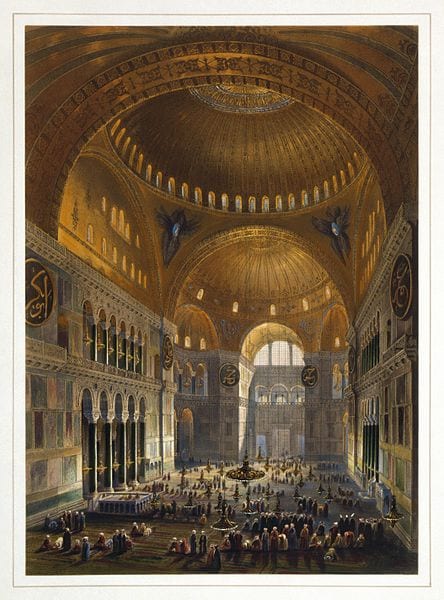
Hagia Sophia during its time as a mosque (1852) by Gaspare Fossati and Louis Haghe. Public Domain.
The Hagia Sophia is back in the news—this time because Turkey’s Supreme Court ruled that the church, turned mosque, turned museum, could once again be used as a mosque. This is—ostensibly anyway—a religion blog, or at least one mostly concerned with religion. The takes of the religious though, in my opinion, have missed the significance of this decision. The Russian Orthodox Church has expressed dismay. Many Christians I know see it as a victory for Islam over a beleaguered and disfavored Christianity. Turkish nationalists are, to put it mildly, pleased.
These are predictable and understandable reactions from all sides. But to lose the thread there, at the question of cultural or even aesthetic significance is to miss what’s really going on. The Turkey of today is not the Turkey of a century ago, nor is Erdogan a typical NATO ally. The Islam of modern Turkey is not the Islam that conquered Constantinople so many centuries back. To see only the cultural victory or loss is to miss what made such a thing possible; it is to surrender politics to the realm of the symbolic, missing the forest through the trees (as the saying goes).
Modern Turkey was born from the ashes of the once-ascendant Ottoman Empire. In fact, Constantinople was not renamed Istanbul until 1930; this was, contrary to popular belief, less about Islamifying the city than about Turkifying it. This new state was Wilsonian doctrine about national determination taken to its extreme. The country would officially be secular, banning, for example, head-coverings from places of public prominence. It, however, also exchanged basically its entire Christian population with Greece (taking in Greece’s Muslims as it sent away its Christians). The new Turkey would be secular in its government, yes, but it would also define a “Turk” as, in effect, a “Turkish-speaking Muslim.” Hence the need to call Kurds “Mountain Turks,” since their use of Kurdish set them apart from the broader population.
This may seem odd: why get rid of the Christians if you’re dedicated to secularism? We must remember, however, that sectarianism is never so simple as religion or ethnicity—it’s some combination of both, with questions of language and broader acculturation thrown in. Members of the IRA were not necessarily pious Catholics, nor were members of the UDA always committed Presbyterians. These identities are formed over generations, often having far more to do with how society sorts you, rather than how you would like to sort yourself. Thus the new Turkish nation could be officially—even at time viciously—secular, while ensuring that its population was Muslim (since here “Muslim” means “Turk” as much as anything else).
This brings us to Erdogan, Turkey’s current president. His headship has meant many things, but most of all it has meant the slow re-Islamification of the country, an attempt to strip away the official secularism of the its founding. “Muslim” should now mean “Muslim,” not something more ambiguous. He found a willing base in Turkey’ more rural population. As Gary Brecher has hinted, Turkey is the country with perhaps the most demographic similarity to the United States. Decades of dominance by the cosmopolitan coastal cities like Istanbul and Izmir (this might be analogous to the broad liberal consensus in America across the mid-twentieth century) had left the generally more religious, “red state” in-landers in search of a leader. They found one in Erdogan. The deal was really quite simple: he would make Turkey more economically and religious significant, build a sort of pan-Turkish coalition, and make the country, well, great again. They, in turn, would vote for him and end the cycle of military coups and coastal dominance that had obtained since the country’s founding. Some people call this ideology “Neo-Ottoman.” Maybe it is. Maybe it’s not. The most important thing is that, without understanding this deal, we cannot understand what is happening with the Hagia Sophia.
Previous Post

May 7, 2020
In the Ruins of Decaying Empire
Next Post
November 13, 2020 Political Christianity: Body or Soul?
Browse Our Archives
Select a Category Academia Culture Politics Reviews Theology Uncategorized
Select a Month October 2026 September 2026 August 2026 July 2026 June 2026 May 2026 April 2026 March 2026 February 2026 January 2026 December 2025 November 2025 October 2025 September 2025 August 2025 July 2025 June 2025 May 2025 April 2025 March 2025 February 2025 January 2025 December 2024 November 2024 October 2024 September 2024 August 2024 July 2024 June 2024 May 2024 April 2024 March 2024 February 2024 January 2024 December 2023 November 2023 October 2023 September 2023 August 2023 July 2023 June 2023 May 2023 April 2023 March 2023 February 2023 January 2023 November 2022 October 2022 September 2022 August 2022 July 2022 June 2022 May 2022 April 2022 March 2022 February 2022 July 2021 December 2020 November 2020 July 2020 May 2020 April 2020 February 2020 January 2020 December 2019 November 2019 October 2019 August 2019 July 2019 April 2019 March 2019 December 2018 August 2018 July 2018 June 2018 May 2018 April 2018 March 2018 January 2018 December 2017 November 2017 September 2017 August 2017 July 2017 June 2017 May 2017 April 2017 March 2017 February 2017 January 2017 December 2016 November 2016 October 2016 September 2016 August 2016 July 2016 June 2016 May 2016 April 2016 March 2016 February 2016
Follow Us!
TAKE THE
Religious Wisdom Quiz
According to 2 John, anyone who does not continue in the teaching of Christ does not have what?
Select your answer to see how you score.
Truth Salvation The Holy Spirit God
Related posts from Jappers and Janglers

Secrets & Lies in the Age of Truth...



Apostasy, Scandal, and a Road Well-Trod
TRENDING AT PATHEOS Religious Music and Entertainment

The Problem with False Prophets
Miller’s Station UMC| 10/18/26| Anchor Verse: Jeremiah 23: 1, 9-23 I...

Emotion in Early Christianity by Andrew Crislip
Andrew Crislip’s Emotion in Early Christianity examines an often overlooked dimension of...

16 Spiritual Touchstones for a More Grounded Life
After decades of spiritual study, here are 16 principles I try...

Catholic Evangelization: Sharing Your Faith Every Day
Welcome back to the Graceful Awakening mini-series called, “From Faith to Mission.” ...

The Pillar of the Boatmen: the Ancient Monument...
The Pillar of the Boatmen is a Romano-Gaulish sculpture that dates from...

In one sense walking into Westminster Abbey is like walking down the...
view all Religious Music and Entertainment blogs
Ad-Free & Subscriber Log-In Subscription Support
- About Us
- 2026 Calendar
- Videos
- Podcasts
- Library of World Religions
- Faith In Media Tracker
- Advertise With Us
- Write for Us
- Privacy Policy
- Terms of Service
- Do Not Sell My Data
- Contact Us
- Radiant Digital
- Manage Newsletter Subscriptions
- Unsubscribe From Notifications
- Sitemap
Copyright 2008-2026, Patheos. All rights reserved.
Subscription Support Ad-Free & Subscriber Log-In
Follow Patheos