
BuddhistCatholicContemplativeEvangelicalGeneral ChristianHinduJewishLatter-day SaintMuslimNew VisionsProgressive Christian
Beliefs
- Buddhist
- Catholic
- Contemplative
- Evangelical
- General Christian
- Hindu
- Jewish
- Latter-day Saint
- More Voices
- Muslim
- New Visions
- Pagan
- Progressive Christian
Topics
- Religion News
- Food and Religion
- Sports and Religion
- Religious Art
- Religious Music and Entertainment
- Religious Events
- History and Religion
- Style and Religion
- Politics and Religion
- Women in Religion
- Recreation Outdoors and Religion
- Business Finance and Religion
- Careers Workplace and Religion
- Education and Religion
- Family Parenting and Religion
- Health Fitness and Religion
- Home and Religion
- Relationships and Religion
- Technology and Religion
- Travel and Religion
Columnists
- Buddhist Columnists
- Business Finance and Religion Columnists
- Careers Workplace and Religion Columnists
- Catholic Columnists
- Contemplative Columnists
- Education and Religion Columnists
- Evangelists Columnists
- Family Parenting and Religion Columnists
- General Christian Columnists
- Health Fitness and Religion Columnists
- Hindu Columnists
- History and Religion Columnists
- Home and Religion Columnists
- Jewish Columnists
- More Voices Columnists
- Latter Day Columnists
- Muslim Columnists
- New Visions Columnists
- Nonreligious Columnists
- Pagan Columnists
- Politics and Religion Columnists
- Progressive Columnists
- Recreation Outdoors and Religion Columnists
- Relationships and Religion Columnists
- Religion News Columnists
- Religious Art Columnists
- Religious Events Columnists
- Religious Music and Entertainment Columnists
- Sports and Religion Columnists
- Style and Religion Columnists
- Technology and Religion Columnists
- Travel and Religion Columnists
- Women in Religion Columnists
Resource Library
- 2026 Calendar
- Library of World Religions
- The 100 Most Holy Places on Earth
- Patheos Answers
- Podcasts
- Videos
- Faith Leaders Database
- Anglican Episcopalian
- Bahai
- Baptist
- Buddhism
- Christianity
- Confucianism
- Eastern Orthodoxy
- Hinduism
- Holiness and Pentecostal
- ISKCON
- Islam
- Judaism
- Lutheran
- Methodist
- The Church of Jesus Christ of Latter-day Saints
- New Age
- Paganism
- Presbytarian and Reformed
- Protestantism
- Religion Behind the Scenes
- Roman Catholic
- Scientology
- Shia Islam
- Sikhism
- Sufism
- Sunni Islam
- Taoism
- Zen
- See all religions
Research Tools
 Ad-Free & Subscriber Log-In Subscription Support
Ad-Free & Subscriber Log-In Subscription Support
Follow Patheos 

- Trending:
- Forgiveness
- |
- Marriage
- |
- Consciousness
- |
- Death Penalty
- |
- Election
- |
- Halloween

- Home
- Religious Music and Entertainment
- Nietzsche and Me
Nietzsche and Me
Last updated on: February 14, 2020 at 5:16 pm by Chase Padusniak
Nietzsche and Me 2020-02-14T17:16:19-04:00 Chase Padusniak
Patheos Explore the world's faith through different perspectives on religion and spirituality! Patheos has the views of the prevalent religions and spiritualities of the world.
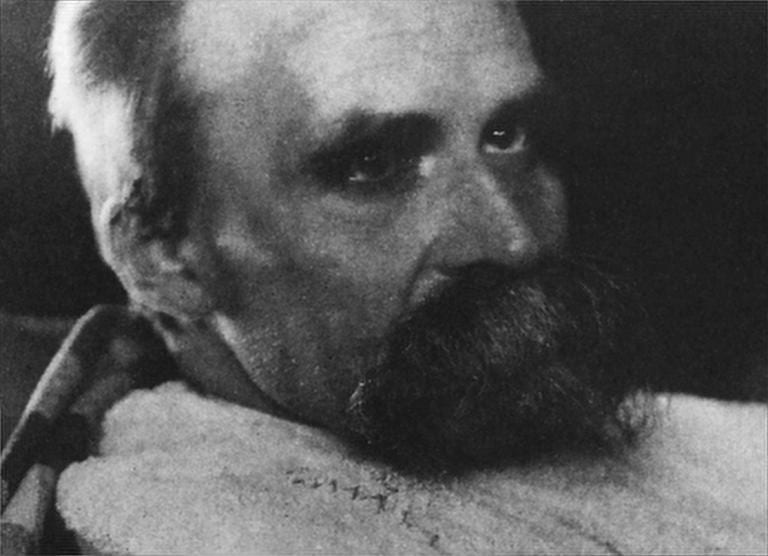
A cropped photograph from Hans Olde’s series “Der kranke Nietzsche” (“The Ill Nietzsche”) (1899). Public Domain.
A student followed me out of class the other day; he couldn’t believe that I, a Christian, could find Nietzsche edifying, let alone that I kept a painting of him catty-corner from my icons. Around the same time, a Twitter friend asked me much the same question: why look to Nietzsche for faith?
My answer is necessarily a personal one—that’s all it can be. What has Friedrich Nietzsche to do with Jesus Christ? The pairing seems impossible, and yet, for me, it has been fundamental—dare I say, essential.
Ironically enough, the best place to start might be The Antichrist:
Nihilist and Christ: They rhyme; they do not merely rhyme.
This is shocking. Is the Christian not the opposite of a nihilist? Does he or she not believe in something, perhaps the grandest something to ever give meaning to life: a god-man, a sacrificial victim who saw greater purpose in death and resurrection, in suffering and abjection, than in comfort and aimless hedonism? How much odder, then, to say that Jesus Himself was a nihilist. Not just the fruit but the root itself signifies a denial of meaning, of the possibility of significance.
Nietzsche knew this would be shocking; that’s one of his primary ways to, as the crunchy Leftists of the 90s might have put it “wake people up.” He believed this to be true, because he believed Christianity to be too pie in the sky. We need only look at the lines immediately preceding the ones cited above:
This was his [Paul’s] revelation at Damascus: he grasped the fact that he needed the belief in immortality in order to rob “the world” of its value, that the concept of “hell” would master Rome—that the notion of a “beyond” is the death of life. (The Antichrist)
Christianity asks us to live up to “ideals,” to abstract principles greater than ourselves, beyond ourselves, things we must necessarily fall short of. He’s not wrong: we imply this with our treasured word “grace.” For Nietzsche, this makes the Christian a hypocrite, one who denies life its vitality by imagining that the truth of life lies outside its finite bounds. Christianity glorifies self-effacement, poverty, and sacrifice—notions that gut life of its—for him—intrinsic verve. Christ is thus the most nihilistic of all. He voluntarily hands Himself over to die in the name of life-giving death. In doing so, He become the paradigm for Christian belief and practice. Essentially, Jesus stands as the hypocrite who teaches all others to fall short, to hope in the unseen, to destroy life in the name of a supposed life-beyond-life.
Nietzsche’s alternative is the embrace of life itself, the doing-away-with of all such idealistic pretensions, the, as he puts it, “revaluation of all values.” Rather than assuming some inherent morality to the universe, one that we must discern and, by grace, try to live up to, he prefers that we embrace life itself in a constant process of overcoming, always destroying what we have been only a moment earlier to become something greater, something stronger. If Christianity leads to hypocrisy, this, at least, leads to a kind of sincerity, a full embrace of the vicissitudes of lived experience, refusing to cave in, to do anything but live.
There is an honesty here. If one’s true fulfillment comes in—to choose an extreme example—murdering children, then so be it. There can be no intrinsic prohibition on such a thing. We other people might argue that such a drive is unhealthy, that it couldn’t possibly be based in anything but resentment, but we can’t in principle rule it out. Each person is different; each person’s process of self-overcoming will thus be different. Embracing life qua life means constant self-destruction, which is a kind of giving birth. All things are permitted, at least in theory. Hence, Nietzsche writes:
I am, for instance, in no wise a bogey man, or moral monster. On the contrary, I am the very opposite in nature to the kind of man that has been honoured hitherto as virtuous. Between ourselves, it seems to me that this is precisely a matter on which I may feel proud. I am a disciple of the philosopher Dionysus, and I would prefer to be even a satyr than a saint. (Ecce Homo)
Previous Post

February 7, 2020
Abusing Religious Liberty
Next Post

April 7, 2020 The Religious Left and the Atheistic Right
Browse Our Archives
Select a Category Academia Culture Politics Reviews Theology Uncategorized
Select a Month October 2026 September 2026 August 2026 July 2026 June 2026 May 2026 April 2026 March 2026 February 2026 January 2026 December 2025 November 2025 October 2025 September 2025 August 2025 July 2025 June 2025 May 2025 April 2025 March 2025 February 2025 January 2025 December 2024 November 2024 October 2024 September 2024 August 2024 July 2024 June 2024 May 2024 April 2024 March 2024 February 2024 January 2024 December 2023 November 2023 October 2023 September 2023 August 2023 July 2023 June 2023 May 2023 April 2023 March 2023 February 2023 January 2023 November 2022 October 2022 September 2022 August 2022 July 2022 June 2022 May 2022 April 2022 March 2022 February 2022 July 2021 December 2020 November 2020 July 2020 May 2020 April 2020 February 2020 January 2020 December 2019 November 2019 October 2019 August 2019 July 2019 April 2019 March 2019 December 2018 August 2018 July 2018 June 2018 May 2018 April 2018 March 2018 January 2018 December 2017 November 2017 September 2017 August 2017 July 2017 June 2017 May 2017 April 2017 March 2017 February 2017 January 2017 December 2016 November 2016 October 2016 September 2016 August 2016 July 2016 June 2016 May 2016 April 2016 March 2016 February 2016
Follow Us!
TAKE THE
Religious Wisdom Quiz
What city’s walls fell after the Israelites marched around them?
Select your answer to see how you score.
Babylon Jericho Nineveh Jerusalem
Related posts from Jappers and Janglers

American Movie: The Beauty of the Chuds

The Good Samaritan: Who Is My Neighbor?

Shimmering Opacity in a Country Church

TRENDING AT PATHEOS Religious Music and Entertainment

When Halloween Unmasks Married Hearts
Written by Dr. David K. Ewen from Eternal Truth Bible College Behind...

Aristotle. He’s been called the father of logic, the father of the...

Methodist Central Hall and Westminster Abbey
Situated on the same square is Methodist Central Hall and Westminster Abbey. ...

57th Dove Awards Honor Dolly Parton, Crown New...
On gospel music’s biggest night, the 57th annual GMA Dove Awards honored...

The First Eucharistic Controversy: Christ’s Real Presence
For Catholics, the Eucharist is the source and summit of the Christian...

What a Stop Sign Can Teach Us About...
How to Make a Decision When You Can't Hear God Main point:...
view all Religious Music and Entertainment blogs
Ad-Free & Subscriber Log-In Subscription Support
- About Us
- 2026 Calendar
- Videos
- Podcasts
- Library of World Religions
- Faith In Media Tracker
- Advertise With Us
- Write for Us
- Privacy Policy
- Terms of Service
- Do Not Sell My Data
- Contact Us
- Radiant Digital
- Manage Newsletter Subscriptions
- Unsubscribe From Notifications
- Sitemap
Copyright 2008-2026, Patheos. All rights reserved.
Subscription Support Ad-Free & Subscriber Log-In
Follow Patheos