
BuddhistCatholicContemplativeEvangelicalGeneral ChristianHinduJewishLatter-day SaintMuslimNew VisionsProgressive Christian
Beliefs
- Buddhist
- Catholic
- Contemplative
- Evangelical
- General Christian
- Hindu
- Jewish
- Latter-day Saint
- More Voices
- Muslim
- New Visions
- Pagan
- Progressive Christian
Topics
- Religion News
- Food and Religion
- Sports and Religion
- Religious Art
- Religious Music and Entertainment
- Religious Events
- History and Religion
- Style and Religion
- Politics and Religion
- Women in Religion
- Recreation Outdoors and Religion
- Business Finance and Religion
- Careers Workplace and Religion
- Education and Religion
- Family Parenting and Religion
- Health Fitness and Religion
- Home and Religion
- Relationships and Religion
- Technology and Religion
- Travel and Religion
Columnists
- Buddhist Columnists
- Business Finance and Religion Columnists
- Careers Workplace and Religion Columnists
- Catholic Columnists
- Contemplative Columnists
- Education and Religion Columnists
- Evangelists Columnists
- Family Parenting and Religion Columnists
- General Christian Columnists
- Health Fitness and Religion Columnists
- Hindu Columnists
- History and Religion Columnists
- Home and Religion Columnists
- Jewish Columnists
- More Voices Columnists
- Latter Day Columnists
- Muslim Columnists
- New Visions Columnists
- Nonreligious Columnists
- Pagan Columnists
- Politics and Religion Columnists
- Progressive Columnists
- Recreation Outdoors and Religion Columnists
- Relationships and Religion Columnists
- Religion News Columnists
- Religious Art Columnists
- Religious Events Columnists
- Religious Music and Entertainment Columnists
- Sports and Religion Columnists
- Style and Religion Columnists
- Technology and Religion Columnists
- Travel and Religion Columnists
- Women in Religion Columnists
Resource Library
- 2026 Calendar
- Library of World Religions
- The 100 Most Holy Places on Earth
- Patheos Answers
- Podcasts
- Videos
- Faith Leaders Database
- Anglican Episcopalian
- Bahai
- Baptist
- Buddhism
- Christianity
- Confucianism
- Eastern Orthodoxy
- Hinduism
- Holiness and Pentecostal
- ISKCON
- Islam
- Judaism
- Lutheran
- Methodist
- The Church of Jesus Christ of Latter-day Saints
- New Age
- Paganism
- Presbytarian and Reformed
- Protestantism
- Religion Behind the Scenes
- Roman Catholic
- Scientology
- Shia Islam
- Sikhism
- Sufism
- Sunni Islam
- Taoism
- Zen
- See all religions
Research Tools
 Ad-Free & Subscriber Log-In Subscription Support
Ad-Free & Subscriber Log-In Subscription Support
Follow Patheos 

- Trending:
- Forgiveness
- |
- Marriage
- |
- Consciousness
- |
- Death Penalty
- |
- Election
- |
- Halloween

- Home
- Religious Music and Entertainment
- Abusing Religious Liberty
Abusing Religious Liberty
Last updated on: February 9, 2020 at 1:27 pm by Chase Padusniak
Abusing Religious Liberty 2020-02-09T13:27:49-04:00 Chase Padusniak
Patheos Explore the world's faith through different perspectives on religion and spirituality! Patheos has the views of the prevalent religions and spiritualities of the world.
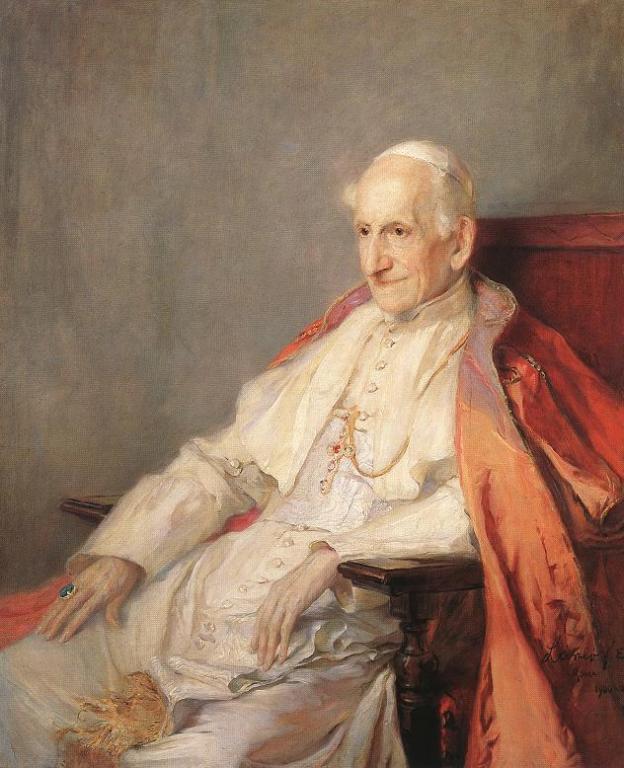
Portrait of Pope Leo XIII (1900) by Philip de Lászlo. Public Domain.
But what makes this anti-Catholic? The decision allows universities to defraud workers of their wages. This is one of the sins that cry out to heaven for vengeance. It is bad, very bad in fact. This, however, sounds abstract. How do we know it involves being defrauded of wages? The fact is that the Church has long supported labor unions as a necessary means of balancing the employer-employee relationship. Pope Francis has spoken about it. The USCCB has spoken about it. There is a history to this effect in the United States. But, most tellingly, Pope Leo XIII spoke out in favor of unions when they were just beginning:
Let the working man and the employer make free agreements, and in particular let them agree freely as to the wages; nevertheless, there underlies a dictate of natural justice more imperious and ancient than any bargain between man and man, namely, that wages ought not to be insufficient to support a frugal and well-behaved wage-earner. If through necessity or fear of a worse evil the workman accept harder conditions because an employer or contractor will afford him no better, he is made the victim of force and injustice. In these and similar questions, however – such as, for example, the hours of labor in different trades, the sanitary precautions to be observed in factories and workshops, etc. – in order to supersede undue interference on the part of the State, especially as circumstances, times, and localities differ so widely, it is advisable that recourse be had to societies or boards such as We shall mention presently, or to some other mode of safeguarding the interests of the wage-earners; the State being appealed to, should circumstances require, for its sanction and protection.
If a workman’s wages be sufficient to enable him comfortably to support himself, his wife, and his children, he will find it easy, if he be a sensible man, to practice thrift, and he will not fail, by cutting down expenses, to put by some little savings and thus secure a modest source of income. Nature itself would urge him to this. We have seen that this great labor question cannot be solved save by assuming as a principle that private ownership must be held sacred and inviolable. The law, therefore, should favor ownership, and its policy should be to induce as many as possible of the people to become owners.
Many excellent results will follow from this; and, first of all, property will certainly become more equitably divided. For, the result of civil change and revolution has been to divide cities into two classes separated by a wide chasm. On the one side there is the party which holds power because it holds wealth; which has in its grasp the whole of labor and trade; which manipulates for its own benefit and its own purposes all the sources of supply, and which is not without influence even in the administration of the commonwealth. On the other side there is the needy and powerless multitude, sick and sore in spirit and ever ready for disturbance. If working people can be encouraged to look forward to obtaining a share in the land, the consequence will be that the gulf between vast wealth and sheer poverty will be bridged over, and the respective classes will be brought nearer to one another. A further consequence will result in the great abundance of the fruits of the earth. Men always work harder and more readily when they work on that which belongs to them; nay, they learn to love the very soil that yields in response to the labor of their hands, not only food to eat, but an abundance of good things for themselves and those that are dear to them. That such a spirit of willing labor would add to the produce of the earth and to the wealth of the community is self evident. And a third advantage would spring from this: men would cling to the country in which they were born, for no one would exchange his country for a foreign land if his own afforded him the means of living a decent and happy life. These three important benefits, however, can be reckoned on only provided that a man’s means be not drained and exhausted by excessive taxation. The right to possess private property is derived from nature, not from man; and the State has the right to control its use in the interests of the public good alone, but by no means to absorb it altogether. The State would therefore be unjust and cruel if under the name of taxation it were to deprive the private owner of more than is fair.
In the last place, employers and workmen may of themselves effect much, in the matter We are treating, by means of such associations and organizations as afford opportune aid to those who are in distress, and which draw the two classes more closely together. Among these may be enumerated societies for mutual help; various benevolent foundations established by private persons to provide for the workman, and for his widow or his orphans, in case of sudden calamity, in sickness, and in the event of death; and institutions for the welfare of boys and girls, young people, and those more advanced in years.
The most important of all are workingmen’s unions, for these virtually include all the rest. History attests what excellent results were brought about by the artificers’ guilds of olden times. They were the means of affording not only many advantages to the workmen, but in no small degree of promoting the advancement of art, as numerous monuments remain to bear witness. Such unions should be suited to the requirements of this our age – an age of wider education, of different habits, and of far more numerous requirements in daily life. It is gratifying to know that there are actually in existence not a few associations of this nature, consisting either of workmen alone, or of workmen and employers together, but it were greatly to be desired that they should become more numerous and more efficient. We have spoken of them more than once, yet it will be well to explain here how notably they are needed, to show that they exist of their own right, and what should be their organization and their mode of action. (Rerum Novarum)
I am sorry to quote at such length, but sometimes quantity makes the point: the Catholic Church has invariably been on the side of the existence of unions, especially in contexts where workers are likely to be abused, degraded, and denied their dignity by a lack of reasonable compensation for the work they do. This is such a context. Adjuncts and graduate students are massively overworked and underpaid.
These measures are meant to be cost savers for universities, whose tuition demands and general costs have skyrocketed over the last several decades. Why should teachers suffer for this? Why should those who do so much work miss out? Why not cut administrative bloat? Why not stop investing so much money in new building projects and various amenities? People will have many answers, but they come down to this: without unions, it’s easy to take advantage of teachers. Students demand more services of various sorts; people need to be hired to do those services. Deans and the lot of administrators need to be paid well. And so, workers miss out.
If enriching those who work less at the cost of those who bear the brunt of a given workplace’s burden is not “defrauding a worker of their wages,” then I am not sure what could be.
These schools say this will allow them to protect and foster their Catholic identity. Never mind that many of these universities are precisely those so often singled out for not giving a lick about the treasures of the Catholic tradition; never mind that many of them have cut theology and philosophy and music in recent years to prop up growing business programs. How can you use Catholic identity to commit a sin? How can you call it “religious liberty” when it gives you the freedom to disagree with your own Church?
Previous Post

February 3, 2020
Living Saints: Leszek
Next Post

February 14, 2020 Nietzsche and Me
Browse Our Archives
Select a Category Academia Culture Politics Reviews Theology Uncategorized
Select a Month October 2026 September 2026 August 2026 July 2026 June 2026 May 2026 April 2026 March 2026 February 2026 January 2026 December 2025 November 2025 October 2025 September 2025 August 2025 July 2025 June 2025 May 2025 April 2025 March 2025 February 2025 January 2025 December 2024 November 2024 October 2024 September 2024 August 2024 July 2024 June 2024 May 2024 April 2024 March 2024 February 2024 January 2024 December 2023 November 2023 October 2023 September 2023 August 2023 July 2023 June 2023 May 2023 April 2023 March 2023 February 2023 January 2023 November 2022 October 2022 September 2022 August 2022 July 2022 June 2022 May 2022 April 2022 March 2022 February 2022 July 2021 December 2020 November 2020 July 2020 May 2020 April 2020 February 2020 January 2020 December 2019 November 2019 October 2019 August 2019 July 2019 April 2019 March 2019 December 2018 August 2018 July 2018 June 2018 May 2018 April 2018 March 2018 January 2018 December 2017 November 2017 September 2017 August 2017 July 2017 June 2017 May 2017 April 2017 March 2017 February 2017 January 2017 December 2016 November 2016 October 2016 September 2016 August 2016 July 2016 June 2016 May 2016 April 2016 March 2016 February 2016
Follow Us!
TAKE THE
Religious Wisdom Quiz
How did Jesus die?
Select your answer to see how you score.
Hanging Spearing Stoning Crucifixion
Related posts from Jappers and Janglers



500 Days of Paralyzing Anxiety

The Greatest Christmas Story Ever Told
TRENDING AT PATHEOS Religious Music and Entertainment

In one sense walking into Westminster Abbey is like walking down the...

'Super Scam Me' Exposes AI Jon Bon Jovi...
Leslie Pickett believed she was in a relationship with Jon Bon Jovi....

The Brazilian Remake of Kendricks' 'Flywheel' Opens in...
“Flywheel,” the story that launched the Kendrick Brothers’ filmmaking career is getting...

The Dangers of Gradual Accommodation (Winking at Sin)
Recently, the “law of gradualness” resurfaced during the opening of a weeklong,...

The Iron Gates and the Lion of the...
Yesterday, I didn't finish my report about, well, yesterday. So I'll...

The Image: On the Horror of Capitalism and...
The Image Then went the Pharisees, and took counsel how they might...
view all Religious Music and Entertainment blogs
Ad-Free & Subscriber Log-In Subscription Support
- About Us
- 2026 Calendar
- Videos
- Podcasts
- Library of World Religions
- Faith In Media Tracker
- Advertise With Us
- Write for Us
- Privacy Policy
- Terms of Service
- Do Not Sell My Data
- Contact Us
- Radiant Digital
- Manage Newsletter Subscriptions
- Unsubscribe From Notifications
- Sitemap
Copyright 2008-2026, Patheos. All rights reserved.
Subscription Support Ad-Free & Subscriber Log-In
Follow Patheos