
BuddhistCatholicContemplativeEvangelicalGeneral ChristianHinduJewishLatter-day SaintMuslimNew VisionsProgressive Christian
Beliefs
- Buddhist
- Catholic
- Contemplative
- Evangelical
- General Christian
- Hindu
- Jewish
- Latter-day Saint
- More Voices
- Muslim
- New Visions
- Pagan
- Progressive Christian
Topics
- Religion News
- Food and Religion
- Sports and Religion
- Religious Art
- Religious Music and Entertainment
- Religious Events
- History and Religion
- Style and Religion
- Politics and Religion
- Women in Religion
- Recreation Outdoors and Religion
- Business Finance and Religion
- Careers Workplace and Religion
- Education and Religion
- Family Parenting and Religion
- Health Fitness and Religion
- Home and Religion
- Relationships and Religion
- Technology and Religion
- Travel and Religion
Columnists
- Buddhist Columnists
- Business Finance and Religion Columnists
- Careers Workplace and Religion Columnists
- Catholic Columnists
- Contemplative Columnists
- Education and Religion Columnists
- Evangelists Columnists
- Family Parenting and Religion Columnists
- General Christian Columnists
- Health Fitness and Religion Columnists
- Hindu Columnists
- History and Religion Columnists
- Home and Religion Columnists
- Jewish Columnists
- More Voices Columnists
- Latter Day Columnists
- Muslim Columnists
- New Visions Columnists
- Nonreligious Columnists
- Pagan Columnists
- Politics and Religion Columnists
- Progressive Columnists
- Recreation Outdoors and Religion Columnists
- Relationships and Religion Columnists
- Religion News Columnists
- Religious Art Columnists
- Religious Events Columnists
- Religious Music and Entertainment Columnists
- Sports and Religion Columnists
- Style and Religion Columnists
- Technology and Religion Columnists
- Travel and Religion Columnists
- Women in Religion Columnists
Resource Library
- 2026 Calendar
- Library of World Religions
- The 100 Most Holy Places on Earth
- Patheos Answers
- Podcasts
- Videos
- Faith Leaders Database
- Anglican Episcopalian
- Bahai
- Baptist
- Buddhism
- Christianity
- Confucianism
- Eastern Orthodoxy
- Hinduism
- Holiness and Pentecostal
- ISKCON
- Islam
- Judaism
- Lutheran
- Methodist
- The Church of Jesus Christ of Latter-day Saints
- New Age
- Paganism
- Presbytarian and Reformed
- Protestantism
- Religion Behind the Scenes
- Roman Catholic
- Scientology
- Shia Islam
- Sikhism
- Sufism
- Sunni Islam
- Taoism
- Zen
- See all religions
Research Tools
 Ad-Free & Subscriber Log-In Subscription Support
Ad-Free & Subscriber Log-In Subscription Support
Follow Patheos 

- Trending:
- Forgiveness
- |
- Marriage
- |
- Consciousness
- |
- Death Penalty
- |
- Election
- |
- Halloween

- Home
- Religious Music and Entertainment
- Abusing Religious Liberty
Abusing Religious Liberty
Last updated on: February 9, 2020 at 1:27 pm by Chase Padusniak
Abusing Religious Liberty 2020-02-09T13:27:49-04:00 Chase Padusniak
Patheos Explore the world's faith through different perspectives on religion and spirituality! Patheos has the views of the prevalent religions and spiritualities of the world.
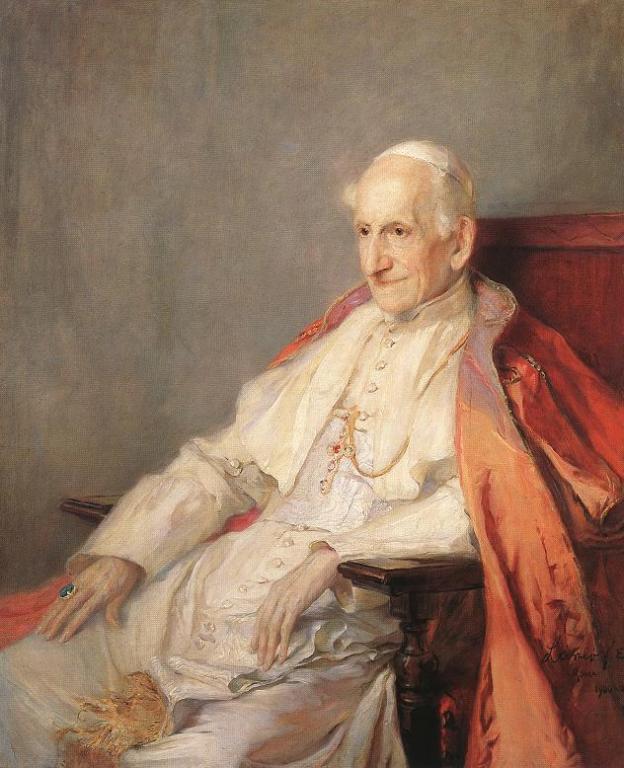
Portrait of Pope Leo XIII (1900) by Philip de Lászlo. Public Domain.
America Magazine is reporting a victory for religious liberty. In essence, an appeals court ruled that religious universities must be left alone; coercion by the state is not allowed, since schools do not receive various federal grants. This is supposed to be a “live and let live” situation, giving religious colleges an opportunity to govern themselves in ways consistent with their traditions:
The corollary to this arrangement (no public support) is that the government will leave private institutions alone in matters touching on faith (no regulation). The separation of church and state is above all a rule for keeping the state out of the church’s business. The government should be especially careful about meddling in relations between religious schools and their teachers. The Supreme Court has held that the federal Equal Employment Opportunity Commission cannot invoke employment discrimination laws to protect teachers in religious schools from being fired. And in 1979 it ruled that the N.L.R.B. cannot order collective bargaining in Catholic high schools.
The lower federal courts have applied this principle to collective bargaining in higher education as well. They have worried, rightly, that letting the N.L.R.B. supervise contract negotiations between universities and their faculties will entangle the government in the study, teaching and practice of religion. Justice Breyer put it bluntly when he sat on the First Circuit: “Congress did not contemplate that the Board would require church-operated schools to grant recognition to unions as bargaining agents for their teachers.” (America Magazine)
In practice, this has mostly involved what’s mentioned at the end there: labor relations. The piece goes on to highlight this fact:
For 40 years the Labor Board has paid little heed to these directions. In recent years it has been particularly insistent on charting its own course. For example, in 2014 it ordered a union election at Pacific Lutheran University for faculty not on the tenure track. In 2017, it claimed jurisdiction over adjunct faculty at Duquesne University. Unless they taught in the Theology Department, the N.L.R.B. held, they did not perform a sufficiently important role in maintaining Duquesne’s religious educational environment.
The N.L.R.B. (i.e., the government) imagines that it can carve the universe of higher education neatly into secular and religious parts. If it had its way, it would claim authority to oversee course loads, the manner of teaching, the teachers’ obligation to counsel students, and other terms and conditions of employment for all faculty, excepting only those specifically charged with “propagating religious tenets, or engaging in religious indoctrination or religious training.” (America Magazine)
This, the author says, is nonsensical. How can you teach literature at a Catholic school without bringing in theology? What about history? And psychology? On this point, the piece is not wrong. A Catholic university worth its salt embraces the tradition in educating its students; religion should imbue all parts of such a college’s curriculum. It makes no sense to limit faith merely to religious studies or theology. The court, in the author at America’s view, recognized this and left Catholic schools to their own devices.
Except that it didn’t. Ironically, the court’s decision has made it possible—even economically advantageous—for Catholic universities to sin. The articles goes on about unionization efforts because that is, in practice, what is most likely to be affected by the ruling. In late 2018, graduate students and non-tenure track faculty at Marquette fought to unionize. Early this year such a union was struck down at Duquesne. In 2017, St. Louis University accepted an adjunct labor body at the bargaining table. I myself have participated in efforts to unionize with my fellow graduate students at Princeton; I have supported friends trying to do the same at Columbia.
Previous Post
February 3, 2020
Living Saints: Leszek
Next Post

February 14, 2020 Nietzsche and Me
Browse Our Archives
Select a Category Academia Culture Politics Reviews Theology Uncategorized
Select a Month October 2026 September 2026 August 2026 July 2026 June 2026 May 2026 April 2026 March 2026 February 2026 January 2026 December 2025 November 2025 October 2025 September 2025 August 2025 July 2025 June 2025 May 2025 April 2025 March 2025 February 2025 January 2025 December 2024 November 2024 October 2024 September 2024 August 2024 July 2024 June 2024 May 2024 April 2024 March 2024 February 2024 January 2024 December 2023 November 2023 October 2023 September 2023 August 2023 July 2023 June 2023 May 2023 April 2023 March 2023 February 2023 January 2023 November 2022 October 2022 September 2022 August 2022 July 2022 June 2022 May 2022 April 2022 March 2022 February 2022 July 2021 December 2020 November 2020 July 2020 May 2020 April 2020 February 2020 January 2020 December 2019 November 2019 October 2019 August 2019 July 2019 April 2019 March 2019 December 2018 August 2018 July 2018 June 2018 May 2018 April 2018 March 2018 January 2018 December 2017 November 2017 September 2017 August 2017 July 2017 June 2017 May 2017 April 2017 March 2017 February 2017 January 2017 December 2016 November 2016 October 2016 September 2016 August 2016 July 2016 June 2016 May 2016 April 2016 March 2016 February 2016
Follow Us!
TAKE THE
Religious Wisdom Quiz
True or False: Matthew records that magi from the east brought three gifts to Jesus.
Select your answer to see how you score.
FALSE TRUE
Related posts from Jappers and Janglers


500 Days of Paralyzing Anxiety

The Greatest Christmas Story Ever Told
TRENDING AT PATHEOS Religious Music and Entertainment

57th Dove Awards Honor Dolly Parton, Crown New...
On gospel music’s biggest night, the 57th annual GMA Dove Awards honored...

The First Eucharistic Controversy: Christ’s Real Presence
For Catholics, the Eucharist is the source and summit of the Christian...

What a Stop Sign Can Teach Us About...
How to Make a Decision When You Can't Hear God Main point:...

Archdiocese Hosts Military Marriage Retreat in Germany
RASTATT, Germany — The transient military lifestyle, with its frequent deployments and...

Nearly every morning, I make the drive to Detroit with my high-school-age...

The Real AI Story Is Adoption Without Trust
Artificial intelligence has crossed a political threshold. It is no longer a...
view all Religious Music and Entertainment blogs
Ad-Free & Subscriber Log-In Subscription Support
- About Us
- 2026 Calendar
- Videos
- Podcasts
- Library of World Religions
- Faith In Media Tracker
- Advertise With Us
- Write for Us
- Privacy Policy
- Terms of Service
- Do Not Sell My Data
- Contact Us
- Radiant Digital
- Manage Newsletter Subscriptions
- Unsubscribe From Notifications
- Sitemap
Copyright 2008-2026, Patheos. All rights reserved.
Subscription Support Ad-Free & Subscriber Log-In
Follow Patheos