
BuddhistCatholicContemplativeEvangelicalGeneral ChristianHinduJewishLatter-day SaintMuslimNew VisionsProgressive Christian
Beliefs
- Buddhist
- Catholic
- Contemplative
- Evangelical
- General Christian
- Hindu
- Jewish
- Latter-day Saint
- More Voices
- Muslim
- New Visions
- Pagan
- Progressive Christian
Topics
- Religion News
- Food and Religion
- Sports and Religion
- Religious Art
- Religious Music and Entertainment
- Religious Events
- History and Religion
- Style and Religion
- Politics and Religion
- Women in Religion
- Recreation Outdoors and Religion
- Business Finance and Religion
- Careers Workplace and Religion
- Education and Religion
- Family Parenting and Religion
- Health Fitness and Religion
- Home and Religion
- Relationships and Religion
- Technology and Religion
- Travel and Religion
Columnists
- Buddhist Columnists
- Business Finance and Religion Columnists
- Careers Workplace and Religion Columnists
- Catholic Columnists
- Contemplative Columnists
- Education and Religion Columnists
- Evangelists Columnists
- Family Parenting and Religion Columnists
- General Christian Columnists
- Health Fitness and Religion Columnists
- Hindu Columnists
- History and Religion Columnists
- Home and Religion Columnists
- Jewish Columnists
- More Voices Columnists
- Latter Day Columnists
- Muslim Columnists
- New Visions Columnists
- Nonreligious Columnists
- Pagan Columnists
- Politics and Religion Columnists
- Progressive Columnists
- Recreation Outdoors and Religion Columnists
- Relationships and Religion Columnists
- Religion News Columnists
- Religious Art Columnists
- Religious Events Columnists
- Religious Music and Entertainment Columnists
- Sports and Religion Columnists
- Style and Religion Columnists
- Technology and Religion Columnists
- Travel and Religion Columnists
- Women in Religion Columnists
Resource Library
- 2026 Calendar
- Library of World Religions
- The 100 Most Holy Places on Earth
- Patheos Answers
- Podcasts
- Videos
- Faith Leaders Database
- Anglican Episcopalian
- Bahai
- Baptist
- Buddhism
- Christianity
- Confucianism
- Eastern Orthodoxy
- Hinduism
- Holiness and Pentecostal
- ISKCON
- Islam
- Judaism
- Lutheran
- Methodist
- The Church of Jesus Christ of Latter-day Saints
- New Age
- Paganism
- Presbytarian and Reformed
- Protestantism
- Religion Behind the Scenes
- Roman Catholic
- Scientology
- Shia Islam
- Sikhism
- Sufism
- Sunni Islam
- Taoism
- Zen
- See all religions
Research Tools
 Ad-Free & Subscriber Log-In Subscription Support
Ad-Free & Subscriber Log-In Subscription Support
Follow Patheos 

- Trending:
- Forgiveness
- |
- Marriage
- |
- Consciousness
- |
- Death Penalty
- |
- Election
- |
- Halloween

- Home
- Religious Music and Entertainment
- Notre Dame de Paris is Burning
Notre Dame de Paris is Burning
Last updated on: April 15, 2019 at 3:46 pm by Chase Padusniak
Notre Dame de Paris is Burning 2019-04-15T15:46:15-04:00 Chase Padusniak
Patheos Explore the world's faith through different perspectives on religion and spirituality! Patheos has the views of the prevalent religions and spiritualities of the world.
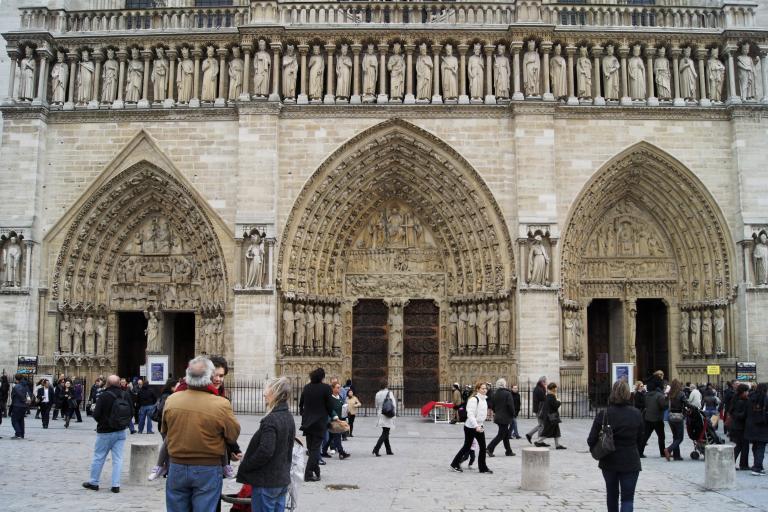
The Eastern facade of Notre Dame. Wikipedia.

Notre Dame is perhaps the most famous cathedral in the work. And now, it’s on fire. It remains to be seen how much of the structure will remain. A 19th-century spite has fallen and, at least from photographs, the flames seem bright and undeterred. Many relics and priceless artifacts are exposed to destruction. The cause also remains unclear. The whole thing seems shrouded in smoke; what the fire illuminates remains no more available for comprehension. We watch and it burns—paralyzed, unsure what to do, knowing only that we fear and do not know.
This was my reaction anyway. My entire Facebook and Twitter feeds are unending lament. If not lament, they are continuing and hellish confusion. No one seems to have any idea what to say, except to express sorrow. Prayers are requested; prayers are offered. But, as Pope Francis has said, “there is no room for individualism in the dialogue with God” (Crux). We, as a community, are equally confused, and thus seem somehow individuals in isolation, united in some paralyzed, nebulous hope. And sometimes, pure lamentation is all we can offer; there is nothing wrong in this. We do have a book in the Bible called Lamentations after all, devoted to the cry of the Israelites after the fall of Jerusalem:
Jerusalem remembers
in days of wretched homelessness,
All the precious things she once had
in days gone by.
But when her people fell into the hands of the foe,
and she had no help,
Her foes looked on and laughed
at her collapse.
Jerusalem has sinned grievously,
therefore she has become a mockery;
Those who honored her now demean her,
for they saw her nakedness;
She herself groans out loud,
and turns away.
Her uncleanness is on her skirt;
she has no thought of her future.
Her downfall is astonishing,
with no one to comfort her.
“Look, O LORD, at my misery;
how the enemy triumphs!”
(Lamentations 1:7-9)
Although such passionate, righteous wailing is wholly acceptable, I would like to offer a bit about the past of the cathedral in the hope that we might remember it and where it comes from. In doing so, I hope to suggest that, horrible as this is, it is a remarkable symbol of the excessive nature of our sins, our transgressions against the faith and the created world.
Started in 1163, the Cathedral was finished in 1345. Oddly, this means that, rather than being some hallmark of medieval France, it was actually finished fairly late in medieval history, representing something of its architectural apex, the crowning achievement of its Capetian kings and ecclesiastical establishment. It has what is thought to be the largest rose window designed and crafted during the 13th century. Notre Dame remains the seat of the bishop of Paris and has, over the years, accumulated a great number of artifacts and relics, including what is said to be a part of the Crown of Thorns and a piece of the True Cross. St. Joan of Arc was beatified there in 1909. The ceremony, while a reflection of French politics, is also a wonderful testament to the victory of the saint over here secular enemies. Notre Dame is, in a sense, the religious heart of France. St. Joan is among its most famous medieval saints. Could there be a more fitting place for her to be glorified?
This brief story speaks to the significance of the place. It honors the Theotokos, the Mother of God. It is the “home” of French Catholicism Beyond this, however, it is the cultural heart of France, a reminder of its past, of its immense, nearly unbelievable artistic accomplishments in a time once, quite often called the “Dark Ages.” In St. Joan’s story, we see how Notre Dame encapsulates so much about what France is, and, by extension, what the legacy of medieval Europe is.
Previous Post

April 11, 2019
Medieval Socialism
Next Post

April 18, 2019 Japanese Anti-Capitalism and the Post-Christian Future
Browse Our Archives
Select a Category Academia Culture Politics Reviews Theology Uncategorized
Select a Month October 2026 September 2026 August 2026 July 2026 June 2026 May 2026 April 2026 March 2026 February 2026 January 2026 December 2025 November 2025 October 2025 September 2025 August 2025 July 2025 June 2025 May 2025 April 2025 March 2025 February 2025 January 2025 December 2024 November 2024 October 2024 September 2024 August 2024 July 2024 June 2024 May 2024 April 2024 March 2024 February 2024 January 2024 December 2023 November 2023 October 2023 September 2023 August 2023 July 2023 June 2023 May 2023 April 2023 March 2023 February 2023 January 2023 November 2022 October 2022 September 2022 August 2022 July 2022 June 2022 May 2022 April 2022 March 2022 February 2022 July 2021 December 2020 November 2020 July 2020 May 2020 April 2020 February 2020 January 2020 December 2019 November 2019 October 2019 August 2019 July 2019 April 2019 March 2019 December 2018 August 2018 July 2018 June 2018 May 2018 April 2018 March 2018 January 2018 December 2017 November 2017 September 2017 August 2017 July 2017 June 2017 May 2017 April 2017 March 2017 February 2017 January 2017 December 2016 November 2016 October 2016 September 2016 August 2016 July 2016 June 2016 May 2016 April 2016 March 2016 February 2016
Follow Us!
TAKE THE
Religious Wisdom Quiz
Which parable teaches about praying persistently, like a widow before a judge?
Select your answer to see how you score.
The Sower The Talents The Mustard Seed The Persistent Widow
Related posts from Jappers and Janglers

American Movie: The Beauty of the Chuds
Shimmering Opacity in a Country Church

TRENDING AT PATHEOS Religious Music and Entertainment

Dolly Parton’s Last Song Wins Dove Award with...
Bluegrass band The Grascals, speaking on the red carpet at the 57th...

The Image: On the Horror of Capitalism and...
The Image Then went the Pharisees, and took counsel how they might...

We are approaching the date of our new American national holiday: October...

Letters on Living the Faith by C.S. Lewis
Most of us met C.S. Lewis as a public intellectual. Mere Christianity....

When Halloween Unmasks Married Hearts
Written by Dr. David K. Ewen from Eternal Truth Bible College Behind...

Aristotle. He’s been called the father of logic, the father of the...
view all Religious Music and Entertainment blogs
Ad-Free & Subscriber Log-In Subscription Support
- About Us
- 2026 Calendar
- Videos
- Podcasts
- Library of World Religions
- Faith In Media Tracker
- Advertise With Us
- Write for Us
- Privacy Policy
- Terms of Service
- Do Not Sell My Data
- Contact Us
- Radiant Digital
- Manage Newsletter Subscriptions
- Unsubscribe From Notifications
- Sitemap
Copyright 2008-2026, Patheos. All rights reserved.
Subscription Support Ad-Free & Subscriber Log-In
Follow Patheos