
BuddhistCatholicContemplativeEvangelicalGeneral ChristianHinduJewishLatter-day SaintMuslimNew VisionsProgressive Christian
Beliefs
- Buddhist
- Catholic
- Contemplative
- Evangelical
- General Christian
- Hindu
- Jewish
- Latter-day Saint
- More Voices
- Muslim
- New Visions
- Pagan
- Progressive Christian
Topics
- Religion News
- Food and Religion
- Sports and Religion
- Religious Art
- Religious Music and Entertainment
- Religious Events
- History and Religion
- Style and Religion
- Politics and Religion
- Women in Religion
- Recreation Outdoors and Religion
- Business Finance and Religion
- Careers Workplace and Religion
- Education and Religion
- Family Parenting and Religion
- Health Fitness and Religion
- Home and Religion
- Relationships and Religion
- Technology and Religion
- Travel and Religion
Columnists
- Buddhist Columnists
- Business Finance and Religion Columnists
- Careers Workplace and Religion Columnists
- Catholic Columnists
- Contemplative Columnists
- Education and Religion Columnists
- Evangelists Columnists
- Family Parenting and Religion Columnists
- General Christian Columnists
- Health Fitness and Religion Columnists
- Hindu Columnists
- History and Religion Columnists
- Home and Religion Columnists
- Jewish Columnists
- More Voices Columnists
- Latter Day Columnists
- Muslim Columnists
- New Visions Columnists
- Nonreligious Columnists
- Pagan Columnists
- Politics and Religion Columnists
- Progressive Columnists
- Recreation Outdoors and Religion Columnists
- Relationships and Religion Columnists
- Religion News Columnists
- Religious Art Columnists
- Religious Events Columnists
- Religious Music and Entertainment Columnists
- Sports and Religion Columnists
- Style and Religion Columnists
- Technology and Religion Columnists
- Travel and Religion Columnists
- Women in Religion Columnists
Resource Library
- 2026 Calendar
- Library of World Religions
- The 100 Most Holy Places on Earth
- Patheos Answers
- Podcasts
- Videos
- Faith Leaders Database
- Anglican Episcopalian
- Bahai
- Baptist
- Buddhism
- Christianity
- Confucianism
- Eastern Orthodoxy
- Hinduism
- Holiness and Pentecostal
- ISKCON
- Islam
- Judaism
- Lutheran
- Methodist
- The Church of Jesus Christ of Latter-day Saints
- New Age
- Paganism
- Presbytarian and Reformed
- Protestantism
- Religion Behind the Scenes
- Roman Catholic
- Scientology
- Shia Islam
- Sikhism
- Sufism
- Sunni Islam
- Taoism
- Zen
- See all religions
Research Tools
 Ad-Free & Subscriber Log-In Subscription Support
Ad-Free & Subscriber Log-In Subscription Support
Follow Patheos 

- Trending:
- Forgiveness
- |
- Marriage
- |
- Consciousness
- |
- Death Penalty
- |
- Election
- |
- Halloween

- Home
- Religious Music and Entertainment
- Being Byzantine (Catholic)
Being Byzantine (Catholic)
Last updated on: August 7, 2018 at 5:35 pm by Chase Padusniak
Being Byzantine (Catholic) 2018-08-07T17:35:24-04:00 Chase Padusniak
Patheos Explore the world's faith through different perspectives on religion and spirituality! Patheos has the views of the prevalent religions and spiritualities of the world.
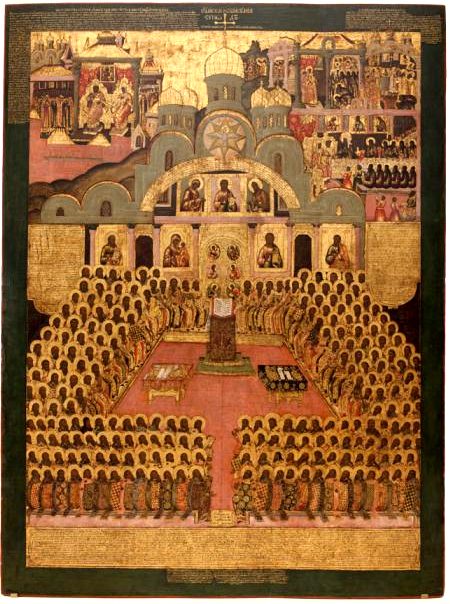
Icon of the Seventh-Ecumenical Council (1670s). Public Domain.
This is a tough piece to write. Not because I am ashamed of being Byzantine Catholic, but because I know the topic—even simply the name—cannot help but inspire strong passions. Some Orthodox will rail against Uniatism, against the political machinations of the Latins, forcing good Byzantines into robber unity with the West. Some Latin Catholics will look askance at some Melkites calling Vatican I a local council; their ears perk up at our subtraction of the Filioque from the Creed. To be Byzantine is to be precarious. Writing from such a position makes me fearful, fearful that my reasons for being what I am will upset my brethren, fearful that even a hint of the Pharisee’s prayer will fall from my lips, if not in word, then in spirit—”O God, I thank you that I am not like the rest of humanity—greedy, dishonest, adulterous—or even like this tax collector” (Luke 18:11). I beg God to take such a spirit of self-righteousness away from me. I know that it lives inside me, but I pray it will not live inside these words.
Yet I feel the need to confess, to explain. In part, I need to because I want people to better understand what and who Byzantine Catholics are. In part, I need to because I want others to better understand why I am what I am. I would like a resource to point to when interrogated, one with which to say “here are my thoughts. Here is why.”
Being Byzantine is precarious. And it is my embrace of that precariousness that leads me to this position. Theology and communion are messy affairs, and so the Ruthenian Church (one of the Byzantine Catholic Churches) feels like home to me.
I’ll begin by explaining my journey, how I got here, and then I’ll answer a few common objections, hopefully explaining why messy communion suits me better than absolute certainty—that is, why I am what I am and why I allow precariousness to define my ecclesial identity. Along the way, I may critique a few of things that I have found difficult in contemporary Latin Catholicism and Eastern Orthodoxy. I hope these critiques will be taken in a spirit of charity (a spirit in which, I assure you, they are intended).
I ended up Byzantine because I was angry at the West, specifically at Thomism. This is the sad truth. I had devoted my life to reading and studying mystics or pseudo-mystics, many of them Western—Pseudo-Dionysius, Eriugena, Hadewijch of Brabant, Mechthild of Magdeburg, Marguerite Porete, Meister Eckhart, Richard Rolle, Julian of Norwich, Margery Kempe, Nicholas of Cusa, Søren Kierkegaard, Simone Weil, and Adrienne von Speyr. I was not a Thomist, even if I thought Aquinas himself was all right. Baptized Roman, and now finding my way back to the Faith, I was hurt by constant attacks on my love for these mystics, especially when being fond of them was thought to be anti-Thomistic, or, some might say, anti-Western.
I considered Orthodoxy, but quickly found that many in the Orthodox Church were as anti-Western as the Latins I had met were anti-Eastern (or, at least, anti-mystical). I felt trapped. Reading the Cappadocians, listening Metropolitan Kallistos Ware, perusing the works of David Bentley Hart, the East seemed pristine, more accepting. In practice, I found that people were people, that territorialism abounded wherever I looked.
So I sat down and considered my options. My study of the medieval West (as well as reading a bit more about theological diversity in the East) had convinced me that the simplistic historical narratives I had encountered were simply too clean, too convenient, to be true. The West had a special respect for Thomism—true enough. But what does one do with Meister Eckhart, Thomist and apophatic mystic? What about if one reads Thomas himself as a mystic? What of Eriugena writing that the Filioque was no issue (and even that the Byzantine East had the better case!) in the 9th century? What of St. Gregory Palamas and the Immaculate Conception? Does the Divine Liturgy not have us sing:
It is truly meet to bless you, O Theotokos, ever-blessed [ my Church’s translation has “immaculate”] and most pure, and the Mother of our God. More honorable than the Cherubim, and more glorious beyond compare than the Seraphim, without defilement you gave birth to God the Word. True Theotokos we magnify you!
Previous Post

August 3, 2018
Death to the Death Penalty?
Next Post

December 22, 2018 A Catholic Country?
Browse Our Archives
Select a Category Academia Culture Politics Reviews Theology Uncategorized
Select a Month October 2026 September 2026 August 2026 July 2026 June 2026 May 2026 April 2026 March 2026 February 2026 January 2026 December 2025 November 2025 October 2025 September 2025 August 2025 July 2025 June 2025 May 2025 April 2025 March 2025 February 2025 January 2025 December 2024 November 2024 October 2024 September 2024 August 2024 July 2024 June 2024 May 2024 April 2024 March 2024 February 2024 January 2024 December 2023 November 2023 October 2023 September 2023 August 2023 July 2023 June 2023 May 2023 April 2023 March 2023 February 2023 January 2023 November 2022 October 2022 September 2022 August 2022 July 2022 June 2022 May 2022 April 2022 March 2022 February 2022 July 2021 December 2020 November 2020 July 2020 May 2020 April 2020 February 2020 January 2020 December 2019 November 2019 October 2019 August 2019 July 2019 April 2019 March 2019 December 2018 August 2018 July 2018 June 2018 May 2018 April 2018 March 2018 January 2018 December 2017 November 2017 September 2017 August 2017 July 2017 June 2017 May 2017 April 2017 March 2017 February 2017 January 2017 December 2016 November 2016 October 2016 September 2016 August 2016 July 2016 June 2016 May 2016 April 2016 March 2016 February 2016
Follow Us!
TAKE THE
Religious Wisdom Quiz
I made a rash vow that cost me my only child after a military victory. Who am I?
Select your answer to see how you score.
Jephthah Samson Barak Gideon
Related posts from Jappers and Janglers

American Movie: The Beauty of the Chuds

Apostasy, Scandal, and a Road Well-Trod

Which is the Original Bible? Is it the...
TRENDING AT PATHEOS Religious Music and Entertainment

The Iron Gates and the Lion of the...
Yesterday, I didn't finish my report about, well, yesterday. So I'll...

Dolly Parton’s Last Song Wins Dove Award with...
Bluegrass band The Grascals, speaking on the red carpet at the 57th...

The Image: On the Horror of Capitalism and...
The Image Then went the Pharisees, and took counsel how they might...

We are approaching the date of our new American national holiday: October...

Letters on Living the Faith by C.S. Lewis
Most of us met C.S. Lewis as a public intellectual. Mere Christianity....

When Halloween Unmasks Married Hearts
Written by Dr. David K. Ewen from Eternal Truth Bible College Behind...
view all Religious Music and Entertainment blogs
Ad-Free & Subscriber Log-In Subscription Support
- About Us
- 2026 Calendar
- Videos
- Podcasts
- Library of World Religions
- Faith In Media Tracker
- Advertise With Us
- Write for Us
- Privacy Policy
- Terms of Service
- Do Not Sell My Data
- Contact Us
- Radiant Digital
- Manage Newsletter Subscriptions
- Unsubscribe From Notifications
- Sitemap
Copyright 2008-2026, Patheos. All rights reserved.
Subscription Support Ad-Free & Subscriber Log-In
Follow Patheos