
BuddhistCatholicContemplativeEvangelicalGeneral ChristianHinduJewishLatter-day SaintMuslimNew VisionsProgressive Christian
Beliefs
- Buddhist
- Catholic
- Contemplative
- Evangelical
- General Christian
- Hindu
- Jewish
- Latter-day Saint
- More Voices
- Muslim
- New Visions
- Pagan
- Progressive Christian
Topics
- Religion News
- Food and Religion
- Sports and Religion
- Religious Art
- Religious Music and Entertainment
- Religious Events
- History and Religion
- Style and Religion
- Politics and Religion
- Women in Religion
- Recreation Outdoors and Religion
- Business Finance and Religion
- Careers Workplace and Religion
- Education and Religion
- Family Parenting and Religion
- Health Fitness and Religion
- Home and Religion
- Relationships and Religion
- Technology and Religion
- Travel and Religion
Columnists
- Buddhist Columnists
- Business Finance and Religion Columnists
- Careers Workplace and Religion Columnists
- Catholic Columnists
- Contemplative Columnists
- Education and Religion Columnists
- Evangelists Columnists
- Family Parenting and Religion Columnists
- General Christian Columnists
- Health Fitness and Religion Columnists
- Hindu Columnists
- History and Religion Columnists
- Home and Religion Columnists
- Jewish Columnists
- More Voices Columnists
- Latter Day Columnists
- Muslim Columnists
- New Visions Columnists
- Nonreligious Columnists
- Pagan Columnists
- Politics and Religion Columnists
- Progressive Columnists
- Recreation Outdoors and Religion Columnists
- Relationships and Religion Columnists
- Religion News Columnists
- Religious Art Columnists
- Religious Events Columnists
- Religious Music and Entertainment Columnists
- Sports and Religion Columnists
- Style and Religion Columnists
- Technology and Religion Columnists
- Travel and Religion Columnists
- Women in Religion Columnists
Resource Library
- 2026 Calendar
- Library of World Religions
- The 100 Most Holy Places on Earth
- Patheos Answers
- Podcasts
- Videos
- Faith Leaders Database
- Anglican Episcopalian
- Bahai
- Baptist
- Buddhism
- Christianity
- Confucianism
- Eastern Orthodoxy
- Hinduism
- Holiness and Pentecostal
- ISKCON
- Islam
- Judaism
- Lutheran
- Methodist
- The Church of Jesus Christ of Latter-day Saints
- New Age
- Paganism
- Presbytarian and Reformed
- Protestantism
- Religion Behind the Scenes
- Roman Catholic
- Scientology
- Shia Islam
- Sikhism
- Sufism
- Sunni Islam
- Taoism
- Zen
- See all religions
Research Tools
 Ad-Free & Subscriber Log-In Subscription Support
Ad-Free & Subscriber Log-In Subscription Support
Follow Patheos 

- Trending:
- Forgiveness
- |
- Marriage
- |
- Consciousness
- |
- Death Penalty
- |
- Election
- |
- Halloween

- Home
- Religious Music and Entertainment
- Loving Oneself
Loving Oneself
Last updated on: May 15, 2018 at 10:43 am by Chase Padusniak
Loving Oneself 2018-05-15T10:43:00-04:00 Chase Padusniak
Patheos Explore the world's faith through different perspectives on religion and spirituality! Patheos has the views of the prevalent religions and spiritualities of the world.
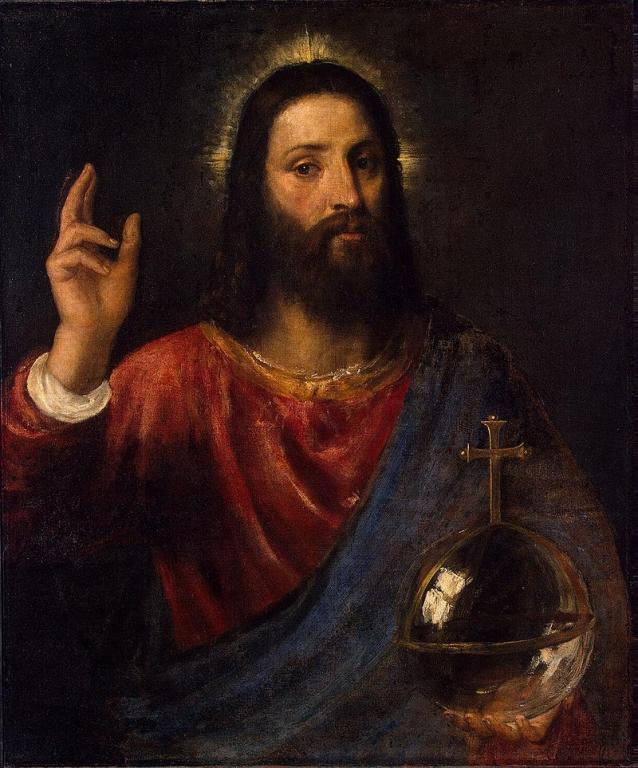
Salvator Mundi (Christ’s Blessing) (c.1570) by Titian. Public Domain.
I have spent some time lately reflecting on particular words—a short phrase really. Brevity brings with it great power, condensing meaning, demanding attention with its pithiness. Perhaps this is why we like to pull quotations from writers (excerpted sometimes way out of context). It might be why poetry holds such sway over so many. Who doesn’t know what a wheelbarrow looks like? Yet who wouldn’t rather hear one described by William Carlos Williams?
Which words have I been meditating on then? Simple enough ones, those that end the Divine Liturgy of St. John Chrysostom: “for He is good, and loves mankind.” Or, as I hear it more often at my church: “for Christ is good and loves us all.” What comes before this “for”? A request for mercy and salvation. The priest says, in full:
May Christ, our true God [if it Sunday: risen from the dead] through the prayers of His most pure Mother, and of the holy, glorious, and all-praised Apostles; and of our holy father John Chrysostom, Archbishop of Constantinople, of Saint [whose temple it is], of Saint[s] [whose day it is], and of all the Saints, have mercy on us and save us, for He is good, and loves mankind.
But it’s the last part that caught me, the bit that seems to summarize the rest, in a way, distill the entire liturgy down to its essence: God’s love for everyone. Such an idea, of course, is not without great Biblical precedent. 1 John testifies to God’s love as seen in the Incarnation of Christ:
Beloved, let us love one another, because love is of God; everyone who loves is begotten by God and knows God. Whoever is without love does not know God, for God is love. In this way the love of God was revealed to us: God sent his only Son into the world so that we might have life through him. In this is love: not that we have loved God, but that he loved us and sent his Son as expiation for our sins. Beloved, if God so loved us, we also must love one another. No one has ever seen God. Yet, if we love one another, God remains in us, and his love is brought to perfection in us. (1 John 4:7-12)
The words of the liturgy, however, carry a special force. This is for reasons of my own that, I hope, may speak to others.
When I was younger, I was a much angrier person, at least externally. I grew up in a household filled with cursing and yelling and a willingness to speak one’s mind. If you were upset at someone, you let them know. Sometimes very hurtful things were said, things that would come to be regretted. Honesty of feeling was, if not prized, the norm.
This changed for me as I grew older, in part because of my mother’s passing. Life came to seem too short to be angry, to not pick and choose one’s fights. I became more religious (or really became religious at all). In time, I came to put an emphasis on loving people humbly and treating them charitably; this required diminishing myself and acting respectfully to them even when it didn’t seem they were respecting me.
And this was a good thing. Christ does call on us to make ourselves small so as to make Him big. For many Christians, this can be a very difficult calling. I know, in my case, it took quite a good deal of getting used to, given the anger and bombast of my childhood. It was an important journey, one in which I learned to forgive, to let go, and to recognize when I was at fault in a situation (it seemed to turn out, in my experience, that I was always at least a little bit wrong on any given matter).
Previous Post

May 14, 2018
Rigid Christianity?
Next Post
May 16, 2018 Married Priests?
Browse Our Archives
Select a Category Academia Culture Politics Reviews Theology Uncategorized
Select a Month October 2026 September 2026 August 2026 July 2026 June 2026 May 2026 April 2026 March 2026 February 2026 January 2026 December 2025 November 2025 October 2025 September 2025 August 2025 July 2025 June 2025 May 2025 April 2025 March 2025 February 2025 January 2025 December 2024 November 2024 October 2024 September 2024 August 2024 July 2024 June 2024 May 2024 April 2024 March 2024 February 2024 January 2024 December 2023 November 2023 October 2023 September 2023 August 2023 July 2023 June 2023 May 2023 April 2023 March 2023 February 2023 January 2023 November 2022 October 2022 September 2022 August 2022 July 2022 June 2022 May 2022 April 2022 March 2022 February 2022 July 2021 December 2020 November 2020 July 2020 May 2020 April 2020 February 2020 January 2020 December 2019 November 2019 October 2019 August 2019 July 2019 April 2019 March 2019 December 2018 August 2018 July 2018 June 2018 May 2018 April 2018 March 2018 January 2018 December 2017 November 2017 September 2017 August 2017 July 2017 June 2017 May 2017 April 2017 March 2017 February 2017 January 2017 December 2016 November 2016 October 2016 September 2016 August 2016 July 2016 June 2016 May 2016 April 2016 March 2016 February 2016
Follow Us!
TAKE THE
Religious Wisdom Quiz
What is the highest holiday in the Orthodox Christian year?
Select your answer to see how you score.
Nativity Pentecost Epiphany Pascha (Easter)
Related posts from Jappers and Janglers

American Movie: The Beauty of the Chuds


500 Days of Paralyzing Anxiety

The Greatest Christmas Story Ever Told
TRENDING AT PATHEOS Religious Music and Entertainment

Letters on Living the Faith by C.S. Lewis
Most of us met C.S. Lewis as a public intellectual. Mere Christianity....

When Halloween Unmasks Married Hearts
Written by Dr. David K. Ewen from Eternal Truth Bible College Behind...

Aristotle. He’s been called the father of logic, the father of the...

Methodist Central Hall and Westminster Abbey
Situated on the same square is Methodist Central Hall and Westminster Abbey. ...

57th Dove Awards Honor Dolly Parton, Crown New...
On gospel music’s biggest night, the 57th annual GMA Dove Awards honored...

The First Eucharistic Controversy: Christ’s Real Presence
For Catholics, the Eucharist is the source and summit of the Christian...
view all Religious Music and Entertainment blogs
Ad-Free & Subscriber Log-In Subscription Support
- About Us
- 2026 Calendar
- Videos
- Podcasts
- Library of World Religions
- Faith In Media Tracker
- Advertise With Us
- Write for Us
- Privacy Policy
- Terms of Service
- Do Not Sell My Data
- Contact Us
- Radiant Digital
- Manage Newsletter Subscriptions
- Unsubscribe From Notifications
- Sitemap
Copyright 2008-2026, Patheos. All rights reserved.
Subscription Support Ad-Free & Subscriber Log-In
Follow Patheos