
BuddhistCatholicContemplativeEvangelicalGeneral ChristianHinduJewishLatter-day SaintMuslimNew VisionsProgressive Christian
Beliefs
- Buddhist
- Catholic
- Contemplative
- Evangelical
- General Christian
- Hindu
- Jewish
- Latter-day Saint
- More Voices
- Muslim
- New Visions
- Pagan
- Progressive Christian
Topics
- Religion News
- Food and Religion
- Sports and Religion
- Religious Art
- Religious Music and Entertainment
- Religious Events
- History and Religion
- Style and Religion
- Politics and Religion
- Women in Religion
- Recreation Outdoors and Religion
- Business Finance and Religion
- Careers Workplace and Religion
- Education and Religion
- Family Parenting and Religion
- Health Fitness and Religion
- Home and Religion
- Relationships and Religion
- Technology and Religion
- Travel and Religion
Columnists
- Buddhist Columnists
- Business Finance and Religion Columnists
- Careers Workplace and Religion Columnists
- Catholic Columnists
- Contemplative Columnists
- Education and Religion Columnists
- Evangelists Columnists
- Family Parenting and Religion Columnists
- General Christian Columnists
- Health Fitness and Religion Columnists
- Hindu Columnists
- History and Religion Columnists
- Home and Religion Columnists
- Jewish Columnists
- More Voices Columnists
- Latter Day Columnists
- Muslim Columnists
- New Visions Columnists
- Nonreligious Columnists
- Pagan Columnists
- Politics and Religion Columnists
- Progressive Columnists
- Recreation Outdoors and Religion Columnists
- Relationships and Religion Columnists
- Religion News Columnists
- Religious Art Columnists
- Religious Events Columnists
- Religious Music and Entertainment Columnists
- Sports and Religion Columnists
- Style and Religion Columnists
- Technology and Religion Columnists
- Travel and Religion Columnists
- Women in Religion Columnists
Resource Library
- 2026 Calendar
- Library of World Religions
- The 100 Most Holy Places on Earth
- Patheos Answers
- Podcasts
- Videos
- Faith Leaders Database
- Anglican Episcopalian
- Bahai
- Baptist
- Buddhism
- Christianity
- Confucianism
- Eastern Orthodoxy
- Hinduism
- Holiness and Pentecostal
- ISKCON
- Islam
- Judaism
- Lutheran
- Methodist
- The Church of Jesus Christ of Latter-day Saints
- New Age
- Paganism
- Presbytarian and Reformed
- Protestantism
- Religion Behind the Scenes
- Roman Catholic
- Scientology
- Shia Islam
- Sikhism
- Sufism
- Sunni Islam
- Taoism
- Zen
- See all religions
Research Tools
 Ad-Free & Subscriber Log-In Subscription Support
Ad-Free & Subscriber Log-In Subscription Support
Follow Patheos 

- Trending:
- Forgiveness
- |
- Marriage
- |
- Consciousness
- |
- Death Penalty
- |
- Election
- |
- Halloween

- Home
- Religious Music and Entertainment
- Mary, May, and International Workers’ Day
Mary, May, and International Workers’ Day
Last updated on: May 1, 2018 at 10:06 pm by Chase Padusniak
Mary, May, and International Workers’ Day 2018-05-01T22:06:48-04:00 Chase Padusniak
Patheos Explore the world's faith through different perspectives on religion and spirituality! Patheos has the views of the prevalent religions and spiritualities of the world.
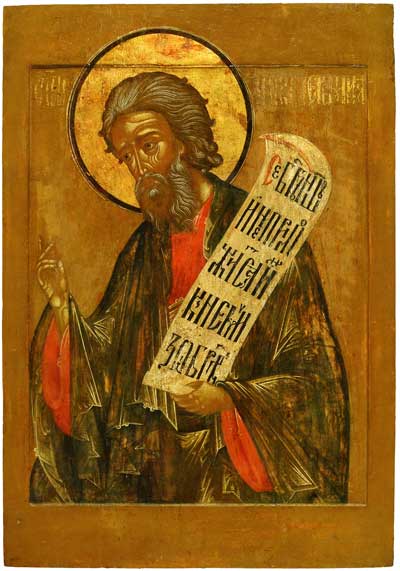
An icon of Jeremiah (c.1654). Public Domain.
May First means many things. In England, it means May Poles and dancing. For Latin Catholics, it signifies the beginning of the month of Mary, a celebration (complete with crowning, flowers, and singing) of the Queen of Heaven. And beyond these, for Leftists the world over the first of May means protests, a day of targeted unrest, channeling the fights carried on year round into one day of loud dissatisfaction.
I see symbolic power in the coincidence of International Workers’ Day and the beginning of this Latin Catholic celebration. I’m a Byzantine Catholic, and as far as I know, there’s no particular connection within our tradition between Mary and the month of May. Still, the whole thing seems suggestive to me, an opportunity for reflection on what the Theotokos can (and should) mean to us, what celebrating her humility and obedience ought to signal for how we treat our brothers and sisters in this fractured world.
What I am not saying (to be clear) is that one must see things this way. I understand some might see this as a sly attempt to further my political commitments (I don’t think of it this way, but rather as a reminder of my own failures to love and support the myriad oppressed and downtrodden peoples of the world—and I do fail every day, over and over). Regardless, this is merely a reflection, one I hope others might find valuable, as I have found contemplating Mary’s role in our salvation in connection with May Day edifying.
So, what is May First? It seems to have pagan roots as a celebration of new life, the casting away of winter, but by the Early-Modern Period the Theotokos and the month came into connection. She gave birth to Christ and signals our redemption from the barrenness of our fallen state. In this sense, she is our “spring,” our mother whose decision to humble herself in accepting miraculous pregnancy portends our salvation and rebirth as members of the Body of Christ. Many have imagined how confusing a virgin pregnancy must have been for those around her, the social costs it must have entailed—suspicion, mockery, and more. Regardless, Mary said yes to God and thus gave birth to God, making our salvation possible.
What, if anything, does that have to do with workers? The short answer is that historically it doesn’t. CNN has summed the labor history of this day up quite succinctly:
May Day is also a labor holiday in many areas of the world, and that part of its history is a thornier story. May Day has shared a date with International Workers’ Day since the 1880s. At the time, labor movements around the world were fighting for fair work accommodations like eight-hour workdays and unions. The date was chosen because it aligned with the anniversary of the Haymarket affair in Chicago, where police killed four people at a peaceful protest after someone threw a bomb into the crowd.
The event had a huge impact on labor movements across the world. (CNN)
International Workers’ Day thus recalls a day of gross violence against organizers and protesters. Often, this comes with violence, as it did this year. Some might say it’s ridiculous to associate such a day with Mary, but May Day needn’t be violent; I don’t intend to suggest any connection between the Theotokos and violent force.
Rather, what strikes me about this coincidence is a mutual emphasis on humility and obedience to God. Our Lord demands service to the poor; He demands that His justice be carried out by our human hands (or, at least, this strikes me as one plausible reading of the “Our Father”). The Gospels abound in examples of how serving God means serving the poor, how our very judgment before the divine cannot be disentangled from the good works that arise from deep faith. Here is but one example:
Now someone approached him and said, “Teacher, what good must I do to gain eternal life?” He answered him, “Why do you ask me about the good? There is only One who is good. If you wish to enter into life, keep the commandments.” He asked him, “Which ones?” And Jesus replied, “‘You shall not kill; you shall not commit adultery; you shall not steal; you shall not bear false witness; honor your father and your mother’; and ‘you shall love your neighbor as yourself.’” The young man said to him, “All of these I have observed. What do I still lack?” Jesus said to him, “If you wish to be perfect, go, sell what you have and give to [the] poor, and you will have treasure in heaven. Then come, follow me.” When the young man heard this statement, he went away sad, for he had many possessions. Then Jesus said to his disciples, “Amen, I say to you, it will be hard for one who is rich to enter the kingdom of heaven. Again I say to you, it is easier for a camel to pass through the eye of a needle than for one who is rich to enter the kingdom of God.” When the disciples heard this, they were greatly astonished and said, “Who then can be saved?” Jesus looked at them and said, “For human beings this is impossible, but for God all things are possible.” Then Peter said to him in reply, “We have given up everything and followed you. What will there be for us?” Jesus said to them, “Amen, I say to you that you who have followed me, in the new age, when the Son of Man is seated on his throne of glory, will yourselves sit on twelve thrones, judging the twelve tribes of Israel. And everyone who has given up houses or brothers or sisters or father or mother or children or lands for the sake of my name will receive a hundred times more, and will inherit eternal life. But many who are first will be last, and the last will be first. (Matthew 19:16-30)
Previous Post

April 17, 2018
The Narcissism of Expectations
Next Post
May 2, 2018 Christian Anti-Gnosticism
Browse Our Archives
Select a Category Academia Culture Politics Reviews Theology Uncategorized
Select a Month October 2026 September 2026 August 2026 July 2026 June 2026 May 2026 April 2026 March 2026 February 2026 January 2026 December 2025 November 2025 October 2025 September 2025 August 2025 July 2025 June 2025 May 2025 April 2025 March 2025 February 2025 January 2025 December 2024 November 2024 October 2024 September 2024 August 2024 July 2024 June 2024 May 2024 April 2024 March 2024 February 2024 January 2024 December 2023 November 2023 October 2023 September 2023 August 2023 July 2023 June 2023 May 2023 April 2023 March 2023 February 2023 January 2023 November 2022 October 2022 September 2022 August 2022 July 2022 June 2022 May 2022 April 2022 March 2022 February 2022 July 2021 December 2020 November 2020 July 2020 May 2020 April 2020 February 2020 January 2020 December 2019 November 2019 October 2019 August 2019 July 2019 April 2019 March 2019 December 2018 August 2018 July 2018 June 2018 May 2018 April 2018 March 2018 January 2018 December 2017 November 2017 September 2017 August 2017 July 2017 June 2017 May 2017 April 2017 March 2017 February 2017 January 2017 December 2016 November 2016 October 2016 September 2016 August 2016 July 2016 June 2016 May 2016 April 2016 March 2016 February 2016
Follow Us!
TAKE THE
Religious Wisdom Quiz
What woman was turned into a pillar of salt?
Select your answer to see how you score.
Rebekah Lot’s wife Esther Sarah
Related posts from Jappers and Janglers

Apostasy, Scandal, and a Road Well-Trod



TRENDING AT PATHEOS Religious Music and Entertainment

When Halloween Unmasks Married Hearts
Written by Dr. David K. Ewen from Eternal Truth Bible College Behind...

Aristotle. He’s been called the father of logic, the father of the...

Methodist Central Hall and Westminster Abbey
Situated on the same square is Methodist Central Hall and Westminster Abbey. ...

57th Dove Awards Honor Dolly Parton, Crown New...
On gospel music’s biggest night, the 57th annual GMA Dove Awards honored...

The First Eucharistic Controversy: Christ’s Real Presence
For Catholics, the Eucharist is the source and summit of the Christian...

What a Stop Sign Can Teach Us About...
How to Make a Decision When You Can't Hear God Main point:...
view all Religious Music and Entertainment blogs
Ad-Free & Subscriber Log-In Subscription Support
- About Us
- 2026 Calendar
- Videos
- Podcasts
- Library of World Religions
- Faith In Media Tracker
- Advertise With Us
- Write for Us
- Privacy Policy
- Terms of Service
- Do Not Sell My Data
- Contact Us
- Radiant Digital
- Manage Newsletter Subscriptions
- Unsubscribe From Notifications
- Sitemap
Copyright 2008-2026, Patheos. All rights reserved.
Subscription Support Ad-Free & Subscriber Log-In
Follow Patheos