
BuddhistCatholicContemplativeEvangelicalGeneral ChristianHinduJewishLatter-day SaintMuslimNew VisionsProgressive Christian
Beliefs
- Buddhist
- Catholic
- Contemplative
- Evangelical
- General Christian
- Hindu
- Jewish
- Latter-day Saint
- More Voices
- Muslim
- New Visions
- Pagan
- Progressive Christian
Topics
- Religion News
- Food and Religion
- Sports and Religion
- Religious Art
- Religious Music and Entertainment
- Religious Events
- History and Religion
- Style and Religion
- Politics and Religion
- Women in Religion
- Recreation Outdoors and Religion
- Business Finance and Religion
- Careers Workplace and Religion
- Education and Religion
- Family Parenting and Religion
- Health Fitness and Religion
- Home and Religion
- Relationships and Religion
- Technology and Religion
- Travel and Religion
Columnists
- Buddhist Columnists
- Business Finance and Religion Columnists
- Careers Workplace and Religion Columnists
- Catholic Columnists
- Contemplative Columnists
- Education and Religion Columnists
- Evangelists Columnists
- Family Parenting and Religion Columnists
- General Christian Columnists
- Health Fitness and Religion Columnists
- Hindu Columnists
- History and Religion Columnists
- Home and Religion Columnists
- Jewish Columnists
- More Voices Columnists
- Latter Day Columnists
- Muslim Columnists
- New Visions Columnists
- Nonreligious Columnists
- Pagan Columnists
- Politics and Religion Columnists
- Progressive Columnists
- Recreation Outdoors and Religion Columnists
- Relationships and Religion Columnists
- Religion News Columnists
- Religious Art Columnists
- Religious Events Columnists
- Religious Music and Entertainment Columnists
- Sports and Religion Columnists
- Style and Religion Columnists
- Technology and Religion Columnists
- Travel and Religion Columnists
- Women in Religion Columnists
Resource Library
- 2026 Calendar
- Library of World Religions
- The 100 Most Holy Places on Earth
- Patheos Answers
- Podcasts
- Videos
- Faith Leaders Database
- Anglican Episcopalian
- Bahai
- Baptist
- Buddhism
- Christianity
- Confucianism
- Eastern Orthodoxy
- Hinduism
- Holiness and Pentecostal
- ISKCON
- Islam
- Judaism
- Lutheran
- Methodist
- The Church of Jesus Christ of Latter-day Saints
- New Age
- Paganism
- Presbytarian and Reformed
- Protestantism
- Religion Behind the Scenes
- Roman Catholic
- Scientology
- Shia Islam
- Sikhism
- Sufism
- Sunni Islam
- Taoism
- Zen
- See all religions
Research Tools
 Ad-Free & Subscriber Log-In Subscription Support
Ad-Free & Subscriber Log-In Subscription Support
Follow Patheos 

- Trending:
- Forgiveness
- |
- Marriage
- |
- Consciousness
- |
- Death Penalty
- |
- Election
- |
- Halloween

- Home
- Religious Music and Entertainment
- The Byzantine Dorothy Day
The Byzantine Dorothy Day
Last updated on: March 19, 2018 at 9:16 pm by Chase Padusniak
The Byzantine Dorothy Day 2018-03-19T21:16:46-04:00 Chase Padusniak
Patheos Explore the world's faith through different perspectives on religion and spirituality! Patheos has the views of the prevalent religions and spiritualities of the world.
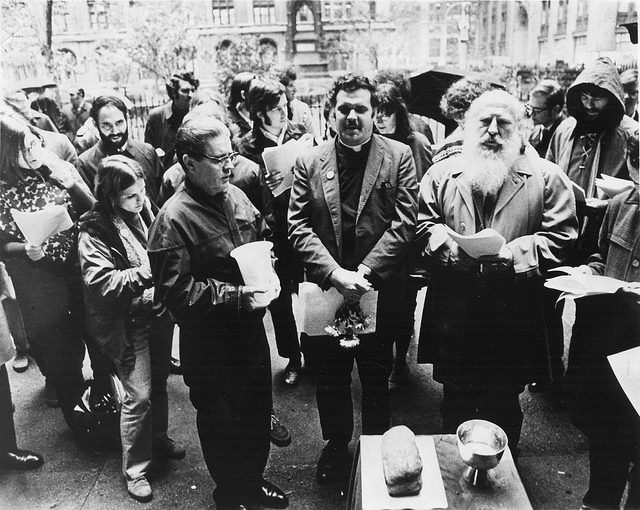
Fr. David Kirk presiding at an open-air liturgy in Manhattan in the late 1960s or early 1970s (Flickr).
It’s no secret that I love Dorothy Day. She has helped me make sense of a Church that can often seem riven by division, academic equivocation, and a strangely-conservative politics. I don’t see much negative about Day, but she’s long been subject to criticism: she was a liberal (never mind her Anarchism and avowed anti-capitalism), she hated the sexual ethic of the Church, she opposed what it means to be an American.
Her Byzantine analogue (and who knew she had one?), Fr. David Kirk, has largely been spared such attacks. Perhaps it’s because there are fewer Byzantines; perhaps it’s because he wrote less (though one has to admire the snap of a title like Quotations from Chairman Jesus). In writing this piece to carry his legacy to more people, I might run the risk of opening him up to attack. I hope not, but his life and legacy seem so beautiful to me that it’s incumbent upon me to use my meager soapbox to say a meager something.
So who was he? One could say a priest, an activist, even a saint. It might be best, therefore, to start with a short biography.
Fr. Kirk was born in Louisville, Mississippi in 1935 to Baptist parents. The racial tensions of the South of his youth would come to shape him. At the age of 12, he supposedly befriended a black man named Clint who was accused of murdering his wife. Young Fr. Kirk brought him food in the woods where he was hiding until Clint (whom I presume he thought was innocent) could escape to Louisiana.
This might seem a strange story with which to lead, but it begins to illustrate a major theme in Fr. Kirk’s life, one could even say the thing that brought him to the Melkite Church and drove his lifelong work for the poor: radical community and hospitality (especially with regard to race). An anecdote to this point:
According to Dr. Albert J. Raboteau, a member of the Emmaus House Board, Father David had a life-long interest in interracial justice. As editor of his high school newspaper in Mobile, AL, he spent several weeks attending the local black high school to investigate first hand the inequities of segregation. In 1956, his junior year at the University of Alabama, Arthurine Lucy’s attempt to integrate the school was met with mob violence. He joined with several other students to shield her as she moved about campus. His correspondence with William Faulkner during that same year elicited a letter—later published—detailing the famous author’s views on segregation. (OCA.org)
To continue with his biography: he became a Melkite Catholic (one of the twenty-three Eastern Catholic Churches) in 1963 and was ordained to the priesthood. Fr. Kirk became active in the Civil Rights Movement (even getting arrested with Martin Luther King Jr. once). He moved to New York City to work with Dorothy Day, who told him he was more needed in Harlem. Thus he went there and Emmaus House was born. Over time 60 Emmaus Inns were founded—apartments scattered across the City, intended to help women escape abusive, crack-infested environments.
What is Emmaus House?
The work of Emmaus has involved a traveling kitchen to feed the homeless; job training; Emmaus Inns (apartments for the homeless); legal services for the homeless; and a residence for the homeless.
All of those who live at Emmaus must get the counseling they need, take some responsibility for their education, and do work to help sustain the community. (Incommunion.org)
It is much like a Catholic Worker House (on which it was modelled): it provides for the homeless in a multitude of ways, making available food, medical care, legal assistance, housing, and more. It takes seriously the corporeal and spiritual works of mercy, bringing them together by offering a place for material consolation and a spirit of hope. As one resident put it:
My name is Winifred Daniels. I used to smoke crack and I used to drink. Father David used to call it, the community of wounded. We all are wounded in one way or another and we’re here to help one another. (NPR.org)
Previous Post

January 16, 2018
Catholicism, Poverty, and the Alt-Right
Next Post
March 20, 2018 When Virtue Becomes Vice and Vice Becomes Virtue
Browse Our Archives
Select a Category Academia Culture Politics Reviews Theology Uncategorized
Select a Month October 2026 September 2026 August 2026 July 2026 June 2026 May 2026 April 2026 March 2026 February 2026 January 2026 December 2025 November 2025 October 2025 September 2025 August 2025 July 2025 June 2025 May 2025 April 2025 March 2025 February 2025 January 2025 December 2024 November 2024 October 2024 September 2024 August 2024 July 2024 June 2024 May 2024 April 2024 March 2024 February 2024 January 2024 December 2023 November 2023 October 2023 September 2023 August 2023 July 2023 June 2023 May 2023 April 2023 March 2023 February 2023 January 2023 November 2022 October 2022 September 2022 August 2022 July 2022 June 2022 May 2022 April 2022 March 2022 February 2022 July 2021 December 2020 November 2020 July 2020 May 2020 April 2020 February 2020 January 2020 December 2019 November 2019 October 2019 August 2019 July 2019 April 2019 March 2019 December 2018 August 2018 July 2018 June 2018 May 2018 April 2018 March 2018 January 2018 December 2017 November 2017 September 2017 August 2017 July 2017 June 2017 May 2017 April 2017 March 2017 February 2017 January 2017 December 2016 November 2016 October 2016 September 2016 August 2016 July 2016 June 2016 May 2016 April 2016 March 2016 February 2016
Follow Us!
TAKE THE
Religious Wisdom Quiz
Which book comes last in the New Testament?
Select your answer to see how you score.
Acts Jude Revelation 2 Peter
Related posts from Jappers and Janglers

Apostasy, Scandal, and a Road Well-Trod
Who Founded the Catholic Church?

TRENDING AT PATHEOS Religious Music and Entertainment

Catholic Evangelization: Sharing Your Faith Every Day
Welcome back to the Graceful Awakening mini-series called, “From Faith to Mission.” ...

The Pillar of the Boatmen: the Ancient Monument...
The Pillar of the Boatmen is a Romano-Gaulish sculpture that dates from...

In one sense walking into Westminster Abbey is like walking down the...

'Super Scam Me' Exposes AI Jon Bon Jovi...
Leslie Pickett believed she was in a relationship with Jon Bon Jovi....

The Brazilian Remake of Kendricks' 'Flywheel' Opens in...
“Flywheel,” the story that launched the Kendrick Brothers’ filmmaking career is getting...

The Dangers of Gradual Accommodation (Winking at Sin)
Recently, the “law of gradualness” resurfaced during the opening of a weeklong,...
view all Religious Music and Entertainment blogs
Ad-Free & Subscriber Log-In Subscription Support
- About Us
- 2026 Calendar
- Videos
- Podcasts
- Library of World Religions
- Faith In Media Tracker
- Advertise With Us
- Write for Us
- Privacy Policy
- Terms of Service
- Do Not Sell My Data
- Contact Us
- Radiant Digital
- Manage Newsletter Subscriptions
- Unsubscribe From Notifications
- Sitemap
Copyright 2008-2026, Patheos. All rights reserved.
Subscription Support Ad-Free & Subscriber Log-In
Follow Patheos