
BuddhistCatholicContemplativeEvangelicalGeneral ChristianHinduJewishLatter-day SaintMuslimNew VisionsProgressive Christian
Beliefs
- Buddhist
- Catholic
- Contemplative
- Evangelical
- General Christian
- Hindu
- Jewish
- Latter-day Saint
- More Voices
- Muslim
- New Visions
- Pagan
- Progressive Christian
Topics
- Religion News
- Food and Religion
- Sports and Religion
- Religious Art
- Religious Music and Entertainment
- Religious Events
- History and Religion
- Style and Religion
- Politics and Religion
- Women in Religion
- Recreation Outdoors and Religion
- Business Finance and Religion
- Careers Workplace and Religion
- Education and Religion
- Family Parenting and Religion
- Health Fitness and Religion
- Home and Religion
- Relationships and Religion
- Technology and Religion
- Travel and Religion
Columnists
- Buddhist Columnists
- Business Finance and Religion Columnists
- Careers Workplace and Religion Columnists
- Catholic Columnists
- Contemplative Columnists
- Education and Religion Columnists
- Evangelists Columnists
- Family Parenting and Religion Columnists
- General Christian Columnists
- Health Fitness and Religion Columnists
- Hindu Columnists
- History and Religion Columnists
- Home and Religion Columnists
- Jewish Columnists
- More Voices Columnists
- Latter Day Columnists
- Muslim Columnists
- New Visions Columnists
- Nonreligious Columnists
- Pagan Columnists
- Politics and Religion Columnists
- Progressive Columnists
- Recreation Outdoors and Religion Columnists
- Relationships and Religion Columnists
- Religion News Columnists
- Religious Art Columnists
- Religious Events Columnists
- Religious Music and Entertainment Columnists
- Sports and Religion Columnists
- Style and Religion Columnists
- Technology and Religion Columnists
- Travel and Religion Columnists
- Women in Religion Columnists
Resource Library
- 2026 Calendar
- Library of World Religions
- The 100 Most Holy Places on Earth
- Patheos Answers
- Podcasts
- Videos
- Faith Leaders Database
- Anglican Episcopalian
- Bahai
- Baptist
- Buddhism
- Christianity
- Confucianism
- Eastern Orthodoxy
- Hinduism
- Holiness and Pentecostal
- ISKCON
- Islam
- Judaism
- Lutheran
- Methodist
- The Church of Jesus Christ of Latter-day Saints
- New Age
- Paganism
- Presbytarian and Reformed
- Protestantism
- Religion Behind the Scenes
- Roman Catholic
- Scientology
- Shia Islam
- Sikhism
- Sufism
- Sunni Islam
- Taoism
- Zen
- See all religions
Research Tools
 Ad-Free & Subscriber Log-In Subscription Support
Ad-Free & Subscriber Log-In Subscription Support
Follow Patheos 

- Trending:
- Forgiveness
- |
- Marriage
- |
- Consciousness
- |
- Death Penalty
- |
- Election
- |
- Halloween

- Home
- Religious Music and Entertainment
- Catholicism, Poverty, and the Alt-Right
Catholicism, Poverty, and the Alt-Right
Last updated on: January 17, 2018 at 11:06 am by Chase Padusniak
Catholicism, Poverty, and the Alt-Right 2018-01-17T11:06:19-04:00 Chase Padusniak
Patheos Explore the world's faith through different perspectives on religion and spirituality! Patheos has the views of the prevalent religions and spiritualities of the world.
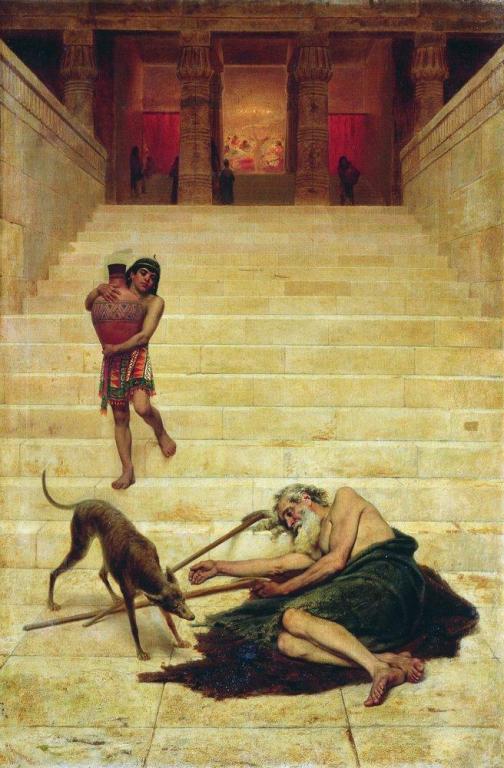
Illustration of Lazarus at the Rich Man’s Gate (1886) by Fyodor Bronnikov. Public Domain.
Journalist: What about your intellectual and cultural journey?
Althusser: I encountered two men. The first one was Jean Guitton, who was a catholic philosopher, a friend of Pope Saint John XXIII and a close friend of Pope Paul VI. He helped me complete my dissertation. The other was a professor of history, whose name was Joseph Hours. He was a wonderful man. During the years 1936–1939, he talked to us about all that had happened: the war, the defeats, the miracle of Petain’s defeat. He explained how Petain had to come to power; he explained everything that has passed… wonderful. So I thought in these lines, considering that at the same time I was a Catholic, I had established a catholic circle [association] in the Lycée where I was studying; I was profoundly Catholic, and had two points of view. On the one hand, there was the church which called for considering and studying social problems with great respect And on the other, there was this history professor [Hours], a Catholic but Galatian-Jacobin; he would tell us about everything he was working on, an incredible world for its specificity. This is how I was shaped.
Journalist: In which moment did you become communist?
Althusser: I became communist because I was Catholic. I did not change religion, but I remained profoundly Catholic. I don’t go to church but this doesn’t matter; you don’t ask people to go to church. I remained a Catholic, that is, an internationalist universalist. I thought that inside the Communist Party there were more adequate means to realize universal fraternity. And then, there was the influence of my wife who had fought in the terrible resistance and who had taught me a lot, a lot. Everything has come to me through women, and this is the reason why I attribute a very important role, a predominant role, to the women’s movement. Women don’t know their capacity, the possibilities, their capability to do politics. (The Crisis of Marxism)
Unsurprisingly, I don’t agree with Althusser that a Catholic need not go to church. Such makes little sense for one who takes the content of the Faith seriously. But he makes an important point: Catholics are, by definition, catholic; we are “internationalist universalists.” The Christendom of the Middle Ages was not, at the religious level, supposed to be a state project. We can see this in the Investiture Controversy (in which the right of the pope to appoint bishops triumphed over the Holy Roman Emperor’s desire to exert his, more local, influence) as well as in, as odd as this may be to say, the Crusades (they’re being “right” or “wrong” does not concern me here; we need only see that they were ostensibly an attempt to snuff out intra-Christian warfare, to spread the Gospel, if by the sword).
This needs to be reiterated in 2018. We live in a time of renewed nationalism, of increasing devotion to particular ideas often associated with particular peoples or nations. There is American Exceptionalism, and the seemingly-inescapable draw of “my country first.” To be Catholic means to worry about others, most especially the poor. It means to be devoted to the spread of the Gospel through justice and charity.
At one level, this is all very abstract. So, how can we possibly enact this?
The absolute and universal truth of the Gospel is always carried on by particular people in specific communities. It is in this sense that we have particular struggles for justice and for evangelization. St. Patrick brought the Good News to the Irish; St. Boniface went to the Saxons. Justin Tse speaks from the Eastern Catholic perspective while The National Catholic Register addresses mostly the Latin Church. Each of us works to accomplish certain ends. The Church needs both Dorothy Day’s fiery social radicalism and St. Francis de Sales gentle edification. In other words, the “internationalist universalism” of the Church always finds particular expression at different moments in history. Take, for example, the “preferential option for the poor”:
Today more than in the past, the Church’s social doctrine must be open to an international outlook, in line with the Second Vatican Council, the most recent Encyclicals, and particularly in line with the Encyclical which we are commemorating. It will not be superfluous therefore to reexamine and further clarify in this light the characteristic themes and guidelines dealt with by the Magisterium in recent years.
Here I would like to indicate one of them: the option or love of preference for the poor. This is an option, or a special form of primacy in the exercise of Christian charity, to which the whole tradition of the Church bears witness. It affects the life of each Christian inasmuch as he or she seeks to imitate the life of Christ, but it applies equally to our social responsibilities and hence to our manner of living, and to the logical decisions to be made concerning the ownership and use of goods.
Today, furthermore, given the worldwide dimension which the social question has assumed, this love of preference for the poor, and the decisions which it inspires in us, cannot but embrace the immense multitudes of the hungry, the needy, the homeless, those without medical care and, above all, those without hope of a better future. It is impossible not to take account of the existence of these realities. To ignore them would mean becoming like the “rich man” who pretended not to know the beggar Lazarus lying at his gate (cf. Lk 16:19-31). (Sollicitudo Rei Socialis)
Previous Post

January 11, 2018
Francis and the Benedict Option
Next Post

March 19, 2018 The Byzantine Dorothy Day
Browse Our Archives
Select a Category Academia Culture Politics Reviews Theology Uncategorized
Select a Month October 2026 September 2026 August 2026 July 2026 June 2026 May 2026 April 2026 March 2026 February 2026 January 2026 December 2025 November 2025 October 2025 September 2025 August 2025 July 2025 June 2025 May 2025 April 2025 March 2025 February 2025 January 2025 December 2024 November 2024 October 2024 September 2024 August 2024 July 2024 June 2024 May 2024 April 2024 March 2024 February 2024 January 2024 December 2023 November 2023 October 2023 September 2023 August 2023 July 2023 June 2023 May 2023 April 2023 March 2023 February 2023 January 2023 November 2022 October 2022 September 2022 August 2022 July 2022 June 2022 May 2022 April 2022 March 2022 February 2022 July 2021 December 2020 November 2020 July 2020 May 2020 April 2020 February 2020 January 2020 December 2019 November 2019 October 2019 August 2019 July 2019 April 2019 March 2019 December 2018 August 2018 July 2018 June 2018 May 2018 April 2018 March 2018 January 2018 December 2017 November 2017 September 2017 August 2017 July 2017 June 2017 May 2017 April 2017 March 2017 February 2017 January 2017 December 2016 November 2016 October 2016 September 2016 August 2016 July 2016 June 2016 May 2016 April 2016 March 2016 February 2016
Follow Us!
TAKE THE
Religious Wisdom Quiz
Which prophet's call included a vision of an almond branch and boiling pot?
Select your answer to see how you score.
Daniel Isaiah Ezekiel Jeremiah
Related posts from Jappers and Janglers

Apostasy, Scandal, and a Road Well-Trod
Who Founded the Catholic Church?

TRENDING AT PATHEOS Religious Music and Entertainment

57th Dove Awards Honor Dolly Parton, Crown New...
On gospel music’s biggest night, the 57th annual GMA Dove Awards honored...

The First Eucharistic Controversy: Christ’s Real Presence
For Catholics, the Eucharist is the source and summit of the Christian...

What a Stop Sign Can Teach Us About...
How to Make a Decision When You Can't Hear God Main point:...

Archdiocese Hosts Military Marriage Retreat in Germany
RASTATT, Germany — The transient military lifestyle, with its frequent deployments and...

Nearly every morning, I make the drive to Detroit with my high-school-age...

The Real AI Story Is Adoption Without Trust
Artificial intelligence has crossed a political threshold. It is no longer a...
view all Religious Music and Entertainment blogs
Ad-Free & Subscriber Log-In Subscription Support
- About Us
- 2026 Calendar
- Videos
- Podcasts
- Library of World Religions
- Faith In Media Tracker
- Advertise With Us
- Write for Us
- Privacy Policy
- Terms of Service
- Do Not Sell My Data
- Contact Us
- Radiant Digital
- Manage Newsletter Subscriptions
- Unsubscribe From Notifications
- Sitemap
Copyright 2008-2026, Patheos. All rights reserved.
Subscription Support Ad-Free & Subscriber Log-In
Follow Patheos