
BuddhistCatholicContemplativeEvangelicalGeneral ChristianHinduJewishLatter-day SaintMuslimNew VisionsProgressive Christian
Beliefs
- Buddhist
- Catholic
- Contemplative
- Evangelical
- General Christian
- Hindu
- Jewish
- Latter-day Saint
- More Voices
- Muslim
- New Visions
- Pagan
- Progressive Christian
Topics
- Religion News
- Food and Religion
- Sports and Religion
- Religious Art
- Religious Music and Entertainment
- Religious Events
- History and Religion
- Style and Religion
- Politics and Religion
- Women in Religion
- Recreation Outdoors and Religion
- Business Finance and Religion
- Careers Workplace and Religion
- Education and Religion
- Family Parenting and Religion
- Health Fitness and Religion
- Home and Religion
- Relationships and Religion
- Technology and Religion
- Travel and Religion
Columnists
- Buddhist Columnists
- Business Finance and Religion Columnists
- Careers Workplace and Religion Columnists
- Catholic Columnists
- Contemplative Columnists
- Education and Religion Columnists
- Evangelists Columnists
- Family Parenting and Religion Columnists
- General Christian Columnists
- Health Fitness and Religion Columnists
- Hindu Columnists
- History and Religion Columnists
- Home and Religion Columnists
- Jewish Columnists
- More Voices Columnists
- Latter Day Columnists
- Muslim Columnists
- New Visions Columnists
- Nonreligious Columnists
- Pagan Columnists
- Politics and Religion Columnists
- Progressive Columnists
- Recreation Outdoors and Religion Columnists
- Relationships and Religion Columnists
- Religion News Columnists
- Religious Art Columnists
- Religious Events Columnists
- Religious Music and Entertainment Columnists
- Sports and Religion Columnists
- Style and Religion Columnists
- Technology and Religion Columnists
- Travel and Religion Columnists
- Women in Religion Columnists
Resource Library
- 2026 Calendar
- Library of World Religions
- The 100 Most Holy Places on Earth
- Patheos Answers
- Podcasts
- Videos
- Faith Leaders Database
- Anglican Episcopalian
- Bahai
- Baptist
- Buddhism
- Christianity
- Confucianism
- Eastern Orthodoxy
- Hinduism
- Holiness and Pentecostal
- ISKCON
- Islam
- Judaism
- Lutheran
- Methodist
- The Church of Jesus Christ of Latter-day Saints
- New Age
- Paganism
- Presbytarian and Reformed
- Protestantism
- Religion Behind the Scenes
- Roman Catholic
- Scientology
- Shia Islam
- Sikhism
- Sufism
- Sunni Islam
- Taoism
- Zen
- See all religions
Research Tools
 Ad-Free & Subscriber Log-In Subscription Support
Ad-Free & Subscriber Log-In Subscription Support
Follow Patheos 

- Trending:
- Forgiveness
- |
- Marriage
- |
- Consciousness
- |
- Death Penalty
- |
- Election
- |
- Halloween

- Home
- Religious Music and Entertainment
- St. Stephen’s Universalism
St. Stephen’s Universalism
Last updated on: December 27, 2017 at 11:20 am by Chase Padusniak
St. Stephen’s Universalism 2017-12-27T11:20:46-04:00 Chase Padusniak
Patheos Explore the world's faith through different perspectives on religion and spirituality! Patheos has the views of the prevalent religions and spiritualities of the world.
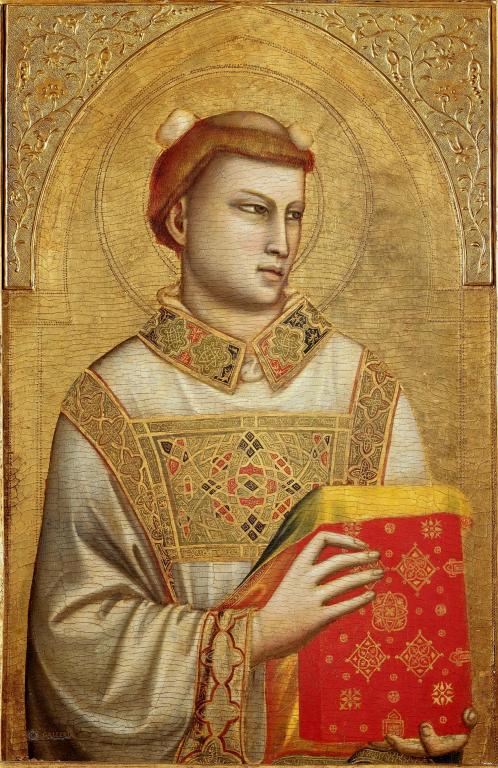
Saint Stephen (c. 1320-1325) by Giotto. Public Domain.
In the West, today marks the Feast of St. Stephen, deacon and first-recorded martyr. Tomorrow, for those Eastern Churches using the Gregorian or Revised Julian calendars (including my own Ruthenian Church), will bring the same celebration, a day to reflect on the first man to “fight the good fight,” to win the stephanos, the crown of martyrdom. December 26th is a state holiday in many countries, especially in Europe, a day to mark the ongoing joy of the Christmas Season, even as it provides time for reflection upon what we all might—theoretically—be called to do.
In thinking about St. Stephen this year, however, I felt especially moved by some of the shorter passages describing him and his speech. His martyrdom is glorious, his almsgiving as a deacon more than admirable, but this deacon attests to something too often forgotten by Christians today—our religion’s inherent universalism.
What do I mean by “universalism?” Certainly I don’t mean “universal salvation” as reputedly espoused by George MacDonald. Rather, I mean the idea that Christ’s message is necessarily a universal one, for all peoples at all times. Universalisms are evangelical by nature; these religions or philosophies seek to bring other groups into their fold. Whatever my dislike of it, Liberalism is certainly a universalism (a point the Nazi jurist Carl Schmitt never tired of attacking). Islam too counts, as does socialism. Their “opposites” might be called “particularisms,” positions like fascism, Nazism, and tribalism, in which specific groups are either privileged as “intrinsically best” or otherwise said to have necessary forms of organization inherent in their own ways of being in the world.
The issue is, of course, more complicated than this. Hegel, for example, thought that where there was a particular, there must also be the universal—the two could not, in any true formulation, be divorced:
Hegel’s Concept has three moments: universality (Allgemeinheit), particularity (Besonderheit), and singularity (Einzeinheit) (sometimes translated as individuality). The precise logical order of explanation is the following: The starting point of the Concept is the universal, which is the essence or substance that has already been identified in the logic of Essence. The Concept then proceeds to an explanation of the particulars, which presupposes the nature of the universal, and adds additional determinations in order to differentiate the presupposed universal into its particular forms. In other words, the particulars are explained as particular forms of the universal itself, as ‘self-particularizations’ of the presupposed universal. It is in this sense that the universal substance is also a ‘subject’ that creates its own particular forms. Finally, the Concept proceeds to singularity, in which the universal achieves concrete existence and the perfect embodiment in a particular form. (Fred Moseley)
As with most any writing about Hegel (or by him), that all sounds very confusing, but the basic idea is that some universal idea (say, Christianity) is what it is only insofar as it is made up of particular forms (say, various rites: Roman, Byzantine, Syriac, and so on). Universalism is thus not merely some homogenizing idea that requires subordination of all existing groups and ideas to it; rather, it finds its fullest expression precisely in that diversity—a unitary diversity, a diverse unity. This is effectively what being catholic means; it is what being Catholic should mean.
What does all of this have to do with St. Stephen? The Acts of the Apostles implies that Stephen was a Greek-speaking Jew, who was appointed by the Twelve to help ensure an equitable distribution of resources between the Hellenistic widows and the Hebrew ones:
At that time, as the number of disciples continued to grow, the Hellenists complained against the Hebrews because their widows were being neglected in the daily distribution. So the Twelve called together the community of the disciples and said, “It is not right for us to neglect the word of God to serve at table. Brothers, select from among you seven reputable men, filled with the Spirit and wisdom, whom we shall appoint to this task, whereas we shall devote ourselves to prayer and to the ministry of the word.” The proposal was acceptable to the whole community, so they chose Stephen, a man filled with faith and the holy Spirit, also Philip, Prochorus, Nicanor, Timon, Parmenas, and Nicholas of Antioch, a convert to Judaism. (Acts 6:1-5)
Previous Post
December 25, 2017
Christos Razdajetsja!
Next Post

December 27, 2017 Japan's Martyrs and Confessors
Browse Our Archives
Select a Category Academia Culture Politics Reviews Theology Uncategorized
Select a Month October 2026 September 2026 August 2026 July 2026 June 2026 May 2026 April 2026 March 2026 February 2026 January 2026 December 2025 November 2025 October 2025 September 2025 August 2025 July 2025 June 2025 May 2025 April 2025 March 2025 February 2025 January 2025 December 2024 November 2024 October 2024 September 2024 August 2024 July 2024 June 2024 May 2024 April 2024 March 2024 February 2024 January 2024 December 2023 November 2023 October 2023 September 2023 August 2023 July 2023 June 2023 May 2023 April 2023 March 2023 February 2023 January 2023 November 2022 October 2022 September 2022 August 2022 July 2022 June 2022 May 2022 April 2022 March 2022 February 2022 July 2021 December 2020 November 2020 July 2020 May 2020 April 2020 February 2020 January 2020 December 2019 November 2019 October 2019 August 2019 July 2019 April 2019 March 2019 December 2018 August 2018 July 2018 June 2018 May 2018 April 2018 March 2018 January 2018 December 2017 November 2017 September 2017 August 2017 July 2017 June 2017 May 2017 April 2017 March 2017 February 2017 January 2017 December 2016 November 2016 October 2016 September 2016 August 2016 July 2016 June 2016 May 2016 April 2016 March 2016 February 2016
Follow Us!
TAKE THE
Religious Wisdom Quiz
How many brothers did Joseph have?
Select your answer to see how you score.
One Two Eleven Five
Related posts from Jappers and Janglers

American Movie: The Beauty of the Chuds

Which is the Original Bible? Is it the...
Who Founded the Catholic Church?
TRENDING AT PATHEOS Religious Music and Entertainment

The Image: On the Horror of Capitalism and...
The Image Then went the Pharisees, and took counsel how they might...

We are approaching the date of our new American national holiday: October...

Letters on Living the Faith by C.S. Lewis
Most of us met C.S. Lewis as a public intellectual. Mere Christianity....

When Halloween Unmasks Married Hearts
Written by Dr. David K. Ewen from Eternal Truth Bible College Behind...

Aristotle. He’s been called the father of logic, the father of the...

Methodist Central Hall and Westminster Abbey
Situated on the same square is Methodist Central Hall and Westminster Abbey. ...
view all Religious Music and Entertainment blogs
Ad-Free & Subscriber Log-In Subscription Support
- About Us
- 2026 Calendar
- Videos
- Podcasts
- Library of World Religions
- Faith In Media Tracker
- Advertise With Us
- Write for Us
- Privacy Policy
- Terms of Service
- Do Not Sell My Data
- Contact Us
- Radiant Digital
- Manage Newsletter Subscriptions
- Unsubscribe From Notifications
- Sitemap
Copyright 2008-2026, Patheos. All rights reserved.
Subscription Support Ad-Free & Subscriber Log-In
Follow Patheos