
BuddhistCatholicContemplativeEvangelicalGeneral ChristianHinduJewishLatter-day SaintMuslimNew VisionsProgressive Christian
Beliefs
- Buddhist
- Catholic
- Contemplative
- Evangelical
- General Christian
- Hindu
- Jewish
- Latter-day Saint
- More Voices
- Muslim
- New Visions
- Pagan
- Progressive Christian
Topics
- Religion News
- Food and Religion
- Sports and Religion
- Religious Art
- Religious Music and Entertainment
- Religious Events
- History and Religion
- Style and Religion
- Politics and Religion
- Women in Religion
- Recreation Outdoors and Religion
- Business Finance and Religion
- Careers Workplace and Religion
- Education and Religion
- Family Parenting and Religion
- Health Fitness and Religion
- Home and Religion
- Relationships and Religion
- Technology and Religion
- Travel and Religion
Columnists
- Buddhist Columnists
- Business Finance and Religion Columnists
- Careers Workplace and Religion Columnists
- Catholic Columnists
- Contemplative Columnists
- Education and Religion Columnists
- Evangelists Columnists
- Family Parenting and Religion Columnists
- General Christian Columnists
- Health Fitness and Religion Columnists
- Hindu Columnists
- History and Religion Columnists
- Home and Religion Columnists
- Jewish Columnists
- More Voices Columnists
- Latter Day Columnists
- Muslim Columnists
- New Visions Columnists
- Nonreligious Columnists
- Pagan Columnists
- Politics and Religion Columnists
- Progressive Columnists
- Recreation Outdoors and Religion Columnists
- Relationships and Religion Columnists
- Religion News Columnists
- Religious Art Columnists
- Religious Events Columnists
- Religious Music and Entertainment Columnists
- Sports and Religion Columnists
- Style and Religion Columnists
- Technology and Religion Columnists
- Travel and Religion Columnists
- Women in Religion Columnists
Resource Library
- 2026 Calendar
- Library of World Religions
- The 100 Most Holy Places on Earth
- Patheos Answers
- Podcasts
- Videos
- Faith Leaders Database
- Anglican Episcopalian
- Bahai
- Baptist
- Buddhism
- Christianity
- Confucianism
- Eastern Orthodoxy
- Hinduism
- Holiness and Pentecostal
- ISKCON
- Islam
- Judaism
- Lutheran
- Methodist
- The Church of Jesus Christ of Latter-day Saints
- New Age
- Paganism
- Presbytarian and Reformed
- Protestantism
- Religion Behind the Scenes
- Roman Catholic
- Scientology
- Shia Islam
- Sikhism
- Sufism
- Sunni Islam
- Taoism
- Zen
- See all religions
Research Tools
 Ad-Free & Subscriber Log-In Subscription Support
Ad-Free & Subscriber Log-In Subscription Support
Follow Patheos 

- Trending:
- Forgiveness
- |
- Marriage
- |
- Consciousness
- |
- Death Penalty
- |
- Election
- |
- Halloween

- Home
- Religious Music and Entertainment
- Christos Razdajetsja!
Christos Razdajetsja!
Last updated on: December 25, 2017 at 8:27 pm by Chase Padusniak
Christos Razdajetsja! 2017-12-25T20:27:20-04:00 Chase Padusniak
Patheos Explore the world's faith through different perspectives on religion and spirituality! Patheos has the views of the prevalent religions and spiritualities of the world.
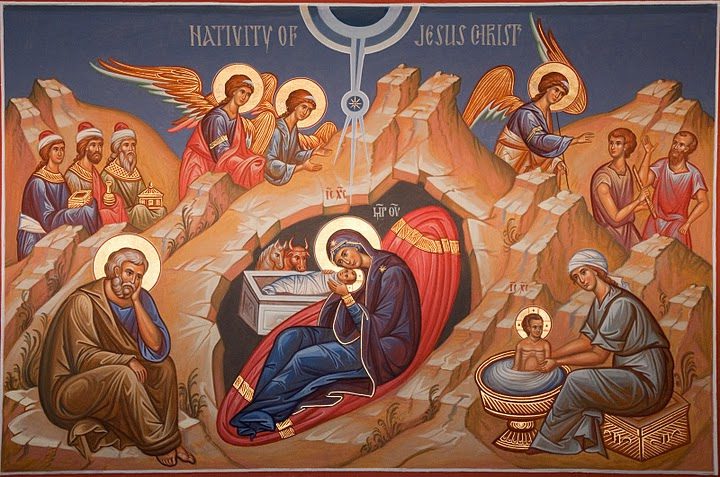
A Nativity Icon. Source.
These are the words with which my Church greets the birth of Christ: Christ is born! The traditional response is slavite Jeho, or “glorify Him!” Slight variations obtain, depending if you’re Russian, Ukrainian, or whatever other Slavic Byzantine tradition one might happen to be, but the point is always the same: God dwells among us; let us offer Him His due praise.
This is, in a way, impossible. We cannot offer God all that He deserves. If we could, He simply wouldn’t be God. And yet we try; we give ourselves over to Him in confessing our sins, in loving one another, and (importantly) in attending the liturgy in these days surrounding His birth. This is a multifarious mission: praise in speech, attendance, and act. We go to church and hear the Gospel, offering songs of praise. The Byzantine tradition has its own particular canon to this end:
Christ is born; glorify Him! Christ comes from heaven; come to welcome Him! Christ is on earth; lift up your hearts! Sing to the Lord, O earth! Be exalted and sing with hearty gladness, O ye people, sing His praise for He is glorified!
Glory to Thee, our God, glory to Thee.
Man was made in the image of God, but he sinned, and lost immortality. He fell from the divine and better life, enslaved completely by corruption. Now the wise Creator fashions him again, for He has been glorified!
Glory to Thee, our God, glory to Thee.
The Creator shaped man with His own hands, but when He saw us perishing eternally, He bowed the heavens and came down to earth, and clothed Himself completely in our nature, truly incarnate from a pure and holy Virgin, for He has been glorified! (The Nativity Canon, Ode One)
And here we see yet another complication. To glorify Christ is our duty and yet beyond us insofar as His Incarnation is His glorification. God has become man—a scandal and yet to His glorify as it means our redemption. What seems lowliness is shown to be grandeur. The child born in nothingness fills the world. The Canon goes on to be even clearer. His glory is always already His, something we partake in in praise, but not something that we ourselves can offer God:
Glory to Thee, our God, glory to Thee.
Thou hast assumed a body of lowly clay, O Christ. By sharing our humble flesh, Thou hast made our race partakers of divinity. By becoming mortal man yet remaining God, Thou hast raised us from death to life. Holy art Thou, O Lord!
Glory to Thee, our God, glory to Thee.
Make merry, O Bethlehem! Thou art the King of Judah’s princes. Christ, the Shepherd of Israel, who rides on the shoulders of the cherubim, has come forth from thee for all to see. He has raised us from death to life, and reigns over all.
Glory to the Father, and to the Son, and to the Holy Spirit, now and ever, and unto ages of ages. Amen. (The Nativity Canon, Ode 3)
The question then remains: when we declare that Christ is born, when we respond that He must be glorified, how can we do this? How can we possibly find anything to do for a God who so loved us that He created the world, who, in the person of the Son, so loved us as to take on our besmirched flesh? Again, we might look to the Nativity Ode as it teaches us that joy, the love that stems from happiness in Christ, ought to motivate us. The final bit above demands merriness at the knowledge of the Lord. Joy should motivate us as we come to grips with the heartening and difficult truth that is the Incarnation.
How does one express this happiness? We go to church, yes. We see our families; we offer ourselves even to those relatives who might otherwise irk us, remaining steadfast in the knowledge that we glorify God in our joy. We break bread together and know each other as broken subjects of sin given hope in the coming of the Lord. Looking around our houses, our apartments, and our tables we see that, no matter how horrible we may seem to one another, we are all God’s children in need of His redemption.
Previous Post

December 22, 2017
Language Matters
Next Post

December 26, 2017 St. Stephen’s Universalism
Browse Our Archives
Select a Category Academia Culture Politics Reviews Theology Uncategorized
Select a Month October 2026 September 2026 August 2026 July 2026 June 2026 May 2026 April 2026 March 2026 February 2026 January 2026 December 2025 November 2025 October 2025 September 2025 August 2025 July 2025 June 2025 May 2025 April 2025 March 2025 February 2025 January 2025 December 2024 November 2024 October 2024 September 2024 August 2024 July 2024 June 2024 May 2024 April 2024 March 2024 February 2024 January 2024 December 2023 November 2023 October 2023 September 2023 August 2023 July 2023 June 2023 May 2023 April 2023 March 2023 February 2023 January 2023 November 2022 October 2022 September 2022 August 2022 July 2022 June 2022 May 2022 April 2022 March 2022 February 2022 July 2021 December 2020 November 2020 July 2020 May 2020 April 2020 February 2020 January 2020 December 2019 November 2019 October 2019 August 2019 July 2019 April 2019 March 2019 December 2018 August 2018 July 2018 June 2018 May 2018 April 2018 March 2018 January 2018 December 2017 November 2017 September 2017 August 2017 July 2017 June 2017 May 2017 April 2017 March 2017 February 2017 January 2017 December 2016 November 2016 October 2016 September 2016 August 2016 July 2016 June 2016 May 2016 April 2016 March 2016 February 2016
Follow Us!
TAKE THE
Religious Wisdom Quiz
Who walked on water with Jesus before losing faith and sinking?
Select your answer to see how you score.
Peter Philip James Thomas
Related posts from Jappers and Janglers

American Movie: The Beauty of the Chuds



The Greatest Christmas Story Ever Told
TRENDING AT PATHEOS Religious Music and Entertainment

The Iron Gates and the Lion of the...
Yesterday, I didn't finish my report about, well, yesterday. So I'll...

Dolly Parton’s Last Song Wins Dove Award with...
Bluegrass band The Grascals, speaking on the red carpet at the 57th...

The Image: On the Horror of Capitalism and...
The Image Then went the Pharisees, and took counsel how they might...

We are approaching the date of our new American national holiday: October...

Letters on Living the Faith by C.S. Lewis
Most of us met C.S. Lewis as a public intellectual. Mere Christianity....

When Halloween Unmasks Married Hearts
Written by Dr. David K. Ewen from Eternal Truth Bible College Behind...
view all Religious Music and Entertainment blogs
Ad-Free & Subscriber Log-In Subscription Support
- About Us
- 2026 Calendar
- Videos
- Podcasts
- Library of World Religions
- Faith In Media Tracker
- Advertise With Us
- Write for Us
- Privacy Policy
- Terms of Service
- Do Not Sell My Data
- Contact Us
- Radiant Digital
- Manage Newsletter Subscriptions
- Unsubscribe From Notifications
- Sitemap
Copyright 2008-2026, Patheos. All rights reserved.
Subscription Support Ad-Free & Subscriber Log-In
Follow Patheos