
BuddhistCatholicContemplativeEvangelicalGeneral ChristianHinduJewishLatter-day SaintMuslimNew VisionsProgressive Christian
Beliefs
- Buddhist
- Catholic
- Contemplative
- Evangelical
- General Christian
- Hindu
- Jewish
- Latter-day Saint
- More Voices
- Muslim
- New Visions
- Pagan
- Progressive Christian
Topics
- Religion News
- Food and Religion
- Sports and Religion
- Religious Art
- Religious Music and Entertainment
- Religious Events
- History and Religion
- Style and Religion
- Politics and Religion
- Women in Religion
- Recreation Outdoors and Religion
- Business Finance and Religion
- Careers Workplace and Religion
- Education and Religion
- Family Parenting and Religion
- Health Fitness and Religion
- Home and Religion
- Relationships and Religion
- Technology and Religion
- Travel and Religion
Columnists
- Buddhist Columnists
- Business Finance and Religion Columnists
- Careers Workplace and Religion Columnists
- Catholic Columnists
- Contemplative Columnists
- Education and Religion Columnists
- Evangelists Columnists
- Family Parenting and Religion Columnists
- General Christian Columnists
- Health Fitness and Religion Columnists
- Hindu Columnists
- History and Religion Columnists
- Home and Religion Columnists
- Jewish Columnists
- More Voices Columnists
- Latter Day Columnists
- Muslim Columnists
- New Visions Columnists
- Nonreligious Columnists
- Pagan Columnists
- Politics and Religion Columnists
- Progressive Columnists
- Recreation Outdoors and Religion Columnists
- Relationships and Religion Columnists
- Religion News Columnists
- Religious Art Columnists
- Religious Events Columnists
- Religious Music and Entertainment Columnists
- Sports and Religion Columnists
- Style and Religion Columnists
- Technology and Religion Columnists
- Travel and Religion Columnists
- Women in Religion Columnists
Resource Library
- 2026 Calendar
- Library of World Religions
- The 100 Most Holy Places on Earth
- Patheos Answers
- Podcasts
- Videos
- Faith Leaders Database
- Anglican Episcopalian
- Bahai
- Baptist
- Buddhism
- Christianity
- Confucianism
- Eastern Orthodoxy
- Hinduism
- Holiness and Pentecostal
- ISKCON
- Islam
- Judaism
- Lutheran
- Methodist
- The Church of Jesus Christ of Latter-day Saints
- New Age
- Paganism
- Presbytarian and Reformed
- Protestantism
- Religion Behind the Scenes
- Roman Catholic
- Scientology
- Shia Islam
- Sikhism
- Sufism
- Sunni Islam
- Taoism
- Zen
- See all religions
Research Tools
 Ad-Free & Subscriber Log-In Subscription Support
Ad-Free & Subscriber Log-In Subscription Support
Follow Patheos 

- Trending:
- Forgiveness
- |
- Marriage
- |
- Consciousness
- |
- Death Penalty
- |
- Election
- |
- Halloween

- Home
- Religious Music and Entertainment
- Byzantine “Advent”
Byzantine “Advent”
Last updated on: December 7, 2017 at 1:30 pm by Chase Padusniak
Byzantine “Advent” 2017-12-07T13:30:00-04:00 Chase Padusniak
Patheos Explore the world's faith through different perspectives on religion and spirituality! Patheos has the views of the prevalent religions and spiritualities of the world.
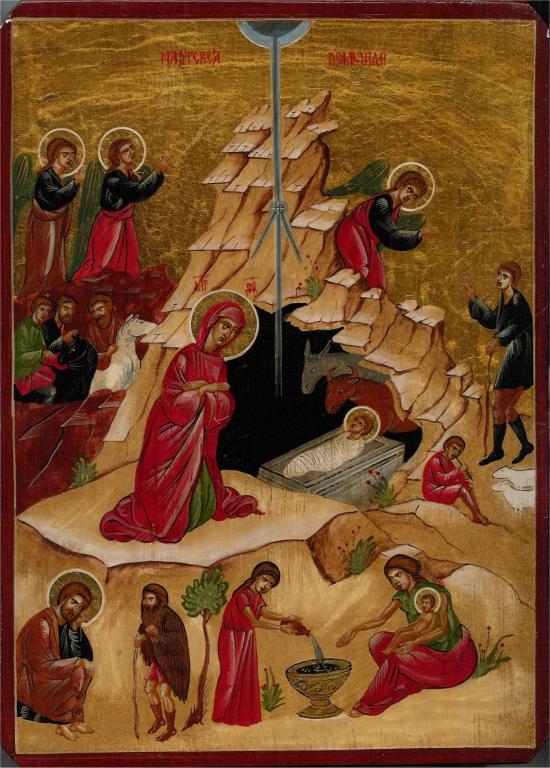
A modern Romanian icon of the Nativity. Source.

Twitter and Facebook have made it more than clear that Latin Advent has begun. Devotionals are being posted, prayers recommended, and all sorts of exhortations are circulating through the digital world. It occurred to me that many people (you treasured few who waste bits of your time reading my work!) might not know much about the Byzantine version of this liturgical period, a preparatory time second only to the Great Fast (before Pascha, also known as Easter) for those of us who draw faith from this particular Eastern tradition.
For starters, we don’t call it Advent (hence the scare quotes in the title). Advent is, after all, a Latinate word [ad (to, toward) + venire (to come) → advenire (to come to, to arrive) → adventus (approach, arrival)]. In English, the word arrived from the French “auvent,” as is so often the case with our Latin holdovers. But here, for us Byzantines, the story gets interesting. “Advent” (as with many liturgical terms) is a translation of the Greek “Parousia”:
The Latin “Advent” is the Latin translation of the Greek word, “Parousia” that does not mean “expectation” of the end of the world, or even simply “expectation,” but “arrival” or “the beginning of a presence.” Etymologically, it means the “arrival” of the King who bestows his parousia, on his devotees for a time. However, he is not yet present in all His glory. (Fr. Joseph Ratzinger)
The Byzantine version is thus very consciously a meditation on the Incarnation. It is true that the end of all things is always on the mind of he who reflects on the coming-to-be-man of the Second Person of the Trinity, but that is not the primary focus. We reflect upon the miraculous birth of God into the material world, upon the arrival of the truth that sets us free:
Everyone who believes that Jesus is the Christ is begotten by God, and everyone who loves the father loves [also] the one begotten by him. In this way we know that we love the children of God when we love God and obey his commandments. For the love of God is this, that we keep his commandments. And his commandments are not burdensome, for whoever is begotten by God conquers the world. And the victory that conquers the world is our faith. Who [indeed] is the victor over the world but the one who believes that Jesus is the Son of God? This is the one who came through water and blood, Jesus Christ, not by water alone, but by water and blood. The Spirit is the one that testifies, and the Spirit is truth. (1 John 5:1-6)
With all of this in mind, the Christmas season brings an end to our waiting and a movement from joyous expectation to revel in the arrival of the Lord. Hence, those of us in the Slavic Byzantine tradition proclaim: Christos Razdajestsja (Christ is born!) and respond with Slavite Jeho (Glorify him!).
This difference of emphasis (perhaps compared to the Latin regard for Christ’s Second Coming—this is clear in the Gospel readings for the period) is also reflected in certain differences of practice. There are no special candles or (to my knowledge) chocolate calendars. Rather, there is a fast, a 40 day fast, beginning the day after the Byzantine Feast of St. Philip (hence it is often called “St. Philip’s Fast”). The requirements are those of most Byzantine-rite abstinences:
According to some sermons of St. Gregory of Nazianzus, he introduced this feast into the Eastern Church about the year 379 or 388. After his departure from Constantinople the celebration of Christ’s Nativity on December 25 was neglected. In 395 Emperor Honorius reinstituted the celebration. St. John Chrysostom tells us how he introduced this feast at Antioch sometime around 380. He explicitly says how he introduced it in imitation of the Church at Rome. St. John believed that the Roman Christians knew the date of Christ’s birth better than anybody else since the imperial city archives were accessible to them.
The first mention of a preparatory period before Christmas is mentioned in a decree of the Council of Saragossa (380). The Council Fathers stated that every Christian should daily go to church from December 17 until the Theophany (January 6th). At the Synod of Mac (581) in present day France it was decreed that from November 11, the day of St. Martin, until December 24 every Christian should fast 3 times a week (Monday, Wednesday, Friday).
Previous Post

December 5, 2017
Tax Plans, Graduate Students, and Bearing the Burden
Next Post

December 12, 2017 Is Love Nice?
Browse Our Archives
Select a Category Academia Culture Politics Reviews Theology Uncategorized
Select a Month October 2026 September 2026 August 2026 July 2026 June 2026 May 2026 April 2026 March 2026 February 2026 January 2026 December 2025 November 2025 October 2025 September 2025 August 2025 July 2025 June 2025 May 2025 April 2025 March 2025 February 2025 January 2025 December 2024 November 2024 October 2024 September 2024 August 2024 July 2024 June 2024 May 2024 April 2024 March 2024 February 2024 January 2024 December 2023 November 2023 October 2023 September 2023 August 2023 July 2023 June 2023 May 2023 April 2023 March 2023 February 2023 January 2023 November 2022 October 2022 September 2022 August 2022 July 2022 June 2022 May 2022 April 2022 March 2022 February 2022 July 2021 December 2020 November 2020 July 2020 May 2020 April 2020 February 2020 January 2020 December 2019 November 2019 October 2019 August 2019 July 2019 April 2019 March 2019 December 2018 August 2018 July 2018 June 2018 May 2018 April 2018 March 2018 January 2018 December 2017 November 2017 September 2017 August 2017 July 2017 June 2017 May 2017 April 2017 March 2017 February 2017 January 2017 December 2016 November 2016 October 2016 September 2016 August 2016 July 2016 June 2016 May 2016 April 2016 March 2016 February 2016
Follow Us!
TAKE THE
Religious Wisdom Quiz
Each chapter except one is an acrostic poem following the Hebrew alphabet. How many chapters make up this book of mourning?
Select your answer to see how you score.
Three Five Seven Twelve
Related posts from Jappers and Janglers

American Movie: The Beauty of the Chuds

Yi Yi: Simply Having a Melancholic Christmas Time

Apostasy, Scandal, and a Road Well-Trod

Which is the Original Bible? Is it the...
TRENDING AT PATHEOS Religious Music and Entertainment

Methodist Central Hall and Westminster Abbey
Situated on the same square is Methodist Central Hall and Westminster Abbey. ...

57th Dove Awards Honor Dolly Parton, Crown New...
On gospel music’s biggest night, the 57th annual GMA Dove Awards honored...

The First Eucharistic Controversy: Christ’s Real Presence
For Catholics, the Eucharist is the source and summit of the Christian...

What a Stop Sign Can Teach Us About...
How to Make a Decision When You Can't Hear God Main point:...

Archdiocese Hosts Military Marriage Retreat in Germany
RASTATT, Germany — The transient military lifestyle, with its frequent deployments and...

Nearly every morning, I make the drive to Detroit with my high-school-age...
view all Religious Music and Entertainment blogs
Ad-Free & Subscriber Log-In Subscription Support
- About Us
- 2026 Calendar
- Videos
- Podcasts
- Library of World Religions
- Faith In Media Tracker
- Advertise With Us
- Write for Us
- Privacy Policy
- Terms of Service
- Do Not Sell My Data
- Contact Us
- Radiant Digital
- Manage Newsletter Subscriptions
- Unsubscribe From Notifications
- Sitemap
Copyright 2008-2026, Patheos. All rights reserved.
Subscription Support Ad-Free & Subscriber Log-In
Follow Patheos