
BuddhistCatholicContemplativeEvangelicalGeneral ChristianHinduJewishLatter-day SaintMuslimNew VisionsProgressive Christian
Beliefs
- Buddhist
- Catholic
- Contemplative
- Evangelical
- General Christian
- Hindu
- Jewish
- Latter-day Saint
- More Voices
- Muslim
- New Visions
- Pagan
- Progressive Christian
Topics
- Religion News
- Food and Religion
- Sports and Religion
- Religious Art
- Religious Music and Entertainment
- Religious Events
- History and Religion
- Style and Religion
- Politics and Religion
- Women in Religion
- Recreation Outdoors and Religion
- Business Finance and Religion
- Careers Workplace and Religion
- Education and Religion
- Family Parenting and Religion
- Health Fitness and Religion
- Home and Religion
- Relationships and Religion
- Technology and Religion
- Travel and Religion
Columnists
- Buddhist Columnists
- Business Finance and Religion Columnists
- Careers Workplace and Religion Columnists
- Catholic Columnists
- Contemplative Columnists
- Education and Religion Columnists
- Evangelists Columnists
- Family Parenting and Religion Columnists
- General Christian Columnists
- Health Fitness and Religion Columnists
- Hindu Columnists
- History and Religion Columnists
- Home and Religion Columnists
- Jewish Columnists
- More Voices Columnists
- Latter Day Columnists
- Muslim Columnists
- New Visions Columnists
- Nonreligious Columnists
- Pagan Columnists
- Politics and Religion Columnists
- Progressive Columnists
- Recreation Outdoors and Religion Columnists
- Relationships and Religion Columnists
- Religion News Columnists
- Religious Art Columnists
- Religious Events Columnists
- Religious Music and Entertainment Columnists
- Sports and Religion Columnists
- Style and Religion Columnists
- Technology and Religion Columnists
- Travel and Religion Columnists
- Women in Religion Columnists
Resource Library
- 2026 Calendar
- Library of World Religions
- The 100 Most Holy Places on Earth
- Patheos Answers
- Podcasts
- Videos
- Faith Leaders Database
- Anglican Episcopalian
- Bahai
- Baptist
- Buddhism
- Christianity
- Confucianism
- Eastern Orthodoxy
- Hinduism
- Holiness and Pentecostal
- ISKCON
- Islam
- Judaism
- Lutheran
- Methodist
- The Church of Jesus Christ of Latter-day Saints
- New Age
- Paganism
- Presbytarian and Reformed
- Protestantism
- Religion Behind the Scenes
- Roman Catholic
- Scientology
- Shia Islam
- Sikhism
- Sufism
- Sunni Islam
- Taoism
- Zen
- See all religions
Research Tools
 Ad-Free & Subscriber Log-In Subscription Support
Ad-Free & Subscriber Log-In Subscription Support
Follow Patheos 

- Trending:
- Forgiveness
- |
- Marriage
- |
- Consciousness
- |
- Death Penalty
- |
- Election
- |
- Halloween

- Home
- Religious Music and Entertainment
- Language Matters
Language Matters
Last updated on: December 22, 2017 at 4:07 pm by Chase Padusniak
Language Matters 2017-12-22T16:07:00-04:00 Chase Padusniak
Patheos Explore the world's faith through different perspectives on religion and spirituality! Patheos has the views of the prevalent religions and spiritualities of the world.
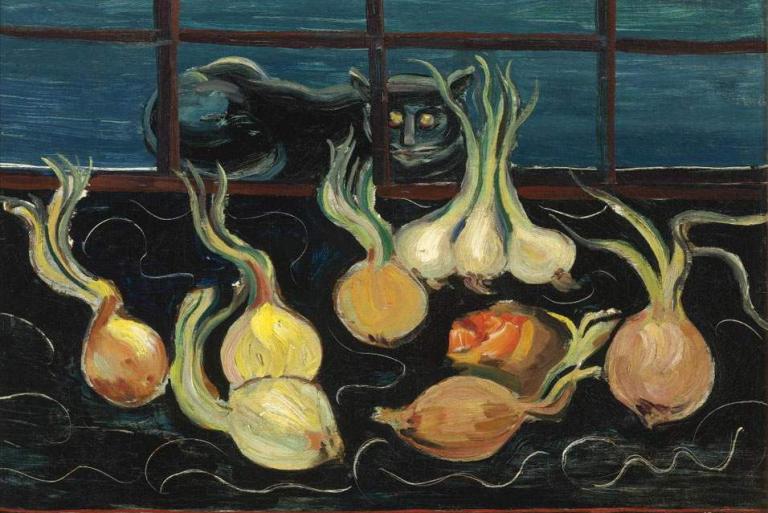
Still Life with Cat and Onions (c. 1928) by Boris Grigoriev.
This seems an obvious statement, but, as with all things obvious, it’s only so when it counts, counts for the one speaking anyway. Our culture is obsessed by the idea that language shouldn’t be allowed primacy of place, especially when it comes to offense. In fact, there’s a whole Oxford Dictionaries entry on “snowflakes”:
The Trump presidency has intensified the war of words between those people who voted for the billionaire businessman and those who oppose his policies. One term that is often lobbed at liberals, particularly online, is snowflake, used as an accusation of fragility and over-sensitivity.
The usage stems from the conception of snowflakes as unique, delicate and precious – all qualities that young, liberal and idealistic people are sometimes accused of having. People who became adults in the 2010s are derisively classed (by some) as Generation Snowflake, prone to offense-taking and less able to accept opposing views.
The term may have gained popularity on university campuses, where good intentions to prevent harassment were considered by some to have gone too far – effectively silencing views that don’t conform to ‘acceptable’ standards. Critics of young idealists point to the trend of providing trigger warnings in advance of comments that might offend, as well as the habit of no platforming speakers who hold unpalatable views. No platforming means to deny people or groups opportunities to speak and share their views. These examples are held up as evidence that young people have become so fearful of offence that they have become intolerant of opinions that diverge from their own.
Author Chuck Palahniuk has been credited with giving the world this meaning of snowflake in his 1996 novel Fight Club, in the line, “You are not special. You are not a beautiful and unique snowflake”. This line inspired a meme, which in turn inspired the current term of abuse.
Here, anyway, I’m not interested in the practical questions per se: trigger warnings, microaggressions, et al. as legal phenomena. How one understands these phenomena, at some fundamental level, stems from how one views language. Demonstrating that we all agree that language is important, and that some beloved “conservative” (at least in some sense) thinkers agree that how we speak about the world informs how we conceptualize it, is my purpose (I myself am clearly not very conservative in the normative sense, but I know many of my co-religionists do identify with the word!). In doing so, I’d like to highlight that debates about terminology, about, even say, “political correctness,” are more complex than many bandying about the term “snowflake” would like to admit.
Let’s begin with Plato and what he has to say about poets and other wordsmiths in the Republic:
Therefore, Glaucon, I said, whenever you meet with any of the eulogists of Homer declaring that he has been the educator of Hellas, and that he is profitable for education and for the ordering of human things, and that you should take him up again and again and get to know him and regulate your whole life according to him, we may love and honor those who say these things—they are excellent people, as far as their lights extend; and we are ready to acknowledge that Homer is the greatest of poets and first of tragedy writers; but we must remain firm in our conviction that hymns to the gods and praises of famous men are the only poetry which ought to be admitted into our State. For if you go beyond this and allow the honeyed muse to enter, either in epic or lyric verse, not law and the reason of mankind, which by common consent have ever been deemed best, but pleasure and pain will be the rulers in our State.
One needn’t agree with Plato (that the poets and other writers of great creativity and influence should be exiled from the polis) to see the claim on which his argument rests: language matters. How people are taught to speak, the words they use to demarcate the world around them, ultimately come to shape how they understand the world—for good or for ill.
Previous Post

December 12, 2017
Is Love Nice?
Next Post
December 25, 2017 Christos Razdajetsja!
Browse Our Archives
Select a Category Academia Culture Politics Reviews Theology Uncategorized
Select a Month October 2026 September 2026 August 2026 July 2026 June 2026 May 2026 April 2026 March 2026 February 2026 January 2026 December 2025 November 2025 October 2025 September 2025 August 2025 July 2025 June 2025 May 2025 April 2025 March 2025 February 2025 January 2025 December 2024 November 2024 October 2024 September 2024 August 2024 July 2024 June 2024 May 2024 April 2024 March 2024 February 2024 January 2024 December 2023 November 2023 October 2023 September 2023 August 2023 July 2023 June 2023 May 2023 April 2023 March 2023 February 2023 January 2023 November 2022 October 2022 September 2022 August 2022 July 2022 June 2022 May 2022 April 2022 March 2022 February 2022 July 2021 December 2020 November 2020 July 2020 May 2020 April 2020 February 2020 January 2020 December 2019 November 2019 October 2019 August 2019 July 2019 April 2019 March 2019 December 2018 August 2018 July 2018 June 2018 May 2018 April 2018 March 2018 January 2018 December 2017 November 2017 September 2017 August 2017 July 2017 June 2017 May 2017 April 2017 March 2017 February 2017 January 2017 December 2016 November 2016 October 2016 September 2016 August 2016 July 2016 June 2016 May 2016 April 2016 March 2016 February 2016
Follow Us!
TAKE THE
Religious Wisdom Quiz
Who was the Roman emperor when Jesus was born?
Select your answer to see how you score.
Julius Caesar Augustus Nero Tiberius
Related posts from Jappers and Janglers

Secrets & Lies in the Age of Truth...

Apostasy, Scandal, and a Road Well-Trod
TRENDING AT PATHEOS Religious Music and Entertainment

57th Dove Awards Honor Dolly Parton, Crown New...
On gospel music’s biggest night, the 57th annual GMA Dove Awards honored...

The First Eucharistic Controversy: Christ’s Real Presence
For Catholics, the Eucharist is the source and summit of the Christian...

What a Stop Sign Can Teach Us About...
How to Make a Decision When You Can't Hear God Main point:...

Archdiocese Hosts Military Marriage Retreat in Germany
RASTATT, Germany — The transient military lifestyle, with its frequent deployments and...

Nearly every morning, I make the drive to Detroit with my high-school-age...

The Real AI Story Is Adoption Without Trust
Artificial intelligence has crossed a political threshold. It is no longer a...
view all Religious Music and Entertainment blogs
Ad-Free & Subscriber Log-In Subscription Support
- About Us
- 2026 Calendar
- Videos
- Podcasts
- Library of World Religions
- Faith In Media Tracker
- Advertise With Us
- Write for Us
- Privacy Policy
- Terms of Service
- Do Not Sell My Data
- Contact Us
- Radiant Digital
- Manage Newsletter Subscriptions
- Unsubscribe From Notifications
- Sitemap
Copyright 2008-2026, Patheos. All rights reserved.
Subscription Support Ad-Free & Subscriber Log-In
Follow Patheos